

What if the most expensive material on a procurement list actually delivered the lowest total project cost? For many asset controllers facing the escalating expenses of concrete replacement and the prohibitive nature of operational downtime, the question of is carbon fibre reinforcement worth it has become a critical component of structural feasibility studies. It’s understandable that the higher initial unit cost of advanced materials creates hesitation, particularly when traditional steel-bonded methods appear more familiar. However, when the tensile capacity of proprietary systems like Tyfo® Fibrwrap® exceeds 1000 MPa whilst weighing a fraction of structural steel, the engineering justification for its specification becomes clear.
We recognise that specifying a premium solution requires a robust evidence base that satisfies both technical requirements and budgetary constraints. This article provides an expert engineering appraisal of Carbon Fibre Reinforced Polymer (CFRP) strengthening, focusing on its capacity to eliminate the corrosion issues that frequently plague traditional reinforcement. By examining the total lifecycle value and the radical reduction in installation periods, we will demonstrate how these sophisticated composites ensure long-term structural reliability and the continued security of essential infrastructure assets.
Key Takeaways
- Learn to evaluate structural interventions through the lens of total lifecycle cost to accurately assess if is carbon fibre reinforcement worth it for critical infrastructure projects.
- Identify the logistical advantages of high-strength, lightweight composites that eliminate the requirement for heavy lifting equipment and intrusive structural propping during remediation works.
- Discover the economic benefits of rapid installation cycles, which allow for critical structural strengthening to be completed without the need for facility shutdowns or operational downtime.
- Evaluate the environmental impact of prolonging the functional lifespan of existing concrete structures, providing a sustainable alternative to the high carbon footprint of demolition.
- Recognise the importance of specifying proprietary, engineered solutions such as Tyfo® Fibrwrap® to ensure long-term structural reliability and compliance with global engineering standards.
Evaluating the Structural and Economic Value of Carbon Fibre Reinforcement
Carbon Fibre Reinforced Polymer (CFRP) represents a paradigm shift in the maintenance and rehabilitation of critical infrastructure. As a high-performance composite material, Carbon-fiber reinforced polymer is increasingly utilised to upgrade ageing structural elements that no longer meet modern safety or load-bearing requirements. For asset managers and technical professionals, determining is carbon fibre reinforcement worth it requires a transition from simple material procurement comparisons to a comprehensive total lifecycle cost analysis. Whilst the initial capital expenditure for composite materials often exceeds that of traditional steel, the radical reduction in ancillary site costs, such as plant hire and site hoarding, frequently results in a lower total contract value.
Engineering feasibility remains the cornerstone of any successful intervention. Before specifying a composite solution, rigorous engineering design and modelling must be undertaken to ensure the material’s properties align with the specific flexural, shear, or axial requirements of the structure. It’s a disciplined approach where empirical data dictates the solution, ensuring that every layer of fabric contributes directly to the long-term security of the asset.
Defining CFRP in the Context of UK Infrastructure
The UK’s infrastructure landscape is characterised by a high density of Victorian-era masonry and mid-century concrete assets that are currently operating beyond their original design lives. CFRP systems typically consist of high-modulus carbon, glass, or aramid fabrics saturated with specialised, high-performance epoxy resins. This combination creates a bond that preserves the structural integrity of bridges, tunnels, and marine structures. The UK market has seen a surge in adoption because these materials facilitate seismic retrofitting and structural preservation without adding the significant dead weight associated with steel plate bonding.
The Engineering Decision Framework
A structured decision framework is vital when identifying the necessity for strengthening. Triggers often include a change of use, the discovery of latent defects, or the requirement to accommodate increased traffic loads. The condition of the existing substrate is assessed through meticulous carbonation testing and pull-off testing to ensure the concrete compressive strength meets the minimum requirements, typically around 17 MPa as per ACI 440.2R guidelines. When the cumulative costs of facility downtime, environmental remediation, and the structural carbon debt of replacement exceed the logistical premium of high-performance composites, CFRP emerges as the only viable alternative to traditional demolition.
Comparing CFRP with Traditional Steel Strengthening Methods
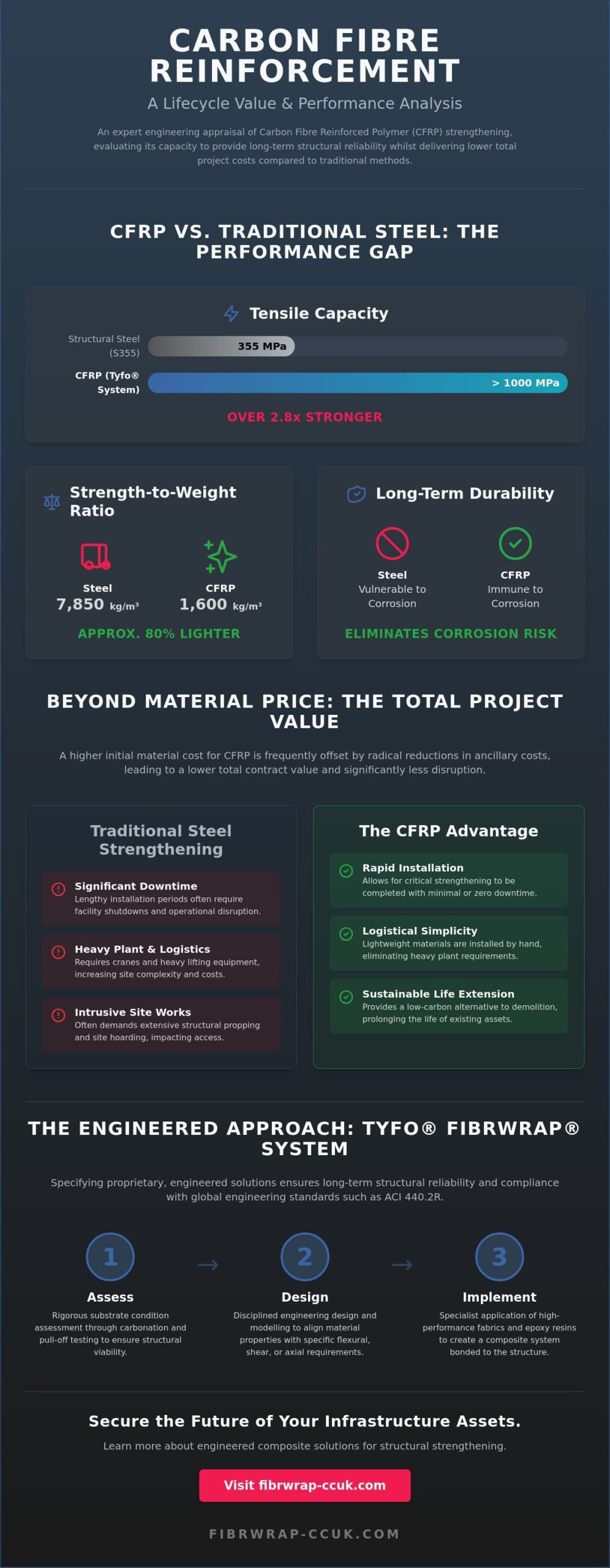
When evaluating whether is carbon fibre reinforcement worth it, the most immediate comparison is drawn against traditional steel plate bonding. Structural steel has remained the industry standard for decades, yet its inherent limitations in weight and environmental vulnerability often complicate remediation projects. In contrast, Carbon Fibre Reinforced Polymer (CFRP) provides a tensile strength that is typically seven to ten times that of steel with an identical cross-section. The typical tensile capacity of Tyfo® systems exceeds 1000 MPa, whereas standard Grade S355 structural steel yields at 355 MPa. This disparity allows for significant structural enhancement with minimal material thickness, ensuring that the original architectural profile is preserved.
Strength-to-Weight Ratio and Dead Load Considerations
The density of CFRP components, approximately 1,600 kg/m³, is remarkably low when compared to the 7,850 kg/m³ of structural steel. This mass reduction is a critical factor in the comprehensive review of CFRP in civil engineering, as it permits axial and shear enhancement without significantly altering the dead load of the structure. For ageing assets with limited foundation capacity, adding heavy steel plates can necessitate secondary foundation strengthening. CFRP avoids this cascading engineering requirement. The lightweight nature of these composites also eliminates the need for heavy lifting equipment and extensive propping, which often dominate the logistics and costs of a steel-based project. If your project involves complex geometries or restricted access, consulting with a specialist engineer can clarify the specific performance gains available through these advanced materials.
Corrosion Resistance and Maintenance Cycles
Corrosion remains the primary cause of failure in traditional steel strengthening systems. Steel plates are susceptible to oxidative degradation, particularly in marine environments or industrial pipelines where chemical exposure is prevalent. CFRP is inherently non-corrosive and doesn’t suffer from the electrochemical reactions that lead to rust. The long-term performance of high-quality epoxy resins ensures that the bond remains intact without the requirement for the repetitive painting or anti-corrosion treatments that steel demands. By specifying a composite solution, asset controllers can significantly extend maintenance cycles. This contributes to the overall conclusion that is carbon fibre reinforcement worth it when long-term reliability and reduced intervention frequency are the priorities. The flexibility of the fabric also allows it to be wrapped around circular columns or irregular beams, providing a level of confinement that is practically impossible to achieve with rigid steel plates.
Quantifying the Return on Investment: Speed, Access, and Disruption
Installation speed is arguably the most significant factor in the economic justification of composite technology. When assessing whether is carbon fibre reinforcement worth it, the reduction in project duration must be quantified through a rigorous analysis of site management costs. Research indicates that the construction period for carbon fibre reinforcement is approximately one-third to one-half that of traditional methods. For instance, reinforcing a 1,000 square metre floor slab typically requires 7-10 days with carbon fibre, compared to the 20-30 days required for bonded steel reinforcement. This acceleration represents a substantial saving in preliminaries and site overheads, which often offsets the higher initial material costs.
Operational Continuity and Reduced Downtime
Operational continuity is preserved through the non-intrusive nature of the application process, which is a critical consideration for assets that can’t be decommissioned. In the context of transportation infrastructure, where night-time possessions are strictly limited and road closures incur heavy financial penalties, the ability to install CFRP whilst the structure remains in operation is invaluable. The Tyfo® Fibrwrap® system is particularly effective in restricted access areas where traditional heavy plant simply can’t be deployed. The successful delivery of such interventions relies on the oversight of a specialist engineering contractor who can navigate the complexities of live environments whilst ensuring compliance with rigorous safety standards.
Logistics and Site Preparation Savings
Logistical savings are further realised through the elimination of heavy plant, cranes, and extensive scaffolding systems. In dense urban environments or remote pipeline locations, the simplified site requirements of CFRP significantly reduce the project’s physical footprint. The material’s minimal thickness, which typically ranges from 2mm to 40mm, ensures that headroom and functional space within buildings are preserved, avoiding the spatial compromises often necessitated by bulky steel sections. These benefits of composite building materials are maximised when bespoke design and engineering are integrated into the early stages of the project. By streamlining the installation process and reducing labour requirements, the total contract value is often found to be more competitive than traditional alternatives, providing a clear answer for those questioning if is carbon fibre reinforcement worth it in a commercial context.
Life-Extension and Sustainability: The Long-Term Case for Composites
The environmental dimension of structural engineering has transitioned from a peripheral concern to a primary driver of procurement decisions. When evaluating if is carbon fibre reinforcement worth it, the analysis must extend beyond immediate performance to encompass the structural carbon debt of the entire asset. Avoiding the demolition of existing concrete structures is the most effective method of reducing the construction industry’s carbon footprint. Research into lifecycle costing suggests that whilst initial material costs vary, the total 50-year lifecycle cost of composite-reinforced assets can be reduced by over 50% compared to traditional steel-reinforced counterparts. This reduction is primarily achieved through the elimination of recurring maintenance cycles and the prevention of premature asset failure, with some industry reports indicating total ownership savings of 40-60% over a 50-year project lifespan.
Sustainable Structural Remediation
The role of structural repairs in meeting UK net-zero targets cannot be overstated, as the embodied carbon within a CFRP remediation project is a fraction of that found in a full rebuild. By prolonging the functional lifespan of a structure, engineers can effectively amortise the original carbon investment over a much longer period. The preservation of existing infrastructure through advanced materials science is not merely a technical choice but a fundamental requirement for achieving a circular economy in the built environment. This approach aligns technical capabilities with broader economic and environmental goals, ensuring that essential assets continue to serve their purpose without the ecological cost of replacement and the heavy carbon footprint of new concrete production.
Long-Term Fatigue and Blast Mitigation
Beyond sustainability, CFRP provides a multi-functional enhancement that includes improved ductility and fatigue resistance. These systems are engineered to withstand complex loading patterns, ensuring the long-term integrity of critical assets amongst changing environmental conditions. The same composite layers used for flexural strengthening can be designed to provide blast mitigation and seismic retrofitting, offering a level of protection that traditional concrete jackets or steel plates cannot match. This dual-purpose utility further reinforces the economic case for specifying advanced composites, as a single intervention addresses multiple structural vulnerabilities simultaneously. To discuss how these systems can be integrated into your asset management strategy, you can request a technical consultation with our specialist engineering team.
Implementing Tyfo® Fibrwrap®: The Specialist Approach to Asset Remediation
The ultimate determination of whether is carbon fibre reinforcement worth it rests upon the precision of its application and the rigour of the preceding engineering design. Whilst the material properties of advanced composites offer undeniable structural advantages, the transition from theoretical benefit to practical asset life-extension requires an integrated approach. The Tyfo® Fibrwrap® system isn’t a generic commodity but a proprietary, engineered solution that’s been rigorously tested to address complex structural challenges. By engaging a specialist contractor like Composites Construction UK, asset managers ensure that the performance specifications defined during the design phase are accurately translated into the physical reinforcement of the structure.
The Importance of Bespoke Design
Generic, off-the-shelf solutions frequently fail to meet the exacting standards required for UK infrastructure remediation. A successful project begins with a comprehensive feasibility study and technical specification that accounts for the specific substrate condition and environmental exposure of the asset. This design-led methodology ensures that the composite system is tailored to the unique load-bearing requirements of the structure. For a more granular understanding of the technical requirements involved, technical professionals should refer to our guide on Tyfo Fibrwrap installation, which outlines the critical stages of surface preparation and material application.
Ensuring Quality Through Specialist Contracting
The efficacy of CFRP strengthening is heavily dependent on the skill of the technicians performing the work. Precise resin mixing and meticulous fabric saturation are essential to ensure the integrity of the bond between the composite and the concrete substrate. Composites Construction UK provides a comprehensive end-to-end delivery model, encompassing initial structural surveys, testing, and the final application of the system. Our quality control protocols include:
- In-situ pull-off testing to verify bond strength, typically requiring a minimum of 1.5 MPa as per industry standards.
- Thermal imaging inspections to identify any potential delamination or voids within the cured system.
- Meticulous documentation of atmospheric conditions to ensure compliance with ASTM standards during the installation window.
This level of technical oversight is what ensures the long-term structural reliability discussed throughout this guide. When considering is carbon fibre reinforcement worth it for a specific project, the answer is found in the partnership between advanced materials science and specialist engineering execution. We invite technical professionals and asset controllers to contact CCUK for a project-specific feasibility assessment to determine the most effective remediation strategy for their essential infrastructure.
Securing the Future of Critical Infrastructure
The determination of whether is carbon fibre reinforcement worth it is ultimately answered by the significant reduction in total contract value when ancillary costs and operational downtime are fully accounted for. The transition from traditional steel-based methods to advanced composites provides a pathway to enhance structural capacity whilst avoiding the carbon debt of demolition. By prioritising materials that offer inherent corrosion resistance and rapid installation, asset controllers can ensure the long-term reliability of essential infrastructure without the spatial or logistical compromises of the past.
Composites Construction UK stands as the exclusive UK licensee for the Tyfo® Fibrwrap® system, offering a comprehensive design, supply, and installation service that’s tailored to the specific requirements of each structure. Our proven history of infrastructure life-extension projects across the UK provides the technical validation necessary for complex remediation works. We invite you to discuss your structural strengthening project with our specialist engineering team to explore how advanced composite science can safeguard your critical assets and ensure their continued utility. We look forward to supporting your next project with engineering excellence and proven results.
Frequently Asked Questions
Is carbon fibre reinforcement more expensive than steel plate bonding?
Initial material procurement costs for CFRP are typically higher than structural steel, yet the total contract value is often reduced through the elimination of heavy plant and complex site logistics. When considering is carbon fibre reinforcement worth it, asset managers must account for the substantial savings in scaffolding and crane hire that traditional steel plate bonding necessitates. The reduction in site preliminaries frequently offsets the material premium, particularly in restricted access environments.
How long does carbon fibre reinforcement last on a concrete structure?
CFRP systems are engineered to provide a minimum service life of 50 years, frequently exceeding the remaining functional lifespan of the host concrete structure. Because the material is inherently non-corrosive, it doesn’t suffer from the oxidative degradation that limits the durability of traditional steel reinforcements. Long-term structural integrity is maintained without the requirement for repetitive anti-corrosion treatments or intensive maintenance interventions throughout the asset’s life.
Can CFRP be used to strengthen cast iron and timber structures?
Yes, CFRP technology is highly effective for the rehabilitation of cast iron and timber structural elements in addition to reinforced concrete. Whilst concrete application remains the most common, the high tensile modulus of carbon fibre allows for the effective strengthening of heritage cast iron beams and timber trusses. This application increases flexural capacity without the aesthetic or weight penalties associated with secondary structural steel frameworks.
Is a structural survey required before specifying carbon fibre strengthening?
A detailed structural survey and substrate testing programme are essential prerequisites for any composite strengthening project to ensure bond integrity. Precise data regarding concrete compressive strength and carbonation depth is required to verify that the host structure can support the intended load transfer. These surveys identify latent defects that must be remediated through concrete repair before the CFRP system is applied to the surface.
What are the fire resistance properties of CFRP systems?
CFRP systems require supplemental fire protection in fire-rated assemblies because the performance of the structural epoxy resin is temperature-dependent. Standard epoxy-bonded systems typically lose bond integrity at temperatures between 60°C and 82°C, necessitating the use of intumescent coatings or cementitious fire boards. These additional layers are applied over the cured composite to meet specific hourly fire ratings required by UK building regulations.
How much time can be saved on a project by using carbon fibre instead of steel?
Project durations are significantly condensed when utilising composite systems, often resulting in time savings of 50% or more compared to traditional steel methods. This acceleration is achieved because CFRP is lightweight and manually applied, removing the need for mechanical lifting and the time-consuming installation of heavy mechanical anchors. Faster programme delivery is a primary factor in determining that is carbon fibre reinforcement worth it for live environments.
Is CFRP strengthening suitable for underwater pipeline rehabilitation?
Specialised CFRP systems are specifically engineered for application in submerged or splash-zone environments, particularly for pipeline rehabilitation and marine pile repair. Proprietary resins are utilised that cure effectively underwater, allowing for structural remediation without the requirement for expensive cofferdams or dewatering. This capability ensures that critical liquid-conveying infrastructure remains operational whilst structural integrity is restored through advanced material science.
Do I need a specialist contractor to install Tyfo® Fibrwrap®?
Yes, the installation of the Tyfo® Fibrwrap® system must be carried out by certified specialist contractors to ensure the proprietary system meets design performance. Its success depends on precise resin mixing and fabric saturation techniques that require specialised training and rigorous quality control. Utilising a certified installer ensures that the system is applied in strict accordance with the original engineering specifications and global safety standards.


