

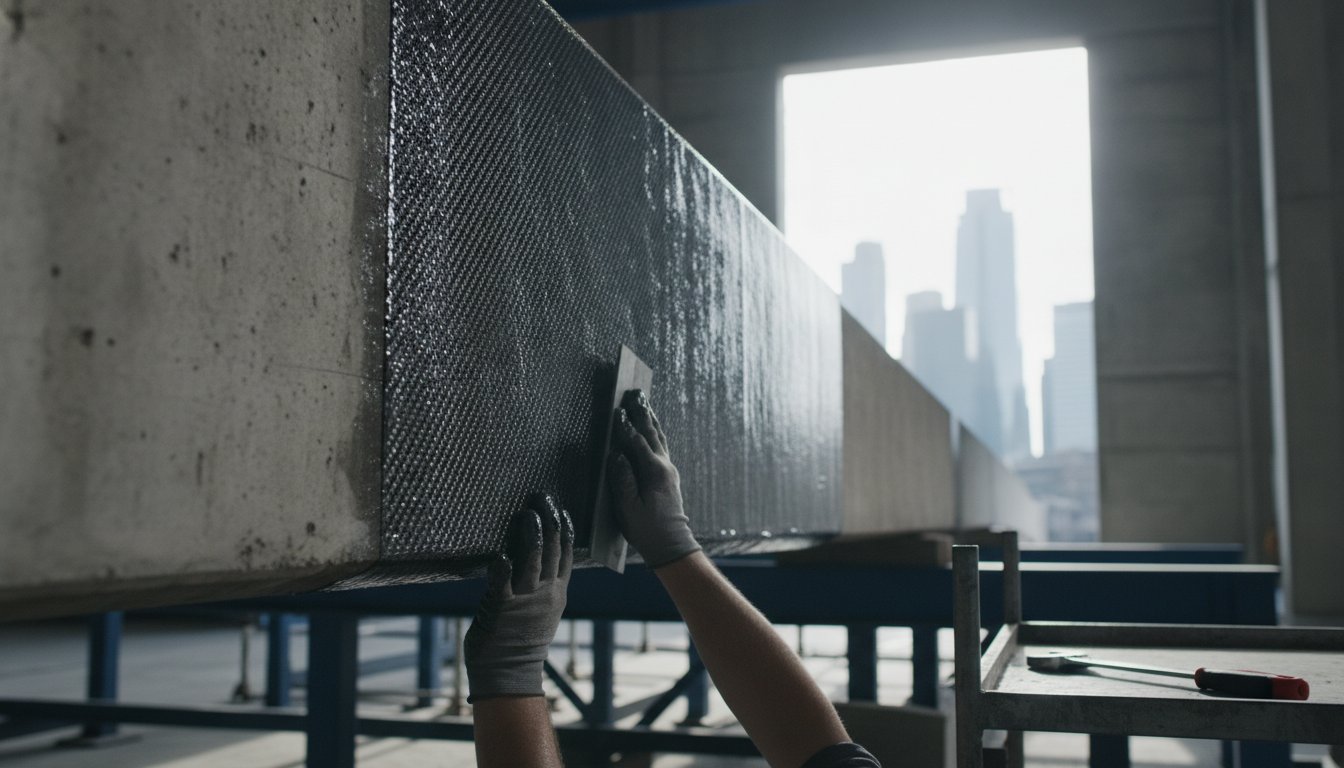
The traditional mandate to demolish and replace structural assets is being superseded by the imperative for carbon-efficient, high-performance life extension. Many technical professionals recognise that ageing infrastructure often fails to meet modern load requirements, especially when the integrity of internal steel is compromised by corrosion. This technical overview offers carbon fibre wrapping for concrete beams explained through the lens of structural engineering and advanced material science. By utilising high-tensile composites like the Tyfo® Fibrwrap® system, engineers can achieve significant structural enhancement whilst avoiding the operational disruption and added dead weight associated with traditional steel plate bonding.
You’ll gain an expert understanding of the engineering justification for CFRP, including its superior strength-to-weight ratio and resistance to environmental degradation. We’ll explore the critical importance of substrate preparation and resin saturation, ensuring you’re equipped to identify the correct application process for your specific project requirements. This analysis provides the empirical evidence needed to prioritise repair over replacement, aligning technical success with broader economic and sustainability goals.
Key Takeaways
- Understand the fundamental mechanics of Carbon Fibre Reinforced Polymer (CFRP), where high-tensile fibres and an epoxy resin matrix work in synergy to enhance structural capacity.
- Discover why carbon fibre wrapping for concrete beams explained through engineering metrics reveals a strength-to-weight ratio five times greater than traditional steel plate bonding.
- Learn how the principle of strain compatibility ensures that the CFRP system, internal steel reinforcement, and concrete substrate function as a single, cohesive unit.
- Identify the critical site requirements for successful installation, specifically why surface preparation and achieving a ‘surface saturated dry’ (SSD) condition account for the majority of the project’s technical success.
- Recognise the role of manufacturer-certified installers and professional indemnity in bridging the gap between theoretical engineering design and reliable site execution.
What is Carbon Fibre Wrapping for Concrete Beams?
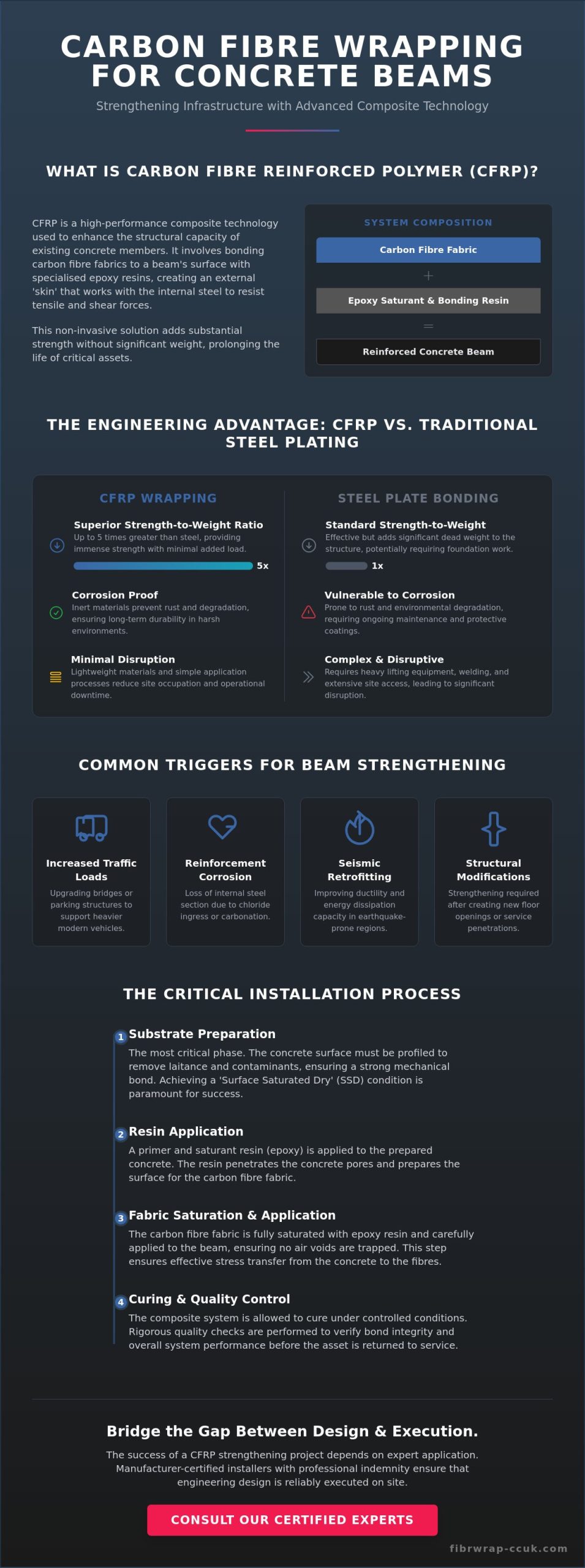
Carbon-fiber reinforced polymer (CFRP) represents a high-performance composite technology designed to augment the structural capacity of existing reinforced concrete members. This method involves the application of carbon fabrics bonded to the beam’s surface using specialised epoxy resins. It’s an intervention that has seen a significant transition from aerospace engineering to the civil infrastructure sector, providing a non-invasive solution for ageing or overloaded structures. When carbon fibre wrapping for concrete beams explained in its simplest form, it’s the creation of an external ‘skin’ that acts in unison with the internal reinforcement to resist tensile and shear forces.
The efficacy of the system is rooted in the synergistic relationship between the high-tensile carbon filaments and the protective polymer matrix. Whilst the fibres provide the necessary stiffness and strength, the resin matrix ensures that stresses are effectively transferred from the concrete substrate into the composite wrap. This allows for a substantial increase in load-bearing capacity without altering the structural dimensions or adding significant dead weight to the facility. It’s a precise engineering solution used to prolong the functional lifespan of critical assets through sophisticated material science.
The Components of a CFRP Wrapping System
A standard CFRP system is comprised of two primary elements: the carbon fabric and the saturant resin. Unidirectional fabrics, where the majority of fibres run in a single direction, are typically employed for flexural strengthening to address specific tensile deficiencies. Conversely, bidirectional fabrics provide reinforcement across multiple axes, making them suitable for complex shear or seismic applications. The performance of these materials is heavily dependent on the quality of the saturant resin, which must facilitate complete fibre impregnation. The Tyfo® Fibrwrap® system is frequently specified as the industry standard due to its extensive track record and rigorously tested material properties, ensuring long-term reliability in diverse environmental conditions.
Common Triggers for Beam Strengthening
Several factors necessitate the use of CFRP wrapping in modern infrastructure management. Changes in building occupancy often lead to increased live load requirements that the original design cannot accommodate. In other instances, remediation is required to correct design inaccuracies or to address the use of substandard materials during the initial construction phase. Environmental factors also play a significant role. The following triggers are commonly identified during structural surveys:
- Increased Traffic Loads: Upgrades to bridge decks or parking structures to support heavier modern vehicles.
- Reinforcement Corrosion: Loss of internal steel section due to chloride ingress or carbonation.
- Seismic Retrofitting: Improving the ductility and energy dissipation capacity of beams in earthquake-prone regions.
- Structural Modifications: Strengthening required after the creation of new floor openings or service penetrations.
By addressing these issues through carbon fibre wrapping for concrete beams explained through engineering rigour, asset owners can avoid the substantial costs and carbon expenditure of full structural replacement.
The Engineering Mechanics of Composite Strengthening
CFRP systems function as externally bonded reinforcement that effectively integrates with the existing concrete section to carry tensile and shear loads. The fundamental principle governing this interaction is ‘strain compatibility’, which dictates that the displacement of the concrete substrate, internal steel, and external composite wrap must be identical at the bond interface. When carbon fibre wrapping for concrete beams explained through mechanical performance, it’s clear that the system’s efficiency depends on this cohesive behaviour. High-performance material science strengthens concrete structures by allowing the CFRP to assume a significant portion of the tensile stress, specifically once the internal steel begins to reach its elastic limit.
The integrity of the bond interface is the primary determinant of success. If the adhesive bond fails, premature debonding occurs, which prevents the composite from reaching its ultimate tensile capacity. Beyond simple load-bearing, CFRP wrapping serves a critical serviceability function by restricting crack propagation. By bridging micro-cracks as they form, the wrap maintains structural stiffness and protects the internal reinforcement from the corrosive effects of moisture and carbonation. For those evaluating specific project requirements, understanding the design feature of each system is essential for ensuring long-term structural security.
Flexural Strengthening: Addressing Tension
Flexural enhancement is typically achieved by bonding CFRP laminates or fabrics to the tension face, or soffit, of the beam. This application increases the moment capacity of the section, providing a critical safety margin when the beam is subjected to loads exceeding its original design. Unlike steel, which exhibits a plastic yield plateau, carbon fibre remains linear-elastic until failure. This characteristic allows the beam to maintain structural integrity even after the internal reinforcement has yielded. However, the design must incorporate adequate end anchorage to ensure the full development of the carbon fibre’s tensile strength, preventing ‘peeling’ at the laminate terminations.
Shear Strengthening and U-Wrapping
Where shear capacity is deficient, CFRP is applied to the vertical faces of the beam, often in a ‘U-wrap’ configuration. This method is the preferred solution when access to the top surface of the beam is restricted by an integrated floor slab. These vertical wraps act as external stirrups, supplementing the internal shear reinforcement and enhancing the beam’s resistance to diagonal tension. Additionally, the wrapping provides a degree of confinement to the concrete core. This confinement increases the concrete’s compressive strain capacity, allowing it to withstand higher stresses before crushing occurs, which is a vital consideration in seismic retrofitting scenarios.
Why Engineers Favour CFRP Over Traditional Steel Plate Bonding
The engineering preference for Carbon Fibre Reinforced Polymer over traditional steel plate bonding is primarily driven by the material’s exceptional strength-to-weight ratio. Carbon fibre typically exhibits a tensile strength approximately five times that of structural steel, yet it weighs significantly less. This allows for the reinforcement of beams without adding substantial dead weight to the structure, which is a critical consideration for ageing foundations. When carbon fibre wrapping for concrete beams explained in a comparative context, the profile thickness is also a major advantage; CFRP systems usually range between 1.3mm and 5mm, whereas steel plates require significantly more clearance and aesthetic concealment. Steel requires propping. Conversely, CFRP is easily handled by small teams without the need for heavy lifting equipment.
Logistically, the application of CFRP eliminates the requirement for complex temporary supports that steel installations necessitate. This reduces the mechanical footprint on site and minimises the risk of damaging the existing concrete during the drilling of anchor bolts. By removing the need for mechanical fixings, the structural integrity of the original beam is better preserved, avoiding the creation of new stress concentrations or pathways for moisture ingress.
Durability and Environmental Resistance
Composite systems offer a decisive advantage in aggressive environments where steel is prone to rapid deterioration. Steel plate bonding is susceptible to electrochemical corrosion at the bond interface, which can lead to delamination and structural failure. CFRP is inherently inert and remains unaffected by chloride ingress or carbonation. Evidence provided in the Virginia Department of Transportation report on CFRP beams demonstrates the robust long-term performance of these materials in bridge infrastructure. Whilst the advanced resins provide protection against UV exposure and chemical ingress, it’s standard practice to apply specialised fire protection coatings for interior applications to ensure compliance with stringent safety regulations.
Operational Efficiency and Reduced Downtime
The speed of application is perhaps the most significant factor for asset controllers. Multiple beams can be wrapped in a fraction of the time required for traditional bolting and welding. Because the process is non-invasive and requires minimal equipment, strengthening can often be performed whilst the facility remains fully operational. This avoidance of facility closure translates into substantial cost savings that often outweigh the initial material expenditure. For engineers seeking to integrate these advantages into complex projects, you can learn more about bespoke design solutions that tailor the wrapping configuration to specific site constraints. The result is a high-performance intervention that extends asset life with minimal operational impact.
The Technical Installation Process for Concrete Beams
The installation of CFRP systems is a rigorous engineering procedure where the final performance is inextricably linked to the quality of the bond interface. When carbon fibre wrapping for concrete beams explained in a technical context, it must be stated that the composite wrap is only as effective as the concrete substrate to which it is adhered. Engineering data suggests that approximately 80% of the labour in a successful strengthening project is dedicated to substrate preparation. Failure to achieve the specified mechanical profile often results in premature delamination, rendering the high-tensile properties of the carbon fibres redundant. For a reliable assessment of your structure’s suitability, you should contact our technical team to discuss a structural survey.
Substrate Preparation and Priming
Successful adhesion requires the concrete surface to be mechanically “opened” to facilitate resin penetration. This is typically achieved through abrasive blasting or grit-blasting to reach a specific Concrete Surface Profile (CSP), usually between CSP 3 and CSP 5 depending on the system requirements. Any spalled concrete or exposed internal reinforcement must be remediated using high-strength repair mortars before the wrap is applied. It’s vital that the surface is levelled to a tolerance that prevents “kinks” in the carbon fabric; even minor deviations can cause stress concentrations that trigger early failure. Once the surface is prepared and reaches a surface saturated dry (SSD) condition, a low-viscosity epoxy primer is applied to seal the pores and provide a chemically active base for the subsequent saturant layers.
Application, Saturation, and Curing
The “wet-lay” method is the most common application for beam wrapping, involving the manual impregnation of carbon fabrics with a two-part epoxy resin. This resin must be mixed with precision to ensure full chemical cross-linking. Unlike pultruded plates which are pre-cured, the wet-lay Tyfo® Fibrwrap® system allows the fabric to conform to the beam’s geometry, including complex corners and service penetrations. During installation, ribbed rollers are used to “de-gas” the fabric, ensuring zero air voids remain between the layers or against the substrate. In the UK climate, temperature monitoring is essential during the curing phase, as ambient conditions directly affect the resin’s viscosity and ultimate glass transition temperature. Proper curing ensures the system achieves its full design strength and long-term durability.
Quality control is maintained throughout the process through rigorous testing protocols. Pull-off tests are conducted on site to verify that the tensile strength of the concrete substrate exceeds the bond strength of the CFRP, ensuring the failure mode remains within the concrete itself. Additionally, witness panels are often created under the same site conditions to allow for independent laboratory verification of the composite’s material properties. These measures ensure that the carbon fibre wrapping for concrete beams explained in the design phase is accurately reflected in the finished structural intervention.
Asset Life-Extension: The Specialist Contractor’s Role
The successful deployment of CFRP systems requires more than just high-performance materials; it necessitates a specialist contractor who serves as the vital link between theoretical engineering design and the complexities of site execution. Whilst the material properties of carbon composites are well-documented, the translation of these properties into a reliable structural intervention depends entirely on the proficiency of the installation team. A specialist contractor ensures that the performance criteria established during the design phase are met through manufacturer-certified application and rigorous quality management. This professional oversight provides asset controllers with the necessary assurance that the structural integrity of their infrastructure is maintained to the highest regulatory standards.
In the context of modern infrastructure management, carbon fibre wrapping for concrete beams explained through the lens of the circular economy reveals a significant sustainability advantage. By opting for structural strengthening over demolition, asset owners can avoid the substantial carbon expenditure associated with the production and transport of new concrete and steel. This approach aligns with broader environmental goals by prolonging the functional lifespan of existing assets, thereby reducing the industry’s reliance on carbon-intensive new-build projects. Composites Construction UK facilitates this process by providing an integrated service model that encompasses structural surveys, bespoke design, and the application of proprietary systems, ensuring a seamless transition from problem identification to long-term solution.
Bespoke Design and Engineering Feasibility
Every structural member presents a unique set of variables, meaning that a standardised approach to strengthening is rarely sufficient. The orientation of the fibres and the precise number of composite layers must be calculated based on specific deficiencies identified through site-specific testing. Assessments for carbonation depth, chloride ion content, and half-cell potential are essential precursors to any design work, as they determine the health of the underlying concrete. Understanding the role of a specialist engineering contractor in structural life-extension is critical for ensuring that these variables are correctly interpreted and that the chosen CFRP configuration provides the required safety margins for the intended use of the facility.
Long-term Asset Protection
The implementation of rigorously tested, globally recognised systems such as Tyfo® Fibrwrap® ensures that the structural capacity of an asset is protected for several decades. This long-term reliability is further reinforced by the specialist contractor’s ability to provide professional indemnity, which is a fundamental requirement for high-stakes infrastructure projects. The peace of mind offered by such systems is invaluable for technical professionals tasked with the guardianship of critical facilities. For those seeking to validate the engineering and economic viability of a specific intervention, you are encouraged to contact our engineering team for a feasibility study. By combining advanced material science with seasoned site expertise, it’s possible to transform ageing structures into resilient, high-performance assets.
Advancing Structural Integrity through Composite Engineering
The shift towards life-extension interventions over wholesale replacement is underpinned by the technical efficacy of composite materials. By integrating high-tensile carbon filaments with advanced epoxy matrices, it’s possible to restore structural integrity and meet modern load requirements without the operational disruption of traditional methods. This analysis of carbon fibre wrapping for concrete beams explained how the synergy of material science and precise installation creates a robust, corrosion-resistant reinforcement layer. It’s a methodical approach that prioritises safety and long-term asset utility.
Composites Construction UK serves as the exclusive UK licensee for Tyfo® Fibrwrap® systems, bringing over 10 years of specialist engineering expertise to complex strengthening projects. Our comprehensive design-and-install service ensures that every intervention is grounded in empirical evidence and site-specific data. To secure the long-term performance of your structural assets, Request a Technical Consultation for Your Strengthening Project. We’re here to help you prolong the lifespan of your essential infrastructure through proven science.
Frequently Asked Questions
Is carbon fibre wrapping for concrete beams fireproof?
CFRP systems are not inherently fireproof. Whilst the carbon fibres themselves possess high thermal resistance, the organic epoxy resin matrix typically begins to lose structural integrity at temperatures between 60°C and 80°C. For interior structural applications where fire ratings are mandatory, specialised intumescent paints or cementitious fire-protection mortars must be applied over the cured wrap to ensure the system meets the required safety standards.
How much strength can CFRP wrapping actually add to a beam?
The increase in load-bearing capacity is dependent upon the specific design parameters and the condition of the concrete substrate. In typical flexural strengthening scenarios, an increase in moment capacity between 40% and 100% is achievable. However, the design is often limited by the tensile strength of the concrete to prevent debonding failure. This highlights why carbon fibre wrapping for concrete beams explained through engineering calculations is essential for every project.
Can carbon fibre wrapping be applied to wet or damp concrete?
Standard CFRP systems require the concrete substrate to be in a Surface Saturated Dry (SSD) condition or possess a moisture content below 4%. The presence of excessive moisture at the interface can inhibit the chemical bond of the epoxy resin, leading to potential delamination. Whilst moisture-tolerant primers are available for specific environments, rigorous drying and moisture testing remain the standard engineering protocol for ensuring a high-performance bond.
What is the typical lifespan of a CFRP structural strengthening system?
When installed correctly by specialist contractors, a CFRP system is designed to match or exceed the remaining service life of the structure, typically 50 years or more. Because carbon fibre is an inert material, it’s not susceptible to the electrochemical corrosion that affects steel reinforcement. The longevity of the system is primarily determined by the protection of the epoxy resin from UV degradation and mechanical damage.
Is CFRP wrapping more expensive than traditional steel plate bonding?
Whilst the raw material cost of carbon fibre is higher than structural steel, the total project expenditure is frequently lower. This is due to the significant reduction in labour costs, the elimination of heavy lifting equipment, and the avoidance of operational downtime. When carbon fibre wrapping for concrete beams explained as a lifecycle investment, the lack of ongoing maintenance for corrosion protection further enhances its economic viability.
Does the beam need to be propped during the wrapping process?
Temporary propping is generally not required during the installation of CFRP wraps unless the structure is currently incapable of supporting its own dead load. Because the system is lightweight and applied manually, the beam remains “live” throughout the process. This allows for strengthening to be conducted in occupied buildings or over active transport routes without the logistical burden of heavy temporary supports.
How do you test if the carbon fibre has bonded correctly to the concrete?
Bond integrity is verified through a combination of non-destructive and destructive testing methods. Acoustic sounding is used to identify any subsurface delamination or air voids by detecting changes in resonance. Additionally, pull-off tests are performed on witness areas to confirm that the bond strength exceeds the tensile capacity of the concrete, ensuring that the failure mode remains within the substrate rather than at the adhesive interface.
Can CFRP be used on historic or listed masonry structures?
CFRP is an excellent solution for the reinforcement of historic masonry structures where traditional methods would be too invasive. Its low-profile nature allows for structural enhancement without altering the aesthetic character of listed buildings. The material can be used for masonry reinforcement to address lateral spreading or to improve the flexural capacity of arches and vaults whilst remaining virtually invisible once finished with appropriate lime-based renders.