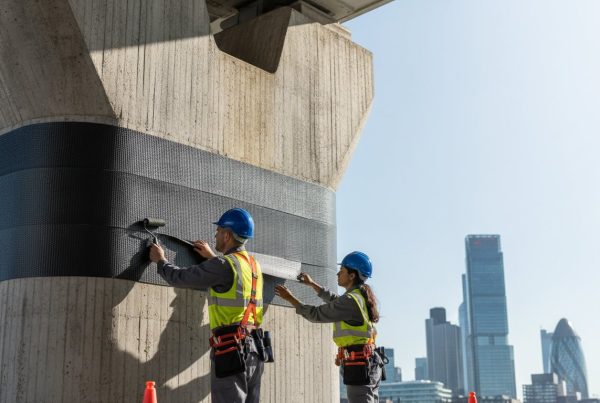

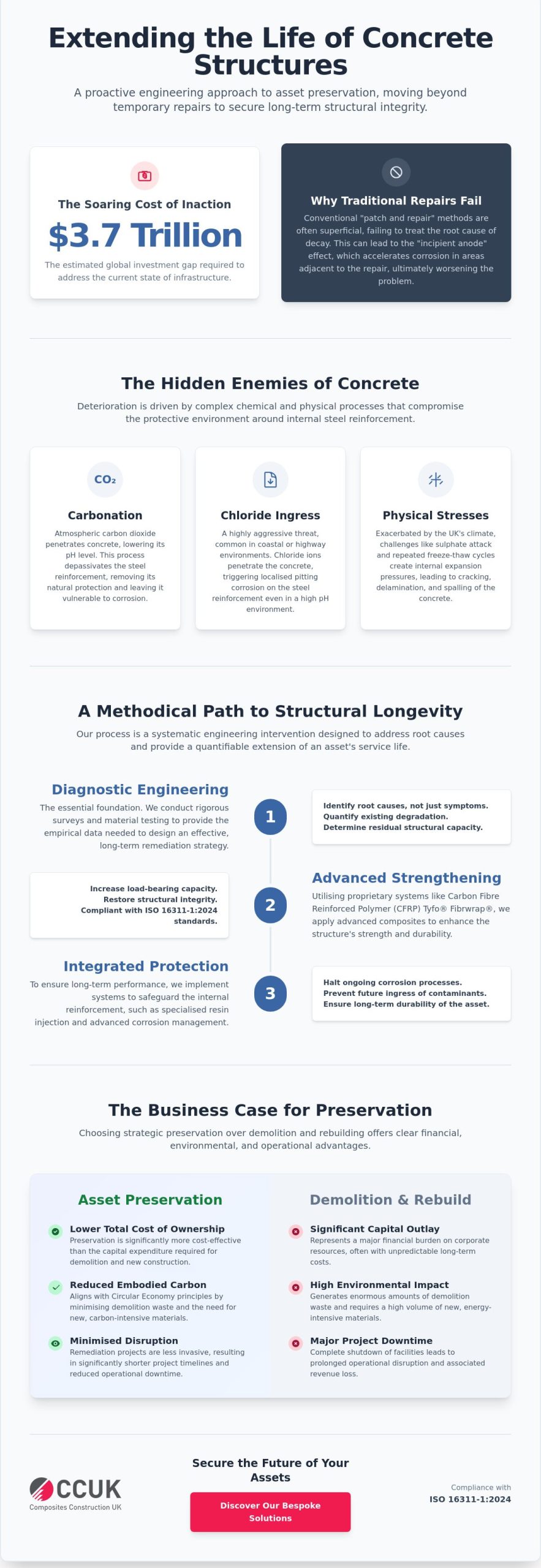
The American Society of Civil Engineers estimates a $3.7 trillion investment gap is required to address the current state of global infrastructure; however, the most sustainable solution isn’t found in new construction but in the strategic preservation of existing assets. Asset controllers frequently face the daunting prospect of decommissioning ageing facilities due to reinforcement corrosion or shifting safety standards, particularly within the challenging environmental conditions of the United Kingdom. It’s widely understood that the financial and operational disruption of traditional demolition represents a significant burden on corporate resources and project timelines.
This technical guide demonstrates that extending the life of concrete structures is achievable through the application of advanced material science and precision engineering interventions. By utilising sophisticated diagnostic techniques and proprietary systems such as Carbon Fibre Reinforced Polymer (CFRP) strengthening, the functional lifespan of critical infrastructure can be substantially prolonged whilst maintaining compliance with ISO 16311-1:2024 standards. This article explores the methodical approach to structural remediation, from initial testing to the implementation of specialised systems designed to increase load-bearing capacity and ensure long-term structural security.
Key Takeaways
- Learn why precise diagnostic engineering and bespoke calculations are essential prerequisites for any successful structural remediation project.
- Understand the application of Carbon Fibre Reinforced Polymer (CFRP) systems, such as Tyfo® Fibrwrap®, as a primary method for extending the life of concrete structures whilst increasing load capacity.
- Discover how integrated protection strategies, including resin injection and corrosion management, safeguard the internal reinforcement of ageing assets.
- Evaluate the business case for asset preservation by comparing the total cost of ownership and the reduction of embodied carbon against the high cost of demolition.
Understanding the Service Life Extension of Concrete Infrastructure
Within the discipline of asset management, the service life of a structure is defined as the temporal window during which the asset maintains its specified safety, stability, and functional requirements. Traditionally, infrastructure management has been characterised by reactive maintenance, where interventions are only initiated following the manifestation of visible distress. However, as the global infrastructure gap continues to widen, a transition toward proactive strategies for extending the life of concrete structures has become a technical necessity for asset controllers. This shift prioritises the preservation of structural viability through advanced engineering rather than the cyclical application of superficial repairs.
Conventional patch and repair methods are frequently insufficient for addressing the underlying mechanisms of structural decay. These localised interventions often fail to treat the electrochemical imbalances within the reinforced concrete, leading to the “incipient anode” effect where corrosion is accelerated in areas adjacent to the new repair. A specialist engineering contractor is required to conduct a rigorous assessment of structural viability, ensuring that the chosen remediation strategy addresses the root cause of deterioration rather than merely concealing its symptoms. It’s a process that demands empirical data over visual estimation.
The Mechanics of Concrete Deterioration
Deterioration is driven by complex chemical and physical processes that compromise the alkaline environment protecting the internal steel reinforcement. Carbonation-induced corrosion occurs when atmospheric carbon dioxide penetrates the concrete pores, lowering the pH level and depassivating the steel. In coastal environments or along highway networks, chloride ingress represents a more aggressive threat, as chloride ions penetrate the cement matrix to trigger localised pitting corrosion. These issues are exacerbated by the UK’s specific climatic challenges, where sulphate attack and repeated freeze-thaw cycles create internal expansion pressures that lead to cracking and spalling.
The Strategic Importance of Asset Remediation
Implementing integrated remediation strategies is critical for mitigating the risk of catastrophic structural failure across both public and private sectors. By adopting these methods, asset owners align their operations with Circular Economy principles, significantly reducing the volume of demolition waste and the demand for new carbon-intensive materials. Through the use of bespoke engineering calculations, the functional capacity of an asset can be restored to meet modern performance standards. By adopting these advanced techniques, the objective of extending the life of concrete structures moves from a theoretical goal to a quantifiable engineering outcome.
Service life extension is a method to maximise the utility of existing concrete assets whilst minimising environmental impact. To see how these principles of durability apply to perimeter infrastructure, you can read more about high-quality reinforced concrete fencing systems.
Diagnostic Engineering: Identifying Root Causes to Extend Structural Life
Precise diagnostic engineering serves as the indispensable foundation for any project aimed at extending the life of concrete structures. It’s impossible to design an effective remediation strategy without first quantifying the extent of existing degradation and identifying the specific environmental drivers behind it. Structural surveys and testing provide the empirical evidence required to justify the capital investment in long-term remediation rather than temporary, superficial repairs. These assessments allow engineers to bridge the gap between the current state of the asset and its required future load-bearing capacity, ensuring that any intervention is both technically sound and economically viable.
Bespoke engineering calculations are required to interpret diagnostic data accurately. It’s not enough to observe surface cracking; engineers must determine the residual strength of the remaining reinforcement and the quality of the concrete matrix. This data-driven approach ensures that the chosen materials and systems are compatible with the existing substrate. If you’re currently managing a deteriorating asset, initiating a detailed structural survey is the first step toward establishing a reliable baseline for life extension.
Non-Destructive and Semi-Destructive Testing Methods
A suite of specialised testing methods is employed to map the health of the structure. Carbonation depth testing, typically using a phenolphthalein indicator on freshly fractured surfaces, determines the extent of chemical neutralisation within the concrete cover. Pull-off tests are conducted to assess the tensile bond strength of the substrate, which is a critical factor when planning for composite overlays. To locate active corrosion in the reinforcing steel before it manifests as surface spalling, half-cell potential mapping is used to measure electrochemical activity. These findings often dictate the need for to halt ongoing oxidation processes.
Analysing Structural Integrity for Future Usage
Modern infrastructure often faces loading requirements that exceed its original design parameters. Evaluating the impact of increased traffic on bridges or heavier machinery on commercial floors requires a sophisticated understanding of structural dynamics. Engineers use Ground Penetrating Radar (GPR) or acoustic sounding to identify internal delamination and hidden voids that could compromise integrity. This technical data is then used to develop tailored strengthening solutions that address specific vulnerabilities. By identifying these signs of internal distress early, asset controllers can implement interventions that prevent further decay and restore the asset’s functional utility for decades to come.
Advanced Strengthening with Tyfo® Fibrwrap® to Extend Asset Lifespan
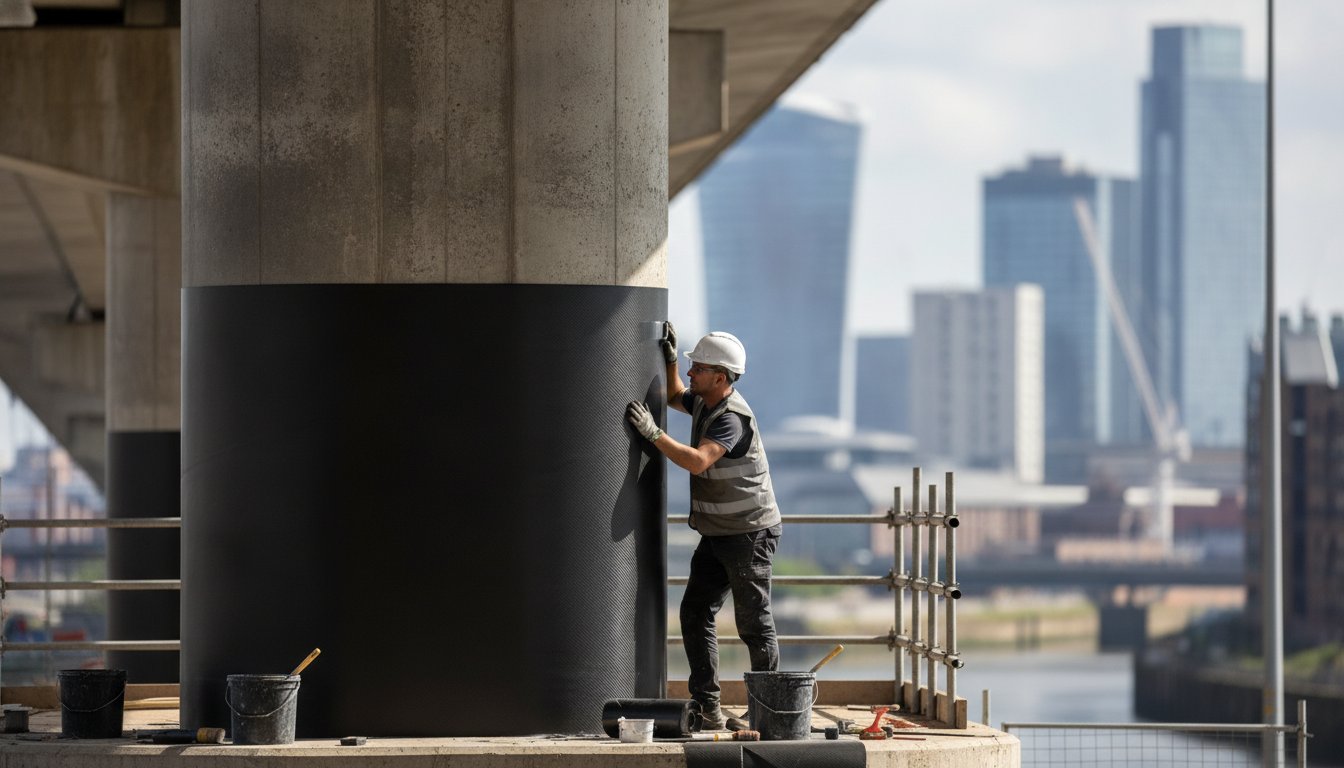
Following the precise diagnostic phase, the implementation of advanced material science becomes paramount for the continued utility of an asset. Carbon Fibre Reinforced Polymer (CFRP) has emerged as a transformative technology in modern structural engineering, offering a sophisticated alternative to traditional, more invasive methods. By bonding high-strength fibres within a polymer matrix, a composite system is created that significantly enhances the flexural, shear, and axial capacities of existing members. This technology is instrumental in extending the life of concrete structures, particularly those where original design specifications are no longer sufficient for current operational demands.
The Tyfo® Fibrwrap® system is widely regarded as the industry standard for composite structural strengthening, supported by extensive empirical data and a robust history of project success across global infrastructure. Its primary advantage lies in its exceptional tensile strength-to-weight ratio; the system provides structural reinforcement whilst adding negligible mass to the overall asset. This characteristic is vital for preserving the original dynamic behaviour of the structure and avoiding the need for foundation upgrades that typically accompany heavier strengthening interventions. It’s a solution that prioritises engineering rigour over brute-force reconstruction.
CFRP vs Traditional Steel Plate Strengthening
When compared to traditional steel plate bonding, CFRP offers superior durability and ease of application in challenging environments. Unlike steel, which remains vulnerable to oxidation and requires ongoing maintenance, carbon fibres are inherently immune to rust and chemical degradation. The installation of composites requires significantly less heavy plant and fewer temporary works, as the lightweight materials can be handled manually in confined spaces. The inherent flexibility of the fabric allows it to be wrapped around columns, beams, and complex geometries with a precision that rigid steel plates cannot match. These factors combine to reduce the total project risk and long-term maintenance liability.
Applications Across Critical Infrastructure
The versatility of Tyfo® Fibrwrap® enables its application across a diverse range of critical national assets. It’s frequently utilised for strengthening concrete beams and slabs to support increased loading from new equipment or the addition of storeys to existing commercial buildings. Beyond load-bearing enhancements, the system provides essential seismic retrofitting and blast mitigation for high-security facilities, where the containment of concrete fragments during an event is critical for life safety. Engineers and asset managers should consult the Tyfo® Fibrwrap® Installation Guide for detailed technical application standards and procedural requirements.
Rapid installation cycles ensure that operational downtime is minimised, allowing critical infrastructure to remain functional throughout the remediation process. Because the system is applied using specialised wet-layup or pre-cured techniques, the disruption to building occupants or traffic flow is substantially reduced compared to demolition and reconstruction. This efficiency, combined with the long-term durability of the material, provides a compelling engineering solution for those tasked with the stewardship of ageing concrete assets.
Integrated Protection: Halting Corrosion for Long-Term Asset Life
Structural strengthening via CFRP provides the necessary load-bearing enhancement, but it represents only one facet of a comprehensive remediation strategy. Without addressing the underlying electrochemical degradation of the steel reinforcement, internal oxidation will persist, eventually compromising the bond between the substrate and the reinforcement system. A truly integrated approach to extending the life of concrete structures requires a multi-layered defence that combines structural enhancement with active corrosion mitigation and moisture management. This synthesis of mechanical reinforcement and electrochemical stabilisation ensures that the structural capacity is not only restored but protected against the aggressive environmental conditions prevalent in the UK.
It’s a common misconception that simply covering a patch repair will stop the decay. In reality, the “halo effect” often occurs where corrosion is accelerated in the areas immediately surrounding a new repair. To prevent this, engineers must look beyond the surface and implement systems that address the chemical environment of the entire member. This proactive stance is what separates short-term maintenance from genuine asset life extension.
Resin Injection and Leak Sealing Techniques
Structural integrity is often compromised by the presence of cracks that act as conduits for deleterious substances such as chlorides and sulphates. High-pressure resin injection is utilised to restore monolithic integrity by filling these voids with specialised epoxy or polyurethane resins. Epoxy resins are typically selected for their high tensile strength and superior bonding properties in structural applications. Polyurethane systems are preferred for leak sealing in pipelines and water-retaining structures because they react with moisture to expand and create a flexible, watertight seal. Effectively sealing these pathways is vital for preventing further ingress and halting internal decay. For a deeper technical analysis, consult our guide to structural repairs.
Cathodic Protection for Long-Term Durability
Cathodic protection acts as a long-term insurance policy by shifting the electrochemical potential of the reinforcing steel to a range where corrosion is thermodynamically impossible. Asset managers must choose between Impressed Current Cathodic Protection (ICCP), which utilises an external power source and permanent anodes, and galvanic sacrificial anode systems that rely on the natural potential difference between metals. ICCP provides a constant, adjustable current that can be monitored remotely, making it ideal for chloride-contaminated highway bridges or marine structures. Galvanic systems are often simpler to install and require no ongoing power supply, making them suitable for targeted interventions in localised repair zones. By integrating these protection systems into concrete repairs, the risk of future spalling is virtually eliminated.
Halting active corrosion is the only way to ensure that strengthening interventions achieve their intended design life. If you require a technical assessment of your asset’s corrosion profile, contact our engineering team to discuss a bespoke protection strategy.
The Business Case for Extending the Life of Concrete Structures
The decision to remediate rather than replace an ageing asset is increasingly driven by a sophisticated analysis of Total Cost of Ownership (TCO). Whilst the initial capital expenditure (CAPEX) of a new build may appear justifiable in a growth phase, the long-term financial and environmental liabilities often favour the strategic preservation of existing infrastructure. For asset controllers and technical professionals, extending the life of concrete structures represents a disciplined approach to capital management that balances immediate performance requirements with future fiscal responsibility. This transition from a “demolish and rebuild” mentality to one of “assess and strengthen” is supported by empirical evidence regarding the longevity of modern composite interventions.
The complexity of modern infrastructure means that the true cost of replacement extends far beyond material and labour. Indirect costs, including the disruption of essential services, loss of revenue during facility closures, and the logistical challenges of managing demolition in dense urban environments, must be factored into the TCO equation. A specialist engineering contractor plays a pivotal role in this process by providing the lifecycle planning and technical expertise required to transform a deteriorating liability into a high-performance asset.
Financial ROI of Structural Life Extension
The financial return on investment for structural remediation is realised through the avoidance of the massive capital outlays required for new construction. Targeted engineering interventions allow for the precise application of reinforcement only where it’s needed, as determined by the diagnostic testing discussed in earlier sections. This surgical approach reduces the scope of works and minimises indirect costs such as road closures, rail disruption, and business downtime. Tyfo® Fibrwrap® systems provide a favourable ROI by extending asset utility for decades whilst avoiding the prohibitive costs associated with complete structural replacement. By maintaining the existing footprint and structural frame, organisations can reallocate capital toward other critical operational priorities.
ESG and Sustainability in Modern Infrastructure
Environmental, Social, and Governance (ESG) criteria are now fundamental to the procurement and management of UK infrastructure. The high carbon footprint of cement production, which accounts for approximately 8% of global CO2 emissions, makes the preservation of existing concrete a primary strategy for meeting UK net-zero targets. By extending the life of concrete structures, the demand for new, carbon-intensive materials is significantly reduced, and the volume of demolition waste directed to UK landfill sites is minimised. This alignment of structural care with corporate social responsibility (CSR) goals demonstrates a commitment to sustainable development. Preserving the embodied carbon within an existing structure is the most effective method for reducing the environmental impact of the built environment whilst ensuring the continued safety and utility of national assets.
Securing the Future of National Infrastructure
The transition from reactive maintenance to integrated remediation represents the most viable path for preserving critical infrastructure. By synthesising precise diagnostic engineering with advanced composite systems and electrochemical protection, asset managers can effectively mitigate the risks associated with structural decay. This methodology ensures that the functional capacity of an asset is not only restored but enhanced to meet evolving safety standards and operational demands. It’s a strategic shift that aligns technical performance with broader economic and environmental objectives.
Successfully extending the life of concrete structures requires a partner with deep technical expertise and a proven history of project delivery. As the exclusive UK licensee for Tyfo® Fibrwrap® systems, we provide specialised engineering design and installation services backed by decades of experience in national infrastructure projects. Our approach prioritises safety and long-term security, ensuring that essential assets remain functional and compliant for years to come. Contact our specialist engineering team for a structural assessment to begin the process of securing your asset’s future utility.
Frequently Asked Questions
How much can CFRP actually extend the life of a concrete structure?
Carbon Fibre Reinforced Polymer (CFRP) systems are engineered to provide a service life extension of several decades, typically ranging from 30 to 50 years when integrated into a comprehensive strategy for extending the life of concrete structures. The actual duration is contingent upon the initial condition of the substrate and the severity of the environmental exposure. By effectively halting the progression of structural distress, these systems ensure the continued utility of the asset without the need for periodic, invasive reconstructions.
Is it possible to strengthen a structure whilst it remains in use?
Structural strengthening can be executed whilst the asset remains fully operational, representing a primary advantage of lightweight composite systems. Because the installation of Tyfo® Fibrwrap® requires minimal heavy plant and no extensive temporary works, disruption to building occupants or traffic flow is significantly reduced. This capability is essential for critical infrastructure such as highway bridges and commercial centres where decommissioning would result in substantial indirect costs and logistical complexity.
What are the main causes of concrete deterioration in the UK?
Concrete deterioration in the United Kingdom is predominantly driven by chloride ingress from de-icing salts and marine environments, alongside atmospheric carbonation. These processes lead to the depassivation of the reinforcing steel, triggering active corrosion and subsequent spalling. Additionally, the UK’s specific climate subjects structures to repeated freeze-thaw cycles and sulphate attack, which create internal expansion pressures that compromise the monolithic integrity of the cement matrix over time.
How does Tyfo® Fibrwrap® compare to traditional steel reinforcement?
Tyfo® Fibrwrap® offers a superior strength-to-weight ratio compared to traditional steel reinforcement, providing significant structural enhancement without adding substantial dead load to the asset. Unlike steel, which is susceptible to oxidation and requires ongoing protective coatings, composite systems are inherently corrosion-resistant and chemically inert. The flexibility of the carbon fibre fabric also allows for the seamless wrapping of complex geometries, a task that is often technically unfeasible with rigid steel plates.
Can cathodic protection be installed on existing bridges?
Cathodic protection systems are frequently retrofitted to existing bridges to halt the electrochemical process of corrosion in chloride-contaminated members. Both Impressed Current Cathodic Protection (ICCP) and galvanic sacrificial anode systems can be integrated into the structure during the remediation phase. These interventions are particularly effective for extending the life of concrete structures where the removal of all chloride-contaminated concrete is either technically impractical or economically unviable for the asset owner.
What testing is required before a life-extension project can begin?
A comprehensive suite of diagnostic tests is required to establish a baseline for structural viability, including half-cell potential mapping to locate active corrosion and carbonation depth testing. Chloride ion concentration analysis and dust sampling are conducted to determine the level of chemical contamination within the concrete cover. Furthermore, pull-off tests are essential to verify the tensile bond strength of the substrate, ensuring it can support the application of high-performance composite strengthening systems.
Is composite strengthening compliant with UK building regulations?
Composite strengthening systems are fully compliant with UK building regulations and international engineering standards when designed according to established protocols such as Concrete Society Technical Report 55 (TR55). These interventions must be supported by bespoke engineering calculations that account for the specific material properties and safety factors required by the Eurocodes. Adherence to these rigorous standards ensures that the remediated structure meets all contemporary requirements for safety, stability, and fire performance within the built environment.
What is the typical maintenance requirement for a CFRP-strengthened asset?
The maintenance requirements for an asset strengthened with CFRP are considerably lower than those for structures utilising traditional steel interventions. Because the composite materials are immune to corrosion, periodic maintenance is typically limited to routine visual inspections and the monitoring of any integrated protective systems, such as cathodic protection sensors. This reduction in long-term maintenance liability contributes to a more favourable total cost of ownership throughout the extended functional lifespan of the remediated infrastructure.