
The functional integrity of a commercial asset isn’t a static property but a declining variable influenced by environmental stressors and evolving load requirements. Whilst surface-level cracking might appear cosmetic, these fissures often serve as the primary diagnostic indicators that the load-bearing capacity of a structure has been compromised. Identifying the specific signs your building needs structural strengthening requires a transition from simple visual observation to rigorous engineering analysis. You’re likely managing the uncertainty of an asset’s remaining lifespan whilst seeking to avoid the service disruptions that typically accompany traditional remediation.
This article establishes a clear diagnostic framework to assist in the identification of structural distress before it escalates into a catastrophic failure. We’ll examine five critical indicators of instability and explain how advanced engineering interventions, specifically Carbon Fibre Reinforced Polymer (CFRP) systems, are utilised to restore asset integrity. By understanding the transition from symptom to engineered solution, the efficacy of systems such as Tyfo® Fibrwrap® can be validated as a sophisticated method for life-extension, ensuring the long-term security of essential infrastructure through empirical science.
Key Takeaways
- Learn to differentiate between superficial concrete shrinkage and critical shear cracking patterns that indicate a definitive loss of load-bearing capacity.
- Identify the chemical mechanisms of degradation, such as chloride ingress and carbonation, which serve as primary signs your building needs structural strengthening.
- Understand the role of non-destructive testing (NDT) and comprehensive structural surveys in providing the empirical data required for precision engineering designs.
- Evaluate the technical advantages of Carbon Fibre Reinforced Polymer (CFRP) systems, such as Tyfo® Fibrwrap®, for extending asset lifespan without the weight penalties of steel.
- Gain insights into upgrading infrastructure to meet modern regulatory standards and the increased live load requirements of contemporary occupancy.
Recognising Visible Indicators of Structural Distress
Visual anomalies in reinforced concrete are rarely just aesthetic. They represent the physical manifestation of internal stress exceeding the material’s capacity. When identifying the signs your building needs structural strengthening, it’s vital to look beyond surface-level mortar decay and focus on the primary load-bearing elements. Understanding the principles of structural integrity and failure allows asset managers to distinguish between benign settlement and active degradation.
Cracking Patterns and Their Engineering Significance
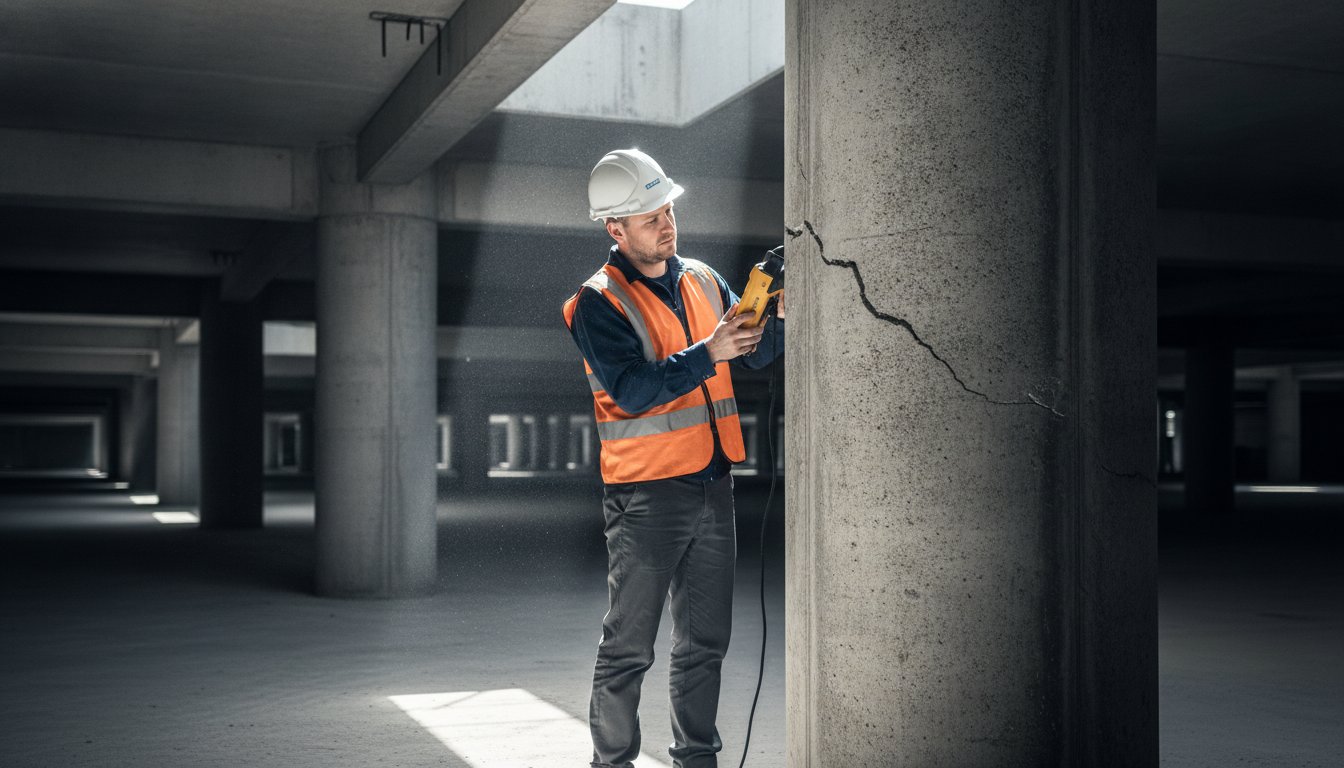
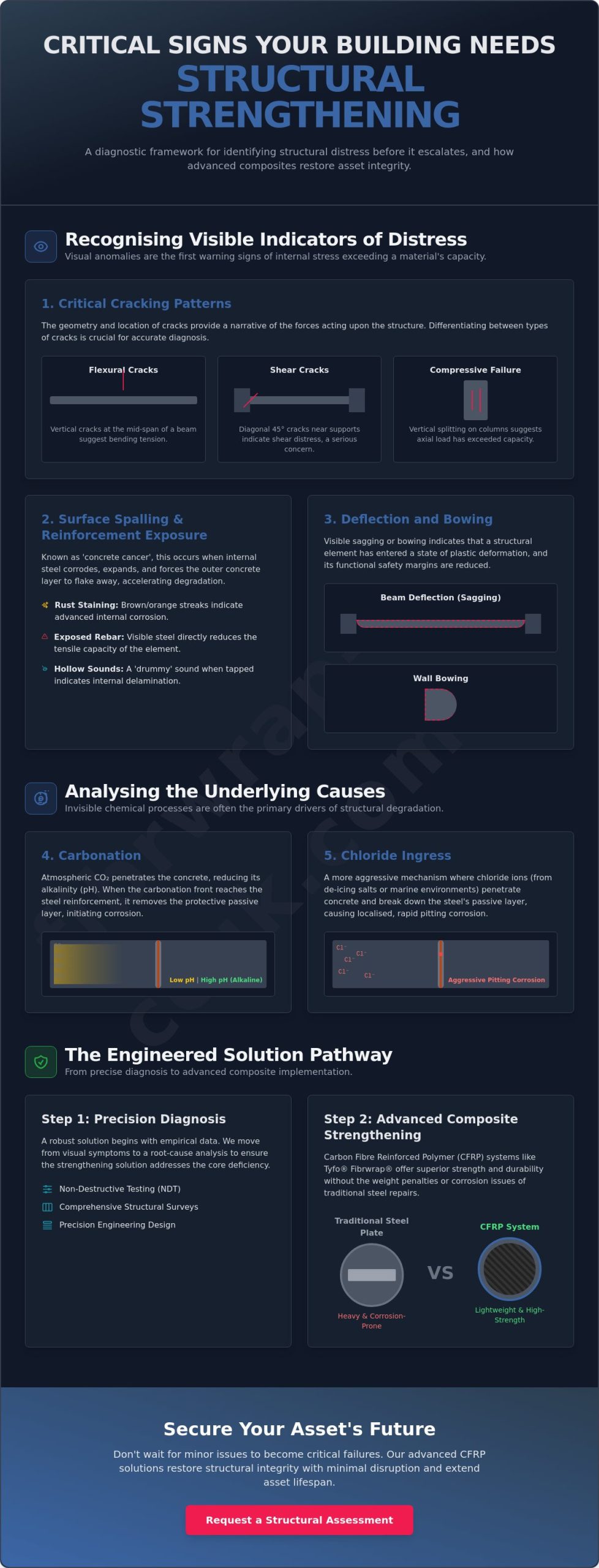
The geometry and location of cracks provide a narrative of the forces acting upon the structure. Vertical cracks located at the mid-span of a beam typically suggest flexural tension, whilst diagonal cracks appearing at a 45-degree angle near the supports are indicative of shear distress. These shear failures are particularly concerning because they can be brittle and sudden. In vertical members such as columns, vertical splitting or crushing patterns suggest that the axial load has exceeded the component’s compressive strength.
Whilst masonry crack stitching is often proposed for domestic repairs, it’s frequently an insufficient, temporary measure for industrial infrastructure. Effective remediation requires crack width monitoring to determine if the movement is active or stabilised. If the fissures continue to propagate, it’s one of the definitive signs your building needs structural strengthening through an engineered design solution that addresses the underlying deficiency.
Surface Spalling and Reinforcement Exposure
Spalling occurs when the internal steel reinforcement undergoes oxidation. As the steel corrodes, it expands to several times its original volume; this generates significant internal tensile forces within the concrete. This process, often colloquially termed concrete cancer, leads to delamination where the outer concrete cover simply flakes away. Once the reinforcement is exposed to the atmosphere, the rate of degradation accelerates exponentially as the protective alkalinity of the concrete is lost.
- Rust Staining: Brown or orange streaks on the concrete surface indicate that internal corrosion is already advanced.
- Exposed Rebar: Visible steel with significant sectional loss directly reduces the tensile capacity of the element.
- Hollow Sounds: When tapped with a hammer, delaminated areas produce a distinct drummy sound, indicating internal voids.
Deflection and bowing are further critical indicators. If a horizontal member exhibits a visible sag or a vertical wall shows a convex deviation from its original plane, the structure has likely entered a state of plastic deformation. These deviations must be measured with precision to assess the remaining functional safety margins of the asset. Identifying these markers early is essential for maintaining the long-term security of the infrastructure.
Analysing the Underlying Causes of Load-Bearing Failure
The transition from visual symptoms to root-cause analysis is critical for developing a long-term remediation strategy. Whilst visible cracking provides the initial impetus for investigation, the underlying chemical and mechanical drivers determine the true extent of the required intervention. These invisible processes often constitute the primary signs your building needs structural strengthening, long before the asset reaches a state of critical instability. Establishing the precise mechanism of failure is the only way to ensure that the chosen strengthening solution addresses the core deficiency rather than merely masking the symptoms.
Chemical Degradation Mechanisms in Concrete
Carbonation is defined as the atmospheric CO2 penetration that destabilises the concrete-steel bond by reducing the alkalinity of the cement matrix. The depth of this penetration is typically evaluated through phenolphthalein testing, where a colour change in a core sample reveals the extent of pH reduction. When the carbonation front reaches the reinforcement, the passive oxide layer is lost; this initiates uniform corrosion and subsequent sectional loss of the steel.
Chloride ingress presents a more aggressive challenge, particularly in coastal environments or infrastructure exposed to de-icing salts. Unlike carbonation, chloride ions can induce localised pitting corrosion, which is significantly harder to detect but can lead to rapid failure of the steel bars. The relationship between chloride concentration and the rate of structural decay is linear; as salt levels exceed the threshold, the structural integrity of the element is compromised from within. Alkali-Silica Reaction (ASR) represents another internal chemical threat, acting as a slow internal explosion where reactive silica in aggregates creates an expansive gel that induces map-cracking and internal tensile failure.
Environmental and Mechanical Stressors
Mechanical fatigue is frequently induced by the cumulative effect of vibration from heavy machinery or adjacent transport infrastructure. These constant micro-oscillations can lead to the propagation of existing micro-cracks, eventually compromising the bond between the concrete and the reinforcement. Similarly, thermal fatigue resulting from extreme temperature cycles causes differential expansion and contraction, which places immense stress on structural joints and bearings over many decades of service.
Water ingress remains the most persistent catalyst for failure, facilitating the freeze-thaw cycle within masonry and concrete. When water trapped in pores freezes, it expands by approximately 9%, creating internal hydraulic pressure that leads to surface scaling and deep-seated cracking. Sudden structural shifts caused by impact damage or seismic events also necessitate immediate assessment. If you suspect your asset has been compromised by these stressors, engaging in a professional engineering design review is the most reliable method for determining the necessary path to restoration. Identifying these signs your building needs structural strengthening early allows for proactive life-extension rather than reactive replacement.
Evaluating Strengthening Requirements for Asset Life-Extension
Structural strengthening is frequently necessitated by factors that extend beyond visible material degradation. Whilst the physical symptoms of distress provide an immediate call to action, the requirement for intervention is often driven by the evolving operational demands placed upon an asset. In many instances, the primary signs your building needs structural strengthening are found within the gap between its original design capacity and its current or projected functional requirements. This paradigm shift from reactive repair to proactive life-extension allows for the continued utility of essential infrastructure, aligning with both economic efficiency and environmental sustainability goals by avoiding the carbon-intensive process of demolition.
Load-Bearing Upgrades for Modern Usage
The repurposing of industrial or commercial assets often introduces load profiles that significantly exceed the original design parameters. A common scenario involves the conversion of standard office space into data centres or hospitality hubs; for instance, installing professional food display and catering equipment from TFSE Products Ltd may require slab reinforcement to manage new point loads. Similarly, the trend toward vertical urban densification often requires the reinforcement of existing columns and foundations to support the additional storeys of a vertical extension. The necessity of rigorous structural design and engineering is paramount before any physical intervention is undertaken, as the feasibility of a capacity upgrade depends entirely on the empirical assessment of existing material properties and the projected load increments.
Remedying Historical Design and Construction Errors
- Code Compliance: Upgrading assets to meet modern UK seismic standards or updated building codes that account for higher environmental loads.
- Design Life Extension: Implementing strengthening measures for structures that have reached or exceeded their intended 50-year design life, ensuring they remain fit for purpose.
- Structural Redundancy: Enhancing the robustness of a structure to prevent progressive collapse in the event of localised failure.
Addressing these historical errors requires a methodical approach that prioritises safety and proven results. By utilising advanced materials to restore or enhance the tensile and compressive capacity of compromised elements, the functional lifespan of a structure can be extended whilst maintaining the highest standards of engineering rigour. This disciplined approach ensures that the asset remains a reliable component of the built environment for decades to come.
The Diagnostic Process: From Site Survey to Engineering Design
Visual assessments are merely the precursor to a formal engineering evaluation. Whilst the visual indicators discussed previously provide the initial impetus, the definitive signs your building needs structural strengthening are established through a rigorous, multi-stage diagnostic process. This phase moves beyond observation into empirical data collection, where the objective is to quantify the remaining material capacity and define the required strength increment. A comprehensive baseline is established through detailed structural surveys, which serve as the foundation for all subsequent engineering calculations and remediation strategies.
Advanced Testing and Data Collection
Non-destructive testing (NDT) is employed to assess the internal integrity of reinforced concrete without compromising its current load-bearing function. Ultrasonic pulse velocity (UPV) testing is utilised to detect internal voids, honeycombing, or deep-seated cracks that are invisible to the naked eye. These internal discontinuities can significantly alter the stress distribution within an element. Simultaneously, cover meter surveys are conducted to map the depth and orientation of internal reinforcement, identifying areas where insufficient cover may have accelerated the chemical degradation processes mentioned earlier.
For projects where advanced composite solutions are being considered, pull-off testing is a critical requirement. This evaluates the tensile strength of the concrete substrate, ensuring it can provide the necessary bond for Carbon Fibre Reinforced Polymer (CFRP) systems. If the substrate doesn’t meet the minimum required pull-off strength, the efficacy of an externally bonded strengthening system cannot be guaranteed, necessitating further surface preparation or alternative repair methods.
Developing the Strengthening Strategy
Once the diagnostic data is synthesised, bespoke engineering calculations are performed to determine the precise performance requirements of the intervention. This involves defining the target ultimate strength whilst simultaneously accounting for ductility and global stiffness. A feasibility study is typically conducted to evaluate the merits of traditional methods, such as steel plate bonding, against advanced composite solutions like Tyfo® Fibrwrap® systems. The selection is frequently influenced by the requirement for minimal weight addition and the necessity to avoid the service disruptions associated with heavy mechanical fixings.
Integrating the strengthening works with existing concrete repairs ensures a cohesive remediation strategy that addresses both the material decay and the structural deficiency. Engaging a specialist engineering contractor is vital for managing these complex variables within a disciplined, safety-critical workflow. If your preliminary inspections suggest signs your building needs structural strengthening, establishing an empirical baseline through NDT is the only reliable path forward. You can contact our technical department to arrange a comprehensive structural survey for your asset.
Implementing Advanced Composite Strengthening Solutions
Once the diagnostic phase has confirmed the definitive signs your building needs structural strengthening, the selection of a remediation technology becomes the primary engineering concern. Traditional methods, such as steel plate bonding or concrete jacketing, often introduce secondary challenges that can complicate asset management. These include significant increases in dead weight, the potential for future galvanic corrosion, and the requirement for invasive mechanical anchoring that may further compromise the substrate. Carbon Fibre Reinforced Polymer (CFRP) systems offer a sophisticated alternative, providing a high strength-to-weight ratio that allows for the restoration of tensile capacity with minimal impact on the structure’s original geometry.
The Tyfo® Fibrwrap® Advantage
Tyfo® Fibrwrap® is a lightweight, non-corrosive composite that offers superior tensile strength without adding significant mass. Unlike rigid steel plates, this system is inherently versatile; it is applied in a flexible state that conforms precisely to complex geometries, including circular columns, arched bridges, and irregularly shaped slabs. This adaptability ensures a continuous bond and uniform load distribution across the substrate, which is essential for maintaining global stiffness. The speed of installation is also a critical advantage. Whilst traditional concrete jacketing requires extensive formwork and prolonged curing periods, composite application is achieved through a disciplined wet-layup process that significantly reduces project timelines and minimises operational downtime for the asset controller.
Sustainability and Long-Term Asset Protection
Choosing repair over replacement is a fundamental pillar of sustainable infrastructure management. Industry data suggests that 75% of construction and engineering firms are expected to dedicate resources to decarbonisation and sustainability targets in 2026. By extending the functional lifespan of an existing structure through advanced materials, the substantial carbon footprint associated with demolition and new-build construction is avoided. This approach aligns technical capabilities with broader environmental goals, framing structural remediation as a form of stewardship for essential infrastructure.
These systems also provide enhanced resistance to future environmental degradation and chemical attacks, such as the chloride ingress or carbonation previously discussed. The long-term durability of the intervention is ensured through specialist application and rigorous quality control protocols. For asset controllers managing the transition from structural distress to long-term security, the implementation of proven composite systems represents a commitment to engineering rigour. If you have identified the signs your building needs structural strengthening, contact the expert team at CCUK for a bespoke structural assessment to determine the optimal life-extension strategy for your asset.
Advancing Asset Integrity through Engineering Rigour
The identification of physical and chemical signs your building needs structural strengthening represents the initial phase of a disciplined asset management strategy. By transitioning from visual observation to empirical diagnostic testing, the specific mechanisms of material degradation can be accurately quantified. This data-driven approach allows for the implementation of advanced composite solutions that restore load-bearing capacity whilst avoiding the carbon-intensive requirement for total asset replacement. It’s a methodology that prioritises both economic efficiency and the long-term sustainability of essential infrastructure.
As the exclusive UK licensee for the Tyfo® Fibrwrap® system, CCUK combines specialist engineering design with a proven track record in national infrastructure life-extension. Our team possesses the technical expertise required to navigate complex structural challenges, ensuring that every intervention is grounded in engineering rigour and safety. Contact our specialist engineering team for a structural assessment to validate your asset’s integrity and explore tailored strengthening solutions. Securing the future of your building begins with an expert-led diagnostic baseline.
Frequently Asked Questions
What are the first signs that a building requires structural strengthening?
The primary indicators include progressive diagonal cracking near supports, surface delamination (spalling), and visible deflection of horizontal members. These physical manifestations are often the first visible signs your building needs structural strengthening to address a deficit in load-bearing capacity. If an asset exhibits sag or bowing that deviates from its original design plane, a formal engineering assessment is required to quantify the remaining safety margins and prevent further degradation.
How do I know if a crack in my concrete is structural or cosmetic?
Cosmetic cracks, such as those caused by plastic shrinkage or minor settlement, are typically shallow, narrow, and random in their distribution. Structural cracks are identified by their specific orientation and location; diagonal shear cracks near beam supports or wide flexural fissures at the mid-span of a slab indicate a compromise in the element’s integrity. Any crack that continues to propagate over time should be treated as a structural concern requiring professional investigation.
Can a building be strengthened without using heavy steel beams?
Advanced composite systems, such as Carbon Fibre Reinforced Polymer (CFRP), provide a lightweight and sophisticated alternative to traditional steel plating. These specialized materials offer superior tensile strength without the significant dead-weight addition or the requirement for invasive mechanical fixings associated with steel. Systems like Tyfo® Fibrwrap® are particularly effective for strengthening columns, beams, and slabs whilst maintaining the original architectural profile and avoiding the logistical challenges of heavy machinery.
What is carbonation, and why does it affect structural integrity?
Carbonation is a chemical process where atmospheric carbon dioxide penetrates the concrete matrix, reducing its pH level and destroying the passive protective layer around the internal steel reinforcement. This loss of passivation leads to oxidation, where the resulting rust expands and generates internal tensile forces. These forces cause the concrete cover to crack and delaminate, ultimately compromising the bond between the steel and concrete and reducing the element’s load-bearing capacity.
Is structural strengthening more cost-effective than demolition and rebuild?
Remediation is generally more cost-effective as it avoids the substantial capital expenditure and carbon debt associated with demolition and new-build construction. By extending the functional lifespan of an asset through targeted engineering interventions, the total cost of ownership is reduced whilst modern safety standards are maintained. This approach is increasingly favoured by asset controllers who prioritise the sustainability of existing infrastructure over the disruption of total replacement.
How long does a CFRP structural strengthening project typically take?
Project timelines for CFRP application are significantly shorter than traditional methods because the system doesn’t require heavy machinery, extensive formwork, or noisy mechanical drilling. Whilst the exact duration depends on the project’s scale, the rapid curing properties of epoxy resins allow for faster site handover and reduced labour costs. This efficiency makes it an ideal solution for infrastructure projects where minimising service disruption is a primary operational requirement.
Do I need a structural survey before choosing a strengthening method?
A comprehensive structural survey is a mandatory requirement to establish an empirical baseline for the subsequent engineering design. Professional surveys utilise non-destructive testing (NDT) to identify the specific signs your building needs structural strengthening, ensuring the chosen solution addresses the root cause of the distress. This diagnostic phase is essential for determining critical material properties, such as concrete compressive strength and reinforcement orientation, before a bespoke solution is developed.
Can structural strengthening be performed whilst the building is still in use?
Structural strengthening using composite systems is frequently performed whilst an asset remains fully operational. The low-profile nature of CFRP and the absence of heavy mechanical equipment allow for minimal disruption to the building’s occupants and essential services. This capability is particularly valuable for data centres, hospitals, and transport infrastructure where closing the facility for traditional repairs would result in significant economic loss or service disruption.