
Could the perceived premium of advanced composites actually represent the most fiscally responsible path for your infrastructure? While the initial material outlay for Carbon Fibre Reinforced Polymer (CFRP) remains higher than traditional structural steel, the total cost of carbon fibre strengthening UK projects is often significantly lower when the full project lifecycle is quantified. Asset managers frequently discover that the 30% to 50% reduction in labour costs, combined with a construction programme that is typically half to two-thirds shorter than traditional steel plate bonding, creates a compelling economic case for modern interventions. This efficiency allows for the preservation of essential assets without the prohibitive expense or logistical burden of full demolition and replacement.
It’s understood that you face increasing pressure from the Building Safety Act 2022 to maintain rigorous digital safety records whilst extending the functional lifespan of ageing structures. This technical evaluation provides a robust justification for CFRP expenditure, examining the specific variables that dictate project quotes and the long-term total expenditure (TOTEX) benefits of composite systems. We’ll examine compliance with Concrete Society Technical Report 55 (TR55) and relevant Eurocodes to ensure your structural strengthening programmes meet the highest standards of engineering rigour and regulatory compliance required for higher-risk buildings.
Key Takeaways
- Understand how shifting from a CAPEX-focused model to a Total Expenditure (TOTEX) approach reveals the long-term financial benefits of composite structural remediation.
- Identify the primary technical cost-drivers in a typical project, including how the specific cost of carbon fibre strengthening UK is balanced against substantial savings in labour and specialised plant.
- Evaluate the technical advantages of CFRP over traditional steel plate bonding, specifically regarding weight-to-strength ratios and the mitigation of secondary structural loading.
- Learn how site-specific variables such as substrate preparation requirements and access constraints directly influence the final project quotation and implementation strategy.
- Discover how early-stage feasibility studies and high-performance systems like Tyfo® Fibrwrap® can prevent over-specification whilst ensuring full compliance with UK structural standards.
The Economic Case for Carbon Fibre Reinforced Polymer (CFRP) in UK Infrastructure
The deployment of Carbon Fibre Reinforced Polymer (CFRP) represents a sophisticated shift in how UK infrastructure is maintained and upgraded. Unlike traditional steel plate bonding, which adds significant dead weight and remains susceptible to environmental degradation, CFRP is a high-tensile, lightweight composite that provides superior structural remediation. Whilst the cost of carbon fibre strengthening UK is often scrutinised at the procurement stage, the material’s performance characteristics offer a distinct advantage over traditional methods. For asset managers, the primary challenge lies in justifying the cost of carbon fibre strengthening UK projects within increasingly tight budgets. This justification is found by moving away from a narrow focus on Capital Expenditure (CAPEX) and instead adopting a Total Expenditure (TOTEX) perspective.
A TOTEX approach accounts for the entire lifecycle of the asset, including the costs of future maintenance, the speed of implementation, and the socio-economic impacts of disruption. CFRP systems allow for the enhancement of load-bearing capacities to meet modern requirements without altering the structural footprint or requiring extensive foundation work. This is particularly critical in urban environments where space is at a premium and the functional requirements of a building may change, such as converting office space into high-density data centres or upgrading warehouse floor loadings for automated robotics.
Asset Life-Extension and Sustainability
Retaining existing concrete and steel structures is no longer merely a financial preference but a sustainability mandate. The environmental value of asset life-extension is quantified through the massive reduction in embodied carbon compared to new construction. By utilising CFRP, engineers can contribute to UK net-zero targets by avoiding the carbon-intensive processes of demolition and re-casting. The long-term financial benefits are clear; avoiding total asset reconstruction preserves capital whilst extending functional utility by decades. This approach aligns technical capabilities with broader environmental goals, ensuring that essential infrastructure remains functional without the ecological cost of replacement.
Regulatory Compliance and Eurocode Standards
Structural integrity is underpinned by adherence to rigorous standards, specifically Eurocode 2 for concrete design and BS EN 1504 for the protection and repair of concrete structures. Engineering calculations must be meticulous to justify the expenditure on specialist interventions, ensuring that every linear metre of carbon fibre is utilised to its maximum design potential. Advanced design features allow for bespoke solutions that provide the necessary safety margins without over-specification. Precise, compliant design is the fundamental prerequisite for ensuring structural safety and legal accountability in 2026.
Analysing the Components of CFRP Strengthening Project Costs
The financial structure of a structural strengthening project is composed of several distinct technical variables that extend beyond the mere procurement of raw materials. Whilst the cost of carbon fibre strengthening UK is influenced by market rates for raw carbon, the total project value is often secured through the minimisation of secondary costs such as scaffolding and heavy lifting equipment. Unlike traditional steel reinforcement where material costs often dominate the budget, CFRP projects typically see a higher proportion of expenditure allocated to high-performance resins and technical design. A Techno-Economic Approach to Carbon Fibre Fabrics suggests that the lifecycle value is heavily influenced by these initial design choices, which must be balanced against the specific structural requirements of the asset.
Professional engineering consultancy fees represent a critical initial investment. These costs cover bespoke design and feasibility studies that prevent the over-specification of materials. By accurately calculating the required reinforcement ratios, engineers can optimise the volume of carbon fibre used, directly impacting the final quotation. This technical oversight ensures that the intervention is both fiscally responsible and structurally sound, providing a clear path for asset managers to justify the expenditure. If you’re currently evaluating the feasibility of a structural upgrade, you can contact our technical department for a preliminary discussion regarding your project requirements.
Material Selection: Plates, Rods, and Fabrics
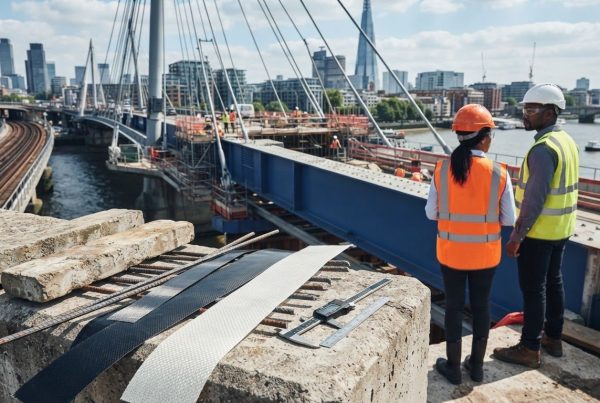
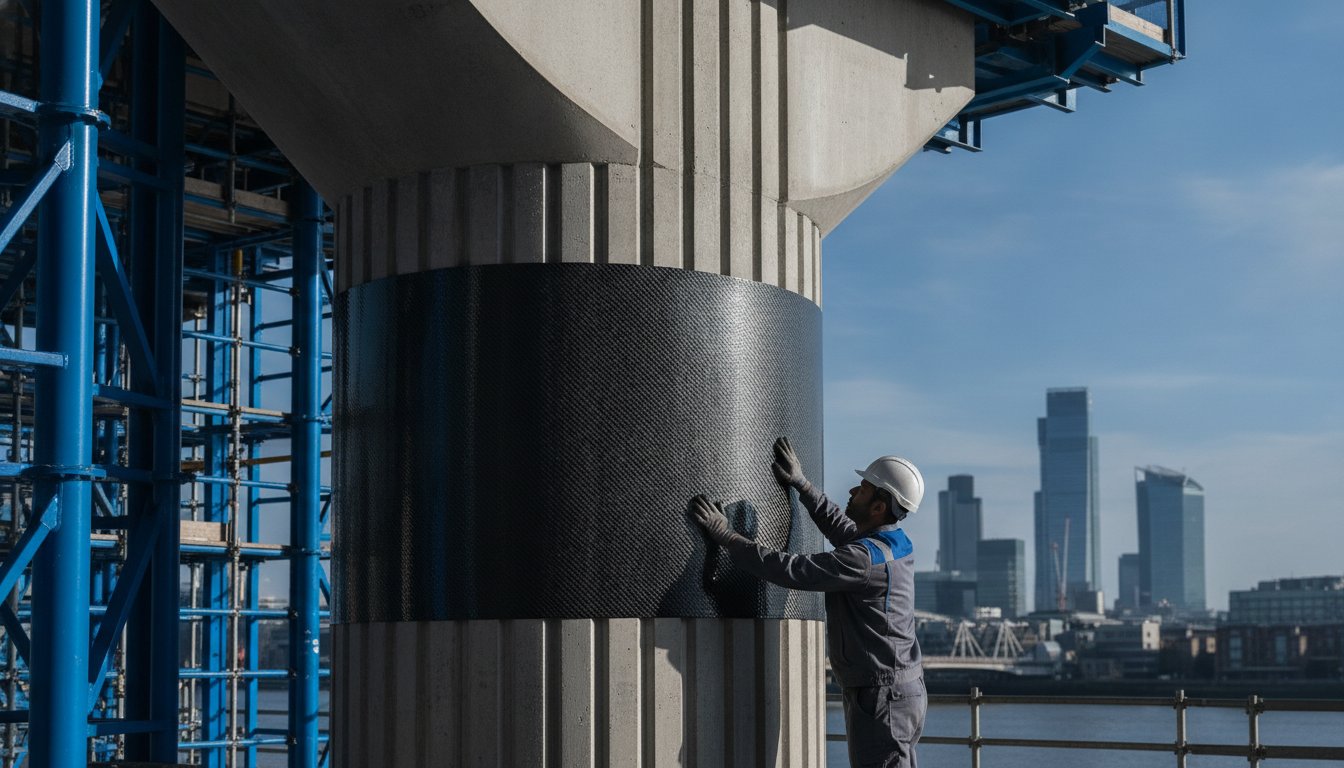
Prefabricated carbon fibre plates are frequently the most efficient choice for flexural strengthening on flat surfaces like bridge soffits or floor slabs. These pultruded sections offer consistent mechanical properties and rapid installation. Conversely, wet lay-up systems are indispensable for column wrapping or reinforcing members with non-linear geometries. The choice between these forms, along with the selection of specific saturant resins and thixotropic adhesives, directly dictates the total material bill. Each system is selected based on its ability to provide the required tensile strength whilst maintaining a minimal profile.
Specialist Labour and Quality Control
The requirement for certified installers is a non-negotiable component of the project budget. Because the performance of the system relies entirely on the chemical and mechanical bond between the substrate and the composite, the precision of application is paramount. This necessitates a rigorous quality control regime, which includes pull-off testing to verify bond strength and carbonation checks to ensure the host concrete is suitable for treatment. These validation steps aren’t merely administrative; they’re essential for maintaining system warranties and ensuring the long-term security of the investment amongst UK assets.
Comparative Analysis: CFRP vs. Traditional Steel Plate Bonding
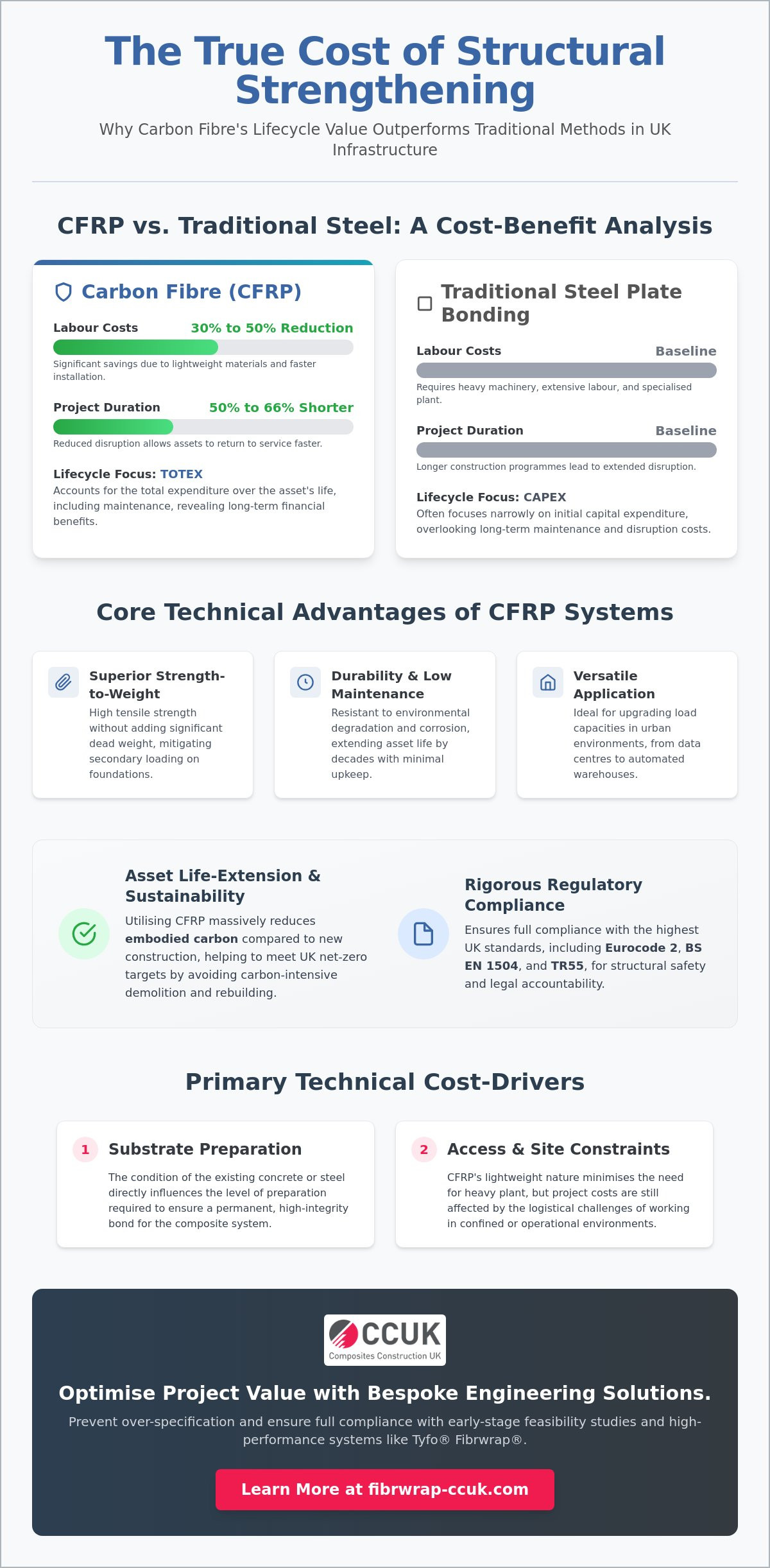
When evaluating the cost of carbon fibre strengthening UK, the comparison with traditional steel plate bonding often centres on logistical overheads rather than just raw material prices. Steel plates require mechanical fixings or welding, both of which necessitate extensive temporary works and heavy lifting plant. In contrast, the high strength-to-weight ratio of CFRP allows for manual handling and rapid application. With a density approximately one-quarter that of steel but a tensile strength ten times greater, CFRP provides structural enhancement without the risk of significant secondary structural loading. This technical superiority is outlined in the Strategic Advantages of Carbon Fibre Strengthening, which details the material’s role in modern engineering.
Installation speeds represent a primary differentiator in project economics. Industry data indicates that the construction period for CFRP strengthening is typically only one-third to one-half that of traditional reinforcement methods. This efficiency is evidenced in large-scale applications; reinforcing a 1,000 square metre floor slab requires only 7 to 10 days with carbon fibre, whilst bonded steel reinforcement can take between 20 and 30 days. This significant reduction in programme duration is a critical factor in the overall cost of carbon fibre strengthening UK, as it directly translates to lower site preliminaries and reduced operational disruption for the asset owner.
Logistical Efficiency and Site Access
The lightweight nature of these composites fundamentally alters the site profile. Because CFRP can be transported and applied without heavy machinery, the need for expensive lifting equipment or reinforced scaffolding is often eliminated. This allows for the installation of strengthening systems in confined spaces or live environments where traditional steelwork would be physically impossible or prohibitively expensive. By reducing the reliance on specialised plant, project managers can more effectively control the budget whilst ensuring the asset remains functional throughout the intervention period.
Durability and Maintenance ROI
Long-term asset management requires a focus on durability and the reduction of recurring maintenance costs. Steel bonding requires ongoing protection against oxidation, necessitating periodic inspections and repainting to prevent bond failure. Composites are inherently resistant to corrosion, making them ideal for harsh marine or industrial settings amongst the UK’s ageing infrastructure. This resistance ensures that structural repairs remain effective for the intended lifespan of the asset without the fiscal burden of rust treatment. By eliminating these recurring maintenance requirements, the return on investment for CFRP becomes increasingly evident over the project’s entire lifecycle.
Critical Variables Influencing Structural Strengthening Quotations
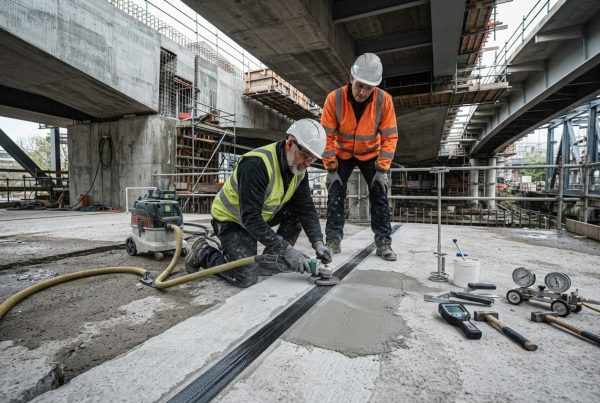
While material selection defines the technical baseline, the final cost of carbon fibre strengthening UK is heavily influenced by site-specific operational variables. Surface preparation is the most critical of these factors; the long-term integrity of the composite bond relies entirely on the quality of the substrate. Achieving the required surface profile typically necessitates mechanical grinding or grit blasting to remove laitance and contaminants. This process is not merely a preliminary task but a fundamental engineering requirement that must be accounted for within the project budget to ensure the design’s specified bond strength is achieved.
Environmental management also plays a significant role in the fiscal outcome. High-performance epoxy resins require specific temperature ranges to cure correctly, often necessitating the use of hoarding or temporary heating during winter months in the UK. Failure to maintain these conditions can lead to incomplete polymerisation, compromising the structural enhancement. Consequently, the provision for climate control and protection from moisture is a necessary component of any robust technical quotation, ensuring that the installation proceeds without delays or material wastage.
The Condition of the Existing Substrate
The state of the host structure dictates the extent of preliminary works required. Before any CFRP can be applied, the substrate must be structurally sound. This often involves extensive concrete repairs to address spalling, honeycombing, or reinforcement corrosion. Pull-off tests are essential at this stage to verify that the concrete’s tensile strength meets the minimum requirements for composite bonding. If the substrate is degraded, the necessary remediation will increase the overall cost of carbon fibre strengthening UK, highlighting the importance of early-stage structural surveys.
Access and Operational Constraints
Logistics and access often represent the most significant “hidden” costs in infrastructure projects. Working on live assets, such as highway bridges or active pipelines, introduces constraints that can limit labour productivity. Whether the project requires scaffolding, Mobile Elevating Work Platforms (MEWPs), or industrial rope access, the chosen method must balance safety with cost-efficiency. Restricted working windows or the necessity for night shifts to avoid operational downtime further influence the labour bill. To mitigate these complexities, we utilise our Design Feature page to assist asset managers in planning bespoke interventions that align with specific site limitations. For a detailed assessment of your asset’s requirements, we recommend requesting a technical site survey to ensure all variables are accurately quantified.
Optimising Project Value with Bespoke Engineering Solutions
Maximising the return on investment for structural remediation requires a transition from generic material application to bespoke structural engineering. Whilst the initial cost of carbon fibre strengthening UK projects is dictated by material and site variables, the ultimate project value is secured through engineering precision. Early-stage feasibility studies are essential in this regard, as they allow for the identification of the most efficient reinforcement patterns, preventing the over-specification of composite materials. By accurately modelling the load paths and utilising advanced limit state design, engineers ensure that every kilogramme of carbon fibre applied contributes directly to the required increase in structural capacity.
The integration of design and installation within a single technical workflow minimises the risk of discrepancies between theoretical performance and on-site reality. When a structural intervention is tailored to the specific nuances of an asset, the cost of carbon fibre strengthening UK becomes a targeted investment in longevity rather than a broad maintenance expense. This methodical approach ensures that the chosen solution addresses the root cause of structural inadequacy, whether it be due to increased loading requirements, seismic vulnerability, or the necessity for blast mitigation in higher-risk buildings.
The Tyfo® Fibrwrap® Advantage
The selection of a high-performance, proprietary system is a fundamental component of value engineering. Utilising the Tyfo® Fibrwrap® system provides asset managers with documented performance data and extensive project history, which is critical for engineering confidence and regulatory approval. This system is specifically engineered for complex challenges, including seismic retrofitting and blast mitigation, where standard off-the-shelf composites may lack the necessary testing validation. Detailed information regarding the application of these specialised materials can be found in our Tyfo Fibrwrap installation guide, which outlines the rigorous standards required for a successful technical deployment.
Choosing a Specialist Engineering Partner
Project success amongst UK infrastructure assets is heavily dependent on the technical competence of the chosen contractor. A specialist engineering partner provides an end-to-end service that encompasses initial structural surveys, bespoke design, and professional installation by certified technicians. This consolidated model ensures that the project remains compliant with Eurocode 2 and BS EN 1504 standards whilst maintaining a steady communication rhythm between all stakeholders. By prioritising safety and engineering rigour, asset managers can extend the functional lifespan of essential structures with absolute reliability. For a bespoke technical assessment of your infrastructure assets, you are invited to Contact CCUK to discuss your specific requirements with our engineering team.
Securing Structural Longevity through Technical Precision
Validating the cost of carbon fibre strengthening UK requires a comprehensive understanding of total expenditure benefits, where the initial material investment is offset by a 30% to 50% reduction in labour and significantly accelerated construction programmes. By prioritising technical rigour and bespoke design, asset managers can ensure that structural interventions meet the stringent requirements of current Eurocodes whilst avoiding the prohibitive costs of demolition. This approach transforms a maintenance requirement into a strategic asset life-extension programme that aligns with both fiscal and environmental objectives.
As the exclusive UK licensee for Tyfo® Fibrwrap® systems, Composites Construction UK provides a comprehensive design-to-installation service with a proven track record in infrastructure remediation. Our engineering team is focused on delivering compliant, high-performance solutions that safeguard essential assets for the long term. We invite you to contact our engineering team for a bespoke CFRP strengthening quotation to begin your technical assessment. Extending the functional utility of your infrastructure through advanced science ensures both fiscal responsibility and structural security.
Frequently Asked Questions
Is carbon fibre strengthening more expensive than using structural steel?
Whilst the initial material outlay for Carbon Fibre Reinforced Polymer (CFRP) is typically higher than structural steel, the total project expenditure is frequently lower. This is achieved through a 30% to 50% reduction in labour costs and the elimination of heavy lifting plant. When the significantly shorter construction programme is quantified, CFRP often represents the most fiscally responsible choice for asset remediation.
What are the primary factors that influence the cost of a CFRP project in the UK?
The cost of carbon fibre strengthening UK is primarily influenced by substrate preparation requirements, site access constraints, and the selected material form. The necessity for grit blasting or mechanical grinding to achieve the required surface profile is a significant technical cost-driver. Additionally, operational variables such as working within live infrastructure or requiring specialised access like industrial rope access will dictate the final quotation.
Can carbon fibre strengthening be used on all types of structural substrates?
CFRP systems are highly versatile and can be applied to reinforced concrete, masonry, timber, and metallic structures such as cast iron. The primary requirement is that the host substrate must possess sufficient internal tensile strength to facilitate a secure mechanical bond. A technical survey is essential to ensure the substrate isn’t too degraded to support the intended strengthening intervention.
How long does a carbon fibre strengthening installation typically take?
Installation is exceptionally rapid, typically requiring only one-third to one-half of the time needed for traditional steel plate bonding. For example, reinforcing a 1,000 square metre floor slab can be completed in 7 to 10 days, whereas bonded steel would require 20 to 30 days. This efficiency is a critical factor in reducing the overall cost of carbon fibre strengthening UK by minimising site preliminaries.
Does CFRP strengthening require ongoing maintenance once installed?
Composites are inherently resistant to corrosion and chemical degradation, meaning they require virtually no ongoing maintenance once correctly installed. Unlike structural steel, which necessitates periodic inspections for oxidation and recurring repainting, CFRP does not rust. This durability ensures a superior return on investment by eliminating the future fiscal burden of corrosion management throughout the asset’s functional lifespan.
Are there specific UK regulations that govern the use of CFRP in construction?
The design and application of composite strengthening in the UK are governed by Concrete Society Technical Report 55 (TR55) and the Design Manual for Roads and Bridges (DMRB) CD 371. All works must also adhere to BS EN 1504 and the requirements of the Building Safety Act 2022. Compliance with these standards ensures that structural interventions are safe, documented, and legally robust.
How do I determine if my structure is a suitable candidate for CFRP strengthening?
Suitability is confirmed through a detailed structural assessment, which includes pull-off testing to verify the tensile strength of the existing concrete or masonry. If an asset requires increased load-bearing capacity or seismic retrofitting without adding significant dead weight, it is likely an ideal candidate. Professional engineering calculations are then utilised to define the specific reinforcement ratios required for the intervention.
What is the expected lifespan of a CFRP strengthening system?
A professionally designed and installed CFRP system is engineered to match or exceed the remaining design life of the host structure. Because the materials are non-corrosive and resistant to environmental fatigue, they provide a permanent solution for structural remediation. Proprietary systems like Tyfo® Fibrwrap® are backed by extensive documented performance data that validates their long-term durability in harsh environments.