
The assumption that structural resilience requires massive additions of steel and concrete is increasingly becoming an engineering fallacy in the face of modern security threats. Asset controllers and technical professionals often find themselves caught between the necessity of stringent blast hardening and the prohibitive weight penalties and operational downtime associated with traditional reinforcement methods. It’s well understood that maintaining the functional continuity of a critical asset whilst meeting evolving API and ASTM blast standards is a complex, multi-faceted balancing act. This article explores how the Tyfo® Fibrwrap® blast mitigation system leverages advanced Carbon Fibre Reinforced Polymer (CFRP) technology to provide superior energy absorption without altering a structure’s architectural footprint.
Through an expert-led analysis, we will examine the material science behind these bespoke composites, their alignment with 2024/2025 safety regulations, and the methodology for achieving rapid, non-intrusive installation in sensitive infrastructure environments. By prioritising engineered ductility over mere structural mass, the utility of essential assets can be extended whilst ensuring long-term security and compliance with the latest industry requirements. You will gain a technical understanding of how these specialised materials are deployed to safeguard infrastructure against exceptional loading events without the logistical burden of conventional hardening.
Key Takeaways
- Analyse the strategic shift from traditional structural hardening to advanced consequence management for the protection of critical national infrastructure.
- Discover how the Tyfo Fibrwrap blast mitigation system utilises Carbon Fibre Reinforced Polymer (CFRP) to enhance structural ductility and prevent catastrophic dilation under explosive loads.
- Compare the efficiency of high-strength composites against traditional steel or concrete methods to minimise dead load and avoid operational disruption during structural upgrades.
- Navigate the complexities of the updated ASTM F1642/F1642M-25 and 2024 API RP 752/753 standards to ensure full regulatory compliance for high-risk assets.
- Understand the necessity of specialist engineering consultancy and installation to guarantee the performance and quality assurance of bespoke blast resilience solutions.
Addressing Blast Vulnerabilities in Critical National Infrastructure
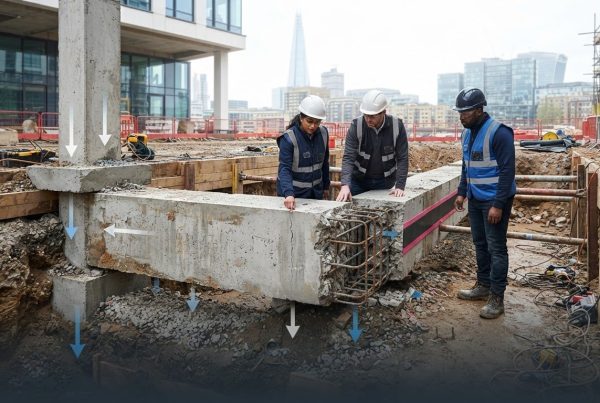
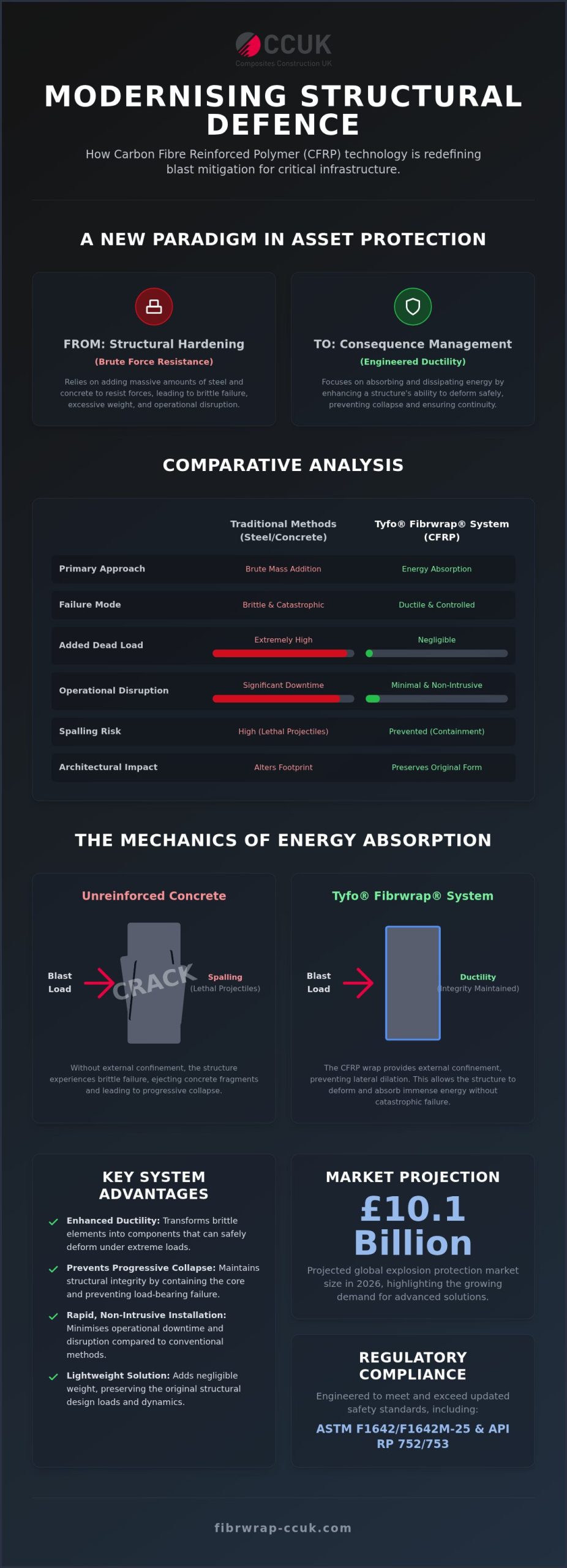
Blast mitigation is defined as a strategic engineering intervention aimed at the management and dissipation of explosive energy rather than its mere resistance. In modern safety programmes, a critical distinction is made between traditional structural hardening and consequence management. Whilst hardening attempts to prevent any deformation through brute mass, consequence management acknowledges the inevitability of an event and focuses on preventing progressive collapse. Unreinforced structures remain highly susceptible to catastrophic spalling; a phenomenon where concrete fragments are ejected at high velocities, becoming lethal secondary projectiles. Traditional reinforcement methods, such as adding steel plates or thick concrete jackets, often fail to meet modern threat profiles due to the excessive dead loads they introduce and their inability to provide the required ductility.
The Evolving Nature of Structural Threats
Protecting critical national infrastructure requires a sophisticated analysis of peak overpressure and impulse duration. In urban and industrial environments, the reflection of blast waves off adjacent surfaces can amplify pressures significantly. High-risk assets amongst transportation networks, power generation facilities, and commercial centres require tailored protection against these dynamic loads. When explosive events occur, reinforced concrete and masonry load-bearing elements often experience brittle failure if they’ve not been specifically detailed for energy dissipation. The implementation of Tyfo Fibrwrap blast mitigation systems addresses these vulnerabilities by providing external reinforcement that manages the rapid transfer of kinetic energy. With the global explosion protection market projected to expand to £10.1 billion in 2026, the demand for validated, non-intrusive solutions is increasingly prevalent.
In addition to structural hardening, a comprehensive security framework for critical assets often includes advanced perimeter control and intercom systems; for example, the technology at mathfel.de illustrates how modern access control can be integrated into high-risk facilities to enhance overall site security.
The Role of Ductility in Structural Survival
Brittle failure is identified as the primary cause of casualties during structural blast events. When a structural member lacks the capacity to deform without losing its load-bearing function, total collapse becomes a high probability. Increasing a structure’s deformation capacity is essential for survival; this represents a fundamental transition from strength-based design to energy-absorption frameworks. The application of advanced Fibre-Reinforced Plastic (FRP) technology allows for the creation of a containment mechanism that prevents the dilation of concrete cores. This confinement enables the structure to undergo significant plastic deformation whilst maintaining its integrity. By integrating Tyfo Fibrwrap blast mitigation strategies, engineers can ensure that essential assets remain functional after an event, prioritising the safety of occupants and the continuity of operations. Detailed engineering insights into these containment mechanisms are available via our design feature documentation.
The Mechanics of Energy Absorption: How Tyfo® Fibrwrap® Enhances Ductility
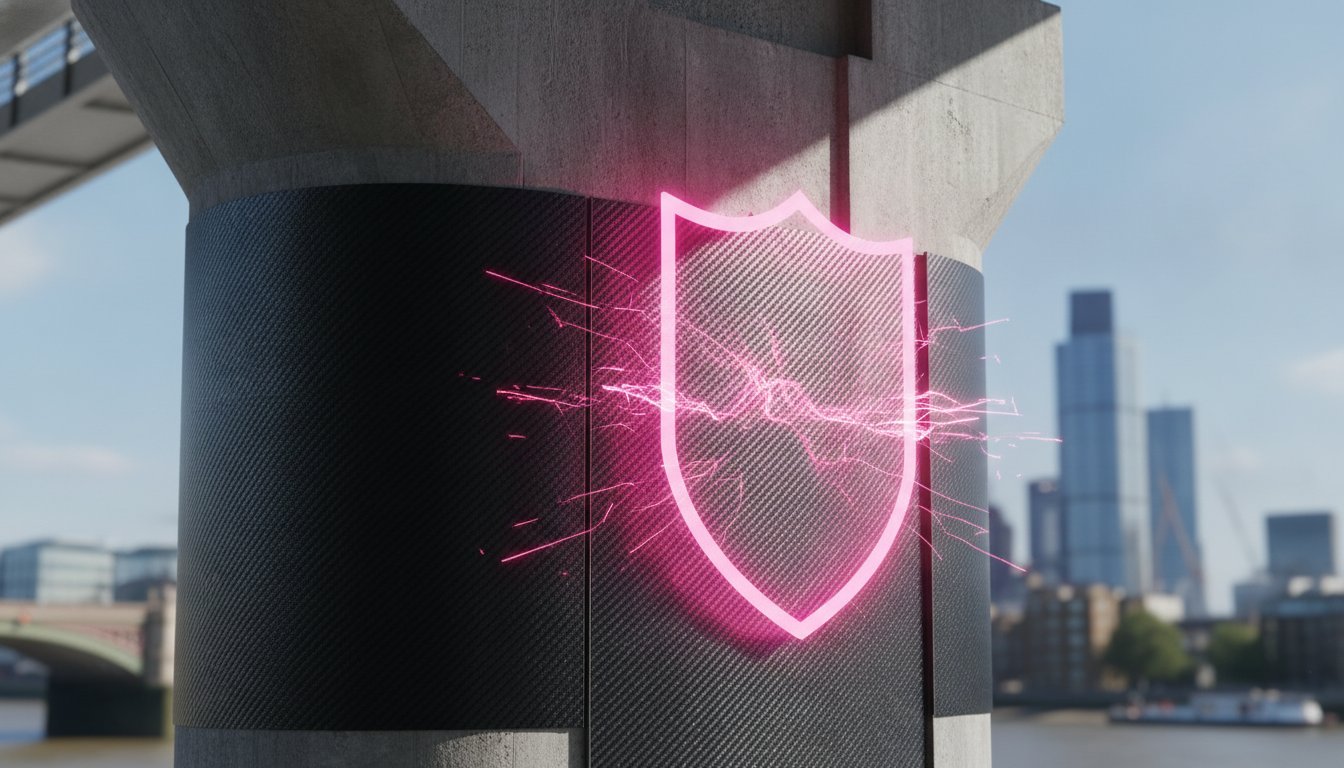
The Tyfo® Fibrwrap® system is a site-applied, wet-layup composite that transforms brittle structural elements into ductile, energy-absorbing components. It’s composed of high-strength carbon or glass fibres saturated with a proprietary epoxy resin, creating a tailored Fibre-Reinforced Polymer (FRP) that conforms to complex structural geometries. When subjected to the extreme impulsive loads of an explosion, the primary function of Tyfo Fibrwrap blast mitigation is the provision of external confinement. This confinement restricts the lateral dilation of concrete columns and walls, effectively forcing the concrete into a triaxial state of stress which significantly enhances its compressive strength and strain capacity. This mechanism allows the structure to sustain large deformations whilst maintaining its axial load-carrying capacity, preventing the catastrophic collapse often seen in unreinforced masonry or concrete.
Material Properties and Performance Standards
The performance of the system is underpinned by an extensive empirical foundation, including over 500 structural and material tests conducted to validate its efficacy under diverse loading conditions. A critical factor in this performance is the high tensile strength-to-weight ratio of the carbon fibre, which allows for substantial strengthening without the deleterious addition of dead load. It’s essential that the bond strength between the composite and the substrate is meticulously managed; this ensures that the energy from the blast is efficiently transferred into the Fibrwrap® system. Research into advanced materials for blast mitigation has consistently demonstrated that the synergy between fibre orientation and resin properties is what dictates the ultimate resilience of the retrofitted member.
Spall Mitigation and Fragment Retention
Beyond structural integrity, the system serves as a protective envelope designed to mitigate the risks associated with primary and secondary fragmentation. Spall mitigation is the engineered containment of concrete fragments within a high-strength composite skin to prevent them from becoming lethal high-velocity debris within an occupied space. By acting as a ductile “skin,” the wrap retains concrete that would otherwise be ejected during the flexural response of a wall or slab. This fragment retention is vital for occupant safety, as secondary debris often causes more casualties than the primary blast wave itself. This multi-hazard capability naturally extends to seismic resilience and general structural strengthening, providing a holistic solution for long-term asset preservation. For those seeking detailed specifications on material performance, our design feature overview provides comprehensive technical data.
Comparative Analysis: Composite Wrapping versus Traditional Structural Hardening
The selection between traditional structural hardening and composite-based mitigation is often dictated by the constraints of the existing asset. Mass-based hardening, typically achieved through the application of heavy-gauge steel plating or reinforced concrete jacketing, relies on brute strength to resist impulsive loads. Whilst effective in specific contexts, these methods introduce significant dead load penalties that existing foundations were rarely designed to accommodate. Conversely, the Tyfo Fibrwrap blast mitigation system utilises high-strength carbon fibre to achieve resilience through ductility rather than mass, ensuring the structural footprint remains virtually unchanged whilst the performance is substantially enhanced. This preservation of the architectural profile is essential in urban environments where space is at a premium and aesthetic integrity must be maintained.
Eliminating Dead Load Penalties
Existing foundations in historic or industrial structures often possess limited spare bearing capacity, making the addition of several tonnes of steel or concrete technically unfeasible without extensive remedial works. Traditional hardening methods frequently necessitate costly and intrusive foundation underpinning, which significantly escalates project budgets and timelines. The Tyfo® Fibrwrap® system maintains the original structural weight, as the composite layers are only millimetres thick. This lightweight profile allows for the strengthening of upper-floor columns and slabs where traditional mass-based methods would compromise the overall structural stability or exceed the permissible floor loading limits. By avoiding foundation upgrades, the total project duration is often reduced by several weeks.
Minimising Operational Disruption
Operational continuity is a primary concern for asset controllers, particularly within high-occupancy commercial centres or critical industrial facilities. The logistics of installing reinforced concrete jacketing involve the delivery of heavy materials, the erection of complex formwork, and extended curing periods, all of which necessitate prolonged facility closures. In contrast, the application of Tyfo Fibrwrap blast mitigation is a rapid, site-applied process that requires minimal equipment and footprint. Composites Construction UK organises site works to ensure that installation can often proceed whilst the building remains partially or fully operational, significantly reducing the indirect costs associated with downtime. The absence of heavy machinery and noisy demolition works ensures that surrounding business activities are not adversely affected.
The long-term durability of these systems provides further differentiation. Unlike steel plating, which is susceptible to corrosion and requires ongoing maintenance or protective coatings, Carbon Fibre Reinforced Polymer (CFRP) is inherently resistant to environmental degradation. Research regarding the efficacy of FRP for blast mitigation highlights that these composites retain their mechanical properties over decades, even in aggressive industrial atmospheres. This longevity, coupled with the preservation of the architectural aesthetic, positions Fibrwrap® as a superior alternative to intrusive traditional works. To discuss project-specific requirements or to request a structural survey, engineers are encouraged to contact our technical team directly.
Engineering Compliance: Navigating the 2025 ASTM and API Blast Standards
Compliance within the UK energy and industrial sectors has become increasingly rigorous following the implementation of updated regulatory frameworks. The ASTM F1642/F1642M-25 standard is utilised as the definitive methodology for testing and classifying the performance of glazing and structural systems under airblast loading. For asset controllers, adhering to these standards is no longer optional. It’s a prerequisite for an operational licence. The Tyfo Fibrwrap blast mitigation system is engineered to meet these specific performance criteria, ensuring that retrofitted components can withstand the predicted impulse and overpressure without catastrophic failure.
The Design and Calculation Framework
Achieving compliance requires a transition from static load assessments to advanced dynamic modelling. Dynamic Increase Factors (DIF) are incorporated into the design process to account for the enhanced strength of materials under high strain rates. Non-linear dynamic analysis is utilised to predict the precise response of the composite-to-substrate interface during an explosive event. This level of precision is essential for critical infrastructure where the margin for error is non-existent. Precision is paramount. For complex projects requiring bespoke design and engineering, these calculations form the basis of the safety case presented to regulatory bodies.
Regulatory Alignment for Asset Managers
Recent updates to API RP 752 and 753 in 2024 have introduced 62 new mandatory requirements concerning the management of hazards in refinery and petrochemical buildings. These updates demand a more granular approach to risk assessment, specifically regarding the proximity of occupied portable buildings to process units. Asset managers should follow a structured approach to ensure alignment:
- Conduct a comprehensive structural survey to identify existing vulnerabilities in load-bearing masonry and concrete.
- Define performance objectives based on the facility’s risk profile, ranging from “low damage” for essential control centres to “collapse prevention” for secondary structures.
- Ensure all Tyfo Fibrwrap blast mitigation installations are accompanied by rigorous third-party validation and quality assurance documentation.
Certified installation by a specialist contractor is the final pillar of regulatory compliance. Without empirical evidence of material properties and bond strength, a mitigation strategy may fail to meet the scrutiny of health and safety audits. Compliance requires evidence. To ensure your facility meets the latest 2025 safety mandates, we recommend you contact our technical department for a detailed compliance review.
Specialist Implementation: Delivering Bespoke Blast Mitigation Solutions
High-consequence structural interventions demand a level of technical rigour that only a specialist engineering contractor can provide. For critical infrastructure projects, the transition from design to physical application must be managed with absolute precision to ensure the theoretical performance of the composite is realised in situ. As the exclusive UK licensee for the Tyfo® Fibrwrap® system, CCUK provides a comprehensive end-to-end delivery model that encompasses initial diagnostics, bespoke engineering, and certified installation. This integrated approach ensures that Tyfo Fibrwrap blast mitigation strategies are grounded in the specific material realities of the asset. By combining these systems with essential concrete repairs, asset controllers can achieve a dual objective: enhancing security whilst simultaneously addressing structural degradation to extend the functional lifespan of the facility.
The Importance of Site Surveys and Testing
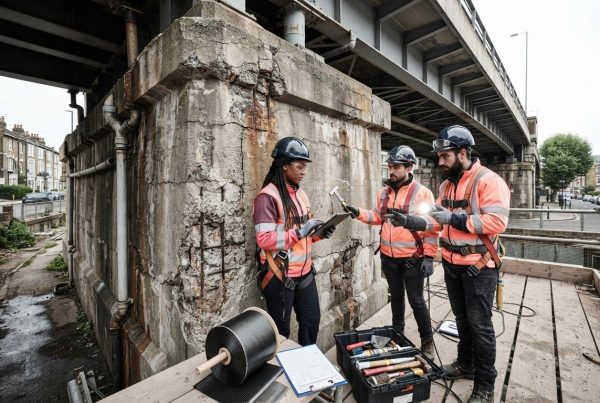
Before any composite is applied, the integrity of the existing substrate must be rigorously validated through empirical testing. CCUK conducts a suite of diagnostic assessments, including pull-off tests to determine the tensile bond strength of the concrete and carbonation surveys to identify any underlying reinforcement corrosion. These data points are essential; they allow our in-house consultancy to tailor the Fibrwrap® specification to the unique condition of the structure. This data-driven methodology justifies the strengthening programme to stakeholders, ensuring that the intervention is both necessary and proportionate to the identified risks. It’s this focus on evidence-based engineering that differentiates a specialist contractor from a general applicator.
Professional Installation and Quality Control
The efficacy of a composite system is heavily dependent on the quality of its installation and the precision of the resin-to-fibre ratio. Certified Tyfo® system applicators undergo rigorous training to master the nuances of site-applied wet-layup techniques, ensuring that air inclusions are eliminated and the bond is uniform. During the saturation and wrapping process, strict quality assurance protocols are followed, including the monitoring of ambient conditions and the preparation of sample witness panels for independent laboratory testing. These measures ensure that the final installation matches the performance characteristics established during the testing of over 500 material samples. For a comprehensive overview of these procedures, engineers should refer to the Tyfo® Fibrwrap® Installation Guide, which details the technical requirements for successful structural strengthening.
By prioritising the repair and strengthening of existing assets through innovative material science, CCUK aligns technical excellence with broader economic and environmental goals. This methodology avoids the significant carbon expenditure and capital cost of replacement, ensuring that essential infrastructure remains resilient for the long term. To initiate a structural survey or to discuss a specific blast mitigation requirement, technical professionals are invited to contact our engineering team directly.
Future-Proofing Critical Assets through Engineered Resilience
The transition from traditional structural hardening to advanced consequence management represents a fundamental shift in infrastructure protection. By prioritising ductility and energy absorption, the Tyfo Fibrwrap blast mitigation system is utilised to ensure that essential structures can withstand extreme impulsive loads without the logistical penalties of added mass. Compliance with 2025 ASTM and API standards is achieved through a rigorous, data-driven approach that integrates bespoke engineering calculations with certified installation. This methodology ensures that the functional lifespan of essential infrastructure is prolonged whilst maintaining the highest safety thresholds.
As the exclusive UK licensee for Tyfo® Fibrwrap®, CCUK provides the technical expertise and national coverage required to safeguard high-consequence assets across the United Kingdom. It’s essential that every intervention is validated against empirical data by our in-house design consultancy to offer a sustainable alternative to structural replacement. This expert-led approach provides asset controllers with the assurance that their facilities are protected by validated, high-performance materials.
Contact our specialist engineering team for a blast mitigation feasibility study to discuss your project requirements. Ensuring the long-term security of the UK’s infrastructure is a collaborative effort grounded in specialised science and engineering rigour.
Frequently Asked Questions
Is Tyfo® Fibrwrap® suitable for both concrete and masonry structures?
Yes, the Tyfo® Fibrwrap® system is engineered for application on both reinforced concrete and unreinforced masonry structures. When applied to masonry, the composite acts as a ductile skin that prevents the brittle fragmentation of bricks or blocks during an explosive event. This containment is critical for maintaining the load-bearing integrity of walls whilst protecting occupants from secondary debris. It’s a versatile solution for diverse UK infrastructure assets.
How does composite blast mitigation compare to steel plate hardening in terms of cost?
Composite blast mitigation is often more cost-effective than steel plate hardening when total project lifecycle costs are considered. Whilst raw material costs vary, the significant reduction in installation time, the elimination of heavy lifting equipment, and the avoidance of foundation underpinning typically result in lower overall expenditure. It avoids the indirect costs associated with prolonged operational downtime required for intrusive and heavy steelwork.
Can the Tyfo® Fibrwrap® system be applied whilst the building remains occupied?
Yes, the installation of Tyfo Fibrwrap blast mitigation can be conducted whilst a building remains occupied due to the non-intrusive nature of the site-applied process. The methodology requires a minimal site footprint and produces negligible noise or vibration compared to traditional demolition and reconstruction. CCUK schedules works to ensure that essential facility operations continue without significant interruption to the asset’s primary utility.
What is the expected lifespan of a Tyfo® Fibrwrap® blast mitigation system?
The expected lifespan of the system typically exceeds 50 years when installed according to the manufacturer’s specifications and protected from direct UV exposure. Carbon fibre reinforced polymers are inherently resistant to corrosion and environmental degradation, unlike traditional metallic reinforcements. This longevity ensures that the structural strengthening remains effective throughout the remaining functional life of the asset without the need for frequent replacement or intensive repairs.
Does the system require regular maintenance once installed?
Once installed and appropriately finished, the system requires minimal maintenance beyond standard structural inspections. Because the composite is non-corrosive and chemically stable, it doesn’t suffer from the oxidation issues common with steel reinforcements. Periodic visual assessments are usually sufficient to ensure the protective coatings or architectural finishes remain intact over time. This reduces the long-term operational burden for technical professionals and asset controllers.
Can Tyfo® Fibrwrap® be used for seismic retrofitting as well as blast mitigation?
Yes, the system is frequently specified for both seismic retrofitting and blast mitigation due to its ability to enhance structural ductility and confinement. By wrapping columns and beam-column joints, the system prevents brittle shear failure and improves the energy dissipation capacity of the structure during dynamic loading events. This multi-hazard capability provides a holistic solution for comprehensive infrastructure resilience against a variety of exceptional loading scenarios.
How does the system perform in the event of a fire following a blast?
The fire performance of Tyfo Fibrwrap blast mitigation is managed through the application of specialised intumescent coatings or cementitious fireproofing layers. Whilst the epoxy resin is sensitive to high temperatures, these protective systems ensure that the composite retains its structural integrity for the required duration specified in building regulations. This allows the structure to meet stringent fire-life safety standards even after an initial explosive event.
What technical documentation is provided for regulatory compliance after installation?
Upon completion, CCUK provides a comprehensive quality assurance package that includes material test certificates, site-specific bond test results, and as-built drawings. This documentation is essential for demonstrating compliance with ASTM F1642 and API standards during regulatory audits. It provides asset managers with a clear audit trail of the engineering interventions and the validated performance of the materials used to secure the facility.