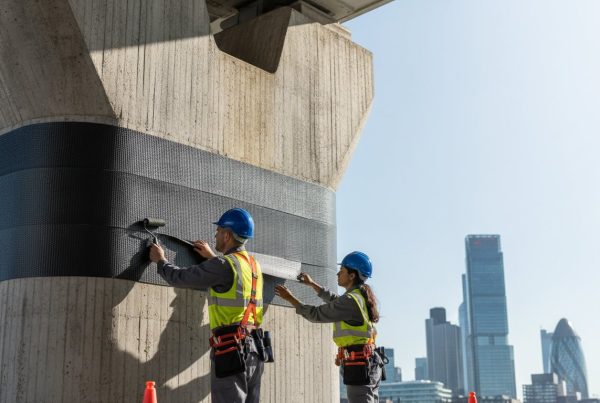


The most sustainable and fiscally responsible asset is not the one yet to be built, but the one whose functional lifespan is meticulously extended through rigorous structural repair project management. For many asset owners, the prospect of structural remediation brings a justified sense of trepidation, particularly when considering the potential for significant operational downtime or the complexities of the UK’s evolving regulatory landscape. It’s understood that the primary objective is to maintain the absolute safety of the structure whilst ensuring that intrusive works do not compromise the ongoing utility of the site.
This technical guide provides a comprehensive framework for overseeing complex remediation, designed to move beyond generic construction workflows toward a discipline led by engineering precision. By reading this, you’ll gain a detailed understanding of how to manage projects with the technical rigour required for full compliance with CDM 2015 and the Building Safety Act. We shall explore the methodologies for integrating specialist systems, such as Carbon Fibre Reinforced Polymer (CFRP) strengthening, and the methodical approach necessary to ensure long-term asset integrity and regulatory security.
Key Takeaways
- Identify why specialist engineering-led processes must supersede generic construction workflows to ensure the long-term integrity of critical infrastructure.
- Learn to navigate the lifecycle of a remediation project, from initial carbonation testing and structural surveys to bespoke technical specification development.
- Understand the rigorous demands of the Building Safety Act 2022 and how to maintain the “Golden Thread” of information throughout the structural repair project management process.
- Discover the logistical and technical requirements for implementing advanced composite solutions, including the application of Tyfo® Fibrwrap® systems for structural strengthening.
- Establish a framework for mitigating operational risks and identifying structural hazards before site mobilisation to ensure safety and minimise downtime.
The Fundamentals of Structural Repair Project Management
Effective structural repair project management represents a significant departure from conventional building maintenance, functioning instead as a precision-oriented engineering discipline. Whilst general construction management often focuses on the logistical coordination of new builds or aesthetic alterations, structural remediation is predicated upon the rigorous diagnosis and rectification of existing material degradation. It requires an empirical understanding of Construction Engineering Principles to ensure that the load-bearing capacity of an asset is not merely restored, but often enhanced to meet modern performance criteria. Within this framework, asset life-extension is treated as a data-driven objective. Decisions are informed by the analysis of material properties and environmental stressors, ensuring that structural integrity is prioritised over superficial cosmetic remediation.
The Role of the Specialist Engineering Contractor
The complexity inherent in modern infrastructure necessitates the involvement of a specialist contractor who can provide end-to-end accountability. These specialists bridge the gap between initial diagnostic testing and the deployment of advanced materials like Carbon Fibre Reinforced Polymer (CFRP). By integrating technical surveys directly into the project scope, the risk of unforeseen site conditions is significantly reduced. This methodology ensures that the transition from bespoke engineering design to physical installation is seamless, maintaining the technical rigour required for high-consequence environments. Such accountability is vital when executing complex strengthening projects where the margin for error is non-existent.
Key Objectives for Asset Controllers
Asset controllers must navigate the tension between immediate capital expenditure (CAPEX) and the long-term durability of the structure. A methodical approach to structural repair project management allows for the identification of solutions that offer the lowest whole-life cost, even if initial material specifications are more sophisticated. Predictable outcomes are achieved through rigorous feasibility studies that assess the structural impact of every intervention before work commences on-site. The goal is always the preservation of operational continuity; by utilising non-intrusive repair techniques and strategic phasing, significant disruption to site operations can be successfully avoided whilst maintaining absolute safety standards and regulatory compliance.
Defining the Project Lifecycle: From Feasibility to Handover
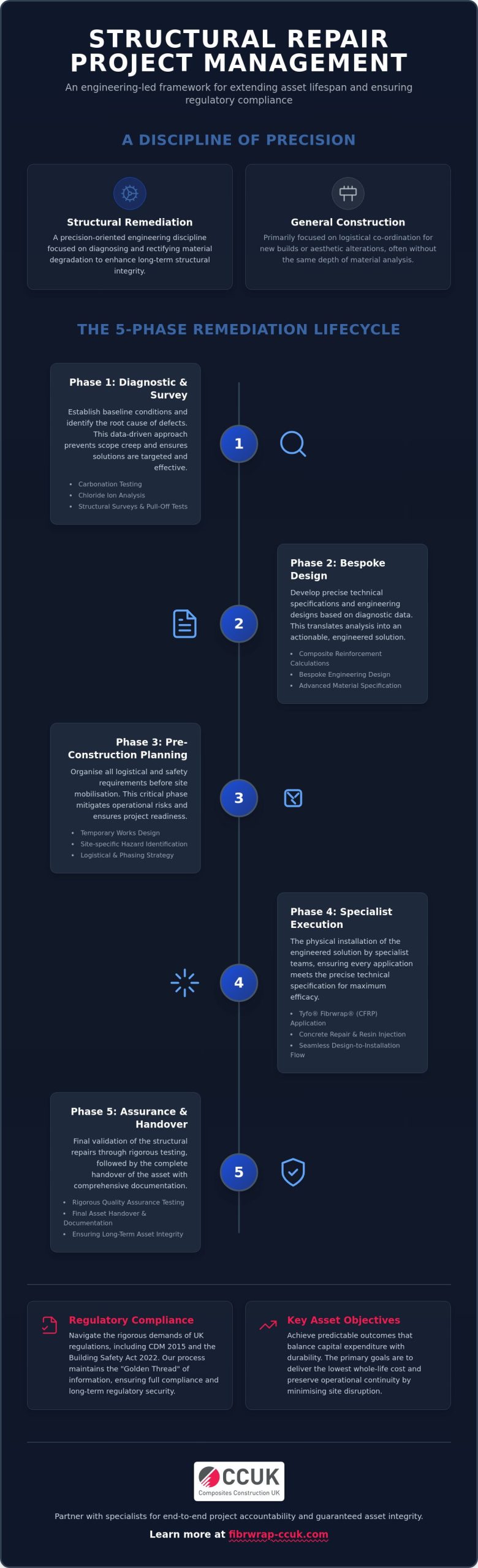
A disciplined approach to structural repair project management is structured around five distinct phases, ensuring that every technical intervention is supported by empirical data and engineering logic. This lifecycle begins with Phase 1: initial structural surveys and carbonation testing to establish baseline conditions. Phase 2 involves the development of bespoke engineering designs and technical specifications. Phase 3 focuses on pre-construction planning, including temporary works design and propping. Phase 4 encompasses the precise execution of specialist repairs, such as CFRP application or resin injection, whilst Phase 5 concludes with rigorous quality assurance testing and the final handover of the asset.
Technical Surveys and Diagnostic Testing
The success of any remediation project is contingent upon the accuracy of the initial diagnostic phase. Technical surveys, including pull-off tests and chloride ion analysis, are utilised to justify the necessity of remedial works and to establish a clear baseline. This data-driven approach is essential for preventing scope creep, as it allows the project team to identify the root cause of defects rather than merely addressing surface-level symptoms. When the underlying mechanism of deterioration is understood, the designed solution can be tailored to provide permanent stability rather than temporary relief.
Engineering Design and Specification
Once the diagnostic data has been verified, the project transitions into bespoke engineering design. This phase requires the development of precise calculations for composite reinforcement, ensuring that the selected systems, such as Tyfo® Fibrwrap®, provide the required enhancement to the structure’s load-bearing capacity. All design work must be conducted in strict accordance with UK regulatory standards, including the requirements set out in the Building Safety Act 2022. For complex assets, engaging a Structural Design and Engineering Consultancy ensures that the technical specifications are both robust and compliant with the latest industry codes.
Following the design phase, meticulous attention is directed toward temporary works and propping. The stability of the asset must be maintained throughout the remediation process, necessitating a detailed sequence of works that accounts for the redistribution of loads during repair. Specialist execution then follows, where high-performance materials like Carbon Fibre Reinforced Polymer (CFRP) are applied by trained technicians. The lifecycle is only complete when quality assurance protocols, such as bond strength testing and thermal imaging, confirm that the installation meets the original design intent. Asset owners seeking to initiate this process may find it beneficial to discuss their specific requirements with an engineering specialist to ensure a predictable project trajectory.
Mitigating Risk Through Specialist Engineering Oversight
The mitigation of risk within complex remediation projects is predicated upon the early identification and categorisation of structural hazards before site mobilisation. Within the framework of structural repair project management, risk is not viewed as an abstract possibility but as a quantifiable engineering challenge that requires a structured response. This involves the creation of a comprehensive risk matrix that evaluates potential failure modes, ranging from global structural instability to localised material degradation. By categorising these risks early, the project team can implement targeted mitigation strategies that protect both the asset and the personnel on-site.
Professional engineering oversight is the primary mechanism for preventing the costly mid-project redesigns that frequently arise from unforeseen technical challenges. When an engineering specialist manages the interface between existing masonry and new composite materials, compatibility issues are addressed during the design phase rather than during execution. This foresight is particularly critical when integrating high-modulus materials with older, more flexible substrates, where differences in thermal expansion and stiffness must be meticulously managed to ensure a monolithic structural response. The application of structural repair project management principles ensures that these technical interfaces are governed by empirical data rather than assumptions.
Managing Temporary Works and Propping
Temporary works, including specialist propping and shoring, are essential components of structural interventions that must be designed with the same degree of rigour as the permanent repairs. These systems are not merely logistical aids; they are critical structural members that maintain the stability of the asset whilst its primary load-bearing elements are being reinforced or replaced. The design of these works must account for the dynamic redistribution of loads that occurs during the repair process. Engaging specialist engineering contractors ensures that temporary works are fully integrated into the broader engineering strategy, providing a secure environment for high-precision works.
Quality Control and Material Performance
The performance of advanced strengthening systems is heavily dependent upon the environmental conditions present during application. For resin injection and the installation of Carbon Fibre Reinforced Polymer (CFRP), parameters such as ambient temperature, substrate moisture content, and dew point must be monitored with precision. The use of certified systems, such as Tyfo® Fibrwrap®, provides an additional layer of security, as these materials have undergone extensive empirical testing to verify their long-term durability. On-site testing protocols, including pull-off tests to verify bond strength and ultrasonic pulse velocity to assess resin penetration, are essential for confirming that the installed system matches the design intent and will perform as expected over the asset’s extended functional lifespan.
Regulatory Compliance and the Building Safety Act 2022
The regulatory landscape for structural remediation has undergone a fundamental transformation following the enactment of the Building Safety Act 2022. For asset owners, structural repair project management now necessitates a rigorous adherence to statutory requirements that extend far beyond traditional health and safety protocols. This is particularly critical for higher-risk buildings (HRBs), which are defined as residential structures at least 18 metres in height or possessing seven or more storeys. The Act mandates a continuous flow of information, ensuring that every structural intervention is documented, verified, and accessible throughout the building’s lifecycle.
Compliance is not merely a legal obligation but a cornerstone of structural integrity. It requires the clear designation of roles, specifically the Principal Designer and Principal Contractor, who are responsible for coordinating the design and construction phases. These roles ensure that all works comply with the Construction (Design and Management) Regulations 2015 (CDM 2015), providing a structured approach to risk management that protects both the workforce and the long-term safety of the building’s occupants.
The Golden Thread of Information
A central requirement of the modern regulatory framework is the maintenance of the “Golden Thread” of information. This entails the creation and preservation of a digital record that encompasses structural surveys, engineering designs, and the specific material properties of installed systems. Within the context of structural repair project management, this transparency is vital for future asset management and safety audits. When proprietary systems such as Tyfo® Fibrwrap® are utilised, detailed records of batch numbers, curing conditions, and bond strength tests must be meticulously logged. The use of specialised project management software facilitates this process, ensuring that data is recorded in real-time and remains immutable for the functional lifespan of the structure.
CDM 2015 and Safety Coordination
The coordination of site activities under CDM 2015 is essential for maintaining a safe working environment, especially during intrusive structural works. Asset owners must ensure that a robust Health and Safety file is maintained, documenting all significant structural alterations and the technical justifications behind them. This file serves as a critical reference for future maintenance and ensures that any subsequent works don’t inadvertently compromise the building’s stability. For a deeper analysis of these requirements, asset controllers should consult our Structural Repairs: A Technical Guide, which outlines the intersections between engineering design and regulatory safety. To ensure your remediation project meets these stringent new standards, you may contact our technical team for a formal compliance review.
Integrating Advanced Composite Solutions into the PM Framework
The integration of advanced composites, such as Carbon Fibre Reinforced Polymer (CFRP), into the structural repair project management framework requires a sophisticated understanding of material science and logistical efficiency. Whilst traditional methods like steel plate strengthening often demand significant heavy machinery and prolonged site-wide closures, composite systems offer a more streamlined alternative. The management of these projects shifts from heavy logistical coordination toward technical oversight, where the focus is placed on the precise control of environmental variables and substrate preparation to ensure a monolithic bond between the reinforcement and the existing structure. This methodology ensures that the technical solutions are as durable as they are efficient.
Scheduling repairs for critical infrastructure, such as industrial facilities or public transport hubs, is significantly enhanced by the use of composite materials. Because these systems are lightweight and require minimal mechanical intervention, they allow for repairs to be conducted with significantly less disruption to site operations. This efficiency is particularly valuable in the current economic climate; material costs for commercial building fabric repairs in 2026 are between 12% and 22% higher than pre-2022 benchmarks, making the speed of installation a critical factor in controlling project expenditure. By reducing the project duration, the indirect costs associated with operational downtime are effectively mitigated.
The Advantages of the Tyfo® Fibrwrap® System
The Tyfo® Fibrwrap® system represents a signature of quality within the field of structural strengthening, necessitating specialist oversight to ensure that its full performance potential is realised. The speed of installation associated with these systems has a profound impact on the project programme, often allowing for the completion of strengthening works in a fraction of the time required for traditional steel-based interventions. The reduction in heavy machinery and the ability to work in confined spaces mean that site-wide closures are frequently avoided. For a detailed analysis of the installation requirements, asset owners should refer to the Tyfo® Fibrwrap® Technical Guide.
Sustainable Remediation: Repair vs. Replacement
Within a modern structural repair project management framework, remediation is increasingly framed as a tool for environmental sustainability. The decision to strengthen an existing asset rather than opting for demolition and replacement results in significant carbon savings, as it preserves the embodied energy of the original structure. With the UK Fibre Reinforced Polymer composites market projected to reach a valuation of USD 2.5 billion by 2026, the shift toward life-extension through advanced materials science is becoming the industry standard. This approach aligns technical capabilities with broader economic and environmental goals, ensuring that essential infrastructure remains functional for decades to come. To ensure your asset receives this level of technical rigour, you may contact CCUK for specialist project management support.
Advancing Infrastructure Longevity Through Engineering Precision
The successful extension of an asset’s functional lifespan is dependent upon a shift from reactive maintenance to a structured, engineering-led methodology. This requires the integration of rigorous diagnostic testing with bespoke design specifications to ensure full compliance with the Building Safety Act 2022. By prioritising technical rigour over aesthetic repairs, asset owners can mitigate the risks of structural failure whilst effectively minimising the economic impact of operational downtime.
A disciplined approach to structural repair project management ensures that every intervention, from resin injection to the application of advanced composites, is executed with absolute precision. As the exclusive UK licensee for the Tyfo® Fibrwrap® system, we provide bespoke engineering designs and professional installation across bridges, buildings, and pipelines. This proven track record in complex rehabilitation allows us to deliver long-term security for your most critical infrastructure. Consult with our Specialist Engineering Team for your next Structural Project to ensure your assets remain safe, compliant, and structurally sound for the future.
Frequently Asked Questions
What is the role of a project manager in structural repair?
The role involves coordinating technical diagnostics, engineering design, and physical installation to ensure the load-bearing capacity of an asset is safely restored. A project manager serves as the primary technical liaison, managing the interface between structural engineers and on-site technicians whilst ensuring that all interventions are documented according to regulatory standards. They’re responsible for maintaining the project’s technical rigour from initial survey through to final handover.
How does structural repair project management differ from general construction?
Structural remediation focuses on the rectification of existing material degradation rather than the assembly of new components. Unlike general construction, which prioritises logistical flow and aesthetic finishes, structural repair project management is predicated upon empirical data from technical surveys and carbonation testing. This requires a deeper understanding of advanced materials science to ensure the long-term stability and integrity of compromised assets.
What regulations govern structural strengthening projects in the UK?
Structural strengthening projects are governed by the Building Safety Act 2022 and the Construction (Design and Management) Regulations 2015 (CDM 2015). For concrete remediation, BS EN 1504 remains the primary standard, whilst Concrete Society Technical Report 55 (TR55) provides the essential design guidance for the application of externally bonded fibre-reinforced polymer (FRP) composite repairs. Compliance with these standards is mandatory for ensuring legal and structural security.
How long does a typical structural repair project take to manage?
The duration varies based on the asset’s scale, but the structural repair project management phase typically extends from the initial diagnostic survey through to the final quality assurance testing. Whilst the physical installation of advanced systems like CFRP is often rapid, the pre-construction phase involves detailed engineering calculations and temporary works design. These stages are essential for maintaining structural integrity and regulatory compliance throughout the project lifecycle.
Why is a specialist contractor needed for CFRP project management?
A specialist contractor possesses the technical expertise required to manage the sensitive environmental variables and substrate preparation necessary for Carbon Fibre Reinforced Polymer application. Systems such as Tyfo® Fibrwrap® require precise oversight to ensure that bond strength and curing conditions are correctly managed. This prevents the material incompatibility issues that often arise when general contractors attempt to install sophisticated composite systems without the requisite engineering background.
What are the risks of poor project management in structural remediation?
The primary risks include catastrophic structural failure, significant cost overruns due to scope creep, and non-compliance with the Building Safety Act. Poor oversight can lead to the installation of incompatible materials or the failure to account for load redistribution during works. This potentially compromises the safety of the asset and its occupants whilst resulting in extensive operational downtime and long-term liability for the asset owner.
How can project management reduce the cost of structural repairs?
Effective management reduces costs by identifying the root cause of structural defects during the feasibility stage, thereby preventing redundant works. By utilising a data-driven approach, project managers can specify high-performance materials that offer a lower whole-life cost. This reduces the need for heavy machinery and site-wide closures, which significantly lowers both the direct capital expenditure and the indirect costs associated with lost operational utility.
What documentation is required upon completion of a structural repair project?
Completion requires the delivery of a comprehensive Health and Safety file and the maintenance of the “Golden Thread” of information. This includes digital records of initial structural surveys, bespoke engineering designs, and material batch numbers. It’s also vital to include on-site quality assurance tests, such as pull-off bond strength results. This ensures that future asset controllers have a transparent and immutable record of all structural interventions.