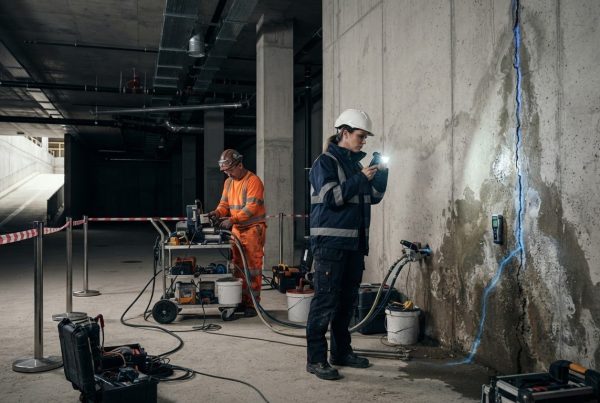


The structural integrity of a multi-million-pound carbon fibre strengthening project relies entirely on a bond interface only millimetres thick. For the asset controller or structural engineer, the uncertainty surrounding the internal cohesive strength of an existing substrate represents a significant risk to the long-term efficacy of any remediation strategy. It is widely recognised that without empirical validation, the application of advanced composites remains a speculative exercise. This technical guide serves to eliminate that ambiguity by providing a comprehensive framework for the concrete pull-off test; ensuring your site data meets the exacting requirements of BS EN 1542.
By mastering the nuances of tensile adhesion assessment, you will gain the reliable data necessary for bespoke engineering calculations and the successful installation of specialised strengthening systems. We shall examine the critical failure modes defined in current British Standards, the precision required in equipment calibration, and how these metrics are integrated into the design of high-performance solutions like Tyfo® Fibrwrap®. This methodical approach ensures that the functional lifespan of critical infrastructure is extended through rigorous science rather than supposition, providing the professional reassurance required for complex structural interventions.
Key Takeaways
- Understand the fundamental role of the concrete pull-off test in establishing the near-surface tensile strength required for critical structural remediation.
- Identify the specific equipment and procedural requirements mandated by BS EN 1542:1999 to ensure site data is both compliant and reproducible.
- Learn to accurately interpret failure modes and Megapascal (MPa) values to differentiate between adhesive delamination and cohesive substrate failure.
- Recognise the environmental variables, including substrate moisture and temperature, that must be managed so your data isn’t compromised by anomalous results.
- Discover how empirical pull-off data is integrated into the design of high-performance composite systems, such as Tyfo® Fibrwrap®, to validate structural bond performance.
Defining the Concrete Pull-Off Test in Structural Engineering
The pull-off test is a fundamental diagnostic procedure utilised to quantify the near-surface tensile strength of a concrete substrate. In the context of structural repairs, this empirical assessment provides the baseline data required to determine whether an existing surface possesses the cohesive integrity to support additional loads or specialised overlays. Technically, the concrete pull-off test is defined as the measurement of the maximum force required to detach a bonded disc from the substrate surface through the application of a direct tensile load. By isolating a circular area of the concrete, engineers can determine the limit at which the internal structure of the material fails, thereby establishing a critical parameter for the design of any subsequent intervention.
The Role of Adhesion Testing in Asset Life-Extension
The transition from costly asset replacement to sustainable remediation is predicated on the availability of high-fidelity material data. Pull-off data provides the technical justification for life-extension strategies, allowing asset controllers to opt for targeted repairs that would otherwise be deemed high-risk. Whilst visual structural surveys are proficient at identifying surface-level degradation, they often fail to detect latent defects such as micro-cracking or carbonation-induced weakening within the cover zone. The implementation of rigorous adhesion testing ensures that the economic benefits of prolonging infrastructure utility are not undermined by premature debonding or substrate failure. This methodical approach allows for the preservation of essential assets through evidence-based engineering rather than conservative replacement cycles.
Primary Applications: From Bridges to Pipelines
The versatility of tensile assessment extends across a diverse range of critical infrastructure projects. It’s most frequently employed in the validation of Carbon Fibre Reinforced Polymer (CFRP) strengthening, where the effective transfer of stress from the concrete to the composite is entirely dependent on the substrate’s tensile capacity. Beyond bridge and pipeline rehabilitation, the test is essential in several specialised engineering contexts:
- Validation of masonry reinforcement and the adhesion of specialised renders.
- Assessment of substrate suitability for blast mitigation systems.
- Quality assurance for seismic retrofitting where high-ductility materials are bonded to older concrete frames.
- Verification of resin injection efficacy in leak sealing and crack remediation.
By establishing a verifiable bond strength, engineers can proceed with the installation of proprietary systems, such as Tyfo® Fibrwrap®, with the confidence that the underlying material can sustain the design stresses. This level of empirical certainty is vital for maintaining the safety and performance of structures subjected to dynamic loading or aggressive environmental conditions.
Technical Methodology and Compliance with British Standards
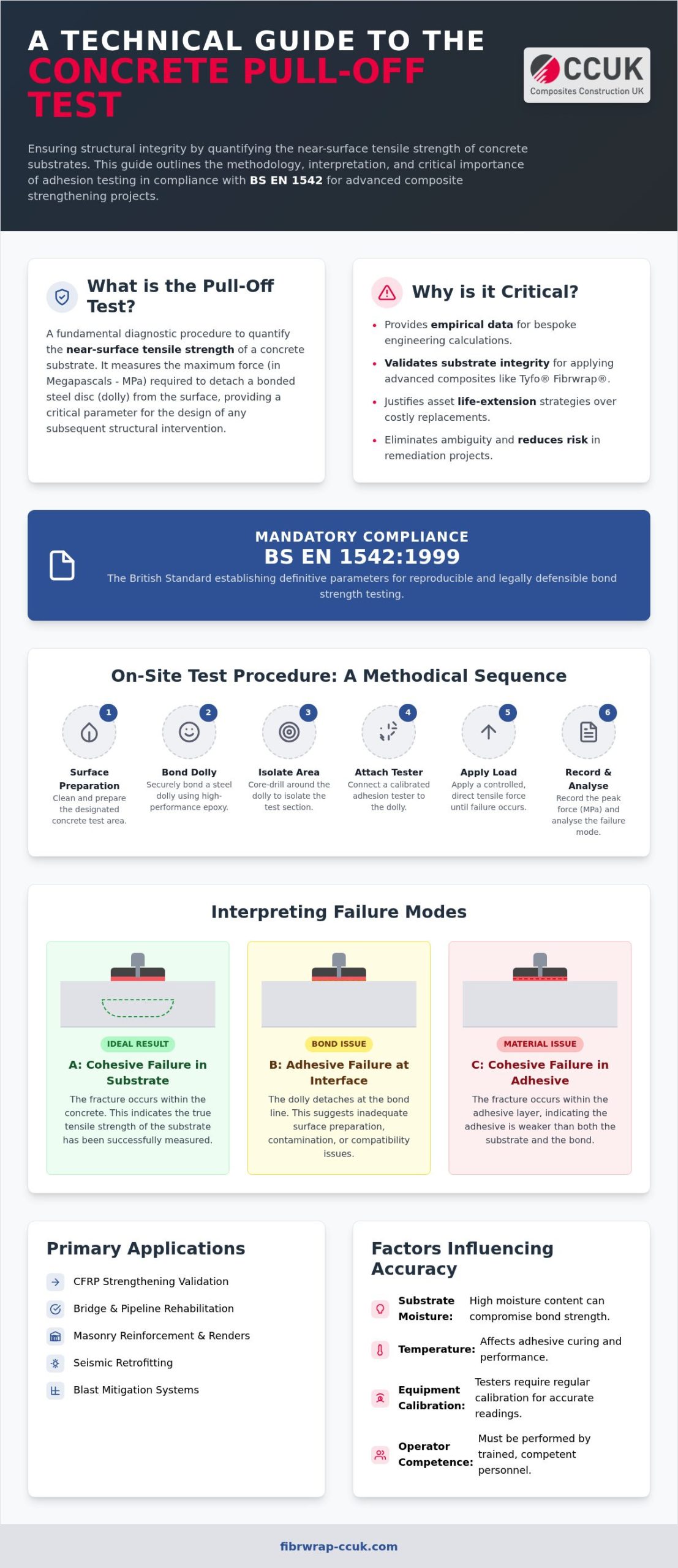
Adherence to BS EN 1542:1999 is mandatory for any professional concrete pull-off test conducted within the United Kingdom. This standard establishes the definitive parameters for determining the bond strength of repair products and structural strengthening systems. To achieve reproducible and legally defensible results, the use of calibrated tensile testers, circular steel dollies, and high-performance epoxy adhesives is required. Data integrity is further supported by established research, such as the Evaluation of Surface Preparation and Overlay Bonding, which confirms that the quality of the bond interface is the primary determinant of long-term system performance. All testing must be performed by competent personnel to ensure data rigour and strict adherence to these established regulatory protocols.
Step-by-Step Procedure for On-Site Testing
The execution of a concrete pull-off test follows a methodical sequence designed to eliminate external variables that could skew the final Megapascal (MPa) readings. Initially, the test location is prepared through meticulous cleaning and degreasing; it’s vital that the adhesive bond to the dolly exceeds the internal tensile strength of the concrete. A 50mm diameter dolly is then bonded to the substrate using a rapid-cure resin, with precise vertical alignment maintained to avoid the introduction of eccentric loading forces.
Once the adhesive has reached full cure, a partial core is drilled around the perimeter of the dolly. This core must penetrate through any repair layer and at least 15mm into the parent concrete to isolate the test zone from the surrounding material. Finally, the tensile tester is attached, and a steady, continuous load is applied at a rate of 0.05 ± 0.01 MPa/s until failure occurs. For projects where structural safety is paramount, consulting a specialist for bespoke engineering calculations ensures that site data is accurately translated into a robust strengthening design.
Equipment Calibration and Precision
Digital gauges are preferred over analogue alternatives for the collection of engineering-grade data, as they provide the precision necessary for modern structural analysis. Inconsistent loading rates remain a frequent source of error in field testing; applying force too rapidly can result in artificially low readings that fail to reflect the true material properties of the substrate. The standardisation of dolly diameter at 50mm is critical, as variations in surface area directly affect the calculated stress. Professional equipment must be regularly calibrated against national standards to ensure the absolute reliability of the tensile measurements amongst varying site conditions.
Interpreting Pull-Off Test Results: Failure Modes and Bond Strength
The efficacy of a concrete pull-off test is fundamentally tied to the qualitative assessment of the fracture surface. Whilst the peak load recorded by the digital gauge provides the necessary quantitative data, the failure mode categorisation determines the validity of the underlying engineering assumptions. If failure is observed primarily within the concrete substrate, it’s concluded that the bond strength of the repair or strengthening system exceeds the internal cohesive capacity of the parent material. Conversely, interface failure at the bond line often indicates a deficiency in surface preparation or a chemical incompatibility between the substrate and the newly applied material. Should the fracture occur within the testing adhesive itself, the result must be discarded; this adhesive failure confirms that the bond between the dolly and the surface was the limiting factor, thereby obscuring the true performance of the concrete.
Minimum Requirements for Structural Strengthening
For high-performance applications such as CFRP strengthening, a minimum tensile bond strength is typically specified by the design engineer, often ranging between 1.0 MPa and 1.5 MPa for structural-grade concrete. These thresholds are critical for ensuring that the composite system can effectively transfer stresses across the bond interface without risk of premature delamination. When site data falls below these specified requirements, the safety factors in the bespoke engineering calculations must be re-evaluated. In some instances, additional substrate preparation or the application of specialised primers may be necessary to enhance the effective bond and meet the rigorous safety criteria required for asset remediation.
Statistical Analysis of Multiple Test Points
A single test point is insufficient for the characterisation of an entire structure; therefore, a representative sample size must be established to account for the inherent variability of aged concrete. Statistical analysis is applied to the aggregate data to determine the characteristic bond strength, ensuring that localised anomalies do not skew the overall structural assessment. Outliers are handled with professional caution, often necessitating additional testing in adjacent areas to confirm whether the result reflects a localised defect or a systemic material failure. Technical asset controllers require detailed documentation that correlates each numerical value with its corresponding failure mode, providing a transparent audit trail for the quality assurance process. This methodical reporting ensures that the strengthening design is grounded in empirical reality rather than optimistic averages.
Factors Influencing Accuracy in Tensile Adhesion Testing
The accuracy of a concrete pull-off test is susceptible to a range of site-specific variables that can compromise the validity of the resulting data. Environmental conditions, particularly ambient temperature and relative humidity, exert a significant influence on the curing kinetics of the dolly adhesive. In the British climate, excessive moisture within the concrete substrate represents a primary risk factor; saturated pores can prevent the resin from achieving a mechanical interlock, leading to premature bond failure. Additionally, operator technique is paramount, as even a minor deviation from perpendicular loading introduces eccentric forces (eccentricity) that artificially lower the recorded tensile strength. For critical infrastructure assessments where the highest degree of precision is required, the use of climate-controlled enclosures is strongly advised to stabilise the testing environment and ensure the adhesive achieves its full design properties.
Surface Preparation and Substrate Condition
Substrate condition is often degraded by long-term carbonation or chloride ingress, both of which can weaken the surface matrix and lead to misleading results if not properly accounted for during the assessment. Mechanical preparation must be selected based on the specific condition of the concrete and the requirements of the proposed strengthening system. Grit blasting is typically preferred for creating a uniform, open-pore profile, whilst needle gunning may be utilised for more localised interventions or where access is restricted. It’s essential that the surface is entirely free from laitance, dust, and oily contaminants that act as bond breakers. Failure to remove these friable layers will result in a measurement of the contaminant’s adhesion rather than the concrete’s true tensile capacity, potentially leading to the approval of an unsuitable substrate.
Common Pitfalls and How to Avoid Them
Several common procedural errors frequently undermine the reliability of site data and should be rigorously avoided. Improper coring depth is a recurring issue; if the core doesn’t penetrate sufficiently into the parent material, ‘edge effects’ from the surrounding concrete can bolster the result by providing lateral support to the test area. Conversely, using outdated or uncalibrated testing equipment introduces systematic errors that invalidate the Megapascal (MPa) readings. Inadequate curing time for the dolly adhesive is another critical pitfall, especially in colder temperatures where resins may require extended periods to reach the necessary cohesive strength. Ensuring that equipment is annually calibrated and that adhesives are cured in accordance with the manufacturer’s centigrade-specific charts is non-negotiable for engineering-grade reporting. To ensure your structural data is robust enough for complex remediation, contact our specialist team to arrange a professional site assessment.
Integrating Test Data into CFRP Strengthening Design
The empirical data harvested from a concrete pull-off test is utilised as the foundational metric for advanced structural analysis. Within the CCUK engineering framework, these results are critical for validating the Tyfo® Fibrwrap® system, where the composite’s performance is intrinsically linked to the substrate’s cohesive strength. There is a direct mathematical relationship between the measured near-surface tensile strength and the composite effective strain; if the substrate displays a low Megapascal (MPa) value, the design strain of the CFRP must be curtailed to prevent premature debonding. Bespoke engineering calculations translate these site-specific MPa readings into verifiable structural capacity, ensuring that the final strengthening solution is both safe and optimised for the specific material properties of the asset.
Justifying Remedial Works to Stakeholders
Empirical evidence serves as a powerful tool for securing project funding and necessary regulatory approvals from asset controllers. In the context of concrete repairs, pull-off data provides the technical justification required to move from speculative maintenance to targeted structural remediation. This data-driven approach establishes a rigorous technical audit trail, which is essential for long-term asset management and future safety audits. By demonstrating that the substrate possesses the requisite integrity to support a specialised overlay, engineers can provide stakeholders with absolute reassurance regarding the sustainability and longevity of the intervention.
The CCUK Approach: Precision and Compliance
Our methodology integrates diagnostic precision with professional execution, moving seamlessly from site assessment to high-performance installation. As a specialist contractor, CCUK provides an end-to-end service that encompasses initial testing, structural design, and the application of proprietary strengthening systems. This integrated model eliminates the risks associated with fragmented project delivery, ensuring that the site data is accurately interpreted and applied by the same team responsible for the final installation. The transition from diagnostic concrete pull-off test results to a completed structural intervention is managed with a focus on safety and proven performance. For those managing critical infrastructure, we invite you to contact our team to discuss a comprehensive structural survey and testing programme tailored to your specific asset requirements.
Advancing Structural Integrity Through Empirical Validation
The successful execution of a concrete pull-off test provides the definitive technical baseline for any structural remediation project. By adhering to the rigorous protocols of BS EN 1542 and accurately categorising failure modes, engineers ensure that strengthening designs are grounded in empirical reality rather than conservative estimates. This methodical approach is essential for the application of high-performance systems like Tyfo® Fibrwrap®, where the integrity of the bond interface dictates the overall efficacy of the intervention and the long-term safety of the asset.
As the exclusive UK licensee for Tyfo® Fibrwrap®, CCUK delivers a comprehensive service that integrates specialist testing with bespoke engineering design and professional installation. Our expertise in UK infrastructure allows for the precise translation of site data into robust, life-extending solutions for bridges, pipelines, and complex concrete frames. To ensure your remediation strategy is supported by engineering rigour, contact our engineering team for specialist concrete testing and design. With the correct diagnostic data, the functional lifespan of essential infrastructure can be safely and sustainably extended.
Frequently Asked Questions
What is the minimum pull-off strength required for CFRP strengthening?
A minimum tensile bond strength of 1.0 MPa to 1.5 MPa is typically required for structural CFRP strengthening applications. These values ensure that the concrete substrate is capable of transferring the design loads to the composite system without risk of debonding. For high-performance systems like Tyfo® Fibrwrap®, specific thresholds are determined through bespoke engineering calculations to account for the unique stress profiles of the structure being rehabilitated.
How many pull-off tests are required per square metre of concrete?
There is no rigid universal frequency, but industry best practice often dictates a minimum of three tests for every 50 to 100 square metres of prepared surface. For critical infrastructure, the testing frequency is typically defined by the lead engineer within the project specification. This representative sampling ensures that localised variations in concrete quality are identified, providing a statistically significant characteristic bond strength across the entire remediation area.
Can a pull-off test be performed on wet or saturated concrete?
Performing a concrete pull-off test on saturated or wet concrete is generally avoided as it compromises the adhesive bond between the dolly and the substrate. High moisture content interferes with the curing of the resin, often leading to an invalid adhesive failure rather than a true measure of the concrete’s tensile strength. Substrates should be allowed to dry until the moisture levels fall within the manufacturer’s specified limits for the testing adhesive.
What is the difference between a pull-off test and a pull-out test?
The primary difference lies in the material being measured; a pull-off test assesses the near-surface tensile strength of the concrete or the bond of an overlay. In contrast, a pull-out test measures the force required to extract an embedded component, such as a rebar or anchor, from the hardened concrete. Whilst both are tensile assessments, they serve distinct purposes in structural surveys and the validation of different reinforcement methods.
How deep should the partial core be for an accurate pull-off test?
For an accurate concrete pull-off test, the partial core should penetrate through any repair material and at least 15mm into the parent concrete substrate. This depth is critical to isolate the test area from the surrounding surface and eliminate edge effects that could artificially inflate the results. Precise coring ensures that the failure occurs within the isolated cylinder, providing a true reflection of the material’s internal cohesive capacity.
What happens if the failure occurs in the adhesive during the test?
If failure occurs within the adhesive layer, the test is considered invalid and must be repeated. This result indicates that the resin used to bond the dolly failed before the concrete reached its tensile limit, meaning the true strength of the substrate remains unknown. Such failures often stem from inadequate surface preparation, moisture contamination, or insufficient curing time for the adhesive amongst colder ambient temperatures.
Is a concrete pull-off test considered a non-destructive test (NDT)?
This procedure is classified as a semi-destructive test because it leaves a physical core hole in the substrate that requires subsequent repair. Unlike purely non-destructive methods like ultrasonic pulse velocity or cover meter surveys, this test physically fractures the material to obtain empirical data. Whilst the damage is localised and easily remediated, it’s a necessary trade-off for obtaining the high-fidelity tensile measurements required for structural strengthening design.
Which British Standard governs the tensile adhesion testing of concrete?
The primary standard governing this procedure in the United Kingdom is BS EN 1542:1999, which details the products and systems for the protection and repair of concrete structures. This standard provides the definitive methodology for measuring bond strength by pull-off. Compliance with this regulatory framework is essential for technical asset controllers to ensure that site data is reproducible, accurate, and suitable for integration into complex engineering calculations.