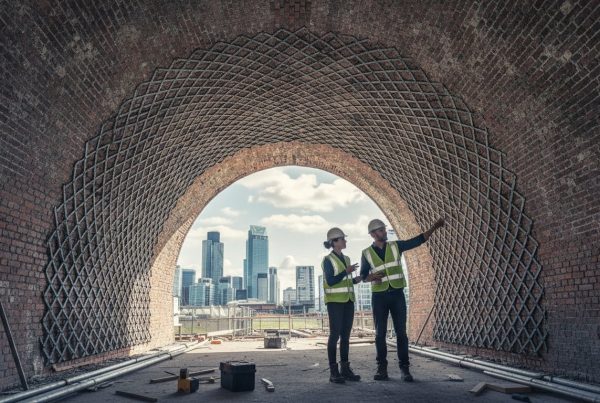

Could the persistent failure of structural remediation be attributed to a fundamental misunderstanding of the substrate’s electrochemical behaviour rather than the quality of the repair mortar itself? For many asset controllers, the discovery of recurring spalling and delamination shortly after a project’s completion is a frustratingly familiar occurrence. These common mistakes in concrete repair projects frequently stem from a failure to address the underlying cause of deterioration, such as carbonation or chloride ingress, before applying a topical solution. When repairs are treated as cosmetic interventions rather than engineered structural life-extension programmes, the risk of premature degradation and asset failure increases significantly.
We recognise the technical and financial pressure exerted by budget overruns and the necessity of maintaining long-term structural integrity in harsh UK environments. This guide identifies the critical technical oversights that lead to asset failure and provides a framework for rectifying them through rigorous diagnostic testing and precise material selection. By examining the integration of advanced systems like Carbon Fibre Reinforced Polymer (CFRP) and adhering to BS EN 1504 standards, we will outline how to transition from reactive patching to a sophisticated, engineering-led strategy that ensures the permanent security of essential infrastructure.
Key Takeaways
- Distinguish between symptomatic “patching” and comprehensive structural remediation by identifying the specific chemical catalysts, such as carbonation or chloride ingress, that drive degradation.
- Implement advanced substrate preparation techniques that secure a robust mechanical key whilst mitigating the risk of “bruising” or micro-cracking inherent in high-impact removal methods.
- Rectify common mistakes in concrete repair projects through the rigorous selection of materials that align with the Modulus of Elasticity and thermal expansion coefficients of the parent structure.
- Manage the critical 48-hour curing window with precision, accounting for the UK’s fluctuating ambient temperatures to ensure the integrity of the repair-to-substrate bond.
- Extend the functional utility of essential infrastructure by integrating repair protocols with advanced structural strengthening systems like Carbon Fibre Reinforced Polymer (CFRP).
The Diagnostic Deficit: Why Most Concrete Repairs Fail Before They Begin
In the context of civil engineering, concrete repair failure is defined as the inability of a remedial intervention to arrest underlying reinforcement corrosion or ongoing structural movement. It’s a common misconception amongst asset controllers that a repair is successful if the patch remains bonded to the substrate. True success is predicated upon the cessation of the degradation mechanisms that necessitated the repair. One of the most prevalent common mistakes in concrete repair projects is the adoption of a symptomatic approach, where visible spalling is treated whilst the chemical catalysts remain active within the parent structure. For high-consequence infrastructure such as bridges, tunnels, or pipelines, relying solely on visual inspections is a high-risk strategy that often leads to premature asset failure.
Latent defects in reinforced concrete assets are defined as inherent physical or chemical deficiencies within the structure that are not detectable through visual observation but possess the potential to cause significant structural compromise over time.
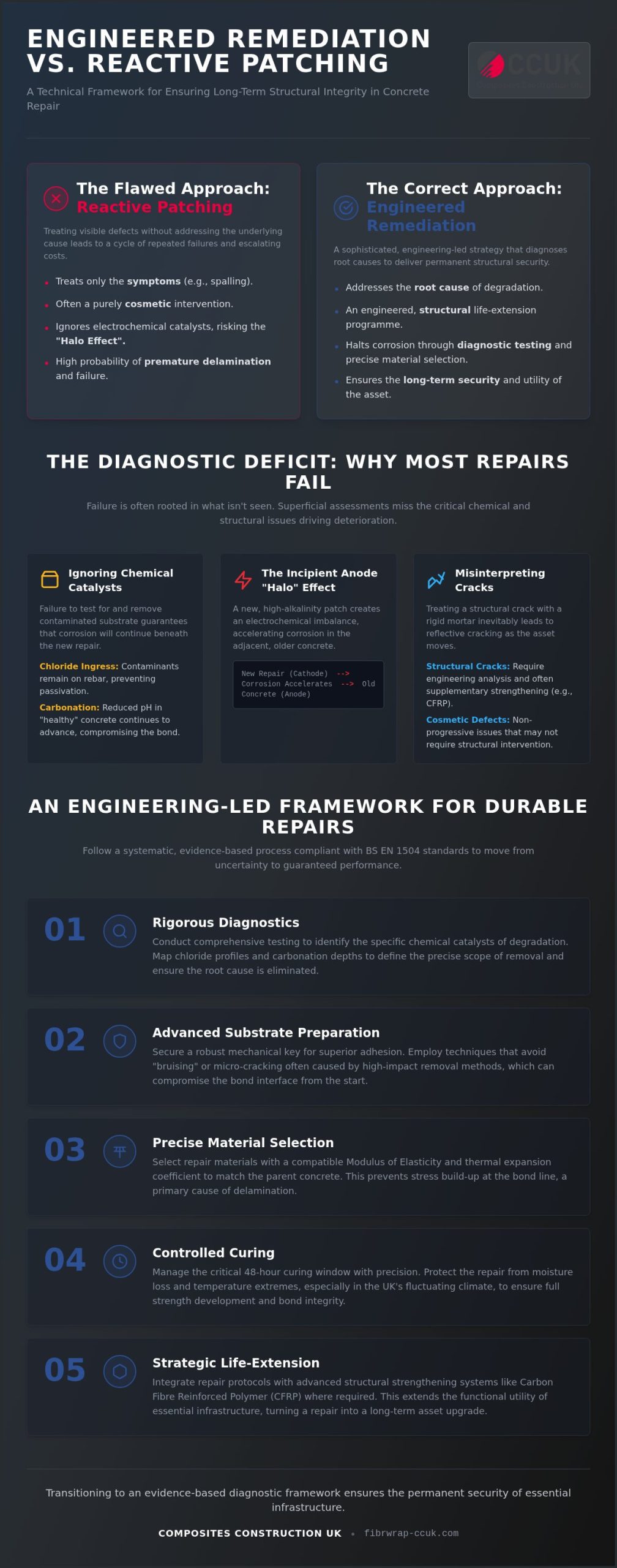
The efficacy of any remediation programme depends on identifying the root causes of concrete degradation before a single kilogram of repair mortar is specified. Without a forensic understanding of the internal environment, a new repair patch may actually accelerate corrosion in the surrounding areas through the incipient anode effect. This phenomenon, often referred to as the “halo effect”, occurs when the electrochemical balance is shifted by the introduction of a high-alkalinity repair material adjacent to chloride-contaminated or carbonated concrete. Avoiding these common mistakes in concrete repair projects requires a transition from reactive maintenance to an evidence-based diagnostic framework.
Inadequate Carbonation and Chloride Testing
Failing to map chloride profiles across a structure often leads to repairs being placed directly onto contaminated substrate. If the chloride content at the level of the reinforcement remains above the threshold for corrosion, the passivating layer on the steel will not be restored, regardless of the repair material’s quality. Similarly, carbonation depth testing is essential for determining the precise volume of concrete removal required. If “active” concrete with a reduced pH level is left behind the new repair, the carbonation front will continue to advance, eventually compromising the bond and leading to further delamination. A comprehensive testing regime ensures that the repair depth is sufficient to reach healthy, alkaline concrete.
Misinterpreting Structural Cracking vs. Cosmetic Defects
Differentiating between cracks caused by thermal movement, settlement, and reinforcement corrosion is a fundamental requirement for remedial design. A frequent error involves “bridging” a live movement joint or a structural crack with a rigid repair mortar, which inevitably leads to reflective cracking as the structure continues its natural cycle of expansion and contraction. Utilising professional structural surveys allows engineers to establish a baseline for the asset’s current condition and differentiate between non-progressive cosmetic issues and active structural threats. This distinction is critical because structural defects often require supplementary strengthening, such as carbon fibre reinforced polymer (CFRP) systems, rather than simple mortar applications.
Substrate Preparation: The Technical Standard for Adhesion
The achievement of a robust mechanical bond between the repair material and the parent concrete is the primary objective of substrate preparation. It’s a stage where precision is often sacrificed for speed, yet the longevity of the entire project depends on the quality of the interface. Common mistakes in concrete repair projects often involve the use of heavy pneumatic breakers which, whilst efficient for bulk removal, frequently cause “bruising”. This phenomenon describes a network of micro-cracks induced in the remaining substrate, significantly compromising the tensile bond strength before the repair material is even mixed. Detailed guidance on assessing these interfacial bond requirements and the physical properties of sound concrete can be found in technical resources such as the Caltrans Concrete Technology Manual, which underscores the necessity of a sound, uncontaminated surface.
Another prevalent error is the practice of “feather-edging” a repair patch to match the surrounding surface level. This inevitably leads to delamination and edge failure because cementitious mortars require a minimum thickness to maintain their structural properties and resist shrinkage stresses. To prevent this, repair perimeters must be square-cut using a diamond saw to a minimum depth of 10mm. This provides a vertical face that allows for proper compaction of the mortar and ensures the repair is mechanically “keyed” into the structure rather than simply sitting on top of it.
Insufficient Removal of Contaminated Concrete
Reinforcement cleaning must reach a “white-metal” standard to ensure all oxidation products are removed. Relying on manual wire brushing is often insufficient for high-consequence assets; abrasive blasting is generally required to achieve the necessary cleanliness. A critical oversight in many projects is the failure to address corrosion on the rear of the steel. The 20mm clearance rule is a mandatory standard, requiring the removal of concrete behind the rebar to allow for total encapsulation. If the back-side of the steel remains embedded in chloride-contaminated concrete, the corrosion cycle will continue unabated, regardless of the surface treatment applied. It’s also vital to protect these prepared surfaces from re-contamination by salts or dust whilst waiting for material application.
Failure to Address Reinforcement Passivation
The application of reinforcement primers is a delicate process where “more” isn’t necessarily “better”. Applying a primer too thickly can create a slip-plane that inhibits the bond, whilst missing the specified “tack-free” window for mortar application leads to catastrophic adhesion failure. To mitigate the “Halo Effect” mentioned in previous sections, the integration of sacrificial anodes is often required. These zinc-based components are strategically placed to provide galvanic protection to the steel adjacent to the repair zone. Managing these complex electrochemical interfaces is a core competency of specialist engineering contractors who prioritise long-term asset stability over temporary cosmetic fixes. For projects requiring high-level technical oversight, consulting with an expert on a bespoke design feature ensures that substrate preparation aligns with international engineering standards.
Material Incompatibility: Beyond the ‘One-Size-Fits-All’ Approach
The selection of inappropriate materials is one of the most technically damaging common mistakes in concrete repair projects. A frequent error occurs when high-strength, modern repair mortars are specified for the remediation of lower-strength historic concrete. Whilst it’s often assumed that a higher compressive strength equates to a superior repair, the disparity in the Modulus of Elasticity (E-modulus) can lead to significant stress concentrations. If the repair material is substantially stiffer than the parent concrete, it’ll fail to deform at the same rate under structural load, eventually causing the load to bypass the repair and overload the adjacent, weaker concrete. This mismatch often results in cracking or total delamination at the interface, rendering the intervention counterproductive.
To prevent shear failure at the bond line, the coefficient of thermal expansion for the repair mortar must be closely matched to that of the parent concrete to ensure uniform movement during temperature fluctuations. Beyond physical movement, the vapour permeability of the material must also be considered. Ignoring “breathability” in repair mortars can lead to moisture entrapment behind the patch, which accelerates internal degradation and can cause the repair to blow off during freeze-thaw cycles.
Ignoring Electrochemical Compatibility and the ‘Halo Effect’
The “Halo Effect”, or incipient anode phenomenon, describes the process where a dense, low-resistivity repair patch triggers rapid corrosion in the surrounding, unrepaired areas. By introducing a highly alkaline repair material into a structure where the surrounding concrete is carbonated or chloride-contaminated, a new electrochemical cell is created. The repaired area becomes cathodic, whilst the adjacent steel, still embedded in contaminated concrete, becomes a sacrificial anode. This leads to accelerated spalling around the perimeter of the new repair. For chloride-contaminated structures, a “patch and hope” strategy is fundamentally flawed. In these scenarios, the technical justification for integrating cathodic protection becomes absolute, as it’s the only method capable of suppressing the electrochemical drive that causes the Halo Effect.
Incorrect Water-to-Cement Ratios in On-Site Mixing
The precision of the material’s final properties is heavily influenced by the mixing process. Excess water is frequently added on-site to improve workability, yet this significantly increases drying shrinkage and reduces the final density of the repair. Such compromises lead to internal voids and a network of shrinkage cracks that provide a direct path for future contaminant ingress. For structural-grade repairs, volume-batching is considered an inferior practice compared to weight-batching, as it doesn’t account for the bulking of damp aggregates or the precise water-cement ratio required for high-performance mortars. Engineers should utilise bespoke design solutions to specify material properties that are tailored to the specific environmental and structural conditions of the asset, ensuring that the repair behaves as a monolithic extension of the original structure.
Execution and Curing: The Critical 48-Hour Window
The transition from substrate preparation to physical application represents a phase where technical precision is frequently compromised by the pressure of site schedules. Achieving a Saturated Surface Dry (SSD) condition is a fundamental prerequisite for successful adhesion. If the substrate remains dry, it’ll draw the hydration water out of the repair mortar, leading to plastic shrinkage and a weakened bond at the interface. Conversely, the presence of standing water is equally detrimental, as it increases the water-to-cement ratio locally and inhibits proper contact. One of the most prevalent common mistakes in concrete repair projects is the “build-up” error, where layers are applied beyond the manufacturer’s specified maximum thickness. This practice induces internal stresses and slumping, particularly in vertical or overhead orientations where gravity acts against the unset material.
In the UK’s fluctuating climate, environmental management is essential for long-term integrity. Failure to manage ambient temperatures during the critical 48-hour window can lead to delayed set times or, in colder months, catastrophic frost damage to the green mortar. Alongside this, the premature removal of formwork is a high-risk error that leads to structural deflection and bond failure before the material has attained sufficient compressive strength. To ensure your project adheres to these rigorous execution standards, you can contact our engineering team for a technical consultation regarding your specific asset requirements.
Inadequate Compaction and Void Formation
Honeycombing within poured repairs creates a porous internal structure that facilitates future moisture and chloride ingress. These voids represent a significant structural deficit, yet they’re often hidden from visual inspection. In hand-applied repairs, common mistakes in concrete repair projects involve failing to vigorously “work” the mortar into the substrate’s surface profile, which leaves air pockets that compromise the bond. The integrity of the internal structure should be verified through non-destructive testing (NDT), such as ultrasonic pulse velocity, to ensure the repair is monolithic and free from significant voids.
The Neglected Art of Curing
Curing is a disciplined process of moisture retention, not merely a period of inactivity. Wind-breaks and shading are as critical as hydration, as high wind speeds can accelerate evaporation even in cool temperatures, leading to plastic shrinkage cracking. Whilst chemical curing membranes offer a modern, efficient solution, their compatibility with subsequent protective coatings or anti-carbonation paints must be carefully verified. Traditional methods, such as the use of damp hessian and polythene, remain highly effective provided they’re maintained consistently. Curing regimes must be established based on material data sheets and documented site conditions rather than guesswork or arbitrary timelines.
Strategic Life-Extension: Integrating Repair with Structural Strengthening
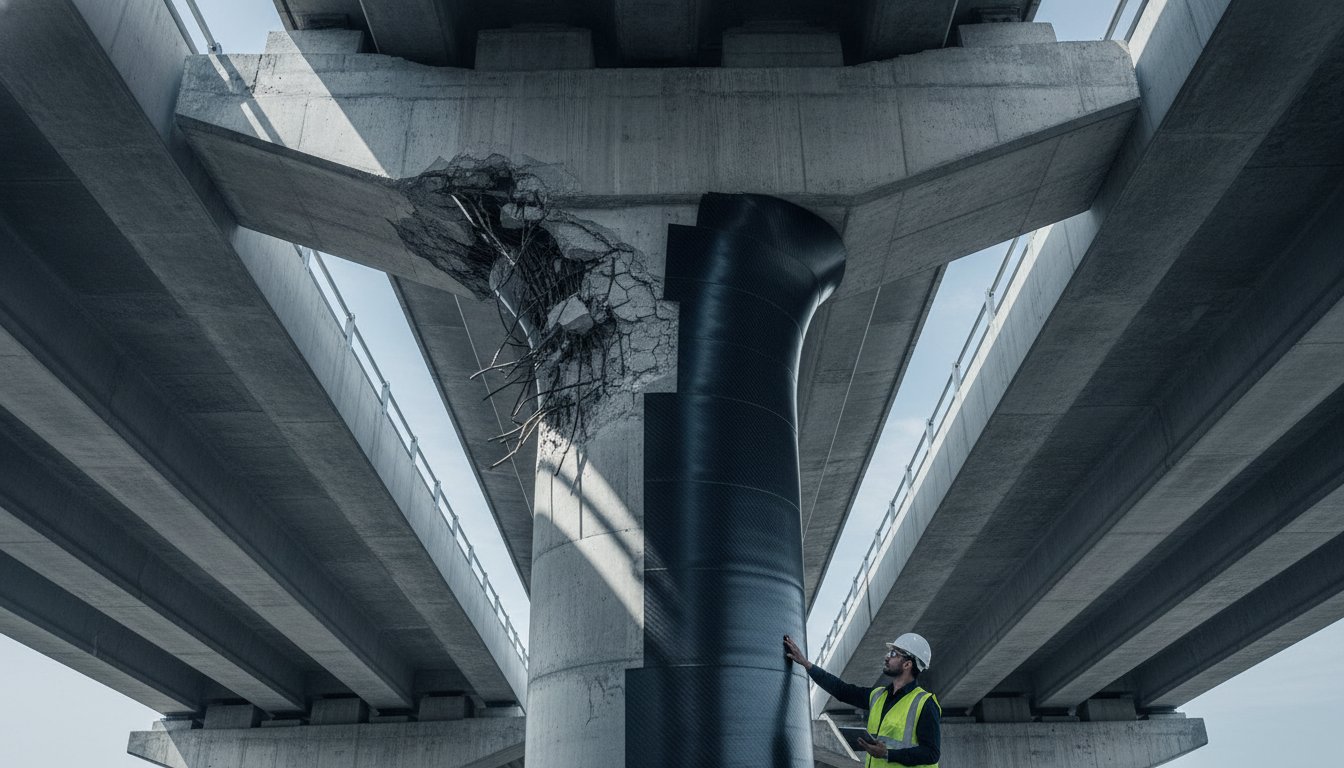
Perhaps the most significant oversight in the remediation of ageing infrastructure is the treatment of concrete repair as a standalone, cosmetic exercise. Whilst previous sections have detailed the technical requirements for substrate preparation and material compatibility, these interventions are ultimately futile if the asset is fundamentally under-strength for its current or future load requirements. One of the most critical common mistakes in concrete repair projects is the failure to recognise that a repaired structure may still be structurally deficient. In these scenarios, the integration of Carbon Fibre Reinforced Polymer (CFRP) strengthening represents a logical progression from remedial patching to comprehensive structural life-extension.
The application of the Tyfo® Fibrwrap® system provides a synergistic solution that addresses both physical degradation and structural capacity. By combining high-performance repair mortars with advanced composite wraps, engineers can restore the monolithic integrity of the concrete whilst simultaneously enhancing its flexural and shear strength. Beyond structural reinforcement, these composites act as a redundant barrier against future corrosive ingress, effectively sealing the repaired zone from moisture and chlorides.
The Tyfo® Fibrwrap® Advantage in Remediation
Integrating the Tyfo® Fibrwrap® system into a remedial programme allows for the arrest of further degradation through the total encapsulation of the structural element. Unlike traditional steel plate bonding, which is susceptible to its own corrosion and difficult to apply to complex geometries, CFRP is lightweight, non-corrosive, and adaptable to circular columns or irregular beams. This versatility is particularly advantageous in seismic retrofitting and the rehabilitation of critical pipelines. Evidence suggests that through the strategic integration of these composite systems, the functional lifespan of essential infrastructure, such as bridges and marine assets, can be extended by 30 years or more, providing a sustainable alternative to total replacement.
Designing for the Long Term
The transition from reactive maintenance to strategic asset management requires a shift in procurement philosophy. It’s a reality of the industry that the lowest initial tender often leads to the highest lifetime cost of ownership, as inadequate diagnostics and poor execution necessitate rework within a few years. A specialist contractor provides the technical security of PI-insured design and installation, ensuring that the remedial strategy is grounded in empirical engineering rigour. Avoiding common mistakes in concrete repair projects requires a holistic view that prioritises safety, durability, and proven results. Contact our engineering team for a comprehensive structural survey and a bespoke repair strategy tailored to your asset’s requirements.
Securing Long-Term Integrity Through Engineering Rigour
The successful remediation of reinforced concrete requires a transition from reactive maintenance to a disciplined, engineering-led strategy. By addressing common mistakes in concrete repair projects, such as the failure to map chloride profiles or the specification of incompatible mortars, asset controllers can arrest the cycle of premature degradation. The integration of advanced diagnostics with precision execution ensures that the bond between the parent structure and the remedial material remains intact under the most demanding environmental conditions.
As the exclusive UK licensee for Tyfo® Fibrwrap® systems, we specialise in the life-extension of national infrastructure through PI-insured engineering design and advanced material science. Our approach prioritises the long-term functional utility of the asset over temporary cosmetic fixes, providing the technical security required for high-consequence structures. We remain committed to preserving the utility of essential infrastructure through sophisticated science and proven results.
Book a Technical Consultation for Your Concrete Repair Project and secure the future of your essential assets through engineering excellence.
Frequently Asked Questions
What is the most common cause of concrete repair failure in the UK?
The primary cause of failure is the lack of comprehensive diagnostic testing to identify carbonation depths and chloride profiles prior to remediation. Many common mistakes in concrete repair projects occur when surface spalling is treated as a cosmetic issue rather than a symptom of electrochemical degradation. Without arresting the underlying corrosion mechanism, the repair will inevitably delaminate as the internal pressure from expanding oxidation products continues to build.
In many cases, moisture ingress from the roof or upper floors is a primary driver of this degradation. To learn more about how specialist contractors like Waffen Waterproofing Pte Ltd address these specific issues through professional ceiling leak repairs, it is worth consulting with experts who understand the link between water penetration and structural decay.
How do I know if my concrete needs structural repair or just cosmetic patching?
Structural repair is necessitated when defects compromise the load-bearing capacity of the asset, typically indicated by cracks wider than 6mm or those accompanied by significant displacement. Cosmetic patching is reserved for minor surface abrasions that don’t expose the internal reinforcement. Any defect involving exposed rebar or progressive cracking should be evaluated through professional structural surveys to establish if supplementary strengthening is required.
Can I apply repair mortar directly over rusted rebar?
Mortar must never be applied directly over rusted reinforcement because oxidation products inhibit the formation of a robust mechanical bond and continue to expand. The steel should be cleaned to a “white-metal” standard, often requiring abrasive blasting to ensure all contaminants are removed. The 20mm clearance rule must also be observed to allow for total encapsulation of the bar in alkaline repair material, preventing future corrosion cycles.
What is the ‘Halo Effect’ in concrete repair and how can it be avoided?
The ‘Halo Effect’, or incipient anode phenomenon, occurs when a new, highly alkaline repair patch is placed adjacent to chloride-contaminated or carbonated concrete, triggering rapid corrosion in the surrounding area. This electrochemical imbalance is avoided by utilising sacrificial zinc anodes or cathodic protection systems. These interventions equalise the electrical potential across the structure, ensuring the new repair doesn’t inadvertently accelerate the degradation of the parent concrete.
How does weather affect the success of a concrete repair project?
Environmental conditions in the UK significantly influence curing cycles and bond strength, particularly during the fluctuating autumn and winter seasons. Temperatures below 5°C can halt the hydration process or cause frost damage to unset mortar, whilst high winds accelerate evaporation and lead to plastic shrinkage. Professional execution requires the use of wind-breaks and temperature-controlled environments to maintain the integrity of the critical 48-hour curing window.
Is it always necessary to use a bonding agent between old and new concrete?
Bonding agents are not universally required and can sometimes act as a slip-plane if applied incorrectly or allowed to dry before mortar placement. Achieving a Saturated Surface Dry (SSD) condition on a properly profiled substrate is often the superior method for ensuring a monolithic bond. The decision to use a specific primer should be based on the manufacturer’s technical data and the specific porosity of the parent concrete.
What are the benefits of using CFRP strengthening alongside traditional concrete repairs?
Integrating Carbon Fibre Reinforced Polymer (CFRP) strengthening provides a secondary line of defence against future corrosive ingress whilst restoring or enhancing the structural capacity of the asset. Unlike traditional steel plate bonding, systems like Tyfo® Fibrwrap® are non-corrosive and adaptable to complex geometries. This hybrid approach addresses common mistakes in concrete repair projects by ensuring the structure is capable of supporting current load requirements whilst being sealed against environmental degradation.
How long should a professional concrete repair last if executed correctly?
A correctly executed concrete repair is expected to provide a service life between 5 and 15 years, depending on the material specified and the environmental exposure. Epoxy injections typically last between 10 and 15 years, whilst standard crack sealants may require maintenance every 5 to 10 years. However, when repairs are integrated with advanced composite systems and comprehensive cathodic protection, the functional lifespan of the structure can be extended by 30 years or more.