

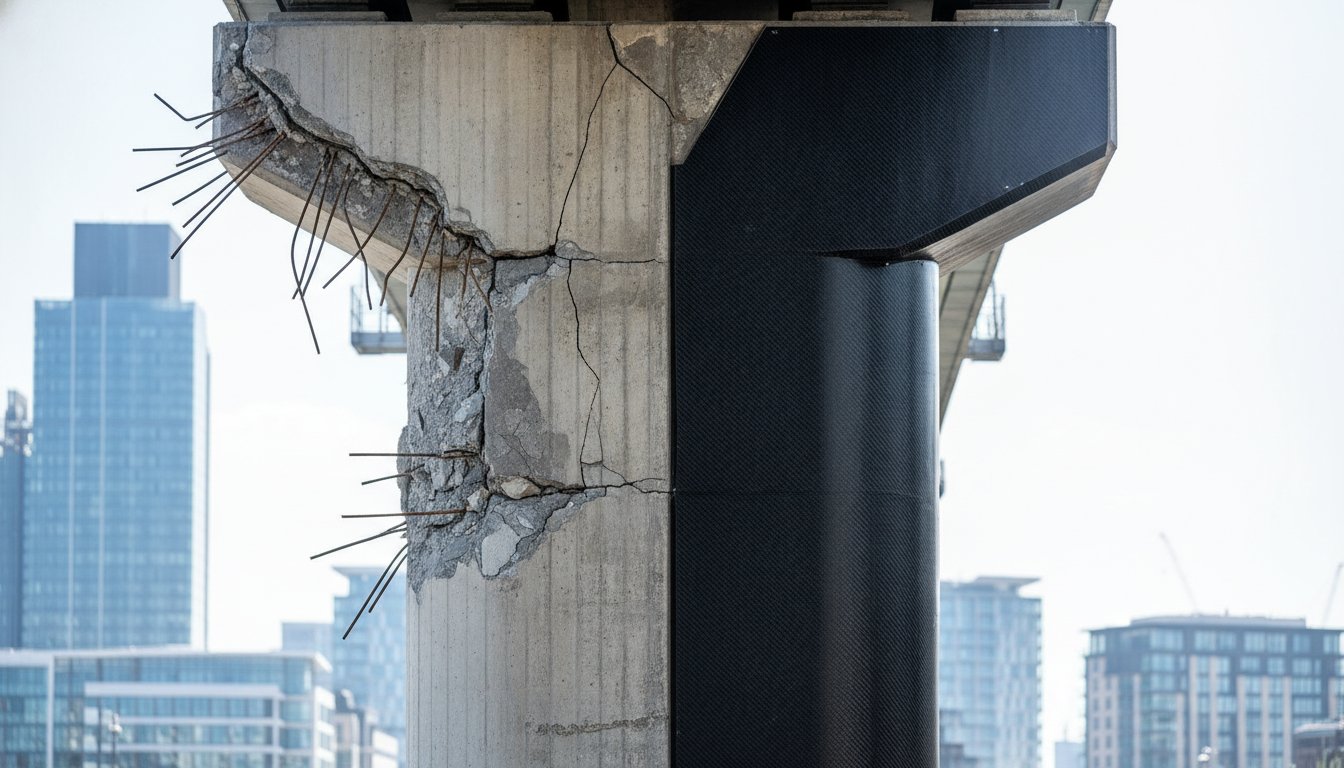
The assumption that a general civil engineering firm possesses the requisite precision to execute advanced structural remediation is a high-stakes fallacy that frequently results in accelerated asset degradation. Whilst the lower initial tender of a generalist may appear fiscally prudent, the risks of using non-specialist repair contractors extend far beyond mere workmanship flaws. Material incompatibility and bond failures are common outcomes. You’ve likely experienced the frustration of budget overruns caused by remedial rework or the persistent anxiety regarding regulatory non-compliance as previous “fixes” fail to meet modern safety benchmarks.
It’s understood that maintaining infrastructure in a climate of shifting standards requires a balance between cost-efficiency and absolute reliability. This article provides an engineering-led analysis of why generalist methods often jeopardise structural integrity. We’ll examine how specialist composite expertise ensures the longevity of critical assets. By exploring the technical demands of the new Eurocode EN 1990-2:2026 and the Construction Products (Amendment) Regulations 2025, we’ll illustrate how a design-supply-install model provides the verifiable performance necessary for full compliance and structural security.
Key Takeaways
- Distinguish between general civil works and the precision-led material science required for advanced structural remediation and composite strengthening.
- Identify the technical risks of using non-specialist repair contractors, specifically regarding material incompatibility and the catastrophic failure of bond interfaces.
- Evaluate the regulatory and insurance implications of remedial works, ensuring alignment with Eurocode EN 1990-2:2026 and BS EN 1504 standards to avoid liability.
- Utilise a professional vetting framework to verify contractor competencies, including specialist material licensing and in-house engineering design capabilities.
- Recognise how an integrated design-supply-install model eliminates the “design-install” gap to ensure absolute structural security and prolonged asset longevity.
The Distinction Between General Contracting and Specialist Structural Remediation
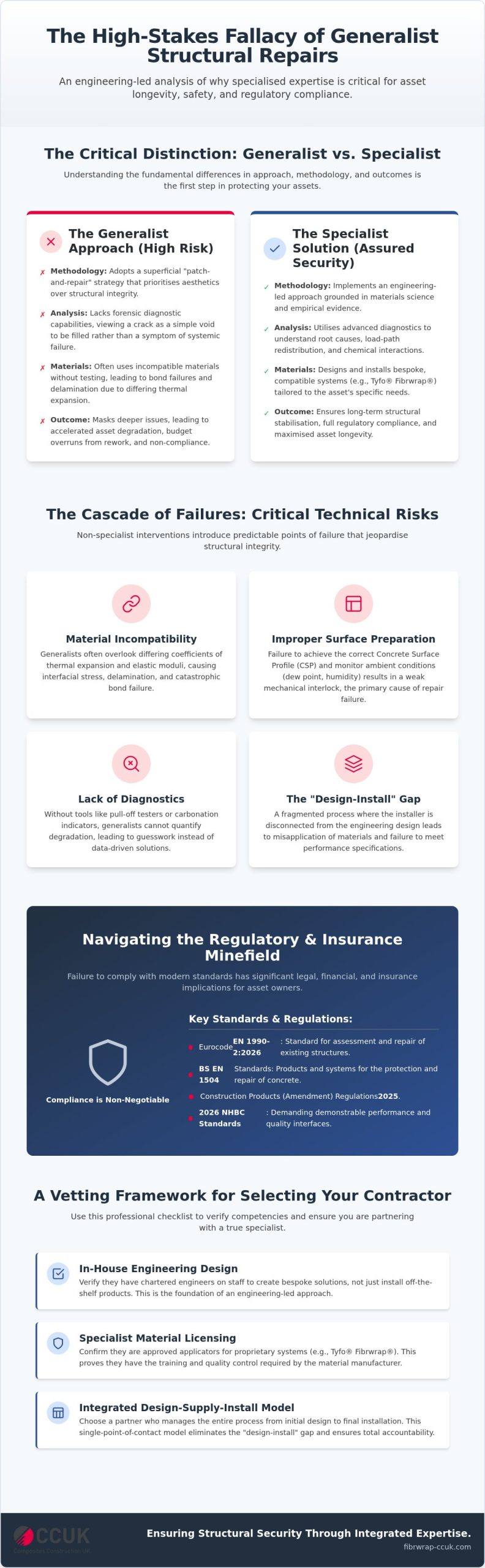
Structural remediation requires a transition from standard construction logic to the rigorous application of materials science. Whilst general civil engineering firms excel at new-build assembly and routine maintenance, they often lack the forensic analytical capabilities required for specialist structural remediation. The primary risks of using non-specialist repair contractors stem from a fundamental misunderstanding of load-path redistribution and the complex chemical interactions between legacy substrates and modern repair materials. Where a generalist sees a crack to be filled, a specialist identifies a symptomatic failure requiring a bespoke engineering solution grounded in empirical evidence.
The Limitations of General Civil Engineering in Asset Life-Extension
General contractors frequently adopt a “patch-and-repair” methodology that prioritises aesthetic restoration over long-term structural stabilisation. This approach is particularly hazardous in the context of critical infrastructure where carbonation, chloride ingress, or reinforcement corrosion have compromised the core matrix. Without investment in specialised diagnostic equipment, such as pull-off testers for bond strength or digital carbonation depth indicators, generalists cannot quantify the extent of degradation. The 2026 NHBC Standards now demand a greater focus on demonstrable performance and the quality of interfaces between building components. Relying on a generalist who lacks these diagnostic tools often leads to superficial fixes that mask deeper, systemic issues, eventually necessitating expensive remedial rework when the asset continues to degrade.
Specialist Accreditations and Technical Oversight
Effective structural strengthening is predicated on an engineering-led project management model. Specialist contractors don’t merely install materials; they integrate detailed feasibility studies into the tender process to ensure that the proposed intervention is technically viable. This involves a deep understanding of material behaviour under diverse environmental loads and fluctuating thermal conditions. For instance, the application of Carbon Fibre Reinforced Polymer (CFRP) Strengthening requires precise environmental control and surface preparation that exceeds standard site practices. By utilising a specialised design-led approach, experts ensure that proprietary systems, such as Tyfo® Fibrwrap®, are tailored to the specific geometric and structural requirements of the asset. This level of technical oversight is essential for compliance with Eurocode EN 1990-2:2026, which provides the standard for the assessment and repair of existing structures. Specialists act as guardians of infrastructure, prioritising safety and proven results over the short-term savings offered by generalist firms.
Technical Risks: Material Incompatibility and Design Failures
The efficacy of structural remediation is fundamentally dependent on the chemical and mechanical synergy between the existing substrate and the new repair matrix. Material incompatibility is frequently the primary cause of premature failure in infrastructure projects. Generalist contractors often fail to account for differing coefficients of thermal expansion or elastic moduli between repair mortars and the host concrete. This misalignment leads to interfacial stress concentrations, resulting in delamination or cracking. The risks of using non-specialist repair contractors are particularly acute when complex material combinations are introduced without rigorous compatibility testing. Without a deep understanding of these material properties, a repair that appears sound initially may fail catastrophically within a single seasonal cycle.
Surface preparation is the most critical stage of any structural intervention, yet it’s where non-specialists most frequently falter. Achieving the correct Concrete Surface Profile (CSP) is not merely a matter of cleanliness; it requires precise mechanical abrasion to ensure an adequate mechanical interlock. Additionally, ambient condition monitoring is often overlooked by generalists. Factors such as the dew point, relative humidity, and substrate temperature dictate the curing kinetics of epoxy resins. If these parameters aren’t meticulously managed, the structural bond is compromised before the material has even reached full strength. This technical oversight often leads to bond failure in Carbon Fibre Reinforced Polymer (CFRP) systems, where the physics of the bond interface are unforgiving of environmental variances.
CFRP and Tyfo® Fibrwrap®: Precision Application Requirements
The application of Carbon Fibre Reinforced Polymer (CFRP) Strengthening necessitates a level of precision that generalists cannot typically provide. In hand-layup systems, maintaining the exact resin-to-fibre ratio is vital for achieving the design tensile strength. Excessive resin creates a brittle, resin-rich layer, whilst insufficient saturation leads to dry fibres and interlaminar shear failure. Proprietary systems like Tyfo® Fibrwrap® are engineered as integrated units that require manufacturer-approved installers who understand the nuances of saturation and air entrapment. Poorly applied wraps can harbour voids which act as initiation points for bond failure under cyclic loading, jeopardising the entire strengthening scheme.
Design Errors in Non-Specialist Strengthening
A recurring issue in generalist-led projects is the reliance on “standard” designs for bespoke structural challenges. Structural strengthening is not a one-size-fits-all process. Every intervention alters the global load path of the structure. If these changes aren’t accounted for, the strengthening may inadvertently overstress adjacent, unreinforced sections. Professional Vetting Your Contractor processes should ensure the firm possesses the capability to perform bespoke engineering calculations before site commencement. This analytical rigour ensures that the reinforcement performs as intended under all limit state conditions. To ensure your asset is managed by experts who understand these complexities, you may wish to consult with our technical specialists regarding your specific project requirements.
Regulatory, Legal, and Insurance Implications for Asset Owners
The legal framework governing structural remediation in the United Kingdom has undergone significant tightening, placing increased accountability on asset owners and controllers. Under the Construction (Design and Management) Regulations 2015 (CDM 2015), and the updated L153 guidance published in February 2026, the duty to ensure contractor competence is non-delegable. Selecting an unqualified firm significantly heightens the risks of using non-specialist repair contractors, potentially exposing the client to criminal liability should a structural failure occur. Compliance is no longer merely a matter of best practice; it’s a statutory requirement defined by adherence to BS EN 1504 and the new Eurocode EN 1990-2:2026 for the assessment of existing structures. When these rigorous standards are bypassed, the resulting Material Incompatibility and Design Failures can lead to long-term liability disputes that persist years after the initial site works are completed.
Professional Indemnity and Specialist Design Liability
A critical vulnerability for asset owners lies in the Professional Indemnity (PI) gap often found in generalist contracts. Whilst a general civil engineering firm may possess standard public liability insurance, they frequently lack the specific design-liability coverage required for advanced material applications like Carbon Fibre Reinforced Polymer (CFRP). If a generalist installs a system designed by a third party, the liability often becomes fragmented amongst multiple entities, leading to protracted legal battles during a failure event. Conversely, specialist engineering contractors provide a single point of responsibility. This integrated model ensures that the design, material selection, and installation are covered under a unified, specialist PI policy, effectively insulating the asset owner from the fallout of technical deficiencies.
Asset Value and Resale Complications
Structural interventions that lack specialist certification can severely compromise the future liquidity of an asset. With the introduction of the Remediation Bill and the 2029/2031 deadlines for unsafe cladding and structural remediation, surveyors and insurers are exercising unprecedented scrutiny. Repairs executed by non-specialists often lack the comprehensive technical data packs required for future structural audits. This absence of verifiable data can lead to difficulties in securing building insurance or result in significant devaluations during the divestment process. A structure with “unauthorised” or uncertified repairs is frequently viewed as a high-risk liability. To maintain asset value, every intervention must be documented with the rigour of a specialist design-install record, proving that the functional lifespan of the structure has been genuinely extended rather than merely patched.
Vetting Your Contractor: A Specialist Selection Framework
Vetting is the primary defence against the risks of using non-specialist repair contractors. When the structural integrity of a high-value asset is at stake, the procurement process must move beyond basic commercial considerations to focus on technical competency. A generalist firm might present an attractive initial tender, but without a proven framework for specialist selection, asset owners risk inheriting a legacy of recurring maintenance issues. Just as structural integrity requires engineering expertise, maintaining the visual standard of an asset through professional respraying is best handled by experts like SKR Specialists to ensure a high-quality finish. To ensure long-term security, technical professionals should utilise a five-step vetting framework that prioritises engineering rigour over mere civil works experience.
- Step 1: Verify specialist material licensing. Confirm the contractor holds exclusive approval for systems like Tyfo® Fibrwrap®. Licensing indicates that the manufacturer has audited the contractor’s technical proficiency.
- Step 2: Review in-house engineering capabilities. A specialist should possess the capacity to perform bespoke structural design rather than relying on generic manufacturer data sheets.
- Step 3: Audit project history. Request case studies specifically related to structural life-extension in environments similar to your asset, such as marine, industrial, or transport infrastructure.
- Step 4: Assess quality control protocols. Evidence of site-specific testing, such as pull-off tests or resin cure monitoring, is essential for verifying bond integrity.
- Step 5: Confirm Professional Indemnity (PI) insurance. Ensure the contractor carries comprehensive PI insurance that specifically covers structural design and the application of advanced composites.
The Role of Structural Surveys and Testing
A reputable specialist will rarely provide a fixed-price quote without first insisting on a comprehensive structural survey. This initial diagnostic phase is vital for identifying the root cause of degradation, whether it’s chloride contamination or carbonation. Red flags in a contractor’s assessment include a failure to request substrate strength data or a lack of interest in environmental conditions. Without these metrics, any proposed repair is speculative. Specialist contractors use empirical data from pull-off tests to ensure that the substrate’s tensile strength can support the proposed strengthening system, a step often skipped by non-specialists.
Manufacturer-Contractor Synergy
The relationship between material manufacturers and specialist installers is a hallmark of technical competence. Exclusive licensing, such as the UK licence for Tyfo® Fibrwrap® systems, ensures that the contractor has direct access to manufacturer-led design support and the latest material science innovations. This synergy allows for the creation of detailed method statements that align with both the material’s specific properties and the structure’s geometric requirements. When vetting a firm, always request technical data sheets and specific method statements as part of the bid. If a contractor cannot demonstrate a clear, authorised link to the material manufacturer, the risk of improper application increases exponentially. To initiate a technically robust assessment of your asset, contact our engineering team today to discuss your specific structural requirements.
The CCUK Solution: Integrated Design, Supply, and Installation
The fragmentation of structural remediation projects often results in a critical disconnect between the initial engineering intent and the final site execution. This “design-install” gap is one of the most pervasive risks of using non-specialist repair contractors, as it allows for technical nuances to be lost during the handover between separate consultants and generalist installers. Composites Construction UK (CCUK) mitigates this risk through a comprehensive, integrated model that encompasses design, supply, and installation within a single point of responsibility. By maintaining internal control over every phase of the project, CCUK ensures that the structural performance requirements established during the diagnostic phase are meticulously realised in the final application.
Central to this integrated approach is the utilisation of the Tyfo® Fibrwrap® system, for which CCUK is the exclusive UK licensee. Unlike generic composite materials, Tyfo® Fibrwrap® is a proprietary system engineered for superior structural performance under extreme conditions, including seismic and blast scenarios. This system’s efficacy is predicated on the synergy between high-strength carbon fibres and specialised epoxy resins, applied by technicians trained in manufacturer-approved protocols. This level of material rigour is essential for addressing the unique challenges of UK infrastructure, where legacy assets often require bespoke interventions to meet contemporary safety standards such as Eurocode EN 1990-2:2026.
End-to-End Project Delivery
CCUK manages the complex transition from the initial feasibility study to the final verified installation with methodical precision. By engaging in a specialist design-and-install contract, asset owners eliminate the ambiguity of shared liability. Every project is underpinned by rigorous internal auditing, ensuring that all interventions meet the highest UK engineering standards and regulatory requirements. This seamless delivery model provides technical professionals with the assurance that their structural assets are being managed by a dedicated guardian of infrastructure.
Commitment to Infrastructure Longevity
In a period of economic contraction within the construction industry, as evidenced by the 15-month decline in the S&P Global/CIPS UK Construction PMI reported in March 2026, the focus must shift towards the sustainability of repair over replacement. CCUK frames specialist structural remediation not merely as a technical necessity but as a strategic economic decision. Extending the functional lifespan of an existing structure through advanced composite technology is significantly more sustainable and cost-effective than complete demolition and reconstruction. This philosophy of specialist restoration is increasingly vital across all sectors; for instance, iRepairMan London provides the precision hardware repairs necessary to extend the life of mobile technology. CCUK maintains a national reach, delivering engineering rigour to infrastructure projects across the United Kingdom, ensuring that safety and long-term asset health are never sacrificed for short-term cost-cutting.
Securing Infrastructure Longevity through Engineering Excellence
The preservation of critical infrastructure necessitates a fundamental shift from standard maintenance protocols toward a precision-led engineering strategy grounded in material science. The risks of using non-specialist repair contractors extend from immediate technical failures, such as bond delamination, to long-term regulatory liabilities that jeopardise asset valuation. By integrating bespoke design with specialised material application, owners can ensure their remediations withstand fluctuating environmental loads whilst adhering to the latest Eurocodes. It’s clear that the future of our built environment depends on moving beyond superficial patches toward scientifically validated structural interventions.
Composites Construction UK acts as a guardian of infrastructure, delivering end-to-end solutions that eliminate the traditional design-install gap. As the exclusive UK licensee for Tyfo® Fibrwrap®, our team provides in-house structural design and engineering consultancy supported by comprehensive PI insurance for all structural interventions. We’re committed to the sustainability of repair. Every asset can reach its maximum functional potential through proven scientific methods. Consult with our specialist engineering team regarding your asset remediation needs to begin securing the future of your essential infrastructure.
Frequently Asked Questions
What defines a specialist contractor in structural repair?
A specialist contractor is distinguished by in-house engineering design capabilities and exclusive licensing for advanced material systems. Unlike generalists, specialists possess the forensic diagnostic tools required to quantify substrate degradation, such as carbonation depth and chloride ingress. Their approach is governed by the rigorous application of materials science to ensure that any intervention is chemically and mechanically compatible with the legacy structure.
Can a general building contractor install CFRP strengthening systems?
Whilst generalists may attempt installation, the precise resin-to-fibre ratios and ambient monitoring required for Carbon Fibre Reinforced Polymer (CFRP) usually exceed standard site capabilities. One of the primary risks of using non-specialist repair contractors is the failure to manage epoxy curing kinetics under fluctuating humidity and temperature. This technical oversight frequently results in interlaminar shear failure or delamination of the composite wrap.
What are the most common causes of structural repair failure?
Structural repair failures typically stem from material incompatibility and a fundamental misunderstanding of load-path redistribution. If the repair mortar’s elastic modulus or thermal expansion coefficient differs significantly from the host concrete, interfacial stress concentrations will cause premature cracking. Specialists mitigate this by using empirical data from pull-off tests to ensure the substrate’s tensile strength can support the proposed reinforcement matrix.
How does using a non-specialist affect my building’s insurance?
Utilising a non-specialist can lead to a significant Professional Indemnity (PI) gap, as generalist insurance often excludes design-liability for advanced composites. If a structural failure occurs, insurers may deny coverage if the contractor lacked the specific material certifications or failed to adhere to Eurocode EN 1990-2:2026. Furthermore, the absence of a verified technical data pack can complicate future asset valuations and insurance renewals.
Why is surface preparation so critical in composite strengthening?
Surface preparation is the foundation of the mechanical interlock between the existing substrate and the new composite system. Achieving the correct Concrete Surface Profile (CSP) through precise mechanical abrasion is essential to ensure adequate bond strength. Without this, the bond interface becomes the weakest link in the structural chain, leading to catastrophic failure when the reinforcement is subjected to design loads.
What certifications should I look for when hiring a structural repair company?
Identify contractors who hold exclusive UK licences for proprietary systems, such as Tyfo® Fibrwrap®, which indicates manufacturer-audited technical proficiency. Accreditations like Constructionline Gold or RISQS for transport infrastructure provide additional verification of safety and quality management systems. It’s also vital to confirm that their PI insurance specifically covers structural design and the application of Carbon Fibre Reinforced Polymers.
What is the risk of separating the design and installation phases?
Separating design and installation creates a fragmented liability chain where the engineering intent may not be accurately translated to site execution. This disconnect often leads to disputes between designers and installers if the system fails to perform as intended. An integrated design-supply-install model eliminates this gap, providing a single point of responsibility and ensuring that every project adheres to the highest engineering standards.
How much more does a specialist contractor typically cost compared to a generalist?
Initial tenders from specialists may reflect the premium nature of the materials and engineering oversight, yet they often provide a lower total life-cycle cost. The risks of using non-specialist repair contractors include substantial financial losses caused by remedial rework when superficial “patch-and-repair” attempts fail. Investing in a specialist intervention ensures asset longevity and avoids the recurring expenses associated with failed structural repairs.


