

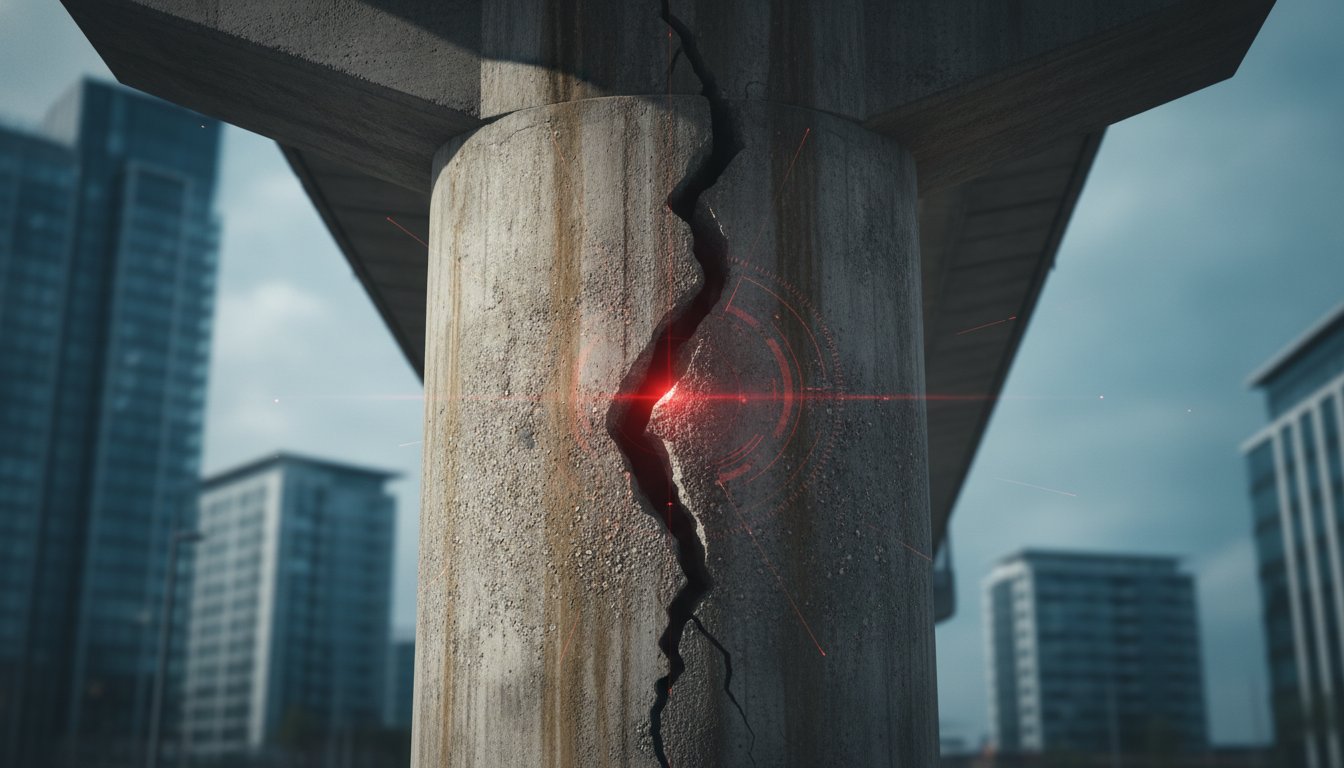
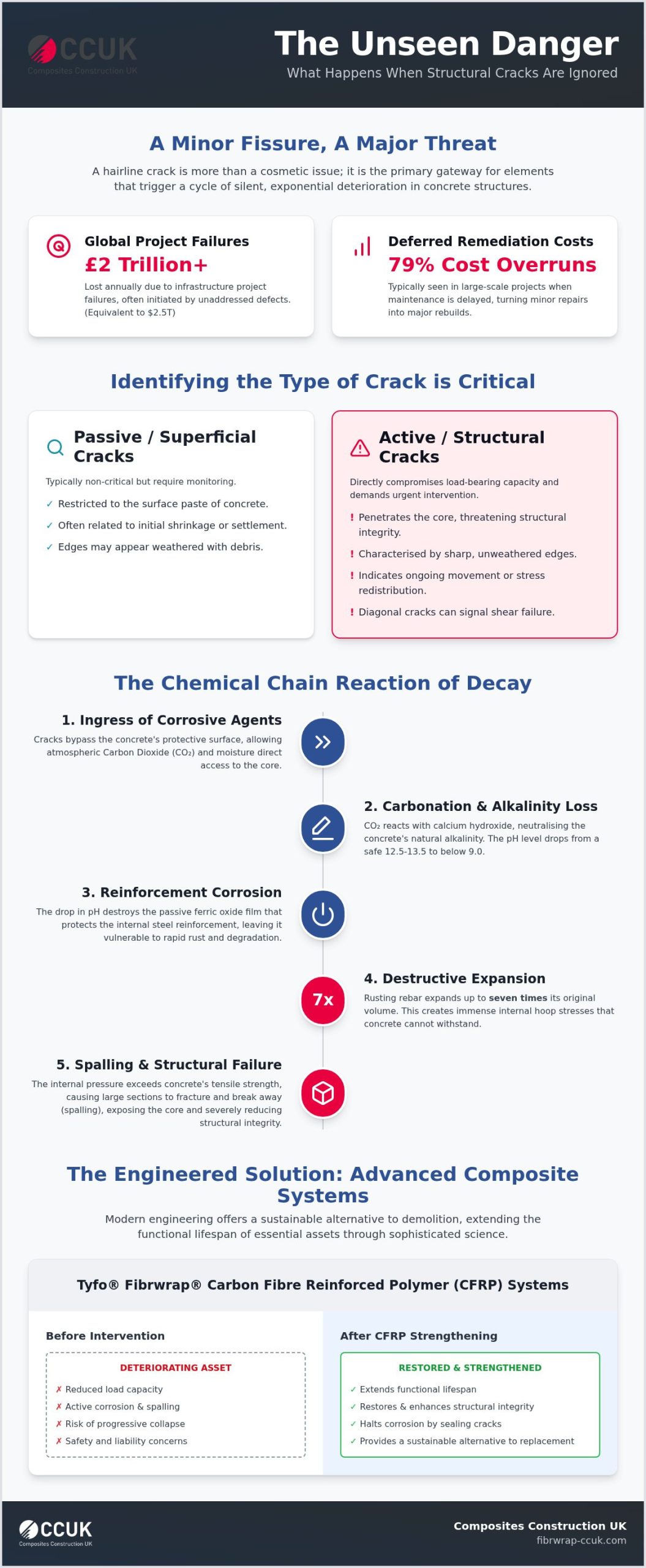
Whilst a hairline fissure in a reinforced concrete slab might appear benign, it often serves as the primary conduit for chloride ingress and carbonation, initiating a cycle of silent, exponential deterioration. Understanding what happens if you ignore structural cracks is critical for asset controllers who must balance immediate budget constraints against the long-term integrity of industrial infrastructure. A minor defect today frequently evolves into a systemic failure, as evidenced by the $2.5 trillion lost annually to project failures and the staggering 79% cost overruns typically seen in large-scale construction when remediation is deferred.
You likely recognise the difficulty in distinguishing between non-critical settlement and genuine structural distress, yet the risks of miscalculation include severe HSE intervention and total asset loss. This article provides a rigorous technical framework for assessing crack severity and justifying maintenance expenditure to stakeholders. You will discover the mechanics of progressive degradation and how modern engineering solutions, such as Tyfo® Fibrwrap® and other CFRP systems, offer a sustainable alternative to traditional demolition by extending the functional lifespan of essential assets through sophisticated science and engineering.
Key Takeaways
- Differentiate between superficial shrinkage and active structural movement to prioritise engineering interventions and resource allocation effectively.
- Understand the mechanics of carbonation and chloride ingress, which compromise concrete alkalinity and facilitate the rapid degradation of internal steel reinforcement.
- Quantify the financial implications and discover what happens if you ignore structural cracks, from escalating remediation costs to the risk of total asset closure.
- Assess the critical safety risks of delayed maintenance, including the potential for progressive collapse and the legal liability associated with falling debris.
- Evaluate the performance benefits of advanced composite systems, such as Tyfo® Fibrwrap®, for extending the functional lifespan of infrastructure without the need for total replacement.
Understanding Structural Cracks in Reinforced Concrete and Masonry
Structural cracks are defined as fractures that directly compromise the load-bearing capacity of a building or civil engineering asset. Unlike superficial shrinkage cracks, which are typically restricted to the surface paste of concrete, structural cracks penetrate the core, threatening the structural integrity and failure threshold of the entire system. Understanding what happens if you ignore structural cracks is essential for maintaining infrastructure, as these defects act as precursors to catastrophic mechanical breakdown. When an asset’s primary skeleton is breached, its ability to distribute intended loads is fundamentally altered, often leading to a redistribution of stress that the original design didn’t account for.
In industrial contexts, such as bridges, silos, or pipelines, even hairline cracks can be deceptive. Whilst they might appear stable under static conditions, the application of dynamic live loads causes these apertures to cycle, effectively pumping moisture and corrosive agents deeper into the substrate. Across UK infrastructure, environmental factors like high humidity and freeze-thaw cycles accelerate this propagation. Moisture trapped within a narrow fracture expands upon freezing, exerting internal hydraulic pressure that widens the gap. This process turns minor defects into significant liabilities that demand specialized intervention; to learn more about moisture-related defects, visit HYPERSEC for expert guidance on humidity control.
Identifying Active vs Passive Cracking
Distinguishing between active and passive movement is a primary objective of any structural survey. Active cracks are characterised by sharp, unweathered edges and a distinct lack of accumulated debris, indicating recent or ongoing movement. Engineers utilise tell-tale monitors or digital sensors to track these apertures over time. The location is equally telling; cracks situated in shear zones, such as near the supports of a beam, demand far more immediate attention than those found in mid-span tension zones. Identifying these patterns early is the first step in a tailored design-led approach to remediation.
The Engineering Significance of Crack Morphology
The orientation of a fracture provides a diagnostic map of the underlying stress. Diagonal cracking in concrete beams is a classic indicator of shear failure, suggesting the internal reinforcement can no longer manage the applied force. In masonry, horizontal cracks often signal wall tie failure or lateral instability caused by wind loading or soil pressure. Conversely, vertical cracks in columns are particularly concerning. These often represent the onset of bursting due to excessive compressive loading, a state where the material’s elastic limit has been exceeded, necessitating urgent structural strengthening to prevent collapse.
The Technical Consequences: Carbonation and Reinforcement Corrosion
When assessing what happens if you ignore structural cracks, the primary technical concern is the breach of the concrete’s protective chemical environment. Concrete typically maintains a high alkalinity, with a pH level between 12.5 and 13.5, which facilitates the formation of a passive ferric oxide film around embedded steel reinforcement. This microscopic layer is the primary defence against oxidation. However, structural fractures provide a direct bypass for atmospheric carbon dioxide and moisture. As CO2 reacts with the calcium hydroxide in the cement paste, the alkalinity is neutralised in a process known as carbonation. Once the pH level drops below approximately 9.0, the passive layer is destroyed, leaving the steel vulnerable to rapid degradation.
The subsequent oxidation of the steel reinforcement is not merely a surface defect but a mechanical catalyst for further destruction. Rusting rebar expands up to seven times its original volume. Because concrete possesses high compressive strength but relatively low tensile strength, this internal expansion generates immense hoop stresses within the substrate. Eventually, these stresses exceed the tensile capacity of the concrete cover, resulting in spalling. This is the point where large sections of concrete break away, exposing the core and significantly reducing the asset’s structural integrity. If you are managing aging infrastructure, a specialised engineering assessment is required to determine the depth of carbonation before visible spalling occurs.
The “Silent Failure” of Internal Corrosion
Internal corrosion often progresses as a silent failure, where the structural capacity is compromised long before external signs become evident. In marine environments or on highway bridges subject to de-icing salts, the ingress of chloride ions acts as a powerful catalyst that accelerates this process even in uncarbonated concrete. The electrochemical nature of reinforcement corrosion in cracked concrete is defined by the formation of an electrolytic cell where the crack acts as a gateway for oxygen and moisture to complete the circuit between anodic and cathodic sites on the rebar. This localised pitting can lead to rapid section loss in critical load-bearing elements.
Loss of Cross-Sectional Area and Load Capacity
The reduction in the cross-sectional area of the steel rebar directly correlates to a linear loss in tensile strength. As the diameter of the reinforcement decreases, the safety margins engineered into the original design are eroded. This creates a high risk of sudden, brittle failure, particularly in over-stressed elements where the ductility of the steel has been compromised by pitting. Specialist structural surveys are essential to quantify this hidden degradation. By identifying the extent of the corrosion of reinforcement steel early, asset owners can implement targeted repairs such as resin injection or cathodic protection, rather than facing the prohibitive costs of total reconstruction.
The Financial Impact: Why Ignoring Cracks is a Budgetary Risk
Financial controllers often view structural maintenance as a deferrable expense, yet the economic reality of infrastructure management follows an exponential growth pattern. A minor intervention today, such as resin injection or leak sealing, represents a small fraction of the capital required once the defect necessitates full-scale structural strengthening. Understanding what happens if you ignore structural cracks is vital for preventing the 79% cost overruns typically associated with reactive large-scale construction projects. When an asset’s integrity is compromised, the valuation of the facility drops significantly, whilst professional indemnity insurance premiums often escalate to reflect the increased risk profile of the site.
Beyond the direct engineering costs, the financial toll of business interruption can be catastrophic. Emergency asset closures, mandated by HSE intervention or the sudden risk of structural collapse, lead to immediate revenue loss that often exceeds the price of the remediation itself. Knowingly ignoring structural defects places the board at significant legal risk. Regulatory bodies increasingly scrutinise the maintenance history of aging infrastructure, and a documented failure to act on known structural distress can lead to severe litigation and the total loss of operating licences.
Remediation vs Replacement Costs
Proactive maintenance strategies allow for the implementation of bespoke design solutions that target specific load-bearing deficiencies without the need for total demolition. By utilising advanced composite technology, the functional lifespan of a structure can be extended by 20 to 30 years. This approach shifts the financial burden from a massive, one-time CAPEX replacement cost to a manageable, planned remediation programme that preserves the asset’s utility and sustainability.
Collateral Damage to Building Services
Structural neglect rarely stays confined to the primary load-bearing elements. As a building or industrial asset shifts, secondary systems experience mechanical stress for which they weren’t designed. This often leads to a chain reaction of failures:
- Waterproofing: Membranes tear as the substrate moves, leading to internal flooding and chemical contamination.
- Mechanical Systems: Misalignment of pipework and HVAC systems causes premature wear and energy inefficiency.
- Glazing: Frame distortion can lead to the catastrophic failure of glass panels in public-facing environments.
The complexity of access also intensifies as damage worsens. What could once be reached with a simple cherry picker may eventually require extensive scaffolding or heavy-duty cranage as the scale of the required intervention grows, further inflating the project overheads.
Safety and Liability: The Hidden Risks of Delay
The physical manifestation of spalling, previously discussed as a chemical consequence, presents an immediate hazard in public-facing or high-traffic industrial environments. Falling concrete fragments, often weighing several kilograms, pose a lethal risk to personnel and the public. Understanding what happens if you ignore structural cracks involves recognising that these defects aren’t static; they’re active threats to life safety. Progressive collapse represents perhaps the most critical risk. This occurs when the failure of a single structural element, such as a corroded column or a sheared beam, triggers a chain reaction that overburdens adjacent components. Because modern structures rely on complex load-sharing mechanisms, the loss of one critical path can lead to a total collapse that far exceeds the initial area of distress.
Fire resistance is equally compromised by structural fracturing. Cracks act as thermal bridges, allowing extreme heat, smoke, and toxic gases to bypass engineered fire-stopping barriers. This breach reduces the period of structural stability during a fire event, potentially leading to premature failure before evacuation is complete. In the UK, the Building Safety Act places a rigorous legal obligation on “Accountable Persons” to manage these risks proactively. Failure to address known structural defects isn’t just an engineering oversight; it’s a breach of statutory duty that carries significant criminal and civil liabilities.
Structural Instability and Catastrophic Failure
Numerous engineering failures illustrate how minor, ignored defects in bridges and commercial buildings eventually culminate in catastrophic failure. Warning signs often include excessive deflection, where beams or slabs visibly sag, and the rapid widening of existing fractures. These symptoms indicate that the material has transitioned from elastic to plastic deformation. The inherent resilience of a structure against extraordinary events, such as seismic activity or blast loads, is also significantly diminished when the primary reinforcement is already compromised by corrosion or section loss.
Insurance and Regulatory Compliance
Structural neglect frequently leads to the voiding of commercial insurance policies, as most contracts require the insured to maintain the property in a “good state of repair.” If a failure occurs and it’s proven that structural cracks were identified but ignored, insurers may refuse to honour claims for property damage or third-party liability. This is a primary example of what happens if you ignore structural cracks in a professional capacity. Engaging a specialist engineering contractor is essential for providing the compliance certification required by the UK Building Safety Regulator. These professionals ensure that all remediation work meets current standards, protecting both the asset and the owner’s legal position.
For a comprehensive assessment of your asset’s integrity, contact our engineering team to discuss a tailored survey and remediation plan.
Engineered Solutions: CFRP Strengthening and Tyfo® Fibrwrap®
Traditional steel plate bonding is frequently found to be inferior to modern composite solutions due to its inherent susceptibility to corrosion and the requirement for invasive mechanical anchoring. Whilst the preceding analysis detailed what happens if you ignore structural cracks, the focus must transition to the technical methodologies available to restore structural capacity. Carbon Fibre Reinforced Polymer (CFRP) strengthening has emerged as the definitive standard for infrastructure rehabilitation, offering a high strength-to-weight ratio that permits significant load-carrying increases without adding substantial dead weight to the structure. Unlike steel, these advanced materials are immune to the electrochemical degradation processes that compromise reinforced concrete, ensuring a durable, long-term solution for aging assets.
The remediation of fractured concrete typically begins with resin injection and leak sealing. This process involves the pressurised delivery of specialised epoxy or polyurethane resins into the crack void, which serves to seal the aperture against moisture ingress and restore monolithic behaviour to the element. Once the substrate is stabilised, CFRP systems like Tyfo® Fibrwrap® are applied to manage tensile stresses. These systems are also increasingly specified for seismic retrofitting and blast mitigation, where the ability of the composite to provide confinement and energy dissipation is critical for protecting infrastructure against extraordinary loading events.
The Tyfo® Fibrwrap® System Advantage
The Tyfo® Fibrwrap® system utilises a wet-lay application process that allows the carbon or glass fibre sheets to be precisely tailored to the geometry of columns, beams, and slabs. This flexibility is particularly advantageous for assets with restricted access or those with strict weight limitations, such as historic bridges or industrial silos. Choosing composite remediation over total demolition is a primary driver of sustainability in the modern built environment. By extending the functional lifespan of existing infrastructure, the carbon footprint associated with new concrete production and the disposal of demolition waste is significantly reduced.
Collaborating with a Specialist Engineering Contractor
Effective structural remediation requires an end-to-end approach that encompasses detailed design, material supply, and expert installation. It’s not enough to simply patch a crack; the underlying cause of the distress must be addressed through rigorous engineering. CCUK utilises advanced asset testing and structural surveys to justify tailored strengthening designs, ensuring that every intervention is grounded in empirical data. This methodology provides asset controllers with the reassurance that their infrastructure meets all current safety and regulatory requirements.
If you’re concerned about the integrity of your infrastructure, the next step is a professional evaluation. Contact our engineering team today to schedule a comprehensive structural assessment and discover how advanced composite science can secure your asset’s future.
Securing Infrastructure Longevity through Proactive Engineering
The progression from a minor surface fracture to a systemic structural failure is dictated by the predictable mechanics of carbonation and reinforcement corrosion. As established, the financial and safety risks associated with deferred maintenance follow an exponential curve, where the window for cost-effective intervention narrows with every cycle of environmental exposure. Proactive remediation isn’t merely a budgetary consideration; it’s a fundamental requirement for maintaining the safety and utility of industrial assets under modern regulatory frameworks. Understanding what happens if you ignore structural cracks allows asset controllers to move from reactive crisis management to a disciplined, science-led maintenance strategy.
Composites Construction UK (CCUK), as the exclusive UK licensee for Tyfo® Fibrwrap® systems, provides the expert design and engineering consultancy required to navigate complex structural challenges. Our nationwide specialist contracting teams are equipped to deliver tailored strengthening solutions that prioritise the sustainability of repair over the high cost of replacement. You can secure the long-term integrity of your infrastructure by engaging with specialists who value engineering rigour and proven results. Request a structural survey and expert remediation plan from CCUK to ensure your essential assets remain safe and functional for decades to come.
Frequently Asked Questions
Can a structural crack be repaired without total demolition?
Yes, structural cracks can be effectively remediated without the requirement for total demolition through the application of advanced engineering techniques such as resin injection and CFRP strengthening. These methods are designed to restore the monolithic behaviour of the concrete and enhance its load-bearing capacity whilst avoiding the significant environmental and financial costs associated with reconstruction. By utilising systems like Tyfo® Fibrwrap®, the functional lifespan of an asset is extended through a non-invasive, high-strength composite overlay.
How much does it cost to fix a structural crack in a commercial building?
The cost of remediating structural defects is highly variable and depends upon the crack morphology, the underlying cause of the distress, and the required strengthening design. Proactive interventions like resin injection or leak sealing are substantially more cost-effective than reactive measures required once the damage has escalated. Understanding what happens if you ignore structural cracks is essential for budget planning, as deferred maintenance typically results in an exponential increase in capital expenditure due to advanced reinforcement corrosion and the need for more complex structural strengthening.
What is the difference between a settlement crack and a structural crack?
Settlement cracks generally occur during the initial lifecycle of a building as the foundations adjust to the subsoil, often resulting in minor, non-progressive cosmetic fissures. Conversely, a structural crack is a fracture that compromises the integrity of a load-bearing element, often identified by its width, orientation, and location within shear or tension zones. Whilst settlement may eventually stabilise, structural cracks frequently indicate active movement or overloading that requires a formal structural survey to determine the necessary remediation path.
Is CFRP strengthening a permanent solution for structural cracks?
Carbon Fibre Reinforced Polymer (CFRP) is considered a long-term, highly durable solution for structural reinforcement due to its inherent resistance to corrosion and high fatigue strength. When designed by a specialist engineering consultancy and installed according to rigorous material standards, CFRP systems can match or exceed the remaining design life of the original structure. The material’s ability to provide external reinforcement without the risk of oxidation makes it a superior alternative to traditional steel plate bonding in aggressive environments.
What happens if a bridge or tunnel has visible concrete spalling?
Visible concrete spalling in infrastructure assets like bridges or tunnels is a critical indicator that the internal steel reinforcement has reached an advanced stage of oxidation and expansion. This process reduces the cross-sectional area of the rebar, directly compromising the tensile strength of the element and posing an immediate safety hazard from falling debris. Such conditions necessitate an urgent structural assessment to quantify the extent of the section loss and to implement a specialised repair strategy, such as concrete repair followed by composite wrapping.
How long does a typical CFRP structural strengthening project take?
The duration of a CFRP strengthening project is significantly shorter than traditional repair methods because the materials are lightweight and require minimal heavy machinery for installation. Small-scale interventions can often be completed within a few days, whilst larger infrastructure projects are typically phased to minimise business interruption. The rapid curing times of the resins used in Tyfo® Fibrwrap® systems allow for a faster return to service, which is a primary advantage for high-traffic commercial and industrial assets.
Do I need a structural survey before repairing wall cracks?
A comprehensive structural survey is essential before any repair work is undertaken to ensure that the root cause of the fracturing is correctly identified. Attempting to seal or hide cracks without addressing the underlying mechanical or chemical triggers, such as subsidence or reinforcement corrosion, often leads to recurring failure and wasted expenditure. A professional assessment provides the technical justification for a specific remediation plan, ensuring that the intervention is both effective and compliant with building regulations.
What are the legal implications of ignoring structural defects in the UK?
Ignoring structural defects in the UK carries severe legal implications under the Building Safety Act and relevant Health and Safety Executive (HSE) regulations. Asset owners and designated “Accountable Persons” have a statutory duty to ensure the safety of their structures; a documented failure to act on known structural distress can lead to criminal prosecution and significant civil liability. Furthermore, structural neglect often voids commercial insurance policies, leaving the organisation fully exposed to the financial consequences of a structural failure or third-party injury.


