

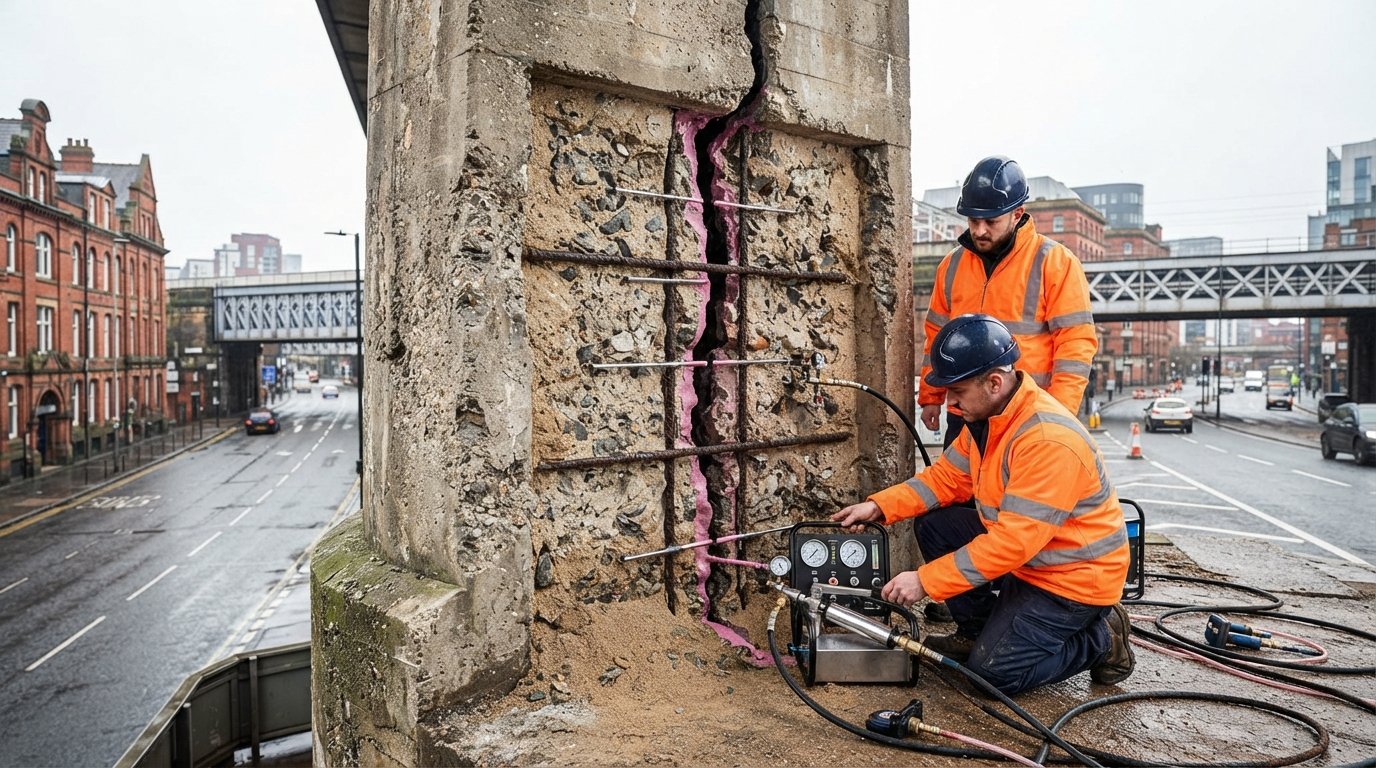
Treating a concrete fissure merely as an aesthetic or moisture nuisance is one of the most perilous oversights in infrastructure management. Asset engineers routinely discover that superficial surface repairs fail to arrest subsurface reinforcement corrosion or dynamic fault propagation, creating acute operational challenges under BS EN 1504 standards. Executing an effective advanced crack injection programme requires moving beyond rudimentary filling to systematically align fluid rheology with the member’s structural load path.
You already recognise that halting active hydrostatic ingress whilst accommodating ongoing ground movement demands rigorous diagnostic discipline rather than broad assumptions. This technical guide provides an authoritative engineering evaluation of advanced polymer systems, pressure regimes, and structural integration methodologies required to permanently eliminate ingress and reinstate monolithic integrity across compromised reinforced concrete. We examine the core diagnostic criteria governing material selection, detailing when to deploy structural epoxies or elastomeric polyurethanes to secure vital civil assets against long-term degradation.
Key Takeaways
- Master the diagnostic criteria of advanced crack injection to re-establish true monolithic load transfer and permanently protect internal reinforcement from aggressive contaminants.
- Determine whether structural epoxies, elastomeric polyurethanes, or hydro-active gels are technically required based on fissure aperture, dynamic movement, and moisture exposure.
- Select optimal low-pressure or high-pressure delivery systems to achieve full-depth resin saturation whilst preventing hydraulic micro-fracturing in vulnerable substrates.
- Recognise why comprehensive internal fissure sealing is an indispensable precursor to composite strengthening systems, eliminating interfacial stress concentrations that cause premature debonding.
- Implement robust quality assurance and non-destructive testing protocols to verify complete defect consolidation and demonstrate compliance with BS EN 1504 standards.
Principles of Advanced Crack Injection in Reinforced Concrete Infrastructure
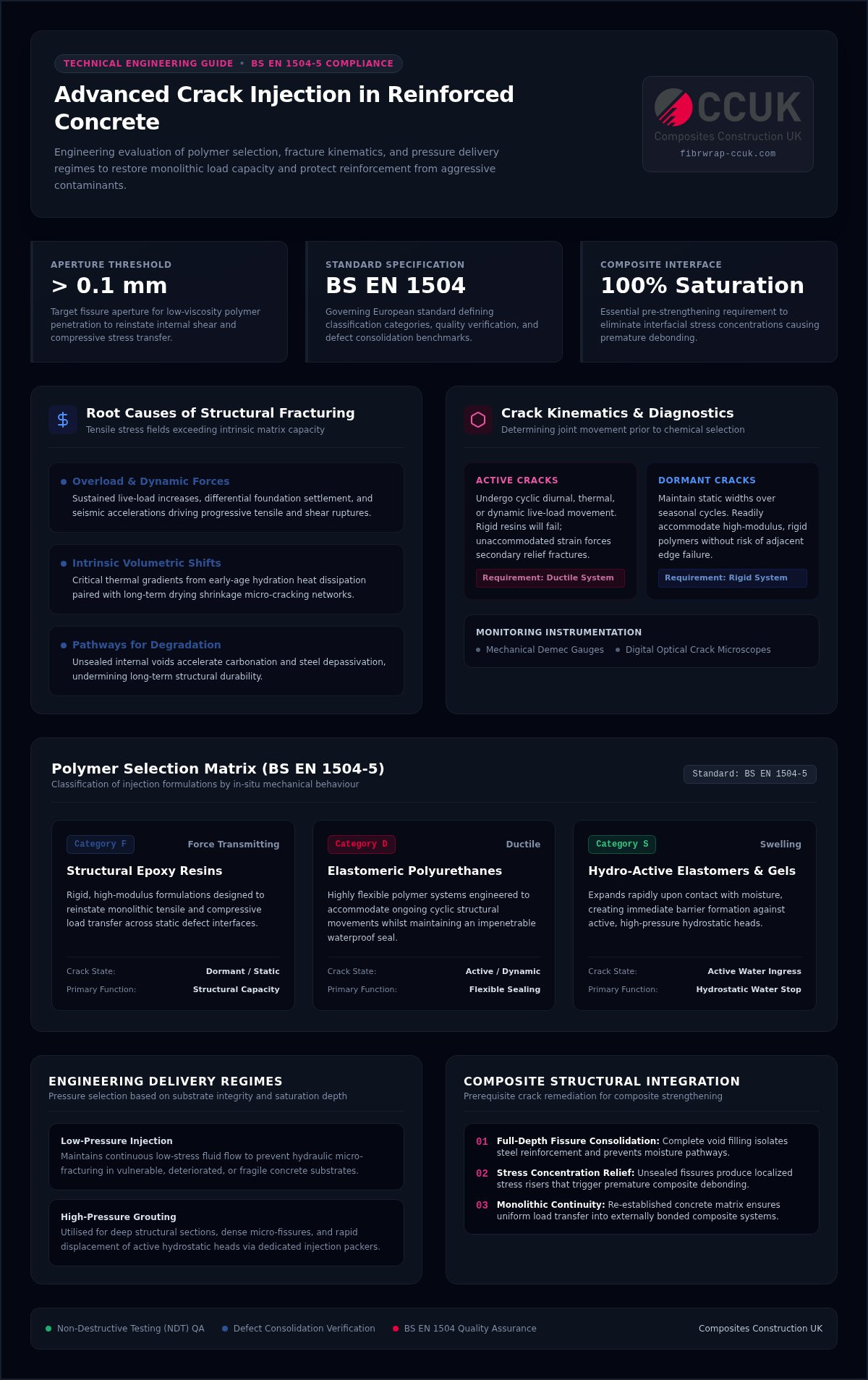
Asset preservation in civil engineering depends on restoring monolithic load capacity whilst isolating vulnerable elements from aggressive ambient conditions. When fissures compromise a structure, basic surface mortaring offers negligible structural remediation. Concealed internal voids remain dry or waterlogged, creating unchecked pathways that accelerate carbonation and steel depassivation. These primary causes of concrete degradation quickly compromise structural durability if the deeper matrix remains unsealed. High-specification advanced crack injection re-establishes internal shear and compressive stress transfer by driving low-viscosity polymers directly into micro-fissures exceeding 0.1 mm in aperture.
Root Causes of Structural Fracturing in Civil Assets
Tensile stress fields exceeding the intrinsic capacity of the concrete matrix stem from diverse structural and environmental factors:
- Overload and Dynamics: Sustained live-load increases, differential foundation settlement, and seismic accelerations induce progressive tensile and shear ruptures.
- Intrinsic Volumetric Shifts: Dissipation of early-age hydration heat causes critical thermal gradients, whilst long-term drying shrinkage produces pervasive network micro-cracking.
- Diagnostic Distinction: Structural surveys must rigorously separate expanding, load-induced fractures from stabilised, autogenous shrinkage cracks prior to grouting.
Active Movement Versus Dormant Crack Characterisation
Crack kinematics dictate chemical selection. Active cracks undergo cyclic diurnal, thermal, or dynamic live-load movement. Injecting a rigid, high-modulus epoxy into an active crack inevitably fails; the unaccommodated strain simply forces a secondary relief fracture through adjacent sound concrete. Dormant cracks, by contrast, maintain static widths and accommodate rigid polymers without risk of edge failure. Field characterisation requires baseline monitoring using mechanical Demec gauges or digital optical crack-width microscopes over seasonal cycles to establish true joint kinematics.
BS EN 1504-5 Compliance and Performance Categories
Engineering compliance under BS EN 1504-5 governs all concrete injection materials, classifying polymers by their functional behaviour within the defect:
- Category F (Force Transmitting): Rigid formulations, predominantly formulated with structural epoxy resins, that restore tensile and compressive load transfer across static interfaces.
- Category D (Ductile): Highly flexible polyurethane polymers engineered to accommodate cyclic structural movements whilst maintaining an impenetrable waterproof seal.
- Category S (Swelling): Hydro-active elastomers and acrylic gels designed to expand upon water contact, delivering immediate barrier formation against high hydrostatic heads.
Adhering to these European performance metrics ensures chosen polymers provide reliable, quantifiable service life. Engineering teams can consult Composites Construction UK regarding our specialized design feature services to align injection chemistries precisely with the mechanical demands of civil infrastructure.
Resin Polymer Selection: Structural Epoxies, Polyurethanes, and Acrylic Gels
Selecting an appropriate injection polymer governs the mechanical continuity, elongation tolerance, and service life of the remediated asset. A critical engineering distinction exists between structural load-transferring resins and flexible water-stopping elastomeric compounds. Misapplying these chemistries invites structural failure; rigid resins crack under cyclic thermal strain, whilst elastomeric polymers lack the compressive and shear strength required to reinstate member capacity. Consequently, advanced crack injection requires balancing rheological properties, glass transition temperatures, and ambient site moisture conditions to deliver lasting remediation.
Structural Epoxy Resins for Load-Transfer Restoration
Structural epoxies are formulated to achieve compressive and tensile strengths exceeding the host concrete matrix. Ultra-low viscosity variants (typically 50 to 150 mPa·s) exploit capillary action to penetrate micro-fissures down to 0.1 mm under controlled pressure. The cross-linking network ensures high resistance to long-term creep deformation under sustained service loads. When specifying these formulations, engineers must account for the glass transition temperature (Tg) relative to peak operational temperatures, alongside moisture-tolerant hardeners if damp fissure interfaces exist.
Polyurethane Foams and Resins for Water Ingress Mitigation
Active hydrostatic water ingress demands a staged chemical response rather than a single material approach:
- Primary Hydrophobic Foams: Fast-reacting, water-activated polyurethane prepolymers expand up to thirty times their liquid volume, cutting off high-velocity flow paths within seconds.
- Secondary Solid Elastomers: Non-cellular, two-component polyurethane resins injected immediately behind the cut-off foam displace residual moisture, curing into dense elastomeric gaskets capable of exceeding 50% elongation under cyclic movement.
Acrylic and Silicate Gels for Deep Substructure Sealing
Hydrophilic acrylic gels exhibit water-like initial viscosities (1 to 5 mPa·s), enabling deep penetration into micro-porous concrete and dense soil matrices. These polymers are ideally deployed in curtain injection programmes behind retaining walls, cut-and-cover tunnels, and subterranean basements where direct crack access is obstructed. The resulting network creates an impenetrable exterior waterproofing membrane that resists biological decay and maintains dimensional stability in continuously saturated subgrades.
Every civil asset presents unique boundary constraints, moisture dynamics, and loading profiles. Asset managers seeking bespoke chemical specifications and expert substrate evaluation are encouraged to contact our engineering consultancy team to discuss tailored polymer strategies.
Engineering Delivery Systems: Low-Pressure Versus High-Pressure Grouting
Matching mechanical delivery systems to defect morphology determines the ultimate success of an advanced crack injection scheme. Pumping pressures must overcome internal capillary resistance without triggering hydraulic fracturing within the concrete substrate. Technicians evaluate member thickness, fracture aperture, and prevailing moisture conditions to select either low-pressure surface port arrays or high-pressure mechanical packers.
Low-Pressure Surface Port Installation Methodology
Surface port delivery operates between 1 and 7 bar, making it ideal for delicate structures, historic assets, and shallow structural sections. The concrete surface along the fissure line is mechanically abraded to remove laitance, followed by sealing with a fast-curing epoxy capping paste. Surface ports are bonded at intervals typically equal to the concrete member thickness. Resin is introduced sequentially using spring-loaded cartridges or low-pressure pumps, proceeding along the crack line only when steady polymer exudation appears at the adjacent open port.
High-Pressure Mechanical Packer Strategies
Massive civil infrastructure components, including bridge abutments, water-retaining structures, and tunnel linings, demand high-pressure delivery to overcome deep fracture resistance and hydrostatic heads. Injection boreholes are drilled at 45-degree angles in an alternating staggered pattern to intercept the crack plane at approximately half the wall depth. Steel or brass mechanical packers featuring internal ball-check valves are torqued within the boreholes. Reciprocating electric or pneumatic pumps then deliver resins at controlled pressures reaching up to 200 bar, driving polymers through saturated internal fissures.
Sequential Pumping and Pressure Regulation Protocols
Pumping protocol requires a methodical, bottom-to-top progression along vertical cracks, which expels air pockets and residual groundwater ahead of the advancing resin front:
- Bottom-Up Progression: Injecting from the lowest packer upward ensures complete volumetric displacement without entrapping pocketed air or water.
- Hydraulic Wedge Mitigation: Technicians monitor in-line pressure gauges continuously, throttling delivery flow to prevent internal hydraulic wedge forces that could split vulnerable concrete elements.
- Induction and Refusal: Injection continues until refusal or sustained back-pressure occurs, allowing required chemical induction times before sealing the ports.
Integrating Crack Remediation with Composite Structural Strengthening
Externally bonded Carbon Fibre Reinforced Polymer (CFRP) composite systems rely entirely on the mechanical integrity of the underlying concrete substrate for effective shear and flexural stress transfer. When fissures remain untreated beneath composite laminates, cyclic live loads concentrate shear strains directly above the unbonded crack lips. This mechanism triggers premature interlaminar peeling and sudden debonding long before the tensile capacity of the carbon fibre is reached. Executing advanced crack injection prior to composite application is therefore an indispensable engineering prerequisite that restores shear continuity across the concrete matrix.
Substrate Preparation for Externally Bonded CFRP
Re-establishing compressive and shear pathways through the concrete core allows subsequent composite overlays to function as designed. Once the internal defects are filled under pressure, technicians grind all surface-mounted entry ports and rigid capping adhesives flush with the surrounding concrete face. Eliminating surface ridges and stepped crack profiles prevents out-of-plane stress concentrations beneath the composite wrap. Asset engineers frequently evaluate these mechanical load paths during the engineering consultancy phase to establish compatible interfacial shear parameters before specifying composite thickness.
Synergy with Tyfo® Fibrwrap® Composite Systems
Combining internal polymer consolidation with external composite wraps creates a robust, multi-barrier rehabilitation system. The primary structural objective involves stabilising the fractured member internally before installing carbon or glass fibre jackets, such as those detailed in our guide to Tyfo® Fibrwrap® installation. Sealing interior fissures prevents moisture and corrosive contaminants from migrating outward, protecting the structural bond line from osmotic blistering and environmental degradation over extended lifespans.
Complementary Concrete Life-Extension Interventions
Modern asset remediation often demands a coordinated series of structural interventions to address complex degradation mechanisms:
- Matrix Consolidation: Review broader engineering frameworks within concrete repairs and structural remediation to coordinate injection with patch repairs and cathodic protection against chloride attack.
- Defect Mitigation: Realign shifted load paths via targeted structural repairs before encasing elements in structural composite jackets.
Asset owners seeking a fully engineered, turnkey approach to concrete rehabilitation can contact our specialist engineering team to arrange a site survey and bespoke strengthening design.
Quality Assurance, Testing, and Specialist Contractor Engagement
Confirming that injected resins have penetrated the full depth and profile of an internal fissure requires objective empirical verification. Surface appearances reveal little about internal polymer saturation. Without rigorous quality control, undetected air pockets, incomplete curing, or bypassed fracture branches leave structures exposed to ongoing degradation. An engineered advanced crack injection regime incorporates both non-destructive and destructive testing protocols to validate structural continuity and satisfy the compliance requirements of BS EN 1504-10.
Non-Destructive and Destructive Verification Techniques
Verifying internal consolidation involves established acoustic and physical testing methods:
- Ultrasonic Pulse Velocity (UPV): High-frequency sound waves transmitted across the remediated plane identify lingering internal voids or discontinuities, evidenced by local transmission velocity drops.
- Direct Core Extraction: Cylindrical cores drilled across injected crack planes provide definitive physical proof of polymer depth, fissure saturation, and adhesive bonding. Subsequent splitting tensile tests confirm whether failure occurs within the concrete matrix rather than along the resin interface.
- Surface Pull-Off Testing: Calibrated tensile dollies adhered to the repaired substrate demonstrate that tensile bond values meet or exceed design thresholds, routinely requiring substrate concrete failure prior to bond failure.
Criteria for Appointing Specialist Engineering Contractors
Achieving predictable structural performance demands seasoned trade contractors rather than general remedial builders. Asset controllers should evaluate proven engineering capabilities, as outlined in our review of specialist engineering contractor selection. Appointed contractors must demonstrate certified operative competency in high-pressure grouting rigs, precise polymer stoichiometric ratio mixing, and hazardous material management under strict civil health and safety regulations. In-house diagnostic engineering expertise remains vital when translating complex defect mapping into bespoke on-site injection procedures.
Commissioning Bespoke Structural Remediation
Commissioning begins with a thorough structural survey to identify fracture mechanics, ground movement, and environmental exposure. A clear quality management plan must specify acceptable refusal pressures, flow rates, core extraction frequencies, and criteria for non-destructive testing before mechanical injection commences on major civil infrastructure. To commission a comprehensive survey or review technical specifications for complex structural assets, contact our technical engineering team directly.
Securing Long-Term Asset Resilience Through Engineered Injection
Safeguarding reinforced concrete infrastructure against progressive degradation requires moving beyond temporary cosmetic fixes. Achieving permanent defect stability relies on rigorous diagnostic mapping, selecting resin polymers aligned with crack kinematics, and maintaining controlled delivery pressures under BS EN 1504 standards. When executing complex composite strengthening programmes, thorough internal consolidation via advanced crack injection remains the fundamental engineering precursor to establishing reliable, continuous load paths across compromised members.
Composites Construction UK delivers bespoke, end-to-end structural solutions across the country, combining non-destructive diagnostic testing with specialist installation. As the exclusive UK licensee for the proven Tyfo® Fibrwrap® structural composite system, our team holds an extensive track record rehabilitating critical civil infrastructure, road bridges, and complex industrial facilities. Proactive structural remediation reliably extends the operational lifespan of vital assets whilst avoiding the severe capital expenditure and operational downtime of complete structural replacement. Consult Composites Construction UK for specialist structural crack injection and asset remediation to restore your critical concrete infrastructure with complete engineering confidence.
Frequently Asked Questions
What constitutes advanced crack injection compared to standard concrete repair methods?
Advanced crack injection uses pressure-driven mechanical pumps and low-viscosity polymers to permeate the full depth of internal fissures, whereas standard concrete repairs typically involve surface renders or topical mortaring. Surface patching leaves subterranean voids unaddressed, accelerating steel depassivation. Advanced injection re-establishes internal shear capacity and compressive continuity across fractured elements, converting disconnected concrete segments back into a monolithic structural member while providing an impermeable seal against environmental contaminants.
How do engineers select between epoxy and polyurethane resins for concrete crack repairs?
Selection depends primarily on crack kinematics and moisture presence. High-modulus epoxies are specified for dormant, dry or damp cracks where force-transmitting load transfer is required across the fracture plane. Polyurethanes are selected when elastomeric movement accommodation or active water mitigation is necessary. Fast-reacting polyurethane foams arrest active leaks instantly, followed by ductile solid resins that tolerate thermal expansion cycles without inducing secondary relief fractures in the substrate.
Can advanced crack injection permanently stop high-pressure groundwater ingress in basements?
Yes, a multi-stage injection strategy permanently stems severe hydrostatic pressure in substructures. Initial rapid-reacting hydrophobic polyurethanes expand within active flow paths, cutting off immediate water inflows within seconds. A secondary injection of non-cellular, flexible polyurethane resin or hydrophilic acrylic gel is then introduced under controlled pressure. This displaces lingering water pockets and forms an elastomeric, impermeable barrier that resists continuous hydrostatic heads and long-term soil movement.
What is the minimum crack width suitable for structural resin injection?
Micro-fissures down to 0.1 mm in aperture are effectively treated using ultra-low viscosity structural epoxies or acrylic gels. Standard epoxy formulations generally penetrate fissures between 0.2 mm and 6.0 mm under modest pressure. For fissures narrower than 0.1 mm, surface impregnations or low-viscosity acrylics are often preferred, as surface tension and particulate aggregates in standard resins restrict capillary draw without excessively high pressures that could damage delicate substrates.
Why is it critical to inject cracks prior to applying carbon fibre composite wraps?
Unfilled fissures beneath externally bonded composite laminates create severe interfacial stress concentrations under cyclic service loads. When shear forces cross an unbonded void, localized stress spikes initiate premature interlaminar peeling and delamination of the carbon fibre wrap. Prior consolidation through advanced crack injection restores shear transfer throughout the concrete matrix, ensuring uniform load distribution into the composite system and preventing internal moisture from degrading the critical adhesive bond line.
How is the depth and completeness of resin penetration verified following injection?
Verification relies on non-destructive and destructive testing protocols. Ultrasonic pulse velocity testing maps acoustic transmission speeds across the fracture plane, identifying remaining voids where signal velocity drops. Destructive core extraction remains the benchmark method, allowing direct physical and microscopic inspection of resin penetration depth. Subsequent splitting tensile tests on extracted cores confirm that tensile failure occurs within the concrete matrix itself rather than along the bonded resin interface.
Does advanced crack injection comply with BS EN 1504 structural concrete standards?
Yes, structural injection procedures align directly with BS EN 1504-5, which specifies performance requirements for injection materials across categories F (force transmitting), D (ductile movement), and S (swelling and water-stopping). On-site execution and verification testing follow BS EN 1504-10 protocols. Compliance ensures that selected polymers possess certified tensile strength, adhesion characteristics, glass transition temperatures, and durability metrics required for civil infrastructure life-extension and regulatory sign-off.


