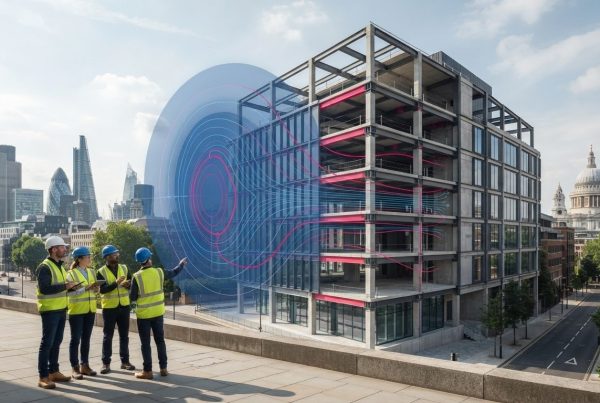

Halting active water ingress is merely temporary containment; true structural leak sealing must restore internal monolithic load capacity while permanently arresting reinforcement corrosion. For asset managers and civil engineers, managing recurring groundwater penetration through basement slabs, retaining walls, or subterranean transit tunnels presents an ongoing operational challenge. Left unmitigated, continuous water ingress accelerates chloride transport, depassivates embedded rebar, and initiates expansive spalling that threatens structural serviceability.
The primary difficulty lies in material specification: misjudging when to deploy rigid epoxy resins for structural rebonding versus elastomeric polyurethanes under active hydrostatic pressure routinely leads to premature repair failure. This engineering guide details the systematic methodology for diagnosing subterranean water pathways, specifying high-performance polymer systems, and executing targeted pressure injection in full alignment with BS EN 1504-5:2013. You’ll explore diagnostic testing methods, mechanical packer installation, and precision delivery protocols designed to halt water ingress and reinstate asset design life.
Key Takeaways
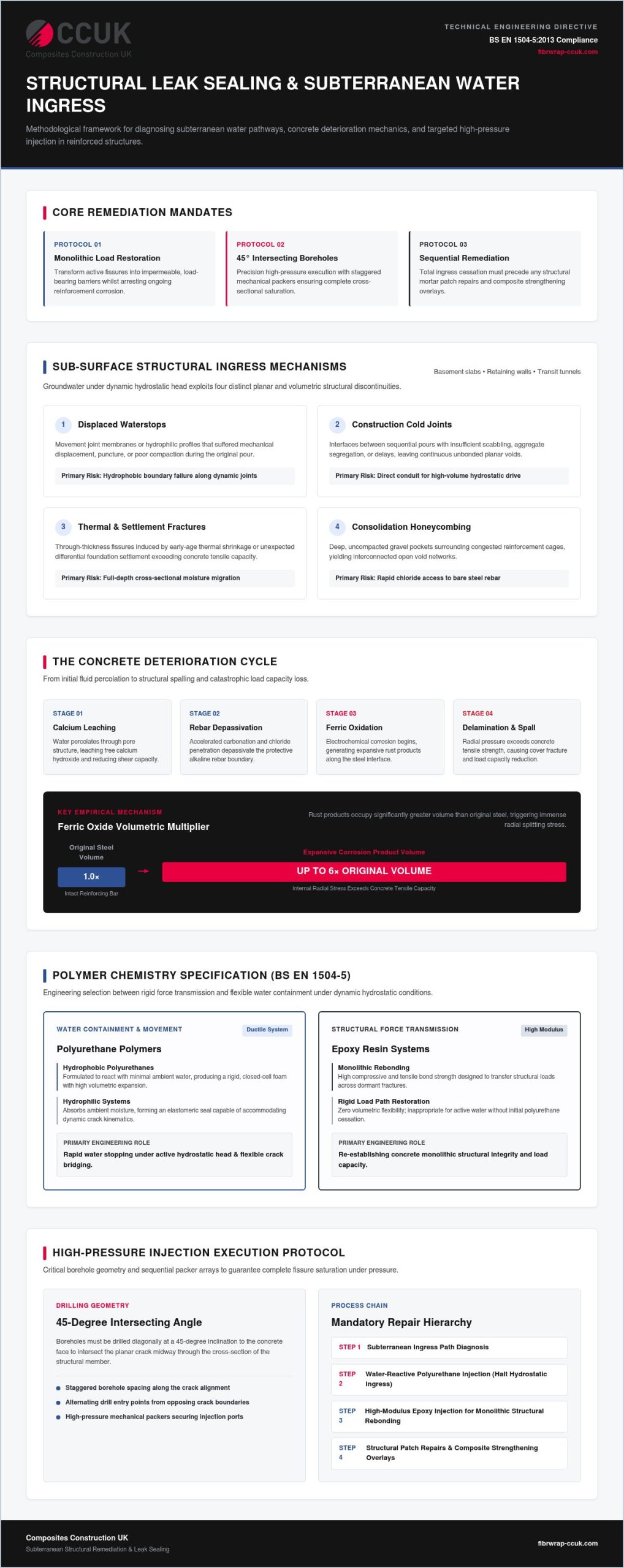
- Discover how advanced structural leak sealing isolates subterranean ingress pathways, transforming active cold joints and honeycombing voids into impermeable, load-bearing barriers.
- Learn the critical rheological criteria for specifying polymer chemistry, balancing rapid-reacting hydrophobic polyurethanes against high-modulus epoxies under active hydrostatic head.
- Master the regulatory compliance framework of BS EN 1504-5 to specify the precise injection category for ductile movement accommodation or rigid force transmission.
- Understand high-pressure injection execution protocols, focusing on 45-degree intersecting borehole geometries and mechanical packer arrays that guarantee complete fissure saturation.
- Explore the mandatory remediation sequencing required to completely arrest moisture ingress prior to executing structural patch repairs and composite strengthening overlays.
Understanding Structural Leakage: Ingress Pathways in Reinforced Concrete
In subterranean civil engineering, structural leak sealing represents the targeted execution of pressure injection to transform compromised concrete fissures into an impermeable, monolithic, and load-bearing barrier. While superficial barrier treatments merely mask seepage, true structural remediation directly confronts the hydraulic mechanics within the concrete element. Under substantial hydrostatic heads, groundwater does not merely percolate through porous zones; it actively exploits structural discontinuities, driving dissolved salts and acidic contaminants deep into the reinforced cross-section. Identifying the exact morphology of these ingress pathways is the critical precursor to specifying an enduring engineering solution.
Primary Mechanisms of Sub-Surface Ingress
Water migration through retaining structures, basement slabs, and subterranean transit assets typically concentrates along distinct material and structural vulnerabilities:
- Displaced waterstops: Movement joint membranes or hydrophilic profiles that suffered displacement, puncture, or poor concrete compaction during the original pour.
- Construction cold joints: Interfaces between sequential concrete pours where insufficient scabbling, aggregate segregation, or delays created planar voids vulnerable to hydrostatic drive.
- Thermal and settlement fractures: Through-thickness fissures induced by early-age thermal shrinkage or unpredicted differential foundation settlement exceeding the concrete’s tensile strain capacity.
- Consolidation honeycombing: Deep, uncompacted gravel pockets formed around congested reinforcement cages, creating open networks for high-volume ingress.
The Deterioration Cycle of Water Infiltration
Chronic water migration establishes a rapid chemical deterioration cycle within the reinforced matrix. As unmitigated groundwater percolates through the pore structure, it leaches free calcium hydroxide from the hydrated cement paste. This continuous leaching elevates porosity and erodes the internal shear capacity of the structural element. Concurrently, fluid ingress serves as a primary transport mechanism for external contaminants, accelerating established causes of concrete degradation such as atmospheric carbonation and chloride penetration.
When migrating moisture depassivates the protective alkaline environment surrounding the embedded reinforcement, electrochemical corrosion begins. Ferric oxidation produces expansive rust products that occupy up to six times the volume of the original steel bar. The resulting internal radial stress quickly exceeds the tensile capacity of the concrete cover, culminating in delamination, progressive surface spalling, and substantial loss of structural load-bearing capacity. Without timely structural leak sealing to halt active water pathways, these failure mechanisms inevitably compound, transforming localised water ingress into widespread structural compromise.
Resin Chemistry: Comparing Polyurethane, Epoxy, and Acrylic Systems
Successful structural leak sealing depends entirely on matching the rheological and chemical behaviour of the polymer to the thermodynamic and mechanical conditions of the fissure. Specifying an injection resin requires a rigorous assessment of crack kinematics, aperture width, ambient temperature, and the presence of dynamic hydrostatic pressure. In accordance with performance criteria set out in BS EN 1504-5, repair polymers are divided into distinct chemical classes, each serving precise functional objectives within concrete remediation.
Polyurethane Ingress Barriers: Hydrophobic vs Hydrophilic
Polyurethanes are the primary defence against active groundwater ingress due to their water-reactive expansion mechanisms:
- Hydrophobic polyurethanes: Formulated to react with minimal ambient water, producing a rigid, closed-cell foam with volumetric expansion up to thirty times the original liquid volume. These resins do not absorb further moisture once cured, making them ideal for cutting off high-volume, high-velocity water gushes.
- Hydrophilic polyurethanes: Chemical formulations that incorporate surrounding water directly into their polymer backbone, creating a flexible, elastomeric cellular matrix. Because they maintain continuous flexibility, they absorb cyclical joint displacement without cohesive tearing or interfacial debonding.
Complex subterranean interventions often utilise a two-stage approach, where an initial rapid-foaming hydrophobic resin arrests dynamic ingress, followed immediately by a dense, non-foaming flexible polyurethane to achieve a permanent, hermetic seal.
Epoxy Resins for Structural Integrity Restoration
Where structural continuity must be restored across non-moving cracks, low-viscosity epoxy systems remain the engineering benchmark. Epoxies provide exceptional compressive and shear strengths that frequently surpass the mechanical properties of the parent concrete substrate. Formulations exhibiting viscosities below 150 mPa·s can penetrate micro-fissures down to 0.1 millimetres under sustained mechanical pressure. However, standard epoxies exhibit poor tolerance for active water flushing during injection. Because surging water streams dilute the unhardened resin and prevent proper cross-linking, epoxies must only be injected into dry or pre-sealed fissures.
Acrylic and Methacrylate Gel Injection
Featuring viscosities comparable to water (typically 1 to 5 mPa·s), water-soluble methacrylate hydrogels excel where particulate suspensions and standard resins cannot penetrate. These ultra-low viscosity systems offer precisely controlled polymerisation rates, with gel initiation times adjustable from forty seconds to several minutes. Methacrylates are uniquely suited for curtain grouting behind subterranean retaining walls, creating an elastomeric membrane within the adjacent soil strata. For complex containment challenges requiring precise polymer selection, consulting a specialist team to deliver bespoke engineering design ensures the chemical system directly matches the hydrogeological conditions of the asset.
Technical Specification and Standards: Compliance with BS EN 1504-5
Specifying structural leak sealing operations requires an enforceable technical framework rather than subjective site practice. BS EN 1504-5:2013 governs the characterisation and performance requirements of injection formulations across UK civil infrastructure. Before field delivery, engineers must translate diagnostic data into detailed execution sheets. These specifications dictate mechanical packer spacing, staging thresholds, maximum allowable pressures, and refusal criteria based on volumetric uptake and sustained pressure stabilisation.
Diagnostic Testing and Crack Characterisation
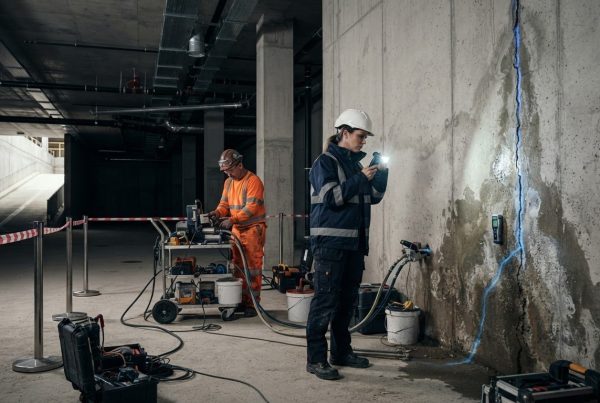
Accurate material selection hinges on rigorous condition surveys. Non-destructive methods, including ultrasonic pulse velocity and ground-penetrating radar, map internal voids and honeycombing without compromising structural cover. Calibrated mechanical tell-tale gauges or vibrating wire crackmeters establish whether discontinuities are dormant or dynamic, tracking thermal and cyclical movements over extended observation windows. Site engineers must also evaluate in-situ hydraulic parameters. Measuring active discharge rates, water pH, and dissolved salts directly influences polymer cure kinetics and ensures the chosen resin won’t suffer wash-out during placement.
BS EN 1504-5 Performance Classifications
The standard categorises concrete injection products according to their intended mechanical behaviour and structural contribution:
- Category F (Force-transmitting): Formulations engineered to transfer compressive, tensile, and shear loads across dormant fissures. Often drawing on technical principles harmonised with the ACI specification for epoxy injection, these high-modulus systems restore monolithic action to cracked structural members.
- Category D (Ductile filling): Elastic polymers designed to seal flexible fractures undergoing repeated displacement, such as movement joints subject to dynamic traffic loading, vibrations, or thermal cycling.
- Category S (Swelling fitted filling): Hydrophilic formulations that expand repeatedly upon contact with water, maintaining positive contact pressure within subterranean expansion zones under fluctuating groundwater regimes.
Mandating compliance with these defined categories eliminates guesswork, ensuring structural leak sealing protocols deliver verified bond strength, chemical resistance, and long-term durability across critical infrastructure assets.
High-Pressure Injection Methodologies for Sub-Surface Structures
While low-pressure gravity feeding through surface ports suffices for non-structural superficial cracks, deep subterranean water exclusion demands high-pressure mechanical injection. Operating pressures between 15 and 200 bar ensure that specialized polymers displace dynamic water throughout the entire cross-section. Executing structural leak sealing via high-pressure methods requires rigorous drilling geometry, calibrated pump delivery, and precise refusal monitoring to prevent hydraulic fracturing within degraded concrete substrates.
Drilling Geometry and Mechanical Packer Setting
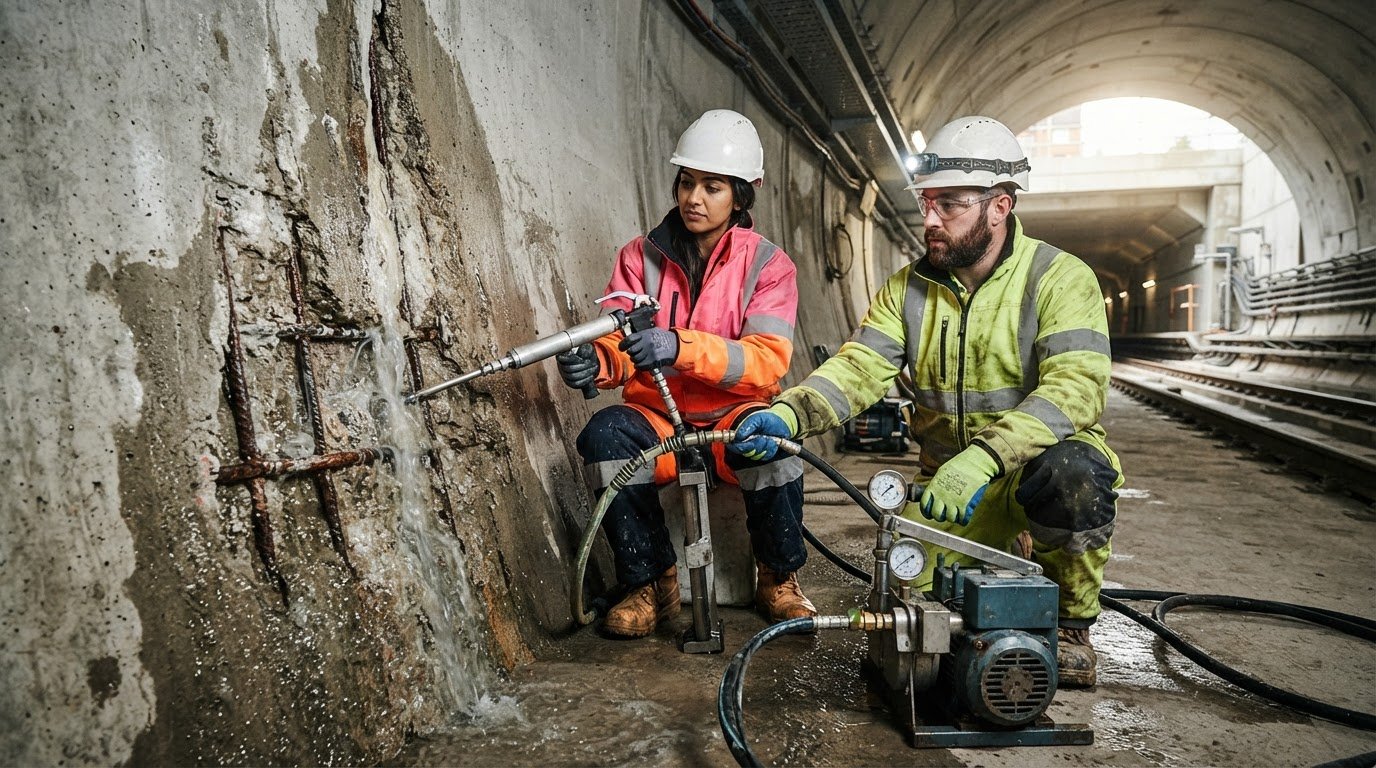
Complete fissure penetration depends on borehole precision. Injection holes are drilled at a 45-degree angle to the concrete face, positioned at an offset calculated to intersect the fracture pathway within the middle third of the structural wall or slab thickness. Technicians arrange boreholes in an alternating, staggered array along both sides of the crack to guarantee intersection regardless of internal plane variations.
Steel mechanical packers, featuring resilient chloroprene expanding sleeves and high-pressure zerk grease nipples, are inserted into flushed boreholes and expanded mechanically. This mechanical compression seals the borehole against blowouts, ensuring injection pressures enter the internal void network rather than escaping at the surface.
Pressure Pumping Execution and Refusal Protocols
Resin delivery is executed using single- or twin-component pneumatic reciprocating piston pumps calibrated to overcome active external water pressure:
- Sequential progression: Pumping begins at the lowest packer on vertical elements or the point of highest water ingress on slabs, proceeding systematically along the array once unreacted polymer discharges from the adjacent port.
- Pressure modulation: Delivery pressures are incrementally increased, continuously balancing flow rate against internal gauge readings to mitigate the risk of micro-crack propagation in fatigued concrete.
- Refusal criteria: Grouting ceases when a targeted pressure threshold is held steadily with zero additional resin intake over a designated dwell time, followed by secondary staged injections where micro-porosity demands consolidation.
Deep Infrastructure and Tunnel Applications
Subterranean infrastructure exhibits complex failure mechanisms requiring specialised delivery techniques. In precast segmental tunnels, active ingress along radial and circumferential joints is mitigated by injecting behind defective elastomeric gasket tracks. For severely degraded retaining walls or secant piles experiencing systemic leakage, curtain grouting is executed by drilling entirely through the concrete envelope to establish an external polymer barrier in the adjacent soil matrix. To evaluate sub-surface defects and formulate bespoke remediation programmes, engage our structural surveys and engineering design services. If your asset requires immediate high-pressure intervention, contact our specialist engineering team to coordinate an on-site technical inspection.
Holistic Remediation: Integrating Leak Sealing with Structural Strengthening
Structural strengthening schemes, particularly externally bonded Carbon Fibre Reinforced Polymer (CFRP) composites, require a sound, chemically stable, and dry substrate. When active groundwater ingress is present, attempting composite application without prior structural leak sealing invariably leads to bond failure. Moisture trapped behind impermeable carbon laminates generates hydrostatic vapour pressure, disrupts polymer curing, and prevents full shear transfer between the concrete substrate and composite fabric. Infrastructure remediation must therefore follow an engineered three-stage sequence: halting active water ingress via high-pressure chemical grouting, reinstating spalled concrete with high-performance repair mortars, and applying structural strengthening overlays.
Substrate Preparation for Advanced Composite Upgrades
Substrate moisture content represents the primary failure risk for composite overlays. Residual pore water within the concrete matrix impedes the interfacial wetting and curing of structural epoxy primers, lowering pull-off tensile adhesion below the standard 1.5 MPa threshold. Prior to installing external carbon reinforcement, relative humidity within the concrete cover zone must be brought within strict engineering tolerances following injection grouting. Only once verification testing confirms complete water exclusion and structural repair mortars have achieved design compressive strength can abrasive surface preparation proceed.
Structural Life-Extension Through Unified Contracting
Asset controllers frequently encounter compromised repairs when leak arrest and structural retrofits are procured through separate, uncoordinated contractors. Executing structural leak sealing prior to composite wrapping delivers comprehensive life-extension for critical civil assets. Once water pathways are permanently isolated and reinforcement passivity is restored, applying systems such as Tyfo® Fibrwrap® Systems completely encapsulates the vulnerable concrete element. This unified methodology prevents future chloride penetration, arrests carbonation, and sustains load-bearing capacity without resorting to costly asset replacement.
Technical Consultation and Specification Support
Complex subterranean transit tunnels, water retaining structures, and industrial assets demand bespoke engineering calculations that account for dynamic crack displacement, residual cross-sectional steel loss, and ongoing hydrostatic loads. Ensuring chemical and mechanical compatibility between injection polymers, structural repair materials, and composite reinforcement requires rigorous technical oversight from initial survey to site handover. Asset owners seeking to evaluate compromised subterranean infrastructure or engineer holistic remediation schemes can engage directly with our technical team through our specialist technical contact portal.
Securing Infrastructure Integrity Through Engineered Water Exclusion
Effective subterranean remediation demands moving past temporary water diversion to rigorous, code-compliant intervention. By isolating active ingress pathways, specifying polymer chemistry under BS EN 1504-5:2013 classifications, and executing high-pressure mechanical injection, engineers permanently halt internal deterioration and restore monolithic load capacity. Halting moisture penetration establishes the essential, sound baseline required before delivering subsequent repair mortars and external composite reinforcement.
With over 25 years of specialist civil contracting and engineering design expertise across critical assets, Composites Construction UK provides unified project delivery from initial diagnostic condition surveys to high-pressure resin delivery and concrete repairs. As the exclusive UK licensee for Tyfo® composite strengthening and remediation systems, we ensure your assets achieve verified, long-term durability. Consult Composites Construction UK for specialist structural leak sealing and engineering design to permanently protect your subterranean structures against persistent groundwater ingress.
Frequently Asked Questions
What is the primary difference between structural leak sealing and standard waterproofing?
Structural leak sealing involves high-pressure injection of engineered polymers directly into the internal concrete matrix, whereas standard waterproofing typically relies on topical barrier membranes or coatings. While surface tanking merely deflects water or traps it within the element, structural injection fills internal voids, honeycombing, and fissures through the full section depth. This halts reinforcement corrosion, stops hydrostatic migration, and can restore compressive and shear transfer across dormant fractures.
Can active, high-pressure water leaks be sealed without draining the asset?
Yes, active high-pressure leaks can be arrested without dewatering subterranean or water-retaining structures. Specialist rapid-reacting hydrophobic polyurethane injection resins react within seconds upon contact with incoming groundwater, generating an expansive, closed-cell barrier that resists dynamic hydrostatic pressure. Once high-velocity water streams are cut off, secondary non-foaming flexible resins or structural epoxies are introduced through the mechanical packer network to consolidate the fissure and deliver a permanent hermetic seal.
Which resin type is appropriate for moving versus non-moving structural cracks?
Resin selection is strictly determined by crack kinematics. Non-moving or dormant fractures require low-viscosity, high-modulus epoxy resins to re-establish structural load transfer and restore monolithic tensile action across the concrete cross-section. Conversely, dynamic cracks and active expansion joints undergoing thermal movement or continuous structural vibration demand flexible, elastomeric polyurethanes or ductile acrylic hydrogels. These flexible polymers accommodate cyclical strain without suffering adhesive failure or cohesive tearing along the concrete interface.
How does BS EN 1504-5 govern structural resin injection works?
BS EN 1504-5 establishes the harmonised technical specifications and performance criteria for injection materials across UK civil engineering assets. The standard classifies polymers into distinct functional groups: Category F for force-transmitting filling of structural cracks, Category D for ductile movement accommodation in dynamic joints, and Category S for swellable water-reactive filling. It dictates testing protocols for adhesion, shrinkage, glass transition temperature, and durability, ensuring specified products perform reliably under site-specific conditions.
Why must structural leaks be completely sealed prior to applying CFRP strengthening?
Structural leak sealing is a vital prerequisite because externally bonded Carbon Fibre Reinforced Polymer (CFRP) composites demand a sound, chemically dry substrate for effective load transfer. Trapped groundwater prevents structural epoxy primers from curing correctly, severely degrading tensile bond strength below the mandatory 1.5 MPa threshold. Additionally, ongoing hydrostatic head behind an impermeable composite wrap creates radial pore pressure, which triggers delamination, substrate spalling, and premature debonding of the strengthening fabric.
What equipment and pressures are typically required for deep concrete injection?
Deep concrete injection requires single- or twin-component pneumatic reciprocating piston pumps capable of delivering materials at pressures ranging from 15 bar up to 200 bar. Steel mechanical packers with pressure-rated zerk grease fittings are anchored into 45-degree intersecting boreholes to withstand these hydraulic forces. High delivery pressures ensure the polymer displaces dynamic water and fully penetrates micro-fractures through the middle third of the wall without causing secondary hydraulic fracturing.
How long do modern chemical injection resins last in underground structures?
When correctly specified and installed to BS EN 1504-5 standards, high-performance polyurethanes, epoxies, and acrylic hydrogels provide a service life matching the remaining design life of the parent structure, often exceeding several decades. Because subterranean resins remain encapsulated within the concrete matrix, they’re protected against ultraviolet degradation and atmospheric weathering. Long-term performance depends on proper diagnostic evaluation, ensuring the cured polymer chemistry continuously tolerates groundwater salinity, freeze-thaw cycles, and cyclical joint displacement.