

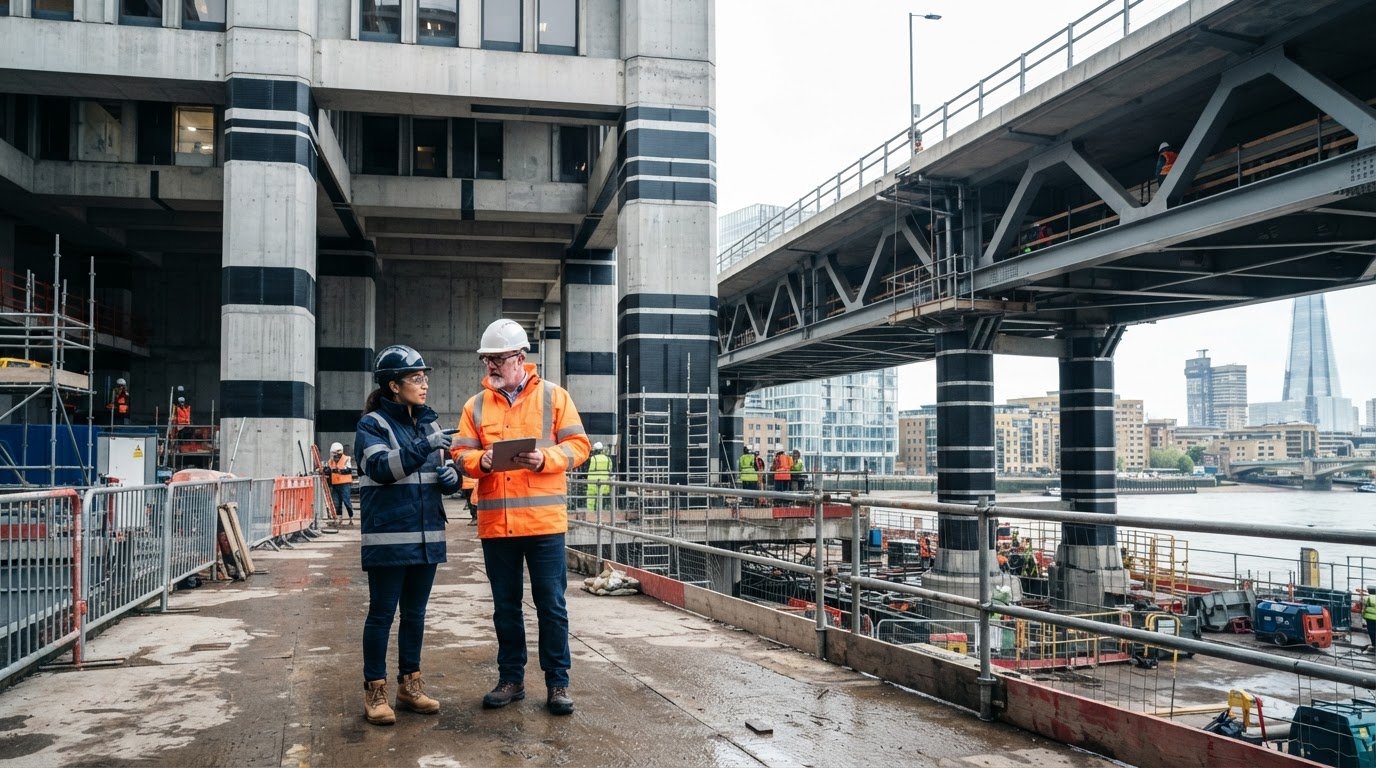
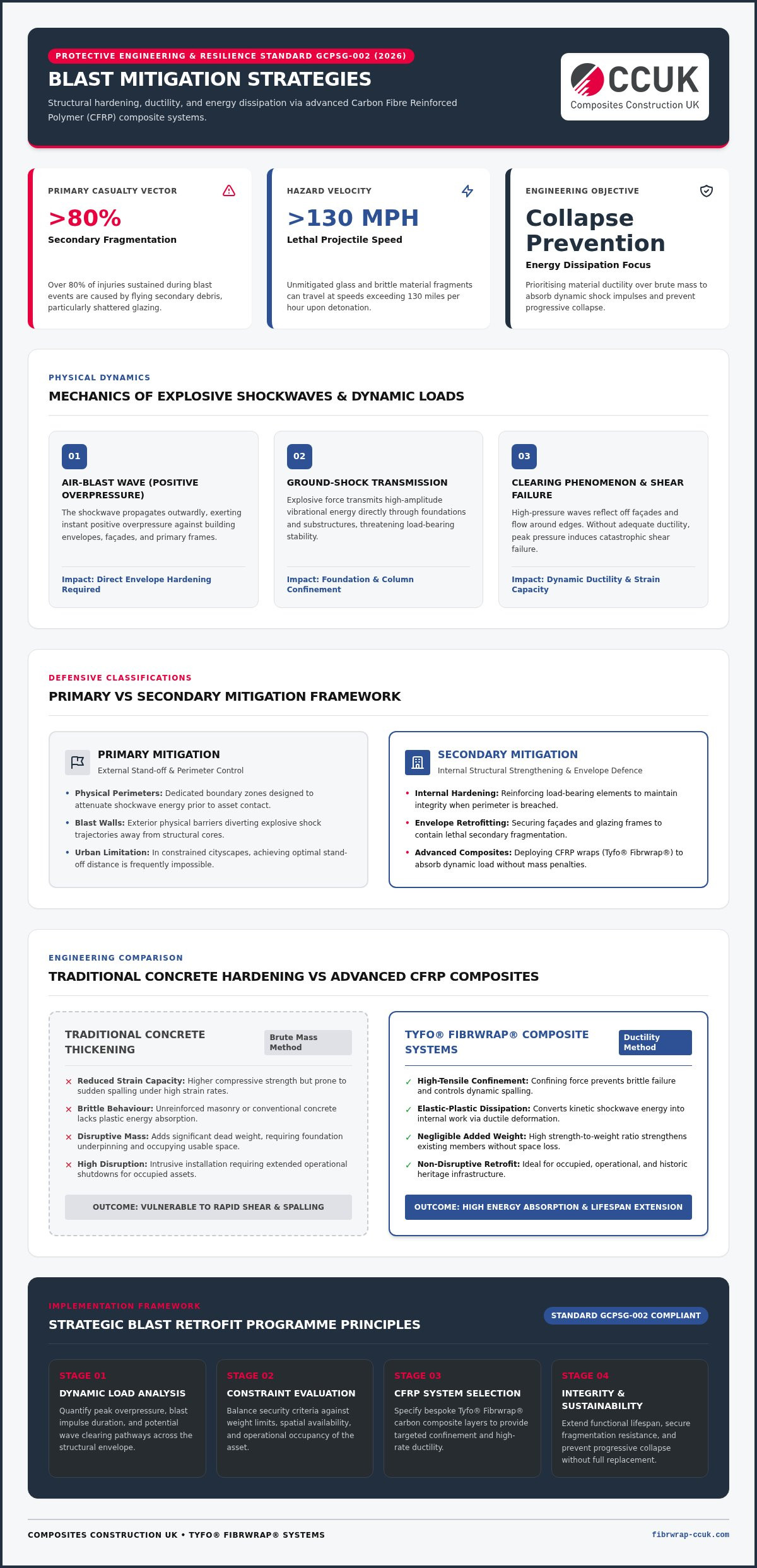
Over 80% of injuries sustained during blast events are attributed to secondary fragmentation, particularly glass, which can travel at velocities exceeding 130 miles per hour. For asset controllers and structural engineers, the challenge isn’t merely preventing initial failure but managing the complex dynamics of energy dissipation to prevent progressive collapse. Implementing effective blast mitigation strategies often feels like a compromise between rigorous security requirements and the practical constraints of weight, aesthetics, and the difficulty of retrofitting occupied or historical buildings. You’re likely concerned about how to achieve high-performance protection without the disruptive mass of traditional concrete hardening.
This article demonstrates how advanced composite engineering, specifically Carbon Fibre Reinforced Polymer (CFRP) systems, can protect critical infrastructure from explosive threats whilst maintaining structural integrity. We’ll provide a framework for selecting mitigation strategies that prioritises ductility and energy absorption over sheer mass. By examining the application of Tyfo® Fibrwrap® systems and adhering to updated standards like GCPSG-002 (2026), you’ll discover how to extend the functional lifespan of essential assets through sophisticated, non-disruptive science.
Key Takeaways
- Understand why prioritising energy dissipation and ductility is more effective than simply increasing structural mass for modern resilience.
- Learn how to develop a strategic retrofit programme by selecting blast mitigation strategies that balance security requirements with existing weight and space constraints.
- Compare the performance of advanced composites against traditional reinforced concrete thickening to determine the most non-disruptive solution for occupied buildings.
- Discover how Tyfo® Fibrwrap® systems provide high-tensile reinforcement that manages explosive impulses while extending the asset’s functional lifespan.
- Recognise the economic and environmental benefits of strengthening existing infrastructure through bespoke engineering design instead of resorting to full structural replacement.
Fundamental Principles of Blast Mitigation Strategies
Blast mitigation strategies are defined by the systematic reduction of structural degradation and human casualty resulting from explosive events. In the discipline of protective engineering, the primary objectives are focused on the prevention of progressive collapse and the minimisation of lethal fragmentation. The efficacy of any intervention relies on a precise understanding of the blast impulse, which is characterised by the relationship between peak overpressure and the specific duration of the dynamic load. While initial risk management often relies on established explosion protection techniques, the physical reality of urban infrastructure requires a deeper integration of material science within the structural frame itself.
The Mechanics of Explosive Loads
When a detonation occurs, the resulting shockwave propagates outwardly, interacting directly with building façades and primary structural frames. This interaction manifests as either an air-blast, which exerts immediate positive overpressure onto the envelope, or a ground-shock, which transmits high-amplitude vibrational energy through the foundations. In constrained urban environments, achieving optimal stand-off distance is frequently impossible. Consequently, the structure itself must absorb the blast energy directly. This response is heavily influenced by the phenomenon of clearing, where the high-pressure wave reflects off the facade and flows around the edges of the structure, relief-mapping the net impulse. Without adequate ductility, the sudden application of peak pressure induces immediate shear failure in conventional reinforced concrete columns.
Primary vs Secondary Mitigation
Protective engineering bifurcates defensive measures into primary and secondary classifications. Primary mitigation encompasses physical perimeters, blast walls, and stand-off zones designed to attenuate the shockwave before it reaches the asset. Secondary blast mitigation strategies, conversely, focus on internal hardening and structural strengthening, ensuring the building envelope and load-bearing elements maintain stability when the primary perimeter is breached or absent. The building envelope serves as the critical line of defence for occupant safety, requiring sophisticated retrofitting to mitigate secondary fragmentation. Through advanced engineering methodologies, such as those detailed in our design features, existing structural elements can be reinforced to survive these extreme dynamic loads, aligning asset protection with long-term operational sustainability.
The Role of Ductility and Energy Dissipation
Brittle materials, such as unreinforced masonry or conventionally detailed concrete, are notoriously susceptible to explosive impulses. These materials lack the inherent capacity to absorb energy through plastic deformation, which leads to catastrophic fragmentation and immediate structural failure. Effective blast mitigation strategies prioritse ductility, allowing a structure to deform and dissipate energy rather than reaching a breaking point instantaneously. By facilitating elastic-plastic behaviour, engineered materials convert the kinetic energy of a shockwave into internal work. This methodology is fundamental to designing buildings to resist explosive threats, ensuring that even if primary elements sustain damage, the global stability of the asset remains intact.
Material Performance Under High-Strain Rates
During an explosion, the loading rate is several orders of magnitude higher than typical seismic or wind events. Concrete often exhibits increased compressive strength but reduced strain capacity under these conditions, making it prone to sudden spalling. Conversely, Carbon Fibre Reinforced Polymer (CFRP) strengthening provides a high-strength, lightweight confining force that significantly enhances a member’s ability to withstand rapid loading without brittle failure. Ductility in blast resilience is the capacity of a structural system to undergo significant inelastic deformation whilst maintaining its load-carrying integrity under extreme dynamic pressure. High-strength composites ensure that structural elements remain functional even after the initial shockwave passes.
Enhancing Structural Redundancy
Preventing progressive collapse, often referred to as “pancake” failure, requires more than hardening individual columns. It necessitates the development of alternative load paths within the existing frame. If a ground-floor column is compromised, the remaining structure must be capable of redistributing those loads through catenary action or enhanced tie-forces. This redundancy is achieved through meticulous connection detailing that prevents the unzipping of floor slabs from their supports. Utilising sophisticated design features allows engineers to model these complex interactions and specify precise reinforcement zones. By integrating Tyfo® Fibrwrap® systems at critical joints, asset controllers can ensure their buildings possess the necessary toughness to survive a major incident. To discuss the specific resilience requirements of your infrastructure, you may consult our specialist engineering team for a technical assessment.
Comparative Analysis: Traditional Hardening vs Advanced Composites
Traditional structural hardening has historically relied on the addition of significant mass to resist explosive impulses. Steel jacketing, whilst providing high confinement, introduces a substantial dead load that often necessitates foundation strengthening. Similarly, reinforced concrete thickening requires the casting of new sections, which consumes valuable internal floor area and adds parasitic weight to the existing frame. Modern blast mitigation strategies have evolved to prioritise the strength-to-weight ratio, favouring materials that enhance ductility without overloading the primary structure or compromising its original design intent.
Weight and Space Considerations
The integration of Carbon Fibre Reinforced Polymer (CFRP) represents a paradigm shift in structural resilience. Unlike traditional methods, CFRP systems add negligible thickness, typically less than 5mm; this is critical for maintaining the functional internal area of high-value commercial assets. For heritage or listed structures, where the preservation of original architectural features is a regulatory requirement, composites allow for internal hardening that remains invisible to the public eye. This approach avoids the costly and complex foundation interventions required when steel or concrete additions exceed the original design capacity of the subsoil.
Installation and Operational Disruption
Operational continuity is a primary concern for asset controllers, particularly in occupied buildings or critical infrastructure hubs. Traditional hardening involves heavy mechanical fixings, welding, and the pouring of wet concrete. These processes generate significant noise, dust, and vibration, often requiring full floor closures. In contrast, the application of composites is a relatively silent, “dry” process that requires minimal site clearance. For a detailed methodology on how these systems are applied with minimal impact on building occupants, refer to our technical guide on Tyfo® Fibrwrap® installation.
From a sustainability perspective, the decision to strengthen rather than replace is compelling. Retrofitting with advanced composites significantly reduces the embodied carbon of a project by eliminating the need for extensive demolition and the high-energy production of new structural steel or bulk concrete. By extending the functional lifespan of existing assets through targeted blast mitigation strategies, engineers can achieve rigorous security standards whilst adhering to modern environmental and economic mandates.
Developing a Strategic Blast Retrofit Programme
Executing effective blast mitigation strategies requires a structured, end-to-end framework that translates threat assessments into precise physical interventions. The process demands a rigorous evaluation of the asset’s existing structural state before any hardening measures are introduced. A successful programme ensures that the chosen materials, whether carbon, glass, or aramid fibres, are selected based on the specific loading demands of the identified threat scenario. Quality assurance protocols must be maintained throughout to guarantee that the installation performs exactly as intended under dynamic loads.
Phase 1: Diagnostic Testing and Feasibility
Initial engineering phases rely on extensive non-destructive testing (NDT) to establish the baseline structural capacity of the substrate. This includes ultrasonic testing and ferroscanning to determine reinforcement layouts and identify sub-surface degradation. Concurrently, computational fluid dynamics (CFD) modelling is deployed to predict specific blast pressure distributions across the facade. Prior to applying advanced composites, any existing defects must be addressed. Engineers should evaluate the necessity of underlying structural repairs to ensure the substrate can sustain the bond stresses developed during a blast event.
Phase 2: Bespoke Engineering Design
Bespoke engineering design involves calculating the exact number of composite layers required to resist the predicted explosive impulse. This stage moves beyond generalised standards to create tailored solutions for specific threat geometries. Attention is focused on detailing the anchor systems, which are critical for ensuring proper load transfer from the composite jacket into the primary structural frame. All designs must achieve strict compliance with UK building regulations whilst meeting the performance criteria outlined in security standards such as GCPSG-002 (2026). This precise calibration ensures the protective system does not alter the global stiffness of the building unfavourably.
Professional installation by certified technicians represents the final, critical phase of the programme. Strict environmental controls must be maintained during the curing process to ensure the long-term durability of the composite matrix. To initiate a comprehensive resilience assessment for your facility, contact the specialist engineering team at Composites Construction UK to discuss a tailored structural survey.
Advanced Mitigation with Tyfo® Fibrwrap® Systems
The Tyfo® Fibrwrap® system represents a sophisticated evolution in composite engineering, designed specifically to address the high-impulse demands of explosive events. As a proprietary Carbon Fibre Reinforced Polymer (CFRP) technology, it is a primary component in modern blast mitigation strategies, providing a high-tensile confining force that restricts structural dilation. The system is characterised by exceptional bond strength and long-term durability, even when deployed in chemically aggressive or high-moisture environments. Its versatility allows for application across a diverse range of critical assets, from the reinforcement of bridge piers to the hardening of subterranean pipeline infrastructure. The successful delivery of such technical solutions relies on the expertise of a specialist engineering contractor who understands the nuances of composite-to-substrate interaction.
Proven Performance in Blast Scenarios
Empirical data gathered through extensive full-scale blast testing confirms that Fibrwrap® systems significantly reduce the risk of catastrophic structural failure. During an explosive event, the system acts as a secondary containment layer, effectively preventing the fragmentation and spalling of concrete that often leads to secondary injuries. By maintaining the integrity of the structural core, the composite ensures the asset remains stable after the initial pressure wave dissipates. This level of protection is equally vital in the utility sector, where the system is utilised for pipeline rehabilitation to protect against internal pressure surges and external physical threats, thereby extending the functional lifespan of essential service networks.
Integration with Building Management
Modern engineering requirements necessitate that protective systems integrate seamlessly with existing building management protocols. Tyfo® Fibrwrap® is fully compatible with specialised fire-resistant coatings and a variety of architectural finishes, ensuring that security hardening does not detract from the building’s aesthetic or fire-safety ratings. Once installed, the system requires minimal maintenance, though periodic visual inspections are recommended to ensure the protective matrix remains uncompromised by external mechanical damage. This non-intrusive approach allows asset controllers to achieve rigorous safety standards whilst prioritising the sustainability of their existing infrastructure. For technical guidance on securing your facility, you are invited to contact our team for a bespoke blast mitigation consultation to discuss your specific resilience requirements.
Securing Infrastructure through Advanced Material Science
Modern structural resilience is defined by the transition from rigid hardening to sophisticated energy dissipation. By implementing ductile blast mitigation strategies, engineers ensure that critical assets absorb explosive impulses without catastrophic failure. This approach maintains the functional integrity of a building whilst avoiding the excessive dead loads and operational disruption associated with traditional concrete thickening or steel jacketing. It’s a methodology that prioritises the long-term utility of existing assets through empirical evidence and engineering rigour.
Achieving this level of security requires a disciplined, end-to-end framework. As the exclusive UK licensee for Tyfo® Fibrwrap® systems, CCUK offers a comprehensive design-to-installation service grounded in over a decade of specialist engineering excellence. Our team ensures that every retrofit is precisely calibrated to the unique threat profile and structural requirements of your infrastructure. This commitment to technical precision provides the absolute reliability necessary for protecting high-value assets in complex environments.
Safeguarding essential infrastructure is a continuous responsibility that demands the highest standards of material performance. Consult our specialist engineers for a bespoke blast mitigation design to ensure your assets remain resilient against evolving threats.
Frequently Asked Questions
What are the primary components of an effective blast mitigation strategy?
An effective programme integrates threat assessment, stand-off management, and structural hardening. It requires a dual approach where primary physical barriers attenuate the shockwave whilst secondary internal reinforcement ensures structural stability. The integration of energy-absorptive materials is essential for managing dynamic overpressure and preventing fragmentation injuries. This methodology prioritises the prevention of progressive collapse through meticulous material selection and bespoke engineering design tailored to specific threat geometries.
Can existing buildings be retrofitted for blast resistance without major demolition?
Existing assets can be hardened without extensive demolition by using advanced composite systems. Unlike traditional concrete jacketing, Carbon Fibre Reinforced Polymer (CFRP) is applied directly to prepared substrates with minimal thickness. This non-disruptive methodology allows for blast mitigation strategies to be implemented in occupied buildings, preserving the internal floor area and avoiding the structural dead loads associated with bulk material additions or foundation strengthening.
How does CFRP compare to steel for structural strengthening against explosives?
CFRP offers a superior strength-to-weight ratio and greater corrosion resistance compared to traditional steel jacketing. Whilst steel provides confinement, it adds significant parasitic weight that often requires foundation strengthening. Composites like the Tyfo® Fibrwrap® system provide high-tensile reinforcement with negligible mass, allowing for faster installation and reduced long-term maintenance costs in harsh environments where steel would be prone to oxidation and environmental degradation.
What is progressive collapse and how do mitigation strategies prevent it?
Progressive collapse occurs when the failure of a single primary structural element leads to the disproportionate failure of surrounding members. Mitigation strategies prevent this “pancake” effect by enhancing structural redundancy and developing alternative load paths. Through the use of composite reinforcement and catenary action detailing, the structural frame is engineered to redistribute loads even if a critical column or transfer beam is compromised during an event.
Are blast mitigation systems visible once they are installed?
Engineered composite systems can be rendered invisible through the application of architectural finishes or fire-resistant coatings. Because the Tyfo® Fibrwrap® matrix adds less than 5mm to the structural profile, it’s easily concealed behind standard cladding, renders, or plasterboard. This makes it an ideal solution for heritage or listed buildings where the preservation of the original aesthetic is a mandatory requirement for planning approval and historical conservation.
How much stand-off distance is required for a typical commercial building?
Stand-off distance requirements are determined by the specific threat level and the building’s inherent structural resilience. While increasing distance is the most effective primary defence, urban constraints often limit this to just a few metres. In such cases, the design must compensate by increasing the hardening of the facade and primary frame to withstand higher peak pressures, as outlined in bespoke engineering calculations and diagnostic modelling.
What UK regulations govern the design of blast-resistant structures?
In the United Kingdom, blast-resistant design is governed by the Building Regulations 2010, specifically Approved Document A regarding disproportionate collapse. Professional guidance is also provided by the National Protective Security Authority (NPSA) and the GCPSG-002 (2026) Blast Mitigation Considerations Guide. These documents establish the performance-based standards required for protecting critical national infrastructure and high-occupancy assets using specialised blast mitigation strategies to ensure long-term security.
How long do composite blast mitigation systems last?
Advanced composite systems are engineered for a functional lifespan exceeding 50 years when installed according to specialist specifications. The epoxy-resin matrix provides inherent resistance to environmental degradation, including carbonation and chloride ingress. Periodic structural surveys and testing ensure the bond integrity remains uncompromised, allowing asset controllers to extend the operational life of essential infrastructure without the need for recurring major interventions or full structural replacement.


