

The most advanced material isn’t automatically the right one for a structure. In advanced materials construction, performance depends on whether the material’s properties suit the structural demand, exposure conditions and practicalities of installation. Engineers need to look beyond a technical data sheet and assess how the complete system will work on the asset itself.
Choosing a material can be challenging because “advanced materials” covers a broad range, and laboratory properties don’t always translate directly into site performance. A fibre-reinforced polymer, for example, may be suitable for strengthening concrete, but its suitability depends on the substrate’s condition, design requirements and quality of application.
This article explains the main material families used in construction, the properties that distinguish them and the applications for which they may be considered. It also outlines how engineers assess structural demands, environmental exposure and installation constraints. With a thorough assessment, repair or strengthening may provide an alternative to replacement and help extend an asset’s useful life where the evidence supports that approach.
Key Takeaways
- Advanced materials construction is defined by performance requirements, not simply by how recently a material was developed.
- Fibre-reinforced polymer composites, including CFRP and GFRP, can be used in structural applications.
- Compare candidate materials against the project’s structural function, exposure conditions and practical installation requirements.
- Use a structured process from asset assessment and design through specification and installation verification.
- Strengthening or repair may help retain an asset, but suitability and limitations require engineering assessment.
What does advanced materials construction mean in structural engineering?
In structural engineering, “advanced material” describes a material engineered or selected to meet particular performance requirements, rather than one that is simply new or technologically novel. Advanced materials construction is the use of engineered materials whose properties, as part of a specified system, are matched to a structure’s demands and conditions. A material’s laboratory properties alone don’t establish how an installed system will perform.
Fibre-reinforced polymers illustrate this distinction. These composites combine reinforcing fibres with a matrix, and include carbon fibre-reinforced polymer (CFRP) and glass fibre-reinforced polymer (GFRP). The overview of Advanced composite materials (ACMs) introduces the broader material family. In construction, engineering value depends on the intended function, design assumptions, compatibility with the existing structure and quality of installation.
Advanced materials supplement conventional concrete, steel and masonry; they don’t automatically replace them. A project may use established materials for the primary structure and introduce a composite or specialist repair system where assessment identifies a specific need. The right choice is the one that meets project requirements and can be designed, installed and assessed reliably.
Which properties make a construction material advanced?
Strength and stiffness matter in relation to the structural demand. Strength concerns resistance to applied actions, whilst stiffness relates to deformation under load. Weight can affect handling and the additional load imposed on an asset. Durability, chemical resistance, thermal behaviour and environmental exposure may also be relevant, depending on the structure and its operating conditions. No single property creates a universal ranking. Compare verified data for the specified material or system with the design assumptions and actual conditions of use.
Where are advanced materials used in buildings and infrastructure?
Applications include strengthening, repair, rehabilitation and protection. These are related, but distinct, intervention objectives. Strengthening addresses a structural capacity requirement; repair treats deterioration or damage; rehabilitation aims to restore or improve an asset’s function; protection helps manage identified exposure risks. These approaches may be considered for buildings, bridges and industrial pipelines, subject to engineering assessment. For further context on repair approaches, see Concrete Repairs and Structural Remediation.
For an existing structure, the decision starts with its condition and the purpose of the intervention, not the material’s novelty. Substrate condition and preparation can influence the performance of bonded systems, so material selection, design and competent application need to be considered together. Where assessment supports intervention, repair or strengthening may offer an alternative to replacement.
Advanced materials in construction: how do they work?
Material families work in different ways, so their engineering function should be considered alongside their composition. Fibre-reinforced polymers (FRPs), including carbon fibre-reinforced polymer (CFRP) and glass fibre-reinforced polymer (GFRP), combine reinforcing fibres with a polymer matrix. The fibres provide directional reinforcement, whilst the matrix binds and supports them and transfers load between them. The resulting behaviour depends on the specified system and how it is designed and installed, not simply on the fibre type.
FRP composites are typically used to strengthen structural elements by adding reinforcement aligned with the required load path. Fibre direction is critical: the strengthening arrangement needs to correspond to the structural action it is intended to address. CFRP strengthening is an engineered intervention, not simply a material purchase. Design, substrate condition, preparation and application all influence how the system interacts with the existing structure.
How do fibre-reinforced polymer composites contribute to structural work?
For an existing beam, column or other structural element, an engineer first establishes the required strengthening function and assesses whether a composite system is suitable. The design needs to account for the element’s condition and the direction of the forces being addressed. Bonded systems also rely on the substrate and installation process, so a product description alone cannot establish the performance of the completed intervention. For system-specific information, consult a technical guide to Tyfo® Fibrwrap® installation, and review structural strengthening design for project-specific engineering considerations.
How do other advanced material families differ?
Advanced cementitious materials have a different composition and engineering role from FRPs. Ultra-high-performance concrete (UHPC), for example, is a cement-based material formulated for demanding performance requirements. Its suitability needs to be established from verified data for the specified mix and application, including relevant test methods and conditions. A broad material label is not a substitute for project-specific design evidence.
Advanced cementitious materials are typically considered where the design calls for a specialised concrete solution, rather than fibre-based reinforcement bonded to an existing element. The two families aren’t direct substitutes: their composition, structural function and installation requirements differ. Protective coatings and repair materials form another category. They address defined exposure or deterioration issues and don’t automatically increase structural capacity. Their purpose should be stated clearly in the specification.
This is the practical distinction behind advanced materials construction: the material family informs the options, but the designed system determines how they are applied to an asset. Comparisons are meaningful only when the data, test conditions and design assumptions relate to the intended use.
How should engineers compare advanced materials for a construction project?
Start with the structural function the intervention must perform, not a material’s novelty or a single headline property. A high strength value doesn’t establish suitability if the proposed system is incompatible with the substrate, cannot be installed within the available access, or hasn’t been assessed for the asset’s service conditions. In advanced materials construction, engineers compare the complete proposed system against project requirements using verified evidence and clearly defined assumptions.
A material data sheet describes a product under stated conditions. On its own, it doesn’t demonstrate how a designed and installed system will behave in a particular structure. Assessment should connect the design requirements with substrate compatibility, environmental exposure and constructability. Structural strengthening design provides context on how project-specific engineering informs system selection.
Which project conditions influence material suitability?
Survey findings establish the starting point. Engineers consider the substrate’s condition, geometry and existing defects, alongside access, sequencing and operational constraints that may affect preparation or installation. Service conditions matter too: moisture, temperature, chemical exposure and other relevant environmental factors should be checked against the proposed system’s verified data. Selection should reflect the asset’s actual condition and documented requirements, not assumptions based on a material category alone.
| Comparison criterion | Questions to ask | Project evidence required |
|---|---|---|
| Structural function | What demand must the intervention address? | Design requirements, structural assessment and stated assumptions |
| Substrate compatibility | Can the system be applied to the existing surface and condition? | Survey findings, substrate assessment and preparation requirements |
| Exposure | Will moisture, temperature or chemicals affect the system? | Recorded service conditions and relevant verified test data |
| Constructability | Can the work be completed with the available access and operational arrangements? | Site constraints, installation sequence and system-specific requirements |
How do lifecycle and sustainability considerations affect comparison?
Compare repair, strengthening and replacement on a consistent, project-specific basis. Define the scope of each option and consider installation disruption, evidence for durability, anticipated maintenance and the asset’s intended service requirements. Claims about lower carbon impact or longer service life are meaningful only when supporting evidence uses comparable boundaries, assumptions and conditions. Without that basis, broad claims can obscure rather than clarify the decision.
The preferred option is the one that meets the structural need and can be delivered and maintained within the asset’s constraints. Where engineering assessment supports repair or strengthening, retaining the existing structure may be a viable alternative to replacement. That conclusion needs to be supported by condition evidence and a considered comparison of available interventions.
What must be checked before advanced materials are specified and installed?
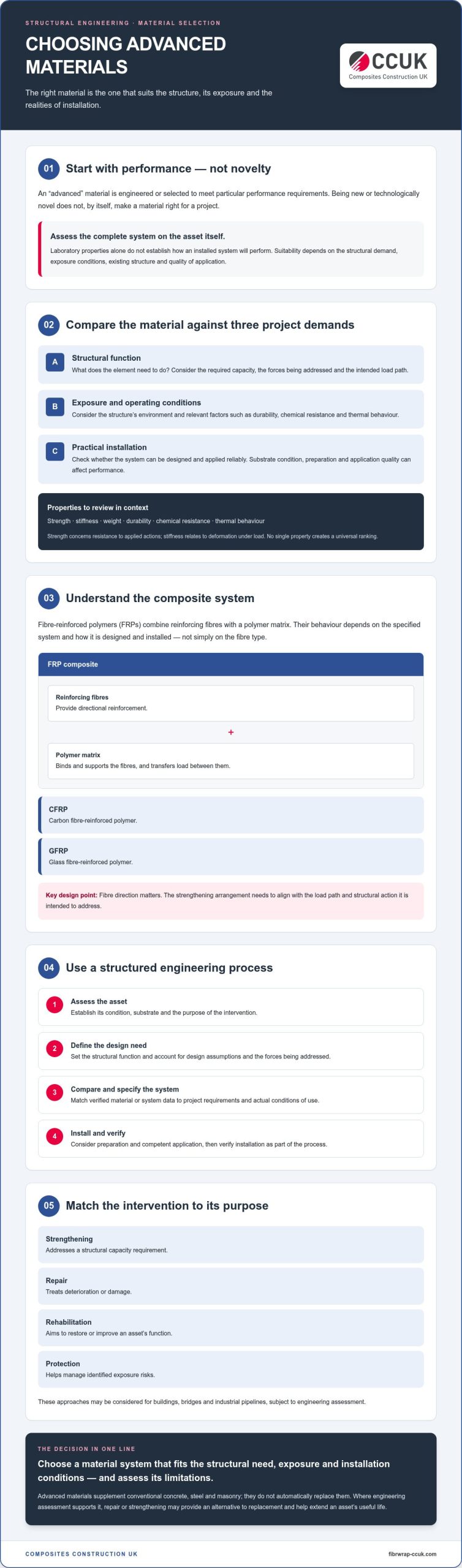
A reliable specification connects the asset’s condition to a defined structural requirement and a verifiable installation process. For advanced materials construction, sequence matters: material selection should follow assessment and design, not precede them. Check standards, test methods and project requirements for each application rather than assuming they apply universally.
- Assess the asset. Establish the structural issue, review available records and identify what further survey or testing is needed to understand the structure and its substrate.
- Define the requirements. State the intervention’s purpose, design demands, exposure conditions and practical constraints, including access and ongoing operation.
- Complete the design. Use assessment findings to develop a project-specific design, recording assumptions and relevant verification requirements clearly.
- Specify the system. Identify the materials, substrate condition, preparation, installation requirements and inspection or quality checks needed to deliver the design intent.
- Verify installation. Check the work against the project specification and document relevant inspections, testing, departures and corrective actions.
What should an engineering assessment establish?
The assessment should distinguish the observed condition from the cause of the problem and identify the intervention required. Surveys, records and appropriate testing can inform design decisions where more evidence is needed. The scope depends on the asset and available information. Document findings with their limitations and assumptions so they can be carried into the design. For broader context, a guide to structural repairs can explain how material interventions fit within asset remediation.
Why do design and installation quality matter?
For bonded systems, the substrate is part of the engineered interface. Its condition and preparation can influence the bond, so project requirements for surfaces and installation details need to be defined and checked during delivery. Workmanship, inspection and quality records help establish whether the installed system matches the design intent. A specialist engineering contractor’s responsibilities across design, specification and application should be clear and agreed for each project.
Check design requirements, standards and testing against the asset, proposed system and applicable project documentation. A material data sheet alone can’t confirm that the completed intervention is suitable. To discuss project-specific structural assessment or strengthening design, contact the engineering team.
How can advanced materials support structural repair and asset life-extension?
Repair and strengthening can sometimes retain a structure that might otherwise be considered for replacement, provided assessment shows that intervention is technically appropriate. The aim isn’t to use an advanced material for its own sake, but to address an identified structural issue and support the asset’s required function. In advanced materials construction, this means matching the proposed material and system to the structure’s condition, design requirements and exposure, then checking that the intervention can be installed as intended.
Carbon fibre-reinforced polymer (CFRP) strengthening and Tyfo® Fibrwrap® Systems are composite systems that may be considered as part of an engineered strengthening solution. Neither is suitable in every situation. The existing substrate, load path, design requirements and installation conditions all need to be assessed. A solution that doesn’t address the cause of deterioration or the structural demand won’t become appropriate simply because it uses a specialised material.
When might composite strengthening be considered?
Composite strengthening may be assessed where an asset requires additional structural capacity or rehabilitation, and the existing structure can support the proposed intervention. The design must respond to the element’s condition and geometry, the load path being addressed and verified project requirements. Substrate condition and preparation, exposure and installation constraints also inform whether a bonded system is suitable. System-specific guidance, including a technical guide to Tyfo® Fibrwrap® installation, should be considered alongside the project design, not as a substitute for it.
Where engineering assessment supports it, strengthening or repair may provide a route to retaining an asset and prolonging its functional use. That outcome depends on the suitability of the intervention and the evidence available. It shouldn’t be assumed from a material’s general properties.
What should asset owners do next?
Before seeking a proposed solution, assemble information that helps an engineer understand the structure and the concern:
- Available drawings, asset records and previous repair information.
- Inspection or survey findings, including observations of damage or deterioration.
- A clear description of the structural issue and relevant operating or exposure conditions.
Specialist engineering input can help determine whether further survey or testing is needed, define the intervention and assess whether a composite system is appropriate. The decision should follow the evidence, not precede it. Repair or strengthening may be a sound alternative to replacement when assessment supports that choice, but design, substrate condition and competent installation remain central to performance.
For project-specific advice on structural assessment or strengthening options, contact the engineering team with the available asset information and a description of the concern.
Make material selection part of a sound structural strategy
Advanced materials construction delivers value when the material and complete system are matched to the asset’s structural needs, condition, exposure and installation constraints. Technical properties alone don’t establish suitability. Assessment, design, substrate preparation and competent application all contribute to whether a repair or strengthening intervention can meet its intended purpose.
For asset owners, the key decision isn’t simply whether a material is advanced, but whether an evidence-led intervention can support the structure’s required function. Where engineering assessment supports repair or strengthening, retaining the asset may be a viable alternative to replacement.
Composites Construction UK provides specialist design, feasibility and installation expertise, alongside structural repair and strengthening services across the UK. Its work includes structural surveys and testing, concrete repair and CFRP strengthening, including Tyfo® Fibrwrap® Systems. To discuss a project-specific structural assessment or strengthening requirement, contact the engineering team with your asset information and a description of the concern.
Frequently Asked Questions
What are advanced materials in construction?
Advanced materials in construction are materials engineered or selected to meet specific performance requirements. The term covers different material families, so it doesn’t mean one material is automatically better than conventional concrete, steel or masonry. Their value depends on the structural function, asset condition, exposure and installation method. Engineers assess verified material data alongside the design and project conditions to determine whether a material or complete system is suitable.
Which advanced materials are commonly used in construction?
Examples include fibre-reinforced polymer (FRP) composites, such as carbon fibre-reinforced polymer (CFRP) and glass fibre-reinforced polymer (GFRP), as well as specialised cement-based materials such as ultra-high-performance concrete. These materials have different compositions and potential functions. FRP composites may be designed for structural strengthening, whilst cement-based materials may be specified for particular concrete applications. Protective and repair materials serve other purposes, so selection depends on the intervention required.
Are advanced materials stronger than steel or concrete?
There’s no reliable universal ranking. Strength depends on the property being compared, the direction and type of loading, and the conditions under which data was measured. Structural performance also depends on how a material is designed and incorporated into a system. Engineers should compare verified test data for relevant conditions and assess the complete intervention against project requirements, rather than judge suitability from a single figure.
How do engineers choose an advanced material for a project?
Engineers begin by defining the structural function the intervention must perform, then consider the asset’s condition, substrate compatibility, geometry, exposure and installation constraints. They review available survey information and identify whether further testing is needed. Candidate systems are assessed against the design requirements and verified technical evidence, including relevant test conditions. The choice should reflect the project as a whole, since a data sheet alone can’t establish how an installed system will perform.
Can advanced materials be used to strengthen existing structures?
Yes. CFRP systems, for example, may be considered for strengthening an existing structural element where assessment identifies a need and confirms the intervention is appropriate. Design must account for the asset’s condition, load path, substrate and project requirements. Preparation and installation also matter, particularly for bonded systems. Advanced materials construction can support repair or strengthening, but it doesn’t guarantee an asset can be retained. That decision depends on engineering assessment.
Do advanced construction materials make projects more sustainable?
Not automatically. A repair or strengthening intervention may help retain an existing asset when engineering assessment supports it, potentially avoiding replacement, but environmental benefits shouldn’t be assumed without comparable evidence. A meaningful assessment defines the scope and assumptions for each option, including relevant material quantities, installation impacts, maintenance and intended service requirements. Claims about carbon impact or service life should be supported by evidence that relates to the project and uses a comparable basis.
Why does installation quality matter for composite construction materials?
Installation quality affects whether the completed system reflects its design intent. For bonded composites, the existing substrate and its preparation form part of the interface, so their condition and specified preparation need to be addressed. Detailing, workmanship and appropriate inspection also contribute to reliable application. Project-specific quality checks and records help confirm that work aligns with the specification. Specialist design and competent installation should therefore be considered together, not as separate concerns.