
The traditional reliance on reinforced concrete jacketing as the primary method for structural remediation often overlooks the substantial engineering penalties associated with added mass and section enlargement. You likely recognise the operational frustrations of lengthy construction programmes and the persistent threat of interstitial corrosion in conventional steel reinforcement. This article provides an authoritative technical comparison of Tyfo Fibrwrap vs concrete jacketing, examining how advanced Carbon Fibre Reinforced Polymer (CFRP) systems align with the rigorous UK standards defined in CS 453 and CD 371.
We will demonstrate how high-performance composites deliver superior load-bearing enhancement with negligible impact on structural profiles. This analysis previews the comparative material properties, installation efficiencies, and the long-term durability of the Tyfo® system, which is engineered to provide a 120-year design life extension. By shifting the focus from wholesale replacement to sophisticated material science, asset controllers can ensure the continued safety of critical infrastructure whilst meeting the net-zero objectives of the 2026 UK construction landscape.
Key Takeaways
- Understand the mechanical principles of confinement that allow Tyfo® Fibrwrap® to enhance compressive strength without the structural penalty of excessive dead weight.
- Evaluate the operational advantages of Tyfo Fibrwrap vs concrete jacketing, focusing on how composite systems significantly reduce project timelines and site footprint.
- Identify the durability benefits of utilising non-metallic materials to eliminate the risk of steel reinforcement corrosion in aggressive or chloride-exposed environments.
- Explore a technical decision matrix designed to assist asset managers in selecting between traditional jacketing, advanced composites, or full structural replacement.
- Recognise the importance of early engagement with a specialist engineering contractor to ensure single-point responsibility from initial design through to final certification.
Structural Strengthening Methodologies: Defining Advanced Composites and Traditional Jacketing
UK infrastructure faces a critical juncture. Many essential assets, including highway bridges, industrial facilities, and commercial buildings, are approaching or exceeding their original design lives. This necessitates robust intervention to maintain safety and serviceability standards. Traditionally, engineers have relied on concrete jacketing. This method involves the application of a reinforced concrete overlay to increase the cross-sectional area of a structural member. Whilst effective for increasing axial capacity, this technique introduces significant dead weight and alters the structure’s dynamic profile. Evaluating Tyfo Fibrwrap vs concrete jacketing requires an understanding of how modern material science addresses these legacy limitations.
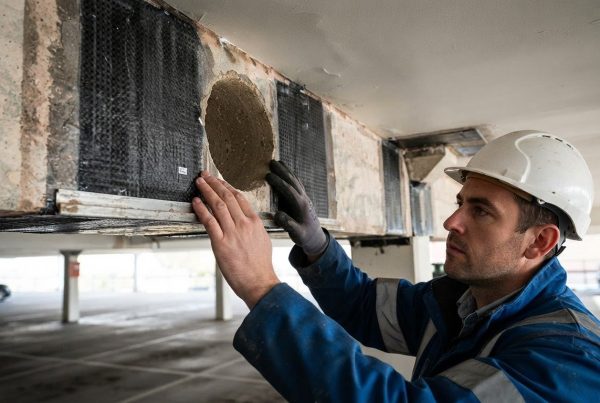
Tyfo® Fibrwrap® represents a paradigm shift in structural engineering. It is a high-strength Fibre-reinforced plastic (FRP) system that utilises a specialised wet-layup process. Carbon or glass fibres are saturated with proprietary epoxy resins and bonded directly to the structural substrate. This creates a thin, high-tensile skin that enhances the existing member’s performance. The engineering shift toward these low-mass interventions is driven by a requirement for precision and the preservation of original architectural clearances.
The Evolution of Structural Rehabilitation
The methodology for structural repairs has transitioned significantly over the last three decades. Early interventions often utilised heavy steel plate bonding, which was prone to corrosion and required complex mechanical anchoring. Tyfo® systems have revolutionised the sector by providing a versatile, non-corrosive alternative that conforms to complex geometries. By leveraging advanced polymers, engineers can achieve significant strength gains without the logistical burden of traditional formwork or the extensive curing times associated with concrete overlays. This evolution reflects a broader commitment to extending the functional lifespan of assets through sophisticated material science.
Core Objectives of Asset Life-Extension
Strengthening projects are typically designed to target specific performance gaps. These objectives often include addressing load-bearing deficiencies, improving seismic resilience, or providing essential blast mitigation. Selecting the appropriate intervention depends on rigorous structural design and engineering. The goal is to balance technical performance with economic and environmental constraints. Whilst concrete jacketing remains a valid traditional baseline, the adoption of Tyfo® Fibrwrap® is increasing. It allows for rapid execution and minimises the carbon footprint associated with high-volume concrete production and transportation.
Mechanical Performance: Load Transfer and Structural Integrity
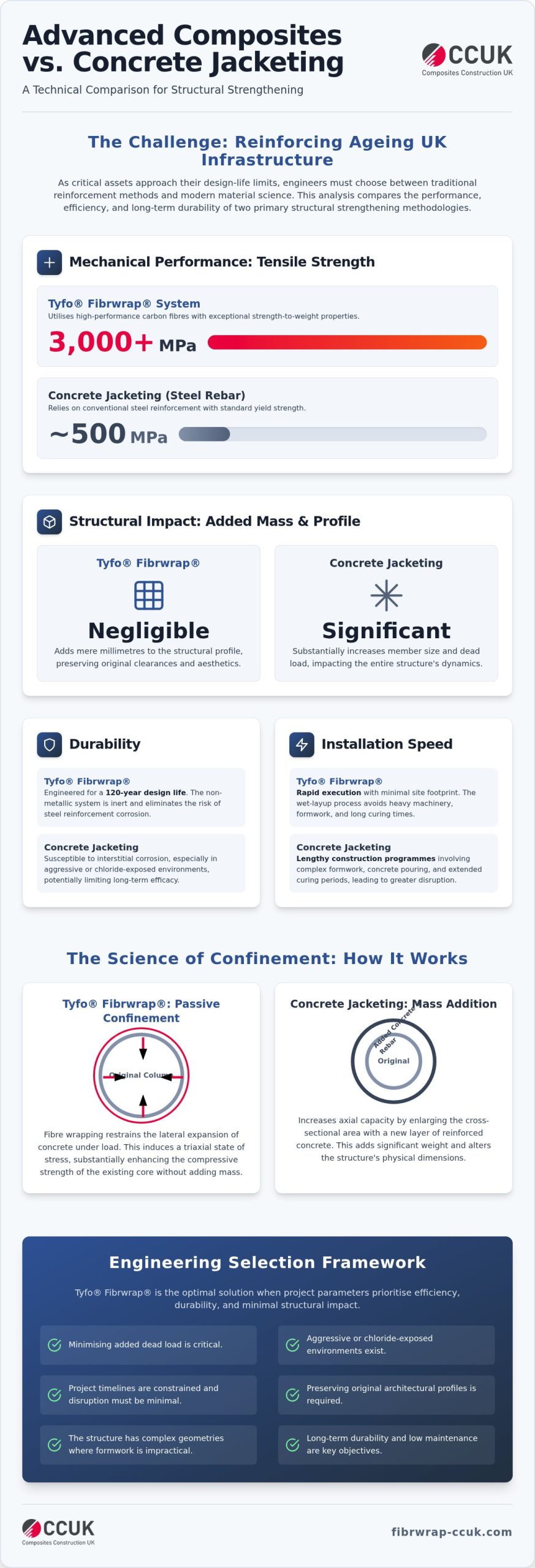
Mechanical efficacy in structural interventions is determined by the efficiency of load transfer and the resulting integrity of the composite member. When evaluating Tyfo Fibrwrap vs concrete jacketing, the primary differentiator lies in the tensile properties of the reinforcement materials. Conventional steel typically offers a yield strength of approximately 500 MPa. In contrast, the carbon fibres utilised in Tyfo® SCH systems provide a tensile strength exceeding 3,000 MPa. This allows for a significant increase in flexural and shear capacity whilst avoiding the requirement for bulky overlays that alter the original design intent.
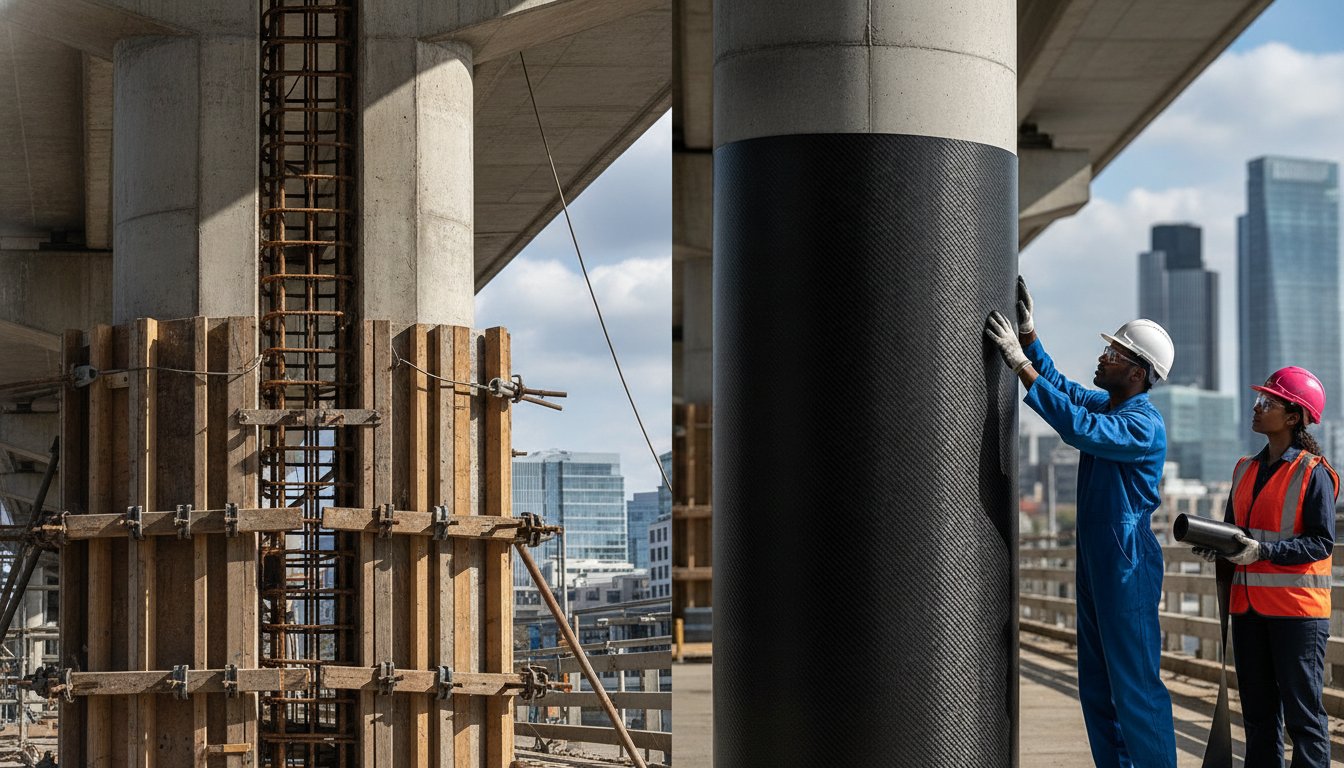
Confinement mechanisms are particularly critical for column strengthening. Traditional jacketing relies on the addition of mass to increase axial capacity, but Tyfo® Fibrwrap® employs passive confinement. By wrapping the fibre around the perimeter, lateral expansion of the concrete under load is restrained. This induces a triaxial state of stress, which substantially enhances the compressive strength of the existing core. In circular columns, this confinement is exceptionally efficient. It often surpasses the performance of reinforced concrete overlays that suffer from the inherent risk of cold joints and bond degradation at the interface.
Tensile Strength and Ductility in Tyfo® Systems
Tyfo® systems utilise high-modulus fibres that provide an exceptional strength-to-weight ratio. These materials are engineered to accommodate dynamic loads and thermal expansion cycles common in UK bridge infrastructure. The wet-layup process ensures that the resin fully saturates the fabric, creating a monolithic bond with the substrate. This precision allows engineers to target specific design capacities with high reliability. If you require detailed technical specifications for a specific project, our team can assist with bespoke structural design and engineering.
Compressive Capacity and Section Enlargement
Operational viability is frequently the primary determinant when selecting between Tyfo Fibrwrap vs concrete jacketing for critical infrastructure projects. Whilst mechanical performance remains paramount, the logistical footprint and the resulting impact on asset availability often dictate the commercial feasibility of a project. Traditional concrete jacketing requires extensive site preparation, including the installation of temporary works, formwork, and reinforcement cages. These ‘wet trades’ introduce a level of disruption that is often incompatible with live environments such as operational rail corridors or occupied commercial centres.
Tyfo® Fibrwrap® systems offer a streamlined alternative. The lightweight nature of the carbon and glass fibre fabrics allows for manual handling without the requirement for heavy plant or specialist lifting equipment. This reduction in logistical complexity directly translates to accelerated programmes. Installation timelines for the Tyfo® system are typically up to 70% faster than traditional concrete jacketing methods, primarily due to the elimination of formwork assembly and the prolonged curing cycles associated with hydraulic binders. For asset controllers managing tight possession windows, this efficiency is a critical advantage.
Spatial Footprint and Clearance Requirements
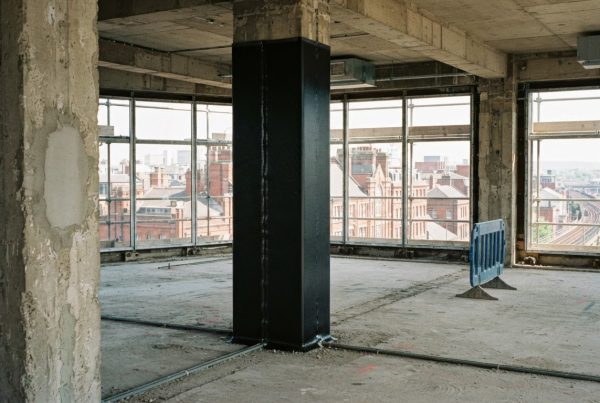
The “zero-profile” nature of Tyfo® Fibrwrap® is particularly advantageous in height-restricted areas or where original architectural aesthetics must be preserved. Unlike concrete jacketing, which adds significant thickness to columns and beams, the composite layup typically adds less than 5mm to the structural profile. This ensures that bridge clearances and usable floor areas remain unchanged. In heritage structures or high-value commercial assets, maintaining the original geometry is often a non-negotiable requirement that only advanced composites can satisfy.
Programme Efficiency and Site Logistics
Efficiency on site is achieved through the rapid curing characteristics of proprietary Tyfo® resins. Whilst conventional concrete requires a 28-day cycle to reach full design strength, composite systems achieve structural capacity within hours of application. This allows for the swift removal of temporary propping and the immediate return of the asset to full service. By minimising the requirement for extensive temporary works, the overall site footprint is reduced, allowing other trades to continue their work unimpeded. If your project requires a rapid turnaround without compromising on quality, you can contact our specialist team to discuss a tailored programme of works.
Long-Term Durability and Sustainability Profiles
Long-term structural reliability is inextricably linked to a material’s resistance to environmental degradation. When comparing Tyfo Fibrwrap vs concrete jacketing, the most significant technical distinction is the susceptibility of the reinforcement to corrosion. Traditional concrete jacketing relies on additional steel reinforcement bars which, whilst providing initial strength, remain vulnerable to chloride-induced corrosion and carbonation over time. This often leads to a cycle of spalling and subsequent remediation. Conversely, Tyfo® Fibrwrap® systems utilise non-metallic carbon and glass fibres that are inherently inert. This eliminates the electrochemical reactions that cause internal structural decay, substantially extending the maintenance interval for the asset.
It’s essential to recognise that the success of any composite intervention depends on the condition of the underlying substrate. Executing comprehensive concrete repairs is a mandatory prerequisite to ensure a robust bond and prevent latent defects from compromising the new system. Once the substrate is stabilised, the Fibrwrap® application provides an impermeable barrier that protects the original concrete from further ingress of moisture and aggressive chemicals.
Resistance to Environmental Degradation
Tyfo® systems demonstrate exceptional performance in marine and chemically aggressive environments where traditional reinforced concrete often fails prematurely. The epoxy resins used in the wet-layup process encapsulate the structural member, effectively halting the progress of carbonation. Long-term adhesion testing has verified that the bond between the Tyfo® composite and the concrete remains stable even under extreme cyclic loading and thermal fluctuations. This durability ensures that the 120-year design life extension remains a realistic engineering objective rather than a theoretical projection.
Carbon Footprint and ESG Strategies
The environmental cost of structural intervention is a primary concern for modern asset controllers. A Life-Cycle Assessment (LCA) frequently reveals that the carbon footprint of Tyfo Fibrwrap vs concrete jacketing is significantly lower for the composite option. This is due to the high volume of cement required for traditional overlays, which is a major contributor to global CO2 emissions. By choosing a low-mass, high-performance solution, engineers can align their projects with corporate ESG strategies and the UK’s broader net-zero infrastructure goals. Prolonging the functional life of a bridge or building through targeted strengthening is inherently more sustainable than demolition and new construction.
If you are seeking to enhance the longevity of your assets whilst meeting stringent sustainability targets, contact our engineering specialists for a comprehensive durability assessment and technical consultation.
Engineering Selection Framework: When to Specify Tyfo® Fibrwrap®
Selecting the optimal strengthening methodology requires a disciplined evaluation of structural, operational, and economic variables. Whilst initial material costs for reinforced concrete may appear lower, the total project value often shifts in favour of advanced composites when indirect costs are quantified. A technical decision matrix for Tyfo Fibrwrap vs concrete jacketing typically prioritises the Tyfo® system when section enlargement is prohibited by architectural constraints or when the existing substructure cannot sustain additional dead weight. Conversely, traditional jacketing may remain appropriate for massive axial load increases where foundation capacity is abundant and site access permits heavy construction activity.
The success of these interventions is predicated on the early engagement of a specialist engineering contractor. This collaborative approach allows for the integration of material properties into the preliminary design phase, ensuring compliance with UK standards such as CS 453 and CD 371 for highway structures. Navigating the regulatory landscape requires a deep understanding of the Building Safety Act 2022 and relevant Eurocodes, making expert guidance essential for ensuring long-term liability protection and warranty validity.
Critical Success Factors for Composite Application
Achieving the design-specified performance of a Tyfo® system depends on rigorous adherence to application protocols. Substrate integrity must be verified through pull-off testing, typically following EN 1542 standards, to ensure the concrete can facilitate effective load transfer. Environmental conditions, specifically ambient temperature and relative humidity relative to the dew point, must be monitored to ensure the proprietary resins cure correctly. Only authorised Tyfo® installers possess the specialised equipment and technical training required to provide the necessary certification and preserve the manufacturer’s warranty.
Partnering with CCUK for Structural Excellence
As the exclusive UK licensee for Tyfo® Fibrwrap®, Composites Construction UK (CCUK) provides a single-point responsibility model that covers the entire project lifecycle. This includes initial structural surveys, bespoke design development, and precision installation by expert technicians. This integrated service ensures that the life-extension of critical infrastructure is managed with the highest level of technical rigour. If you are managing an asset that requires structural enhancement, you can contact the CCUK technical team to initiate a project-specific feasibility study and receive an authoritative engineering assessment.
Optimising Structural Resilience Through Advanced Material Specification
The technical assessment of Tyfo Fibrwrap vs concrete jacketing reveals that whilst traditional methods remain a baseline for certain applications, the engineering advantages of CFRP systems are compelling for modern asset management. High-performance composites deliver exceptional confinement and tensile enhancement without the detrimental dead weight and section enlargement inherent in reinforced concrete overlays. This efficiency is mirrored in the operational phase; project timelines are significantly compressed, allowing critical infrastructure to return to service with minimal disruption to live environments.
As the exclusive UK licensee for Tyfo® systems, Composites Construction UK (CCUK) provides a single-point responsibility model that ensures technical rigour from initial design to final certification. With a proven track record in bridge, building, and pipeline rehabilitation, the focus remains on extending the functional lifespan of essential assets through proven material science and engineering expertise. Selecting the correct methodology is a critical step in safeguarding the UK’s infrastructure for future generations.
Frequently Asked Questions
How does the cost of Tyfo® Fibrwrap® compare to concrete jacketing?
While initial material costs for carbon fibre are higher, the total project expenditure for Tyfo Fibrwrap vs concrete jacketing is often lower. This is achieved through significant reductions in labour, plant requirements, and the avoidance of operational downtime. Traditional jacketing involves expensive formwork and curing periods that extend project programmes. When you factor in the lifecycle benefits and reduced maintenance, composite systems present a highly competitive commercial proposition for critical infrastructure.
Can Tyfo® Fibrwrap® provide the same fire rating as concrete jacketing?
Tyfo® Fibrwrap® systems achieve specified fire ratings through the application of proprietary fire-protective coatings such as Tyfo® VG or Tyfo® RR mineral-based renders. While reinforced concrete provides inherent protection, these specialised coatings ensure that composite systems meet stringent UK building regulations and safety standards. The choice of coating is determined during the bespoke design phase to ensure the structural integrity of the composite remains protected during a thermal event.
What is the typical thickness of a Tyfo® Fibrwrap® strengthening layer?
A typical Tyfo® Fibrwrap® installation is remarkably thin, usually ranging between 3mm and 5mm depending on the number of layers required by the engineering design. This “zero-profile” characteristic is a primary advantage over concrete jacketing, which typically requires a section enlargement of 100mm or more. This minimal thickness ensures that original architectural clearances and functional space within buildings or under bridges are maintained without compromise.
Is concrete jacketing better for seismic retrofitting than CFRP?
CFRP is generally superior for seismic retrofitting because it enhances ductility and confinement without increasing the structure’s mass. Concrete jacketing adds significant weight, which increases the inertial forces acting on the structure during a seismic event. By utilising Tyfo® SEH glass fibre or SCH carbon fibre systems, engineers can improve the energy dissipation capacity of columns and joints, ensuring the structure remains resilient under dynamic loading conditions.
How does added dead weight from jacketing affect bridge foundations?
The added dead weight from traditional concrete jacketing can impose significant stress on existing bridge foundations, sometimes necessitating secondary substructure strengthening. This adds considerable cost and complexity to the project. Tyfo® Fibrwrap® systems add negligible mass to the structural members. This allows the primary focus to remain on enhancing the load-bearing capacity of the superstructure without triggering a requirement for expensive and difficult foundation remediation works.
What is the expected service life of a professionally installed CFRP system?
A professionally installed Tyfo® Fibrwrap® system is engineered to provide a 120-year design life extension. This longevity is achieved through the use of non-corrosive carbon and glass fibres that are encapsulated in high-performance epoxy resins. Unlike traditional reinforced concrete, which remains susceptible to carbonation and chloride ingress, the composite system provides an impermeable barrier that protects the core structural element from environmental degradation and internal decay.
Can Tyfo® Fibrwrap® be installed on structures with active corrosion?
Tyfo® Fibrwrap® shouldn’t be installed directly over active corrosion. The underlying steel reinforcement must be stabilised and the concrete substrate restored through professional concrete repair methods before the composite is applied. This ensures a sound bond and prevents latent expansion from damaging the new reinforcement. Once the substrate is prepared, the wrap acts as an encapsulation layer, preventing further moisture and oxygen from reaching the internal steel bars.
How quickly can an asset be returned to service after CFRP installation?
Assets can often be returned to service within 24 to 48 hours following the application of a Tyfo® system. Unlike concrete, which requires a lengthy curing cycle to reach full design strength, proprietary resins achieve structural capacity rapidly. This programme efficiency is vital for highway bridges and industrial facilities where operational downtime must be minimised. The elimination of heavy formwork and propping further accelerates the transition from construction back to full functionality.