
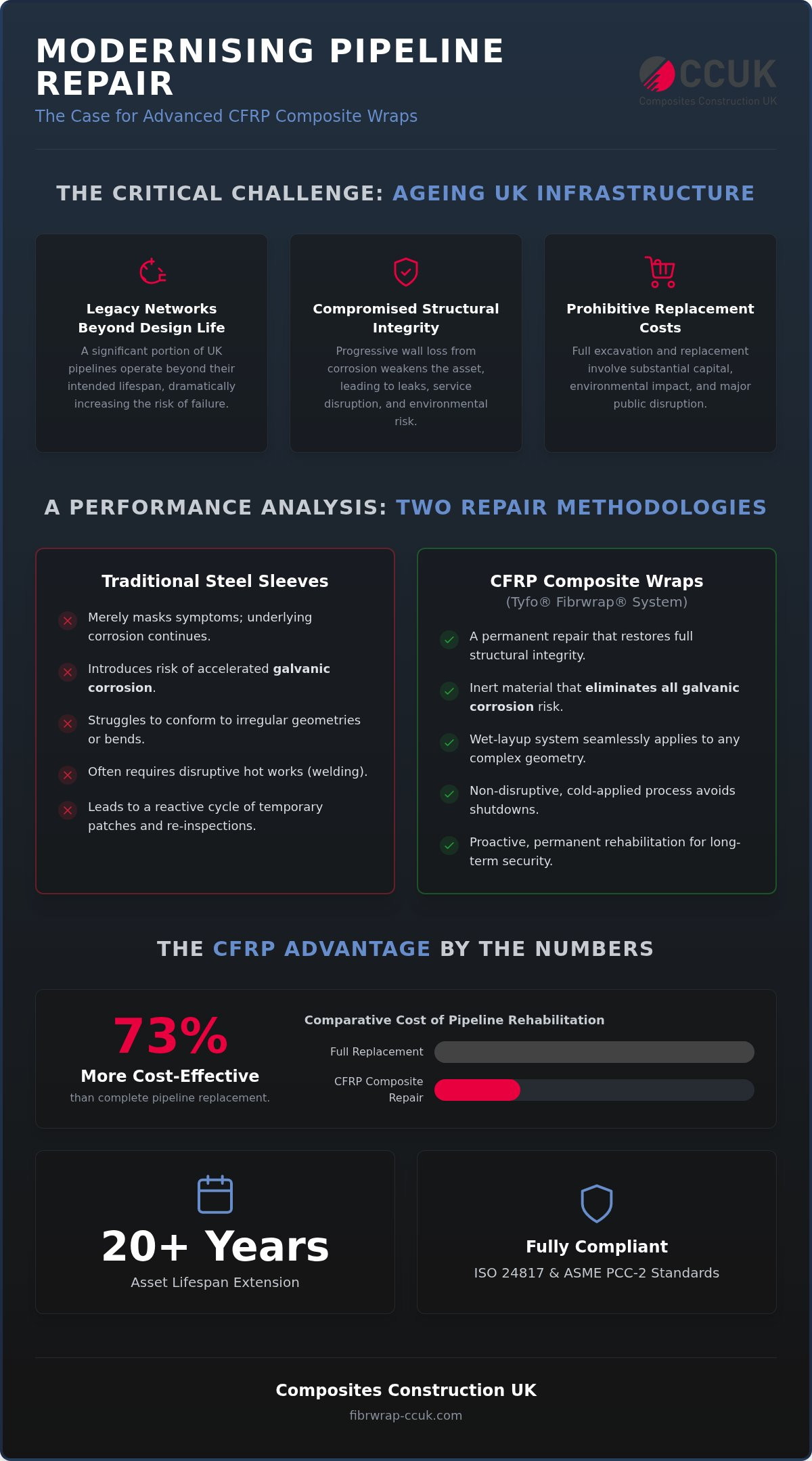
Whilst traditional steel sleeves are often viewed as the standard response to structural degradation, engineered composite wrap systems are 73% more cost-effective than complete pipeline replacement. For technical professionals managing critical assets, the persistent challenge lies in addressing localised thinning or structural failure without triggering the immense operational strain of an unscheduled shutdown. It’s widely understood that traditional metallic repairs can be prone to accelerated corrosion and often struggle with irregular geometries. This article explores how CFRP pipeline repair UK services offer a permanent, non-disruptive alternative that’s grounded in empirical evidence and rigorous material science.
You’ll discover how these advanced carbon fibre systems extend asset lifespan by over 20 years whilst maintaining full compliance with ISO 24817 and ASME PCC-2. We’ll provide a detailed overview of the Tyfo® Fibrwrap® system, focusing on its capacity to handle high-pressure environments through bespoke engineering design rather than off-the-shelf components. By the end of this analysis, the methodology for achieving long-term structural security through sophisticated composite technology will be clearly defined.
Key Takeaways
- Understand the structural risks posed by legacy infrastructure and how advanced materials science addresses both internal and external wall loss.
- Evaluate how the Tyfo® Fibrwrap® system eliminates the risk of galvanic corrosion commonly associated with traditional metallic repair methods.
- Gain insight into the regulatory requirements of ISO 24817 and ASME PCC-2 to ensure your CFRP pipeline repair UK project meets permanent compliance standards.
- Discover why bespoke engineering design is superior to generic repair kits for restoring the functional integrity of complex or irregular pipeline geometries.
- Learn how to extend the functional lifespan of essential assets by over 20 years whilst significantly reducing the total cost of ownership compared to full replacement.
Addressing the Critical Challenges of Ageing UK Pipeline Infrastructure
A significant proportion of the United Kingdom’s water, wastewater, and industrial pipeline infrastructure is currently operating beyond its original design life. These legacy metallic networks are frequently subject to external corrosion and progressive wall loss, which compromises the structural integrity of the asset and increases the risk of catastrophic failure. When high-pressure anomalies or mechanical damage occur, the operational risks become acute, potentially leading to environmental contamination or service disruption. Traditional repair methodologies, such as metallic clamps or welded sleeves, are often deployed as immediate responses to leakage, yet they frequently fail to address the underlying cause of structural decline, merely masking the symptoms whilst the substrate continues to deteriorate through galvanic processes.
The economic burden of total pipeline excavation and replacement is substantial. Beyond the direct capital expenditure, the environmental impact of large-scale civil works and the social cost of disruption must be considered. With the UK government’s infrastructure pipeline including projects valued at £718 billion over the next decade, the requirement for efficient rehabilitation is paramount. In this context, CFRP pipeline repair UK services emerge as a sophisticated engineering alternative that prioritises the extension of functional lifespan over the prohibitive costs of replacement. By utilising a bespoke engineering design approach, the structural capacity of the pipe is restored to its original specification, or enhanced to meet new operational demands.
The Problem with Reactive Maintenance Cycles
Reactive maintenance typically leads to a cycle of unscheduled shutdowns, which severely impact national utility delivery and industrial output. These interruptions aren’t only costly in terms of lost production but also introduce safety risks during emergency interventions. Many asset controllers rely on temporary patches that require frequent, resource-intensive monitoring, yet these interventions don’t resolve the structural deficit. Transitioning to proactive asset care through advanced composite technology allows for a permanent rehabilitation that integrates with the existing structure, providing long-term security without the need for constant re-inspection or future excavation.
Environmental and Structural Stressors in the UK
The integrity of UK pipelines is constantly challenged by several factors that accelerate degradation:
- Groundwater Chemistry: Aggressive chemical compositions in the water table that accelerate the rate of corrosion in carbon steel and cast iron assets.
- Soil Conditions: Varying pH levels and moisture content that create corrosive environments for buried infrastructure.
- Pressure Dynamics: The complex interplay of axial and hoop stresses in high-pressure environments that can exacerbate existing flaws.
Managing these stressors requires a nuanced engineering approach. When wall loss reaches a critical threshold, the decision between repair and replacement becomes paramount. By implementing an engineered CFRP pipeline repair UK solution, it’s possible to restore the full load-bearing capacity of the pipe, effectively bypassing the need for a total replacement whilst ensuring the asset remains compliant with stringent safety standards.
The Engineering Science of CFRP and Tyfo® Fibrwrap® Systems
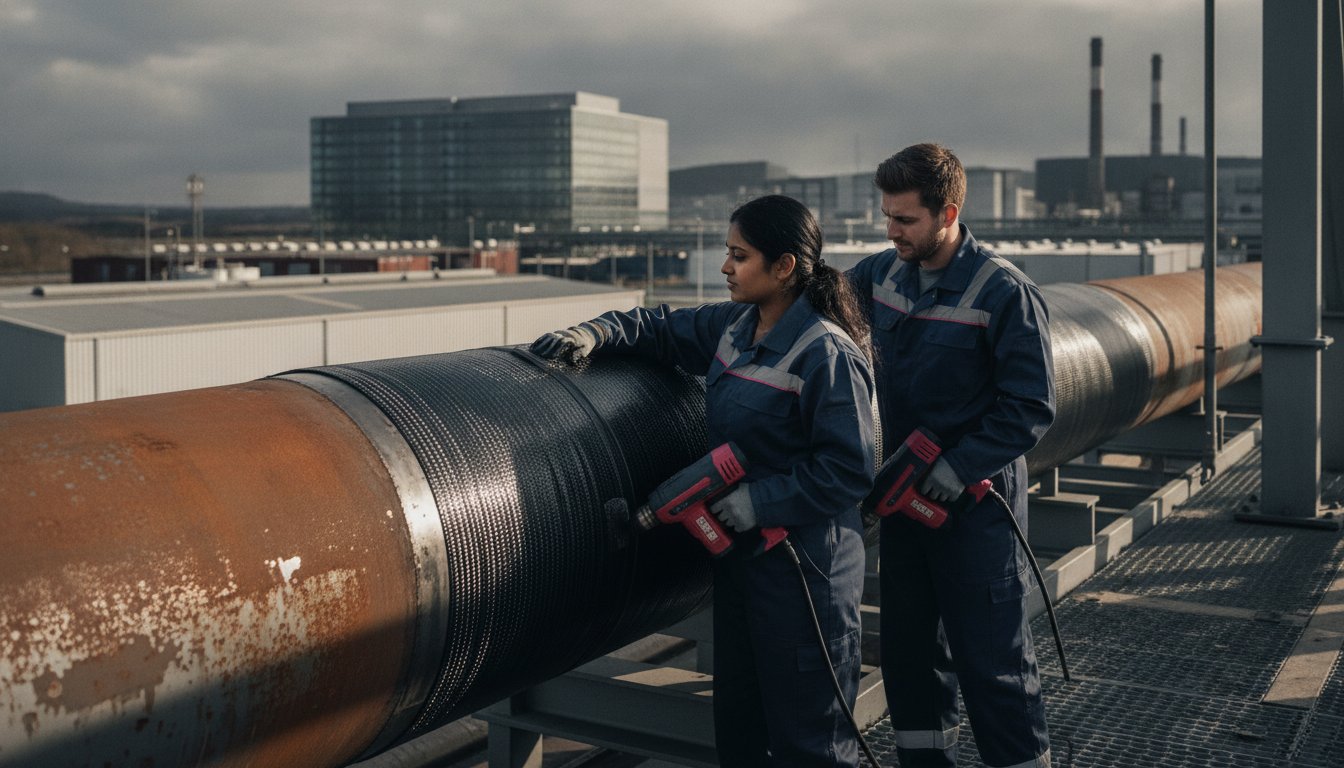
Carbon Fibre Reinforced Polymer (CFRP) is a high-performance composite material comprising high-modulus carbon filaments embedded within a polymer matrix, typically a high-performance epoxy resin. In the context of CFRP pipeline repair UK, this material is utilised to restore structural integrity to assets compromised by corrosion or mechanical damage. The Tyfo® Fibrwrap® system, which is provided exclusively by CCUK in the UK, functions as an externally bonded reinforcement. It’s designed to restore both original hoop strength and axial capacity to pipeline sections that have suffered significant wall loss whilst maintaining a minimal profile. Unlike rigid metallic repairs, the “wet-layup” nature of this system allows for seamless application across irregular geometries, including elbows, tees, and flanges, ensuring a continuous load path that generic kits cannot achieve.
The necessity for such advanced materials is underscored by the current state of Ageing UK Pipeline Infrastructure, which requires solutions that are both permanent and non-disruptive. By implementing a system backed by over 500 independent laboratory tests, engineers can guarantee results that align with the most stringent safety protocols. This technical rigour ensures that the rehabilitated asset can withstand the complex stress states encountered in high-pressure service environments.
Load Transfer Mechanisms in Composite Wraps
The efficacy of an engineered wrap depends on the efficient transfer of stress from the host pipe to the composite overwrap. This is achieved through a high-strength bond at the interface, where the epoxy matrix acts as the medium for load distribution. For non-through-wall defects, the CFRP shares the internal pressure and external loads with the remaining steel. However, for through-wall defects, the composite is engineered to carry 100% of the design pressure, effectively acting as a new pressure vessel wall. This synergy ensures the composite layer works in conjunction with the existing asset rather than acting as a simple patch. Such precision is vital when performing CFRP pipeline repair UK on high-pressure systems where the margin for error is non-existent.
Material Properties and Durability
Tyfo® systems are characterised by exceptional chemical resistance, making them suitable for aggressive industrial environments where traditional coatings might fail. The lightweight nature of carbon fibre allows for installation in confined spaces without the need for heavy lifting equipment or hot works. Additionally, the material’s low mass is complemented by a coefficient of thermal expansion that is carefully managed to ensure compatibility with metallic substrates, preventing delamination during thermal cycling. These properties ensure that the rehabilitated structure remains functional for an additional 20 years or more. Technical professionals seeking to understand the specific performance metrics of these materials can explore the bespoke design features of the Tyfo® system.
CFRP Composite Wraps vs Traditional Steel Sleeving: A Performance Analysis
Traditional steel sleeving has long been the default for structural reinforcement, yet it carries significant logistical and technical liabilities. Installing metallic sleeves typically necessitates extensive excavation and the mobilisation of heavy lifting machinery, which increases the physical footprint and complexity of the project. Conversely, CFRP pipeline repair UK methodologies utilise lightweight materials that are manually applied, significantly reducing site impact. Whilst steel sleeves require precise fitment and often involve complex grouting, composite wraps conform to the existing substrate, ensuring continuous contact and immediate load-sharing without the need for heavy machinery.
One of the most critical advantages of composite systems is the ability to perform repairs on in-service pipelines. Traditional welding on live, high-pressure assets introduces substantial risk and often requires a reduction in operating pressure or a complete shutdown. CFRP avoids these operational interruptions. Research indicates that while material costs for composites may be higher than steel, total project costs are often 24% lower than welded steel sleeves. This is largely due to a 30% to 50% reduction in labour requirements and significantly faster installation timelines, making it a superior choice for CFRP pipeline repair UK in time-sensitive industrial environments.
Eliminating the Risk of Galvanic Corrosion
A recurring failure mode in steel-on-steel repairs is galvanic corrosion, particularly when assets are buried in aggressive UK soils. When a new steel sleeve is placed over an older pipe, the potential difference between the metals can accelerate degradation. Non-metallic CFRP systems are inherently immune to this process. The high-performance epoxy matrix serves as a dielectric barrier, effectively isolating the host pipe from the environment. This reduces the need for complex adjustments to existing cathodic protection systems and ensures the repair remains structurally sound for an additional 20 years or more.
Weight, Logistics, and Site Access
Logistics are simplified when using Tyfo® Fibrwrap® systems. The materials are easily transported to restricted access or environmentally sensitive areas where heavy machinery cannot operate. The absence of hot work permits and welding eliminates ignition risks in volatile environments, enhancing site health and safety. Key logistical benefits include:
- No heavy lifting equipment: Materials are portable and manually applied.
- Elimination of hot works: No welding or spark-producing activities are required.
- Reduced excavation: Minimal clearance is needed around the pipe circumference.
- Optimised crew sizes: Smaller, specialised teams reduce site-based safety risks.
Compliance Frameworks: Navigating ISO 24817 and ASME PCC-2 Design Standards
Compliance isn’t optional when performing structural rehabilitation on critical national infrastructure. In the UK, the regulatory landscape for composite interventions is defined by two primary standards: ISO 24817 and ASME PCC-2 Article 4.1. These frameworks ensure that non-metallic repairs are treated as permanent structural components rather than temporary patches. For any CFRP pipeline repair UK project to be classified as a permanent solution, it must be backed by validated engineering calculations that account for specific defect geometries and operating conditions. Generic, off-the-shelf kits often lack the technical depth required to meet these rigorous criteria, particularly in high-pressure or safety-critical applications where the margin for error is non-existent.
The transition from reactive maintenance to proactive asset care requires a shift in how repairs are specified. By adhering to these international standards, asset controllers can be certain that the composite system will perform as intended throughout its design life. Every intervention is treated as a bespoke engineering project, ensuring that the material properties of the Tyfo® Fibrwrap® system are correctly matched to the structural deficit of the host pipe. This methodical approach provides a level of reliability that’s grounded in empirical evidence and rigorous testing protocols.
Bespoke Engineering and Design Features
The role of bespoke design and engineering is central to ensuring long-term structural security for compromised assets. Every repair begins with a detailed assessment of the host pipe’s condition, including current wall loss and anticipated future corrosion rates. Engineers calculate the required wrap thickness by evaluating hoop and axial stresses, ensuring the composite layer can safely contain the operating pressure for its intended 20-year lifespan. These calculations also factor in environmental degradation and safety margins, providing a level of reliability that matches or exceeds the original asset specification. This level of detail is vital for maintaining the integrity of the CFRP pipeline repair UK process.
Quality Assurance and Installation Protocols
Rigorous installation protocols are essential to translate an engineered design into a successful field application. Surface preparation is the most critical phase; the substrate must be prepared to a specific profile to ensure a robust mechanical bond. Following application, the system undergoes comprehensive testing to verify performance:
- Shore Hardness: Verification of the epoxy matrix cure to ensure material properties are achieved.
- Pull-off Tests: Measurement of the bond strength between the composite and the host substrate.
- Thickness Verification: Ensuring the installed layers match the engineered design thickness.
All data is meticulously documented, providing the certification necessary for regulatory body approval and asset controller peace of mind. For technical professionals seeking to ensure their infrastructure meets these exacting standards, you can contact CCUK for a technical consultation.
Implementing Bespoke CFRP Solutions with a Specialist Engineering Contractor
The successful delivery of a permanent CFRP pipeline repair UK solution requires a unified approach that bridges the gap between theoretical design and field application. By utilising a design-supply-install contract, asset managers ensure that a single entity maintains accountability for the structural integrity of the repair from initial assessment through to final handover. This end-to-end model is particularly valuable for complex infrastructure projects where the interplay between host pipe condition and composite performance must be managed with precision. Whilst general contractors may possess broad civil engineering experience, they typically lack the specialised training and proprietary equipment required for the correct application of Tyfo® Fibrwrap® systems. As the exclusive UK licensee, CCUK provides the technical rigour necessary to ensure that every installation performs as intended under operational loads.
Integration with existing asset management teams is a core component of the delivery process. This collaborative approach allows for the scheduling of repairs during planned maintenance windows or, where necessary, the rapid mobilisation for emergency interventions. By embedding specialist expertise within the broader project framework, risks associated with improper surface preparation or material handling are effectively eliminated. This methodology ensures that the rehabilitated asset meets all regulatory requirements whilst minimising the duration of site-based activities.
The Role of the Specialist Engineering Contractor
The project lifecycle begins with a comprehensive feasibility study to determine the suitability of composite reinforcement for the specific defect. Leveraging the expertise of a specialist engineering contractor is essential for risk mitigation, as it ensures that all bespoke calculations are validated against real-world environmental stressors. Following the design phase, the installation is carried out by trained technicians who adhere to strict quality control protocols, including atmospheric monitoring and bond strength testing. This methodical sequence ensures that the transition from a compromised state to a fully restored asset is documented and verifiable, providing long-term security for technical professionals and asset controllers alike.
Securing the Future of UK Infrastructure
The long-term economic case for adopting advanced composites across national gas and water networks is compelling. By extending the functional lifespan of essential assets by 20 years or more, the requirement for capital-intensive replacement programmes is significantly reduced. This approach also aligns with national Net Zero goals, as the rehabilitation of existing pipes requires far less energy and material than the manufacture and installation of new metallic assets. Extending the utility of legacy infrastructure through sophisticated science is a cornerstone of sustainable asset management. For asset managers looking to evaluate the integrity of their networks, the final step involves contacting CCUK for a structural survey to identify where CFRP pipeline repair UK technology can provide the greatest value.
Advancing Structural Integrity for Critical Pipeline Assets
The shift toward engineered composite solutions represents a fundamental evolution in how national infrastructure is maintained. By prioritising bespoke design over temporary patches, asset managers ensure that CFRP pipeline repair UK projects deliver permanent structural restoration that meets the exacting requirements of ISO 24817 and ASME PCC-2. The Tyfo® Fibrwrap® system provides a non-disruptive methodology for life extension, bypassing the immense costs and environmental impact of full excavation whilst providing over 20 years of additional functional life.
As the exclusive UK licensee for the Tyfo® Fibrwrap® system, CCUK specialises in the design and installation of these advanced materials for critical national infrastructure. Every project is backed by rigorous engineering calculations that ensure long-term security in high-pressure environments. Contact our specialist engineering team for a bespoke pipeline repair feasibility study and secure the future of your essential assets. With the right engineering partner, the challenge of ageing infrastructure becomes an opportunity for sustainable, science-led rehabilitation.
Frequently Asked Questions
Is CFRP pipeline repair considered a permanent solution in the UK?
Yes, CFRP pipeline repair is classified as a permanent structural solution when it adheres to the design criteria of ISO 24817 or ASME PCC-2. Unlike temporary metallic clamps, an engineered composite system integrates with the host pipe to restore full load-bearing capacity. This classification is vital for technical professionals who require long-term structural security for critical infrastructure. Compliance ensures the repair is recognised as a lasting intervention by national regulatory bodies.
Can Tyfo® Fibrwrap® be applied to pipelines whilst they are still in service?
Tyfo® Fibrwrap® systems are specifically designed for application on in-service pipelines, allowing for structural rehabilitation without the necessity for operational shutdowns. This non-disruptive methodology eliminates the financial losses associated with service interruptions. Because the process involves no hot works or heavy machinery, it’s safe for volatile environments. This makes CFRP pipeline repair UK services particularly advantageous for high-pressure gas and water networks that must remain fully operational during the repair process.
Does CFRP repair comply with UK gas and water industry regulations?
Structural composite repairs are fully compliant with UK industry standards when performed by a specialist engineering contractor. The primary governing documents are ISO 24817 and ASME PCC-2 Article 4.1, which provide the technical requirements for non-metallic repairs. These standards are accepted across the water and gas sectors as robust evidence of structural integrity. Every installation must be backed by bespoke calculations that prove the repair meets the specified design life and pressure ratings.
How long does a typical carbon fibre pipe wrap repair take to install?
The duration of an installation varies depending on the defect geometry and site access, but it’s significantly faster than traditional steel sleeving. Most localised repairs are completed within two to five working days, including surface preparation and matrix curing. This efficiency is achieved because the materials are lightweight and manually applied, reducing the time required for heavy equipment mobilisation. Faster installation timelines contribute to a 30% to 50% reduction in total labour costs.
What is the expected lifespan of a CFRP pipeline rehabilitation?
An engineered CFRP pipeline repair UK project is designed to provide a functional lifespan of 20 years or more. This duration is calculated during the design phase, accounting for anticipated substrate degradation and environmental factors. The high-performance epoxy resins used in the Tyfo® system are resistant to chemical attack and galvanic corrosion, ensuring the composite layers maintain their structural properties. This longevity makes it a sustainable alternative to repeating reactive maintenance cycles on ageing metallic assets.
Can CFRP be used on irregular pipeline fittings like elbows, tees, and flanges?
The wet-layup nature of carbon fibre systems makes them uniquely suitable for irregular geometries that are difficult to reinforce with rigid steel sleeves. The flexible fabric conforms seamlessly to elbows, tees, flanges, and reducers, ensuring a continuous load path across the entire fitting. This adaptability is a critical design feature, as it allows for the restoration of hoop and axial strength in complex configurations. Every wrap is bespoke, ensuring full coverage and structural continuity.
What are the main differences between ISO 24817 and ASME PCC-2 standards?
ISO 24817 and ASME PCC-2 Article 4.1 share the same objective of ensuring the safety and reliability of composite repairs, though they differ in their specific calculation methodologies and testing requirements. ISO 24817 is the international standard often preferred in European markets, whilst ASME PCC-2 is a widely recognised American standard for pressure equipment. Both frameworks require a rigorous design process that factors in substrate condition, temperature, and pressure to ensure the repair is structurally sound.
How does the cost of CFRP repair compare to full pipeline replacement?
Research indicates that CFRP composite wrap systems are approximately 73% more cost-effective than complete pipeline replacement. Whilst the initial material costs for advanced carbon fibre may be higher than traditional steel, the total project expenditure is lower due to reduced excavation requirements and the elimination of heavy machinery. By extending the functional lifespan of the existing asset, operators avoid the massive capital investment and environmental disruption associated with installing new pipeline segments.