
Whilst the initial material cost of Carbon Fibre Reinforced Polymer (CFRP) is higher than structural steel, the total project expenditure is frequently 30% to 50% lower because of reduced labour costs and the elimination of heavy lifting equipment. This fiscal reality is becoming a primary driver for asset managers who must reconcile the demands of ageing infrastructure with the necessity for minimal operational disruption. It’s widely understood that traditional replacement methods are often prohibitively expensive and logistically complex, particularly when assets are reaching their theoretical end-of-life or require increased load capacity due to a change of use.
This technical guide demonstrates how specialist structural strengthening contractors UK employ advanced Tyfo® Fibrwrap® systems and traditional engineering methods to facilitate significant asset life-extension. By prioritising a design-led approach that adheres to BS EN 1992 and the Concrete Society’s Technical Report 55, infrastructure can be rehabilitated to meet modern safety standards without the carbon intensity of new construction. We shall explore the technical performance of composite materials, the rigorous documentation requirements of the Building Safety Act 2022, and the methodical processes required to ensure long-term structural integrity and regulatory compliance across the UK’s built environment.
Key Takeaways
- Specialist structural strengthening contractors UK provide a comprehensive “Design, Supply, Install” service that integrates technical surveys with bespoke engineering to extend the functional lifespan of critical assets.
- Advanced Carbon Fibre Reinforced Polymer (CFRP) systems offer a superior strength-to-weight ratio and significantly reduced installation times compared to traditional steel plate bonding.
- Compliance with UK engineering standards, such as Eurocode 2 and the Building Safety Act 2022, is essential for ensuring the long-term safety and regulatory alignment of structural interventions.
- The Tyfo® Fibrwrap® system represents the gold standard for composite strengthening, utilising a wet-lay process to provide seamless reinforcement for complex geometries including columns and beams.
- A strategic focus on asset life-extension through engineered repairs offers a more sustainable and cost-effective alternative to carbon-intensive infrastructure replacement.
Defining the Role of Structural Strengthening Contractors in the UK
Structural strengthening represents a precise technical intervention designed to increase the load-bearing capacity of a structure or to remediate inherent defects within the substrate. For asset controllers managing ageing infrastructure, the involvement of specialist structural strengthening contractors UK is critical to ensuring that modifications are underpinned by rigorous engineering rigour rather than merely aesthetic or superficial repair. A professional contractor doesn’t simply apply material; they provide an integrated lifecycle service encompassing initial structural surveys, bespoke design consultancy, and precision installation. This holistic approach is essential because any modification to a structural element requires a comprehensive load-path analysis to ensure that stresses are redistributed safely without compromising the integrity of the wider asset.
When is Specialist Strengthening Required?
The requirement for engineered reinforcement often arises from a change of use within commercial or industrial environments. For instance, the conversion of legacy office space into high-density data centres necessitates a significant increase in floor loading capacity to support heavy server racks and cooling infrastructure. Beyond load upgrades, strengthening is vital for remediating degradation in Reinforced Concrete caused by carbonation or chloride-induced reinforcement corrosion. Specialist contractors also provide critical national infrastructure protection through seismic retrofitting and blast mitigation systems, ensuring assets remain resilient against extreme loading events.
The Economic Case for Repair over Replacement
Advanced CFRP Systems vs. Traditional Strengthening Methods
The selection of Structural Strengthening Methods often dictates the long-term viability and maintenance requirements of a critical asset. Historically, structural strengthening contractors UK relied heavily on steel plate bonding and concrete section enlargement. Whilst these methods are effective for increasing cross-sectional capacity, they introduce significant dead load and are susceptible to environmental degradation. Modern engineering has shifted towards Carbon Fibre Reinforced Polymer (CFRP) systems, which offer a more sophisticated approach to rehabilitation by utilising advanced materials science to achieve superior performance with minimal physical footprint.
Carbon Fibre Reinforced Polymer (CFRP) Advantages
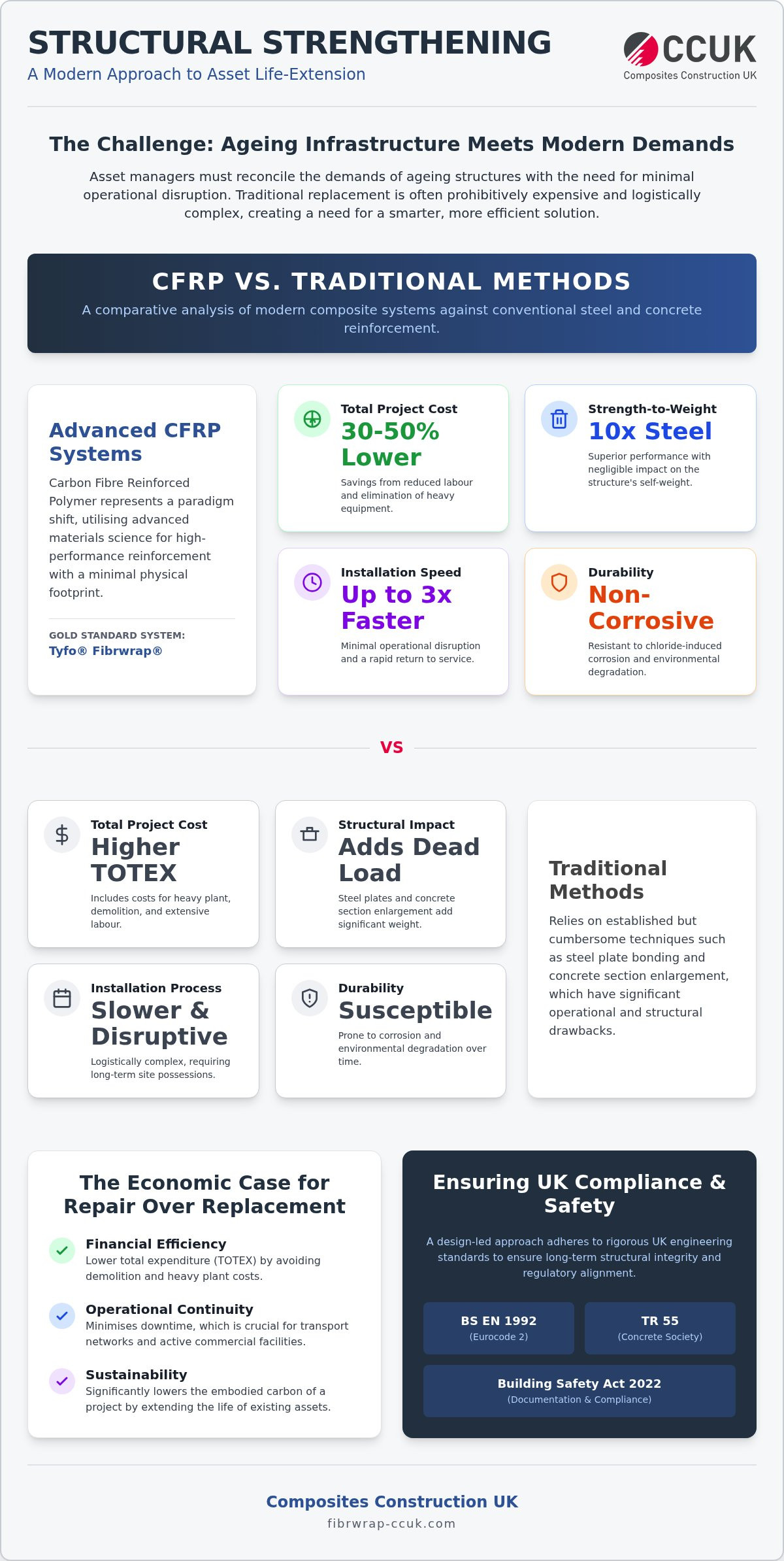
CFRP represents a paradigm shift in structural intervention. The material possesses a strength-to-weight ratio approximately ten times greater than that of structural steel, allowing for high-performance reinforcement with negligible impact on the host structure’s self-weight. This is particularly advantageous in seismic retrofitting or when architectural aesthetics must be preserved. The design features of composite systems enable precise tailoring of fibre orientation to match the specific stress profile of the element, ensuring that the reinforcement is as efficient as it is effective. Installation speed is another critical factor; CFRP applications typically require only one-third to one-half of the time needed for traditional steel bonding, which directly translates to reduced operational downtime.
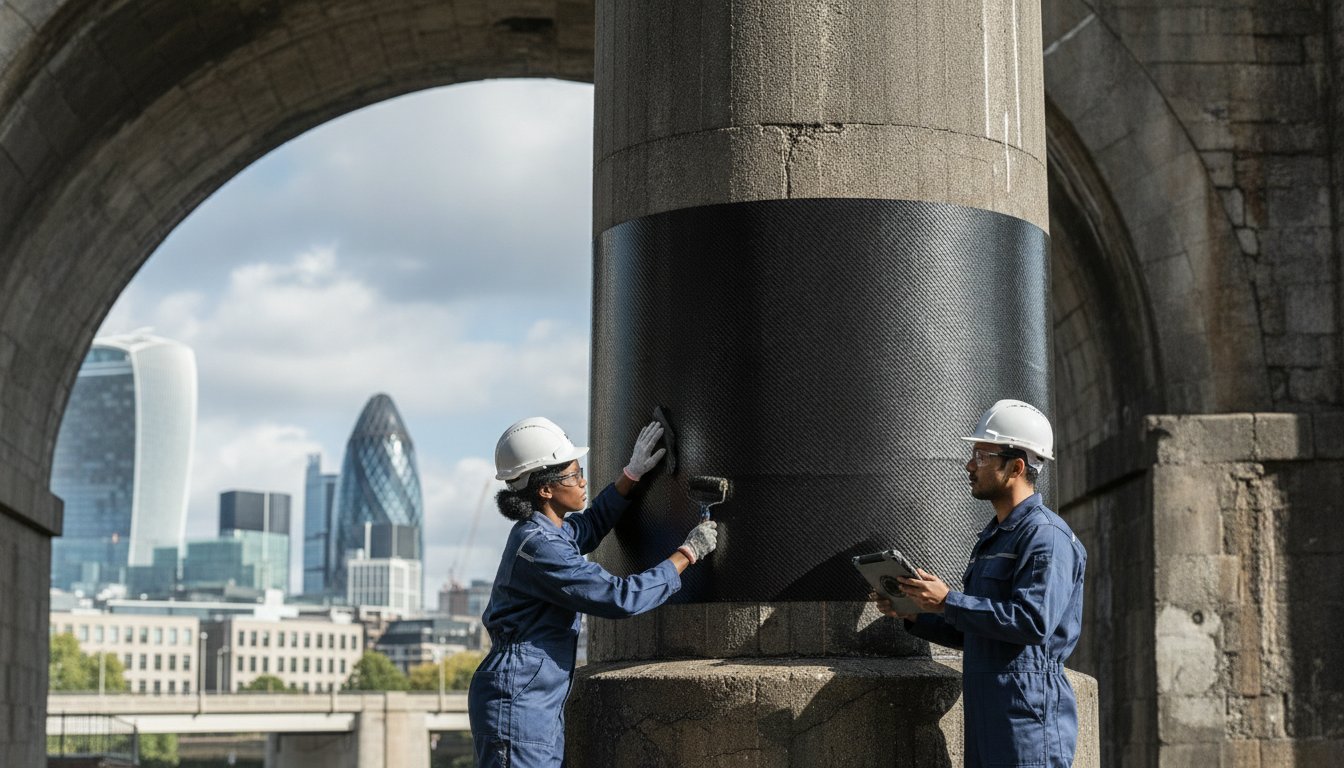
Proprietary solutions like Tyfo® Fibrwrap® utilise a wet-lay application process that provides unparalleled versatility for complex geometries. Unlike rigid steel plates, these flexible fabrics can be seamlessly wrapped around circular columns, flared bridge piers, or irregular beam profiles. This adaptability eliminates the need for complex mechanical fixings and the heavy lifting equipment associated with legacy methods. For asset controllers, this means that even the most challenging confined spaces can be reinforced without the logistical burden of heavy plant machinery.
Traditional Methods: Steel Jacketing and Concrete Enlargement
Traditional techniques, such as steel jacketing or concrete section enlargement, remain appropriate where high levels of impact resistance or extreme stiffness are required. However, the logistical burden of transporting and installing heavy steel components frequently results in protracted project timelines. In the twelve months leading to May 2026, the price index for fabricated structural steel rose by 13.1%, making CFRP an increasingly competitive alternative on a total expenditure (TOTEX) basis. Furthermore, steel requires ongoing protective coatings to prevent oxidation, whereas composite systems remain inert and corrosion-resistant in harsh UK coastal or industrial environments.
Durability is a primary differentiator in the UK’s built environment. A professionally designed CFRP system is engineered to match or exceed the remaining design life of the host structure, often exceeding 50 years. This longevity, combined with the lack of maintenance requirements, provides a high degree of long-term security for technical professionals. If you require a site-specific assessment of these technologies for your infrastructure, you can contact our engineering team for a technical consultation.
Navigating UK Engineering Standards and Compliance
Adherence to rigorous regulatory frameworks is the cornerstone of structural integrity, ensuring that any intervention meets the stringent safety requirements of the UK’s built environment. For structural strengthening contractors UK, the design and application of composite systems are primarily governed by the Concrete Society’s Technical Report 55 (TR55) and the Highways England standard CS 465. These documents provide the requisite engineering parameters for the management and design of carbon fibre strengthening, ensuring that repairs are compatible with the parent structure. Furthermore, all concrete modifications must align with BS EN 1992 (Eurocode 2), which dictates the fundamental principles for reinforced concrete design and ensures that composite materials are integrated without compromising the original design intent.
Regulatory Frameworks for Infrastructure
Infrastructure assets managed by National Highways or Network Rail require contractors to navigate specific technical approval processes. Compliance with CS 448 for the inspection and maintenance of reinforced concrete is mandatory for bridge strengthening projects, where the environment often necessitates high levels of corrosion resistance. In the residential and commercial sectors, the Building Safety Act 2022 has introduced a “golden thread” of information requirement for higher-risk buildings. This legislation places a greater burden of proof on asset controllers to provide a continuous digital record of structural modifications. A specialist contractor plays a pivotal role here, providing the technical justification and detailed documentation required by the Building Safety Regulator (BSR) to ensure the building’s safety case remains valid.
Material Testing and Validation
Technical validation is achieved through a structured regime of on-site testing and quality assurance protocols. Before any composite system is applied, carbonation depth analysis and chloride ion testing are performed to assess the health of the existing substrate. Once the installation is complete, pull-off testing is conducted to verify the bond strength between the CFRP and the concrete, ensuring it meets the minimum requirements specified in the design phase. Membership in the Concrete Repair Association (CRA) is often a prerequisite for this work, as it ensures the contractor adheres to BS EN 1504, the European standard for the protection and repair of concrete structures. For a deeper analysis of these methodologies, technical professionals should refer to our structural repairs and asset remediation guide.
Liability and risk management are equally critical. Because structural strengthening involves complex load-path redistributions, it’s essential that structural strengthening contractors UK carry comprehensive Professional Indemnity (PI) insurance specifically covering design work. This provides asset managers with the necessary financial security and professional reassurance that the engineered solution is backed by technical accountability. By integrating non-destructive testing (NDT) with high-performance materials, contractors ensure that every intervention is both evidence-based and compliant with the highest UK engineering standards.
Key Criteria for Evaluating Specialist Engineering Contractors
Identifying competent structural strengthening contractors UK necessitates a transition from procurement-led selection to an evaluation based on engineering pedigree. A contractor’s ability to offer a unified “Design, Supply, Install” service is paramount. This model ensures that the engineering intent established during the feasibility stage is meticulously translated into the final installation. It eliminates the friction often found between separate design consultancies and material applicators, providing asset controllers with a single point of technical accountability. When the same entity manages the structural survey and the precision application, the risk of design-to-site discrepancies is significantly mitigated.
Technical Capability and Design Expertise
In-house chartered engineers are essential for performing detailed feasibility studies and bespoke load-path calculations. Rather than relying on generic, off-the-shelf specifications, a specialist must tailor every intervention to the specific material properties and geometric constraints of the host structure. This ensures that the reinforcement is neither under-specified for safety nor over-specified for cost. This level of rigour is explored further in our guide on the role of a specialist engineering contractor in structural life-extension.
Site Management and Execution
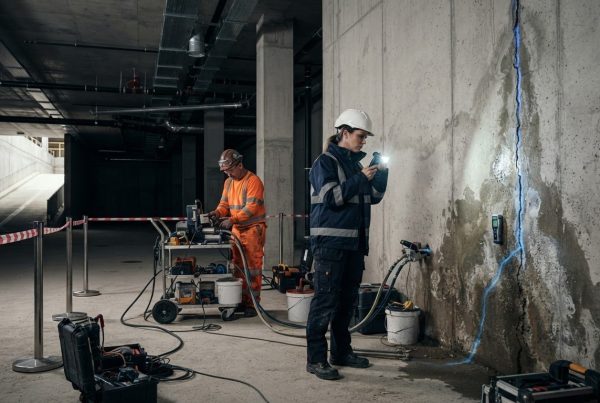
Practical execution in high-risk environments, such as the rail, power, and industrial sectors, demands more than just material application. It requires sophisticated management of temporary works and shoring to maintain structural stability whilst the strengthening is underway. Competent contractors must also demonstrate proficiency in adjacent services, such as resin injection and leak sealing, to address hydrostatic pressure or internal voids before reinforcing the substrate. National logistical capability is vital for ensuring consistent quality and adherence to safety standards across diverse UK infrastructure assets.
Technical certification acts as a signature of quality and exclusivity. Exclusive licensing for high-performance systems, such as Tyfo® Fibrwrap®, ensures that the contractor is trained in the precise wet-lay techniques required for optimal bond performance. This expertise should be validated by a robust project history involving assets of similar scale and complexity. A contractor’s commitment to health and safety is evidenced by their ability to operate within the stringent permit-to-work systems of the UK’s critical national infrastructure. For technical professionals seeking a partner to manage complex structural remediation, you should contact our specialist team to discuss your specific project requirements.
Bespoke Design and Installation: The Tyfo® Fibrwrap® Advantage
The efficacy of a structural intervention is fundamentally dependent on the synergy between material performance and installation precision. As the exclusive UK licensee for Tyfo® Fibrwrap® systems, Composites Construction UK (CCUK) provides a globally recognised solution for the rehabilitation of critical infrastructure. This system is distinguished by its wet-lay application process, which allows for the seamless wrapping of complex geometries including circular columns, tapered bridge piers, and irregular beam profiles. Unlike pre-cured plates, the flexible nature of the Fibrwrap® fabric ensures a continuous bond with the substrate, eliminating the stress concentrations associated with mechanical fixings and providing a more robust load-transfer mechanism.
The Versatility of Fibrwrap® Systems
The technical superiority of the system lies in the ability to tailor fibre orientation to meet specific structural requirements. For instance, high-tensile carbon fibres can be aligned to address flexural deficiencies in slabs, whilst glass-fibre systems are often utilised for the confinement of columns or the enhancement of shear capacity. This bespoke approach is essential for high-security assets requiring seismic retrofitting or blast mitigation, where the energy-absorption characteristics of the composite must be precisely engineered. For a detailed breakdown of the application methodology, technical professionals should refer to our Tyfo® Fibrwrap® installation guide.
With over 25 years of specialist experience, structural strengthening contractors UK have utilised these systems to extend the functional lifespan of diverse assets. From the remediation of bridge abutments affected by reinforcement corrosion to the rehabilitation of high-pressure industrial pipelines, the Tyfo® Fibrwrap® system provides a non-invasive alternative to demolition. The carbon-neutral benefits of repair over replacement are significant, yet the primary driver remains the absolute reliability of the engineered result. Every project is supported by empirical data and rigorous testing, ensuring that the modified structure meets or exceeds its original design life.
Commencing Your Strengthening Project
Successful remediation begins with an exhaustive feasibility study and structural survey. It’s during this initial phase that our in-house engineering consultancy identifies the underlying cause of structural distress and develops a bespoke design that adheres to UK engineering standards. Early-stage engagement with the design team allows for the integration of site-specific constraints into the technical specification, reducing the risk of unforeseen logistical challenges during the installation phase. This methodical approach ensures that every intervention is both cost-effective and technically sound.
Asset controllers and engineers seeking to prolong the utility of essential infrastructure can benefit from early-stage technical support. Our team provides comprehensive design-and-build services that prioritise safety and long-term asset security. To discuss the requirements of your specific project or to request a feasibility assessment, you can contact CCUK for structural consultations. By choosing an integrated “Design, Supply, Install” partner, you ensure that your project is delivered with the technical rigour required by the modern built environment.
Securing the Future of UK Infrastructure Through Engineered Resilience
The preservation of the UK’s built environment requires a transition from reactive maintenance to proactive, engineered life-extension. By integrating sophisticated material science with rigorous load-path analysis, asset controllers can remediate structural defects whilst avoiding the carbon intensity of new construction. The technical superiority of Carbon Fibre Reinforced Polymer (CFRP) systems, particularly the wet-lay Tyfo® Fibrwrap® system, provides a durable and non-invasive solution for complex infrastructure challenges.
Engaging with proficient structural strengthening contractors UK ensures that every modification is underpinned by technical accountability and empirical evidence. Composites Construction UK (CCUK) provides a comprehensive Design, Supply, and Install service, supported by our position as the exclusive UK licensee for Tyfo® Fibrwrap® systems. With national coverage and specialist engineering teams, we ensure that every intervention is compliant with current UK standards and precisely tailored to the host structure’s requirements. It’s this commitment to precision that guarantees the longevity of essential assets. Contact our engineering team to discuss your structural strengthening requirements and secure the functional future of your critical infrastructure.
Frequently Asked Questions
What is the primary difference between CFRP and steel plate strengthening?
The primary distinction lies in the strength-to-weight ratio and environmental durability. Carbon Fibre Reinforced Polymer (CFRP) provides approximately ten times the tensile strength of structural steel whilst adding negligible dead load to the host structure. Unlike steel plates, which require mechanical fixings and are susceptible to oxidation, composite systems are bonded using high-performance resins and remain inert in corrosive environments. This eliminates the requirement for ongoing protective coatings and reduces long-term maintenance liabilities.
How long does a typical structural strengthening project take to complete?
Installation of advanced composites is significantly faster than traditional methods, typically requiring only one-third to one-half of the time needed for steel plate bonding. For instance, reinforcing a 1,000-square-metre floor slab can be completed in 7 to 10 days with CFRP, whereas traditional methods might exceed 20 days. This efficiency is achieved because materials are lightweight and don’t require heavy lifting equipment, allowing structural strengthening contractors UK to accelerate project timelines.
Are structural strengthening systems like Tyfo® Fibrwrap® fire-resistant?
Tyfo® Fibrwrap® systems can achieve fire ratings of two to four hours when integrated with specialised Tyfo® AFP (Advanced Fire Protection) coatings. These systems are tested in adherence to BS EN 1363-1 standards to ensure they maintain structural integrity during thermal events. The application of these intumescent or cementitious coatings is a critical component of the design phase for buildings where life safety and regulatory compliance with UK building standards are paramount.
Can structural strengthening be applied to masonry and timber structures?
Composite strengthening is highly effective for both masonry reinforcement and timber structures. In masonry, it’s utilised to improve flexural and shear capacity or to remediate cracking caused by settlement. For timber, CFRP can be bonded to the tension face of beams to increase load capacity without altering the architectural profile. This versatility makes it a preferred choice for heritage assets where structural upgrades must be achieved with minimal visual impact on the original fabric.
What are the main causes of structural failure in UK concrete buildings?
Structural degradation in UK concrete assets is primarily driven by carbonation and chloride-induced reinforcement corrosion. These processes lead to the expansion of steel reinforcement and subsequent spalling of the concrete cover. Additionally, many legacy structures face failure risks due to increased load requirements from a change of use. Addressing these issues requires a combination of concrete repair and engineered reinforcement to restore the design life and ensure the continued safety of the asset.
How much does CFRP structural strengthening cost per square metre?
Costs for structural strengthening are calculated on a project-specific basis, reflecting the unique engineering requirements and the scale of the asset. Fees are typically structured as fixed-price contracts that encompass the complete “Design, Supply, Install” lifecycle. Whilst initial material costs for CFRP may be higher than steel, the total expenditure (TOTEX) is often 30% to 50% lower. This is due to the elimination of heavy plant machinery and the significant reduction in labour hours required.
What maintenance is required for a structure after composite strengthening?
Professionally installed CFRP systems require minimal maintenance throughout their service life because the materials are naturally resistant to corrosion and chemical attack. It’s recommended that the strengthened elements are included in the asset’s standard inspection regime in accordance with CS 448. These periodic visual assessments ensure that the protective coatings and the bond between the composite and the substrate remain intact, preserving the long-term structural integrity of the reinforced components.
Is it possible to strengthen a structure whilst it remains in operation?
One of the most significant advantages for structural strengthening contractors UK is the ability to perform upgrades whilst the structure remains operational. Because the materials are lightweight and the process is non-invasive, there is no requirement for the heavy plant or extensive demolition that typically causes disruption. This allows for minimal operational downtime in commercial environments and transport networks, where maintaining continuity is a critical financial and logistical requirement for the asset manager.