

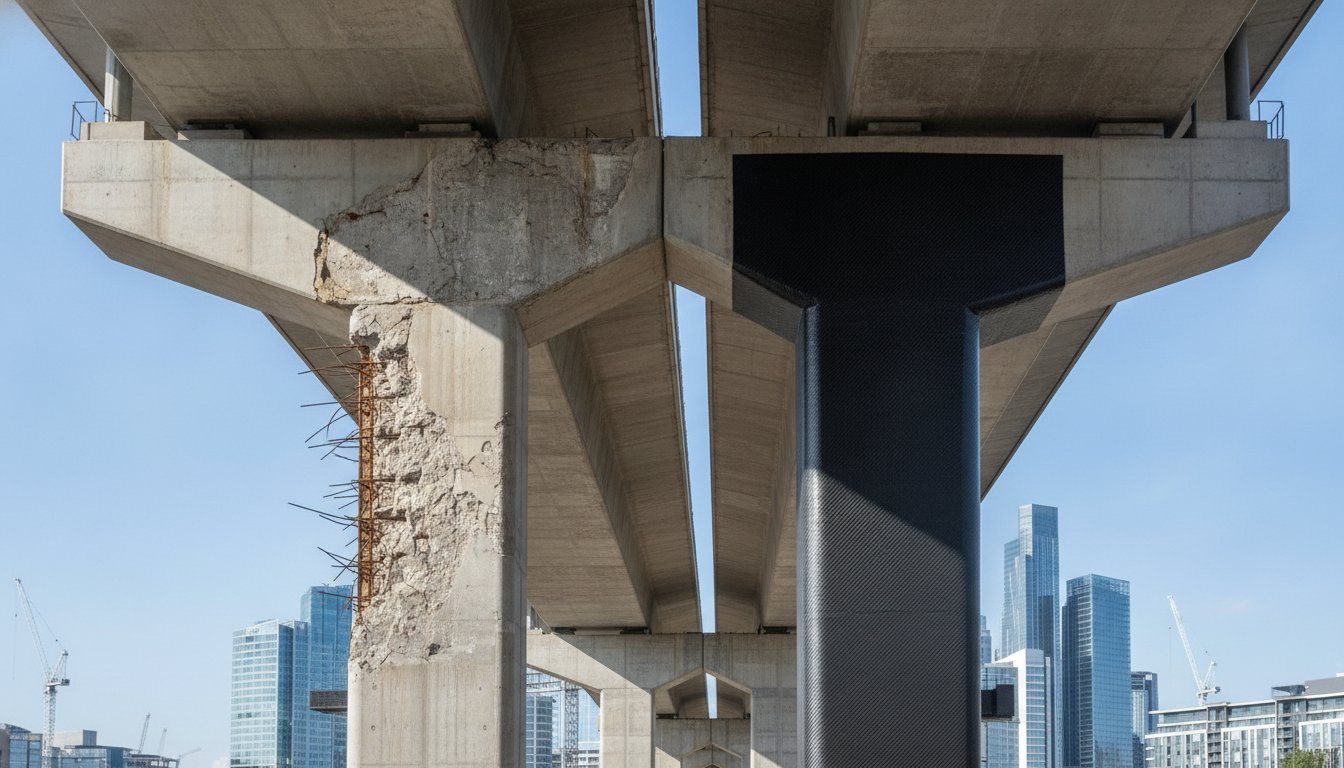
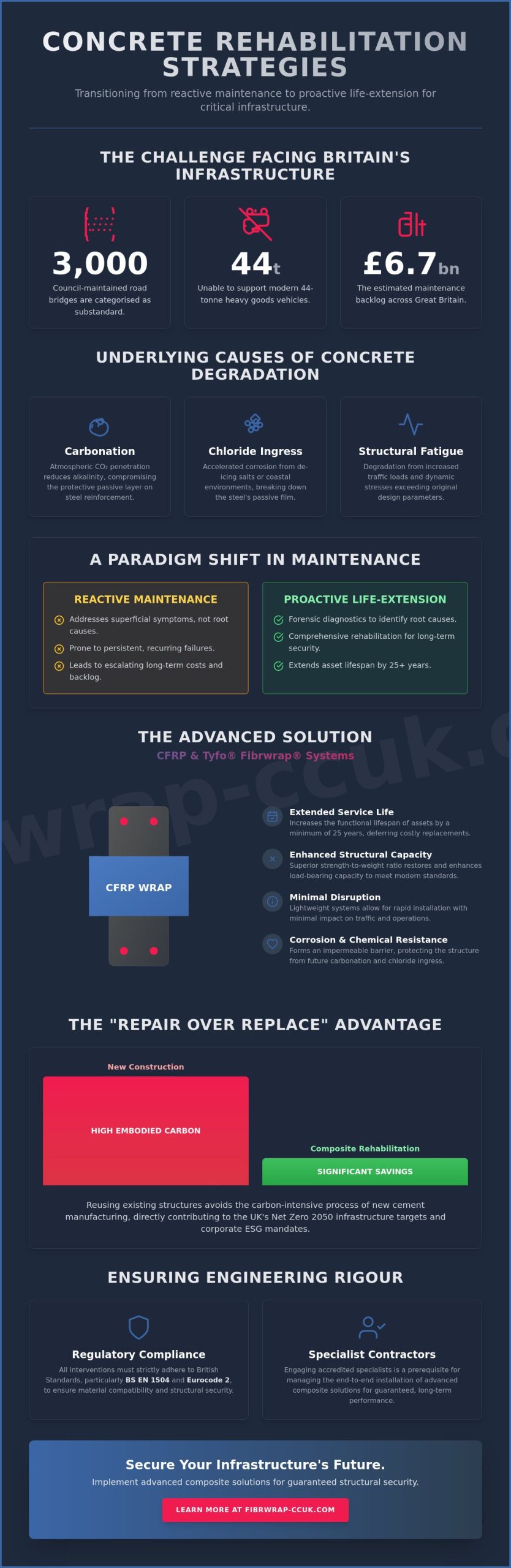
Nearly 3,000 council-maintained road bridges across Great Britain are currently classified as substandard, rendered incapable of supporting the 44-tonne loads required by modern heavy goods vehicles. You’re likely aware that the persistent failure of localised patch repairs often stems from a failure to address the underlying electrochemical corrosion that compromises structural integrity. Implementing comprehensive concrete rehabilitation strategies is therefore essential to manage the £6.7 billion maintenance backlog whilst avoiding the escalating costs of raw materials for new builds.
This technical guide provides the engineering frameworks required to master advanced material selections, including Carbon Fibre Reinforced Polymer (CFRP) strengthening and Tyfo® Fibrwrap® Systems. You’ll gain the expertise to extend the functional lifespan of critical assets by 25 years or more, ensuring strict compliance with BS EN 1504 and the most recent Eurocode 2 standards. We examine the methodical transition from initial structural surveys to the deployment of cathodic protection and resin injection, focusing on structural reuse to significantly minimise the carbon footprint of your infrastructure portfolio.
Key Takeaways
- Understand the methodology for transitioning from reactive maintenance to proactive life-extension whilst maintaining compliance with current BS EN 1504 and Eurocode 2 standards.
- Master the forensic diagnostic processes required to identify underlying deterioration mechanisms, ensuring that chosen concrete rehabilitation strategies address root causes rather than superficial symptoms.
- Evaluate the performance advantages of Carbon Fibre Reinforced Polymer (CFRP) and Tyfo® Fibrwrap® Systems over traditional cementitious patch repairs in high-stress infrastructure environments.
- Learn to develop tiered engineering frameworks that align structural remediation with asset criticality, incorporating specific requirements for seismic retrofitting and blast mitigation.
- Recognise the technical criteria for selecting specialist engineering contractors to manage the end-to-end installation of advanced composite solutions for guaranteed structural security.
Defining Concrete Rehabilitation Strategies in the Modern Regulatory Landscape
Concrete rehabilitation strategies are defined as a methodical, tiered sequence of structural assessment, remediation of existing defects, and subsequent strengthening to meet modern performance criteria. In the current UK civil engineering sector, a decisive shift is occurring where the traditional paradigm of reactive maintenance is being superseded by proactive life-extension frameworks. This evolution is necessitated by the rising costs of raw materials; for instance, C40 grade concrete reached prices between £130 and £150 per m³ in London by early 2026. By prioritising the retention of existing structural assets, engineers can mitigate the significant financial and environmental expenditures associated with total demolition and reconstruction. Asset retention isn’t just a preference; it’s a financial necessity.
The primary catalysts for structural intervention typically include various causes of concrete degradation. These often manifest as:
- Carbonation: The reduction of alkalinity through atmospheric CO2 penetration, compromising the protective passivity of the steel.
- Chloride Ingress: Accelerated corrosion often seen in coastal environments or infrastructure exposed to de-icing salts.
- Structural Fatigue: Degradation resulting from increased traffic loads or dynamic stresses beyond the original design parameters.
These mechanisms compromise the passivity of the internal steel reinforcement, leading to expansive corrosion and subsequent spalling. Strategic rehabilitation aims to restore this passivity whilst simultaneously enhancing the load-bearing capacity of the member to comply with contemporary standards. It’s through these precise interventions that the functional lifespan of infrastructure is extended without the waste of new construction.
The Circular Economy and Structural Longevity
The “Repair over Replace” ethos is now a fundamental component of corporate ESG mandates, directly contributing to the UK’s Net Zero 2050 infrastructure targets. Significant embodied carbon savings are realised through the reuse of existing concrete frames, as the carbon-intensive process of manufacturing new cement is avoided. High-performance composites, such as Carbon Fibre Reinforced Polymer (CFRP), facilitate these upgrades with minimal material waste. These systems allow for structural enhancement without the massive volumetric additions required by traditional concrete jacketing. It’s a method that effectively aligns engineering excellence with environmental responsibility.
Regulatory Compliance and Safety Standards
Technical execution must strictly adhere to British Standards, specifically the BS EN 1504 series, which governs the protection and repair of concrete structures. Compliance ensures that any intervention is compatible with the parent material’s electrochemical and mechanical properties. It’s also imperative that rehabilitated assets are upgraded to meet modern fire safety and blast mitigation requirements. Engaging a specialist contractor with appropriate professional indemnity and technical accreditation is a prerequisite for ensuring that these complex concrete rehabilitation strategies are delivered with the necessary engineering rigour and long-term security. Integration of bespoke design features into the rehabilitation plan ensures that all safety mandates are met without compromise.
Structural Diagnostics: The Foundation of Any Rehabilitation Strategy
Forensic engineering serves as the critical precursor to any successful intervention. It moves beyond the identification of surface-level symptoms to isolate the specific mechanisms of decay. Distinguishing between a chemical attack, such as sulfate exposure or alkali-silica reaction, and mechanical overstress caused by unpredicted loading cycles is paramount. Without this diagnostic rigour, concrete rehabilitation strategies risk being merely cosmetic, leading to the premature failure of patch repairs observed in so many substandard UK assets. Diagnostics provide the empirical evidence required to transition from guesswork to precision engineering.
Non-destructive testing (NDT) methodologies allow for a granular mapping of internal structural defects without compromising the integrity of the member. By quantifying the remaining service life of an asset through empirical data, engineers can provide the objective justification required for capital expenditure. This data-driven approach ensures that the resulting design-led solution is both technically sufficient and economically proportionate to the asset’s criticality. It’s a process that defines the boundary between temporary repair and permanent rehabilitation.
Essential Testing Protocols for Reinforced Concrete
Testing must be comprehensive to be effective. Carbonation depth testing, typically utilising phenolphthalein indicators, reveals the extent of alkalinity loss and the subsequent vulnerability of the reinforcement. Chloride ion content analysis is equally vital, as it determines the threshold for electrochemical corrosion within the concrete matrix. When combined with half-cell potential mapping to identify active corrosion zones and pull-off testing to assess the tensile strength of the substrate, these protocols provide a complete profile of the material’s health. Professional structural surveys and testing are essential to establish this baseline of structural integrity.
Structural Surveys and Feasibility Studies
A rigorous visual inspection categorises spalling, cracking, and delamination to establish a baseline for the structure’s condition. Ground Penetrating Radar (GPR) is then employed for precise rebar mapping and the detection of internal voids or honeycombing that visual checks might miss. The culmination of this process is a feasibility report that balances technical necessity with budgetary constraints. This document allows for the formulation of concrete rehabilitation strategies that are both durable and cost-effective, ensuring that every pound spent contributes directly to the long-term security of the infrastructure asset. Decisions are made on facts, not assumptions.
Comparative Analysis of Remedial Techniques: Traditional vs. Composite Solutions
The selection of appropriate remedial techniques represents the most critical phase in the execution of concrete rehabilitation strategies. Whilst traditional methods have long been the industry standard, their efficacy in high-stress infrastructure environments is often limited by material compatibility and the inherent constraints of cementitious bonding. By contrast, advanced composite solutions offer a transformative approach to structural life extension, providing performance characteristics that frequently exceed the original design specifications. The decision between these methods isn’t merely a matter of cost but of long-term structural viability.
Logistics and operational continuity are significant factors in this comparison. Traditional repairs often necessitate extensive site footprints and prolonged curing times, which can lead to significant operational downtime. Composite systems, however, are characterised by their rapid installation and minimal impact on the surrounding environment. This efficiency is particularly valuable in the UK infrastructure sector, where bridge closures or facility shutdowns incur substantial economic costs. Minimising the physical footprint of the repair works ensures that critical assets remain functional whilst the rehabilitation is underway.
The weight-to-strength ratio of Carbon Fibre Reinforced Polymer (CFRP) provides a distinct advantage for weight-sensitive or restricted-access structures. Unlike steel-plate bonding, which adds significant dead load and requires heavy lifting equipment, CFRP is lightweight and can be applied manually in confined spaces. This property is essential for historic masonry or ageing concrete frames that cannot support additional structural weight. For detailed technical specifications on these processes, engineers should consult the Tyfo® Fibrwrap® installation guide.
Traditional Remediation: Mortars and Resin Injections
Traditional interventions typically involve the application of polymer-modified cementitious mortars to address localised spalling and restore the concrete cover. For structural crack sealing and leak prevention, low-viscosity resin injection is employed to fill voids and restore monolithic integrity. In cases where galvanic corrosion is widespread, cathodic protection systems are integrated to arrest the electrochemical process, preventing further degradation of the reinforcement. These methods remain essential for foundational repair before any secondary strengthening occurs.
Advanced Composite Strengthening (CFRP)
Advanced systems like the Tyfo® Fibrwrap® system are engineered to significantly enhance the flexural and shear capacity of reinforced concrete members. These high-performance composites are the preferred choice for seismic retrofitting and blast mitigation in critical infrastructure, where structural resilience is non-negotiable. CFRP offers superior long-term durability, as it’s inherently resistant to corrosion and environmental degradation, unlike traditional steel-plate bonding which remains vulnerable to the same oxidative processes that compromise the parent structure. It’s a permanent solution for a modern age.
Designing a Tiered Rehabilitation Framework for Critical Infrastructure
Effective infrastructure management requires a tiered approach that aligns the intensity of intervention with the asset’s criticality. This framework moves beyond a binary “repair or replace” decision, instead developing a hierarchy of concrete rehabilitation strategies that range from localised remediation to comprehensive structural upgrades. For the nearly 3,000 substandard road bridges across Great Britain, this methodical prioritisation is the only viable way to manage the £6.7 billion maintenance backlog whilst ensuring public safety. The strategy must be dynamic, accounting for both the current state of decay and the projected future loading requirements of the asset.
A primary objective of this framework is the seamless integration of basic concrete repairs with advanced structural strengthening. If a bridge pier requires spall repair, it’s often the most opportune moment to apply composite wraps that enhance shear capacity or provide seismic retrofitting. This dual-purpose approach requires rigorous temporary works design to maintain structural stability whilst the parent material is being remediated. Coordination of multi-phase programmes is essential; it allows for the execution of these complex concrete rehabilitation strategies in a manner that minimises operational downtime for the asset owner.
Seismic Retrofitting and Blast Mitigation
In high-security facilities and seismic-prone regions, the rehabilitation strategy must prioritise ductility and energy absorption. Enhancing the lateral confinement of concrete columns through composite wrapping significantly increases their ability to withstand exceptional loading events without catastrophic failure. These systems provide critical fragmentation protection, ensuring that even if the concrete matrix is compromised, the structural core remains intact. Case studies in the energy and transport sectors demonstrate that these interventions are often the only way to bring legacy assets in line with modern safety standards without total reconstruction.
Pipeline and Industrial Asset Life-Extension
The rehabilitation of large-diameter pipes in the water and gas sectors presents distinct engineering challenges, particularly regarding the maintenance of hydraulic capacity. Utilising trenchless composite lining techniques for pipeline rehabilitation allows for significant structural reinforcement with a negligible reduction in the internal diameter. This method is particularly effective for addressing both internal corrosion and external soil-loading pressures. It’s a precise application of advanced materials science that restores the structural integrity of the pipeline whilst avoiding the massive disruption and cost of traditional open-cut replacement methods.
To ensure your assets meet these rigorous performance standards, contact our engineering team to discuss bespoke concrete rehabilitation strategies tailored to your specific infrastructure requirements.
Implementation and Life-Extension: The Role of Specialist Engineering Contractors
The technical sophistication of even the most robust concrete rehabilitation strategies remains entirely dependent upon the precision of their physical execution. Transitioning from a theoretical design to a successful structural intervention requires the engagement of a specialist engineering contractor capable of managing the complexities of advanced material applications. Unlike traditional civil works, the installation of high-performance composites necessitates a deep understanding of substrate preparation, resin rheology, and environmental curing conditions. Entrusting these critical tasks to end-to-end specialists ensures that the structural integrity of the asset is restored according to the exact parameters defined during the diagnostic phase.
Empirical verification is central to the implementation process, serving as the final safeguard for structural security. Rigorous quality control protocols, including pull-off tests to verify the tensile strength of the concrete substrate and bond strength verification of the applied composite, are conducted during the application. These tests provide the objective evidence required to confirm that the rehabilitation system is fully integrated with the parent structure. By establishing these benchmarks on-site, the contractor provides asset owners with the documented assurance that the rehabilitated member will perform as predicted under load. It’s a methodical approach that prioritises safety and verified performance above all else.
The Design-Build Advantage in Rehabilitation
Adopting an integrated design-build model significantly reduces the risk of project delays and cost overruns. When engineering and contracting teams operate as a single entity, bespoke design calculations are seamlessly translated into site-specific installation procedures. This cohesion allows for the precise determination of composite thickness and ply orientation, ensuring that the reinforcement is optimised for the specific stresses identified in the structural survey. Seamless communication between structural engineers and site teams ensures that any unforeseen substrate variations are addressed immediately without compromising the project timeline or the life-extension objectives.
Post-Installation Care and Asset Management
The conclusion of the physical works marks the beginning of a long-term asset management phase designed to maximise the return on investment. Implementing structural health monitoring (SHM) systems, such as strain gauges or fibre-optic sensors, allows for the real-time tracking of structural performance post-rehabilitation. The application of specialized protective coatings further shields the rehabilitated concrete from future chemical attack and UV degradation. By scheduling periodic inspections and maintaining a disciplined monitoring schedule, the functional lifespan of the asset is effectively prolonged by 25 years or more, ensuring compliance with modern safety standards whilst significantly reducing the long-term maintenance burden.
Securing Structural Longevity through Advanced Engineering Excellence
The transition from reactive maintenance to sophisticated concrete rehabilitation strategies is no longer optional for the preservation of the UK’s critical infrastructure. Successful life-extension depends on the integration of forensic diagnostics with high-performance materials like the Tyfo® Fibrwrap® system. By prioritising structural reuse over demolition, significant carbon savings are achieved whilst ensuring legacy structures meet the rigorous safety and load-bearing requirements of 2026 and beyond. It’s through this methodical approach that the maintenance backlog can be managed effectively without the environmental cost of new construction.
As the exclusive UK licensee for the Tyfo® Fibrwrap® system, our team provides the technical expertise and UK-wide coverage necessary to deliver these complex interventions with absolute precision. A proven track record is maintained in extending the functional lifespan of essential assets through expert design and end-to-end installation services. Contact our specialist engineering team to discuss your project requirements and ensure the long-term security of your infrastructure portfolio. With the right engineering framework, even the most compromised assets can be transformed into resilient, modern structures.
Frequently Asked Questions
What is the difference between concrete repair and concrete rehabilitation?
Concrete repair typically involves localised interventions to address specific defects like spalling or surface cracks. In contrast, concrete rehabilitation strategies encompass a holistic programme of assessment and remediation designed to restore structural integrity and extend the asset’s functional life by 25 years or more. Rehabilitation addresses the underlying electrochemical or mechanical causes of decay rather than merely treating the visible symptoms.
How long does a typical CFRP rehabilitation project take to complete?
The duration of a Carbon Fibre Reinforced Polymer (CFRP) project is significantly shorter than traditional methods due to the material’s rapid application and curing properties. Whilst a major structural upgrade using concrete jacketing might take months, a comparable CFRP strengthening intervention is often completed in several weeks. This reduction in site time is critical for minimising operational downtime on high-traffic infrastructure or industrial assets.
Can concrete rehabilitation strategies be applied to historic or listed buildings?
Yes, advanced rehabilitation techniques are frequently applied to historic or listed structures where the preservation of architectural character is mandatory. The low-profile nature of CFRP allows for structural strengthening without altering the original dimensions or aesthetics of the building. Because these systems add negligible weight and volume, they’re often the only viable solution for upgrading heritage assets to meet modern safety and load-bearing standards. In instances where these heritage projects also require thermal upgrades, high-performance insulation solutions from Third Coast Spray Foam can be integrated to improve energy efficiency without compromising the structure’s historic fabric.
Is Carbon Fibre Reinforced Polymer (CFRP) more cost-effective than steel-plate strengthening?
CFRP is generally more cost-effective than steel-plate strengthening when total project expenditures, including labour, plant hire, and operational downtime, are considered. Whilst the raw material cost of carbon fibre is higher, the elimination of heavy lifting equipment and the speed of installation result in significant overall savings. Additionally, the inherent corrosion resistance of composites removes the long-term cost of maintenance associated with protecting steel from oxidative decay.
How do environmental factors in the UK, such as freeze-thaw cycles, affect rehabilitation strategy?
UK-specific environmental factors, particularly freeze-thaw cycles and chloride exposure in coastal areas, necessitate the use of highly compatible and durable remedial materials. Effective concrete rehabilitation strategies must ensure that the chosen systems prevent moisture ingress, which causes the expansive pressure responsible for seasonal cracking. Utilising advanced resins and protective coatings ensures that the structural bond remains intact despite the thermal stresses and moisture levels typical of the British climate.
What are the common signs that a concrete structure requires urgent rehabilitation?
Urgent rehabilitation is required when visual indicators such as widespread spalling, exposed reinforcement, or longitudinal rust staining are present. These signs suggest that internal corrosion has reached a critical stage where the parent concrete is no longer protecting the steel core. Other indicators include unpredicted structural deflection or the presence of cracks exceeding 0.3mm in width, which facilitate the rapid ingress of moisture and deleterious chemicals.
Can the Tyfo® Fibrwrap® system be applied to wet or submerged concrete surfaces?
The Tyfo® Fibrwrap® system includes specific formulations engineered for application on wet or submerged concrete surfaces. These specialised resins allow for structural strengthening in environments where traditional dry-lay methods would fail, such as bridge piers in tidal zones or internal pipeline surfaces. This capability ensures that underwater assets can be rehabilitated without the need for expensive and complex cofferdam installations or complete dewatering of the structure.


