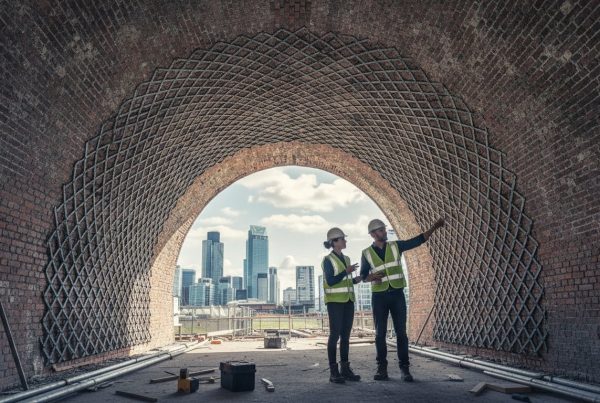

The Carbon Fibre Construction Repair Material Market is currently expanding at a compound annual growth rate of 10.2%, as structural engineers prioritise high-performance composites over traditional remediation methods. It is widely acknowledged that the accelerating degradation of concrete assets, coupled with the logistical complexities of deploying heavy plant in constrained environments, necessitates a more sophisticated approach to asset management. You likely recognise that meeting the UK’s Net Zero 2050 targets requires a shift away from carbon-intensive demolition toward the sustainable extension of existing structural lifespans.
This technical analysis details the strategic advantages of carbon fibre strengthening, demonstrating why CFRP systems are now the preferred solution for complex structural life-extension. We will examine the empirical performance of proprietary systems such as Tyfo® Fibrwrap® and evaluate their alignment with modern safety standards, including the second generation of Eurocode 8 and the Concrete Society’s Technical Report 55. By focusing on the integration of advanced materials science and engineering rigour, this review provides a roadmap for achieving long-term structural security and compliance whilst minimising operational downtime.
Key Takeaways
- Understand the mechanical superiority of CFRP systems, including their exceptional strength-to-weight ratios and inherent resistance to aggressive, corrosive environments.
- Evaluate the strategic advantages of carbon fibre strengthening over traditional methods like steel plate bonding, specifically regarding the mitigation of additional dead weight on existing foundations.
- Discover how the “repair over replacement” philosophy facilitates compliance with Net Zero 2050 targets by extending the functional lifespan of infrastructure with minimal site disruption.
- Recognise why CFRP must be treated as a bespoke engineering solution rather than a commodity, necessitating precise substrate preparation and rigorous pull-off testing for guaranteed performance.
The Evolution of CFRP: Defining Modern Structural Strengthening
Carbon-fiber reinforced polymer (CFRP) represents a sophisticated category of composite materials that has transitioned from high-stakes aerospace engineering into the critical infrastructure sector. In its civil engineering application, CFRP is utilised as a high-performance system designed to enhance the load-bearing capacity of existing structural elements. Traditional reinforcement methods, such as steel plate bonding or concrete jacketing, are increasingly viewed as incompatible with modern asset demands. These legacy techniques often introduce significant dead weight and require intensive logistical support that conflicts with the UK’s commitment to Net Zero 2050. One of the primary advantages of carbon fibre strengthening is its ability to provide substantial structural enhancement without the spatial or weight penalties associated with conventional materials.
The adoption of CFRP is central to a broader national strategy focused on infrastructure life-extension. Rather than pursuing carbon-intensive demolition and reconstruction, engineers are now tasked with prolonging the functional utility of essential assets. This shift requires materials that offer long-term durability and resistance to environmental degradation. CFRP systems provide a tailored response to these challenges, ensuring that infrastructure remains safe and compliant with evolving regulatory standards whilst minimising the carbon footprint of the intervention. It’s a method that prioritises precision and longevity over the disruptive, temporary fixes of the past.
The Composite System: Matrix and Reinforcement
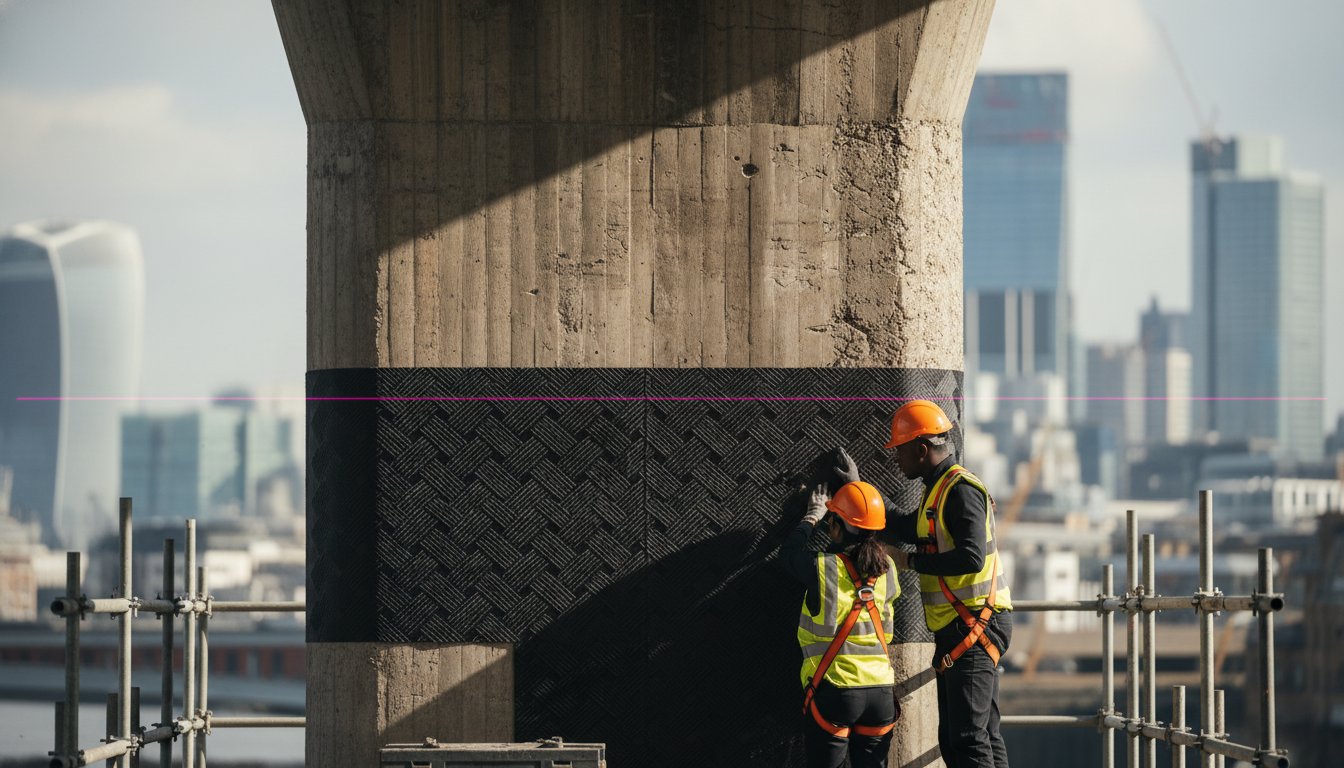
The efficacy of a CFRP installation is derived from the synergistic relationship between high-strength carbon fibres and a polymer resin matrix. The fibres provide the requisite tensile strength, whilst the resin ensures effective load transfer and protects the reinforcement from external environmental factors. Within this field, the Tyfo® Fibrwrap® system is recognised as a premier, proprietary solution that has undergone rigorous testing to validate its performance under extreme conditions. Once the saturation and application process is complete, the resin cures to form a single, monolithic unit with the substrate. This integration is critical for maintaining structural integrity, particularly when addressing complex geometries or bespoke design requirements that would be inaccessible to rigid steel components.
Primary Objectives of CFRP Intervention
Structural engineers specify CFRP for a diverse range of remediation goals. The system is most frequently deployed to address flexural and shear deficiencies in concrete members, often resulting from increased traffic loads or historical design omissions. Beyond standard reinforcement, these systems are essential for seismic retrofitting and blast mitigation in high-risk environments, where the material’s high energy absorption is a vital safety feature. Additionally, CFRP is an effective tool for correcting construction errors or restoring capacity lost to reinforcement corrosion. It provides a versatile, non-invasive alternative to more traditional structural modifications that would otherwise require extensive site closures.
Technical Superiority: The Mechanical Advantages of Carbon Fibre
The mechanical profile of Carbon Fibre Reinforced Polymer provides a distinct departure from traditional structural materials. Engineers and asset managers often specify these systems because the advantages of carbon fibre strengthening include an unmatched strength-to-weight ratio. While structural steel remains a staple of the industry, its inherent density often introduces significant dead weight that can compromise the very foundations it aims to support. CFRP, conversely, offers a fraction of the mass whilst delivering superior tensile performance. This lightweight nature is one of the primary technical advantages of CFRP, allowing for rapid installation without the need for heavy lifting equipment or complex temporary works.
Tensile Strength and Modulus of Elasticity
In terms of raw capacity, the ultimate tensile strength of high-performance CFRP significantly outperforms Grade S355 structural steel. Whilst S355 steel typically yields at 355 MPa, the typical tensile capacity of Tyfo® systems exceeds 1000 MPa. Beyond simple strength, the modulus of elasticity is a critical factor in structural remediation, particularly for deflection control. High-modulus variants allow for precise stiffness adjustments, ensuring that reinforced members maintain their serviceability limits under increased loads. This precision allows for the restoration of structural integrity in beams and slabs where traditional section enlargement would be physically impossible or architecturally undesirable.
Durability in Harsh UK Environments
The UK’s industrial and coastal regions present aggressive environments where traditional reinforcement is prone to rapid oxidation and degradation. CFRP is inherently corrosion-resistant because it’s a polymer-based system. By sealing the substrate, the composite acts as a robust barrier against chloride ingress and carbonation. This preventative quality is essential for reducing the frequency of future concrete repairs. It ensures long-term stability for assets exposed to chemical attack or harsh marine conditions, providing a level of security that metallic alternatives cannot match.
Fatigue resistance is another area where CFRP excels. Metallic alternatives are susceptible to fatigue cracking under cyclic loading, yet polymer-based systems exhibit far greater endurance over millions of cycles. The anisotropic nature of carbon fibre also allows for customisable fibre orientation. Stress paths can be mapped and addressed with surgical precision, ensuring reinforcement is applied only where the structural analysis dictates. This level of bespoke design capability transforms the remediation process from a generic patch-up into a targeted engineering intervention. Selection of the correct fibre alignment is vital for addressing the specific shear or flexural stresses unique to each asset.
Comparative Analysis: CFRP vs Traditional Strengthening Methods
The selection of a structural remediation strategy often involves a direct comparison between legacy techniques and modern composite technology. While traditional methods are well-understood by the wider industry, they frequently impose physical and logistical burdens that modern engineering seeks to avoid. One of the central advantages of carbon fibre strengthening is its ability to bypass the inherent constraints of steel and concrete interventions, offering a streamlined path to asset compliance. When evaluating these systems, engineers must look beyond material costs and consider the total project impact, including foundation loading and operational continuity.
Steel Plate Bonding: The Heavyweight Alternative
Steel plate bonding has historically been a standard response to flexural deficiencies, yet it presents significant handling challenges. The requirement for heavy lifting equipment and extensive mechanical fixings makes installation in constrained environments, such as basement levels or bridge soffits, exceptionally difficult. These mechanical anchors can inadvertently damage existing reinforcement, creating new points of vulnerability. There’s also the persistent risk of corrosion at the interface between the steel and the concrete substrate, which can lead to bond failure over time. By contrast, the operational advantages of carbon fibre strengthening include a lightweight profile that eliminates the need for heavy plant, significantly reducing the risk of interface degradation.
Section Enlargement: The Footprint Problem
Section enlargement, or concrete jacketing, is often specified for column strengthening, but it comes with a high spatial cost. In commercial centres and multi-storey car parks, the reduction in usable space can have direct economic consequences for the asset owner. More critically, the massive increase in dead load from additional concrete often necessitates further strengthening of the underlying foundations. This creates a cascading engineering problem that extends the project scope and budget. CFRP systems, such as Tyfo® Fibrwrap®, provide equivalent confinement and load-bearing enhancement with a negligible increase in the structural footprint. This keeps the global structural stability intact without the need for foundation upgrades.
Installation speed remains a decisive factor in modern infrastructure projects. Composite systems can often reduce programme durations by up to 50% compared to traditional methods. Because there’s no requirement for temporary propping or the extended curing times associated with large-scale concrete pours, assets can remain partially or fully operational during the works. Furthermore, the low-profile nature of CFRP ensures the original architectural profile of the asset is maintained. This is particularly valuable for heritage structures or high-specification commercial buildings where aesthetic preservation is a priority. It’s a method that delivers technical performance without compromising the form or function of the building.
Operational and Environmental Advantages: Disruption and Carbon
The “Repair over Replacement” philosophy serves as a fundamental pillar of modern sustainable engineering, particularly as the UK infrastructure sector strives to meet the requirements of Net Zero 2050. One of the most significant advantages of carbon fibre strengthening is the substantial reduction in whole-life carbon compared to the demolition and reconstruction of an asset. By extending the functional lifespan of a structure through targeted CFRP intervention, the embodied carbon associated with new concrete and steel production is deferred or eliminated entirely. This approach aligns with the circular economy, prioritising the preservation of existing structural value through advanced material science rather than the resource-intensive cycle of rebuild.
Reducing the site footprint is a critical requirement in constrained urban environments where the deployment of heavy plant and machinery is often physically impossible or economically prohibitive. Because CFRP systems like Tyfo® Fibrwrap® are exceptionally lightweight, they can be transported and applied using manual handling techniques, bypassing the need for cranes, piling rigs, or extensive temporary works. This removal of heavy machinery not only reduces site-level emissions but also mitigates the logistical challenges typically associated with large-scale structural repairs in busy city centres. The logistical simplicity of the installation process ensures that site presence is as non-invasive as possible.
Minimising Operational Downtime
The ability to perform structural remediation whilst traffic flows continue is a primary consideration for asset controllers managing live rail or highway networks. Traditional methods often require total closures to accommodate the weight and reach of installation equipment, yet CFRP allows for work to be conducted within limited possessions or during live operations. For industrial assets, such as high-pressure pipelines or power generation infrastructure, the rapid turn-around offered by composite systems ensures that functional utility is restored with minimal impact on service delivery. This operational efficiency is a key component of the business case for specification, where the cost of downtime often exceeds the cost of the repair itself.
Sustainability and the Circular Economy
Sustainability in structural engineering is increasingly measured through the lens of transportation and resource efficiency. The lightweight nature of composite materials results in significantly lower transportation emissions compared to the tonnes of steel or concrete required for traditional section enlargement. These systems are designed for long-term stability, often extending asset life by decades and ensuring compliance with evolving UK building regulations and sustainability certification schemes. By choosing to contact our engineering team for a technical assessment, asset owners can develop a remediation strategy that balances structural safety with environmental responsibility.
Bespoke Design and Installation: The Engineering Requirement
Realising the full advantages of carbon fibre strengthening requires a shift in perspective from simple material procurement to integrated engineering design. CFRP shouldn’t be viewed as a commodity product. It’s a high-performance composite system whose efficacy depends entirely on the quality of the bond and the precision of the application. Substrate preparation is the most critical phase of installation. Without meticulous mechanical abrasion and the removal of laitance, the system cannot achieve the requisite shear transfer. Pull-off testing is conducted to verify that the host concrete possesses the necessary tensile strength to support the reinforcement. These interventions must be seamlessly integrated with broader structural repairs to ensure bond integrity isn’t compromised by underlying delamination or reinforcement corrosion.
The installation of proprietary systems, such as Tyfo® Fibrwrap®, necessitates the use of specialist contractors who possess deep technical knowledge of resin rheology and fibre saturation. It’s not a task for general maintenance crews. Incorrect mixing ratios or environmental contamination during the wet-layup process can lead to significant performance deficits. Professional sobriety in the execution phase ensures that the theoretical capacities calculated during the design stage are fully realised on-site. This disciplined approach is what separates a long-term structural solution from a temporary patch.
Engineering Calculations and Technical Specifications
Developing a robust remediation strategy starts with a detailed design feature analysis. This process involves sophisticated modelling to determine the exact fibre orientation and layer count required to address identified structural deficiencies. In 2026, compliance with the second generation of Eurocode 8 is a primary requirement for seismic resistance, whilst the Concrete Society’s Technical Report 55 (TR55) remains the benchmark for UK concrete strengthening. Engineers must specify the precise combination of epoxy resin matrices and carbon fibres to withstand specific thermal cycles or chemical loads, ensuring the system remains stable throughout its intended service life. Independent technical validation often provides the final layer of assurance for complex infrastructure assets.
Quality Assurance and Performance Monitoring
Performance monitoring and quality control are integral to the lifecycle of a reinforced asset. On-site testing typically includes the creation of witness panels and bond pull-off tests to verify that the cured composite meets the mechanical properties defined in the specification. These tests provide empirical evidence of the system’s performance, ensuring it meets the safety requirements of the Building Safety Act 2022. For critical infrastructure, long-term monitoring strategies allow for the periodic assessment of structural health, providing asset controllers with ongoing security. To discuss your specific project requirements or to request a technical review, contact our specialist engineering team.
Advancing Infrastructure Resilience through Composite Engineering
The strategic integration of high-performance composites represents a fundamental shift in how the industry approaches the remediation of ageing assets. By prioritising the mechanical advantages of carbon fibre strengthening, engineers can effectively resolve the conflict between structural capacity and logistical constraints. These systems provide a verified path toward meeting Net Zero 2050 targets whilst ensuring compliance with the latest Eurocode standards. The transition from traditional demolition to sophisticated life-extension is no longer an optional strategy; it’s a technical necessity for modern infrastructure management.
As the exclusive UK licensee for Tyfo® Fibrwrap® systems, we offer an expert design-to-installation service tailored to complex infrastructure requirements. With over 25 years of composite engineering expertise, our team ensures that every intervention is grounded in empirical rigour and long-term safety. Secure the functional lifespan of your structural assets through a partnership defined by technical authority and proven results. Consult with our Specialist Engineering Team to discuss your specific remediation requirements.
Frequently Asked Questions
What are the primary advantages of carbon fibre strengthening over steel?
The primary advantages of carbon fibre strengthening over traditional steel reinforcement include a significantly higher strength-to-weight ratio and inherent resistance to electrochemical corrosion. Whilst steel plates require intensive mechanical fixings and heavy lifting equipment, CFRP is applied as a lightweight, flexible fabric that conforms to complex structural geometries. This eliminates the risk of interface corrosion and prevents the introduction of additional dead weight that could compromise the existing foundations.
How long does a CFRP structural strengthening system last?
CFRP structural strengthening systems are typically designed to match or exceed the remaining service life of the host structure, often specified for a functional duration of 50 years or more. Because the carbon fibres are encapsulated within a protective polymer resin matrix, the system is exceptionally resistant to environmental degradation, including chloride ingress and carbonation. Long-term durability is further assured through the use of proprietary systems like Tyfo® Fibrwrap® which have undergone extensive accelerated ageing tests.
Is carbon fibre strengthening fire resistant?
The fire performance of CFRP is dependent on the glass transition temperature of the epoxy resin matrix, which typically ranges between 60°C and 80°C. To maintain structural integrity during a fire event, specialized fire-retardant coatings or thick-film intumescent systems are applied to the cured composite. These protective layers ensure the system complies with UK Building Regulations regarding fire resistance and safety in occupied structures, providing the necessary period of structural stability.
Can carbon fibre be used to strengthen historical masonry structures?
Carbon fibre is an effective solution for the non-invasive strengthening of historical masonry structures where aesthetic preservation is a primary requirement. It’s frequently utilised for seismic retrofitting and the containment of lateral spread in heritage buildings. The material’s low profile allows it to be concealed within mortar joints or behind lime-based renders, providing structural stabilization without altering the architectural character or the historical fabric of the asset.
How does the cost of CFRP compare to traditional concrete repair methods?
Whilst the material cost of CFRP is often higher than traditional steel or concrete, the total project cost is frequently lower due to significant reductions in site labour and logistical requirements. The elimination of heavy plant, temporary propping, and extended site closures contributes to a more efficient programme. One of the logistical advantages of carbon fibre strengthening is its ability to be installed in live environments, thereby avoiding the substantial economic losses associated with total operational downtime.
What kind of substrate preparation is required for CFRP application?
Successful CFRP application requires rigorous substrate preparation to ensure a high-strength bond between the concrete and the composite system. The concrete surface must be mechanically abraded, typically through grit-blasting or grinding, to achieve a specified surface profile. All laitance, contaminants, and loose material must be removed, and pull-off testing is conducted to verify that the substrate’s tensile strength meets the minimum requirements defined in the engineering specification before the resin is applied.
Can CFRP be applied to structures that are currently under load?
CFRP can be applied to structures whilst they remain under their existing dead load, although the efficiency of the strengthening is maximised if the live load is temporarily removed or reduced. If the structure is strengthened under load, the design must account for the initial strain already present in the existing reinforcement. Strategic application allows for the enhancement of structural capacity without the need for total evacuations or the complete cessation of traffic flows on bridge decks.
Is CFRP strengthening suitable for underwater or marine environments?
Specialized CFRP systems are specifically designed for application in marine and underwater environments, utilising moisture-tolerant resins that cure effectively in submerged conditions. These systems are used for the rehabilitation of bridge piers, jetty piles, and sea walls where traditional concrete repair would be compromised by tidal action. The inherent corrosion resistance of the polymer matrix makes it an ideal solution for assets exposed to high salinity and constant moisture cycles.