
Did you know that carbon fibre reinforced polymer (CFRP) possesses a strength-to-weight ratio ten times greater than traditional steel, yet it can be installed up to 70% faster? Asset managers across the United Kingdom face a persistent challenge as aging infrastructure is required to accommodate modern traffic loads that frequently exceed original design specifications. You likely recognise that traditional remediation methods, such as concrete jacketing, often lead to protracted traffic disruption and increased vulnerability to reinforcement corrosion. This technical guide examines the evolution of bridge pier strengthening, focusing on how advanced composite solutions like Tyfo® Fibrwrap® systems provide a sophisticated alternative to conventional methods. By reading this analysis, you’ll gain a comprehensive understanding of how to enhance load capacity and extend asset lifespans whilst maintaining strict compliance with CS 453 and CD 371 standards. We will evaluate the mechanical performance of specialised polymers, the transition towards whole-life costing models, and the precise engineering requirements for successful structural reinforcement in high-demand environments.
Key Takeaways
- Understand the evolving structural demands on UK infrastructure and the specific engineering drivers necessitating the reinforcement of ageing bridge piers.
- Identify the mechanical advantages of Carbon Fibre Reinforced Polymer (CFRP), specifically regarding the high-performance confinement provided by Tyfo® Fibrwrap® systems.
- Evaluate the technical and logistical benefits of bridge pier strengthening with composite materials compared to traditional concrete jacketing, particularly concerning dead load and installation speed.
- Recognise the importance of a rigorous engineering process, encompassing initial structural surveys, carbonation testing, and bespoke design to ensure substrate compatibility.
- Learn how partnering with a specialist engineering contractor facilitates the integration of advanced repair technologies into sustainable, long-term asset management strategies.
The Engineering Drivers for Bridge Pier Strengthening in the UK
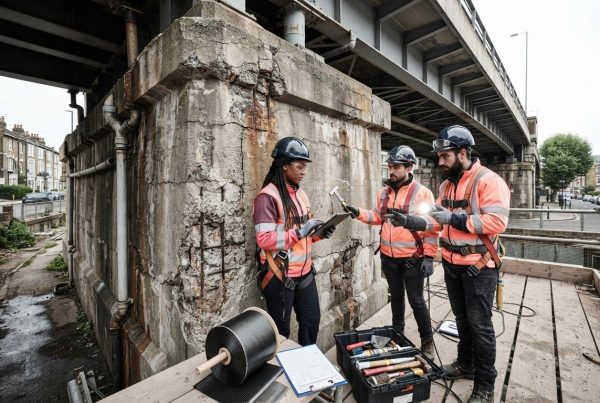
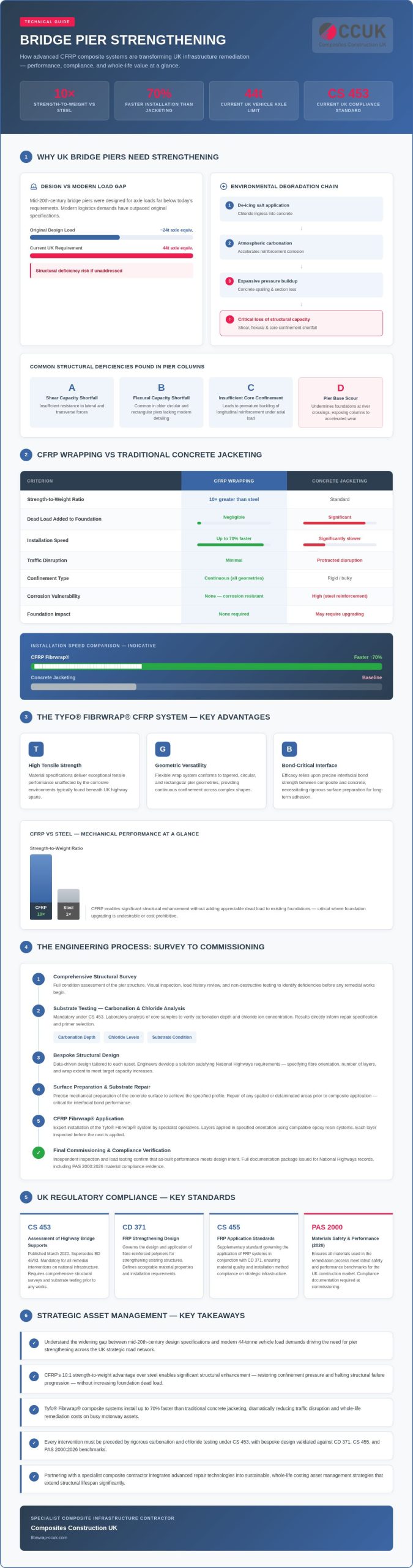
The necessity for bridge pier strengthening across the UK’s strategic road network is primarily dictated by the widening disparity between the original design specifications of mid-20th-century assets and the rigorous demands of contemporary logistics. Many substructures were engineered to accommodate significantly lower axle weights than the current 44-tonne vehicle limits. Consequently, these piers often exhibit structural deficiencies that compromise the safety of the entire span. Beyond load increases, environmental degradation remains a critical factor. The pervasive use of de-icing salts on UK motorways facilitates chloride ingress, which, alongside atmospheric carbonation, accelerates the corrosion of internal steel reinforcement. This electrochemical process leads to expansive pressure, resulting in concrete spalling and a subsequent loss of cross-sectional area in vital support columns.
Common Structural Deficiencies in Pier Columns
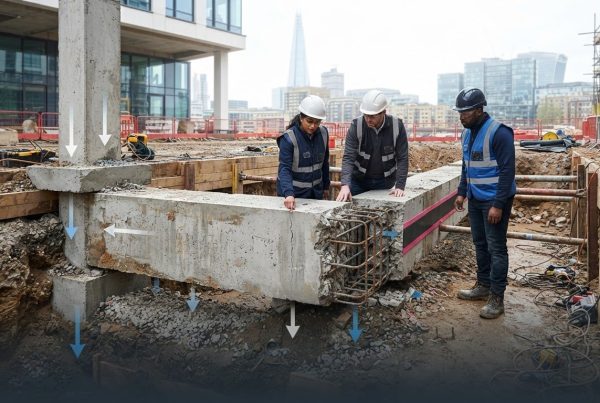
Structural assessments frequently identify shortfalls in both shear and flexural capacity, particularly in older circular and rectangular piers that lack modern detailing. A primary concern is the insufficient confinement of the concrete core, which is essential for preventing the premature buckling of longitudinal reinforcement under high axial loads. In river-crossing scenarios, ‘scour’ at the pier base further exacerbates these issues by undermining the foundation and exposing the lower column to accelerated environmental wear. To address these vulnerabilities, Advanced Composite Systems are increasingly specified to restore structural equilibrium without adding significant dead load to the foundations. This precision-engineered approach ensures that the confinement pressure is restored, effectively halting the progression of structural failure.
UK Compliance and Industry Standards
Adherence to stringent regulatory frameworks is mandatory for any remedial intervention on the national infrastructure. CS 453, published in March 2020, provides the current standard for the assessment of highway bridge supports, superseding the older BD 48/93. Furthermore, CD 371 and CS 455 govern the design and application of fibre-reinforced polymers for strengthening purposes. These standards require that every bridge pier strengthening project is preceded by comprehensive structural surveys and substrate testing to verify carbonation depth and chloride levels. It’s through this data-driven approach that engineers can develop a bespoke design that satisfies National Highways requirements and ensures the long-term integrity of the asset. Compliance with PAS 2000:2026 also ensures that all materials used in the remediation process meet the latest safety and performance benchmarks for the UK construction market.
Advanced Composite Systems: The Role of CFRP in Substructure Reinforcement
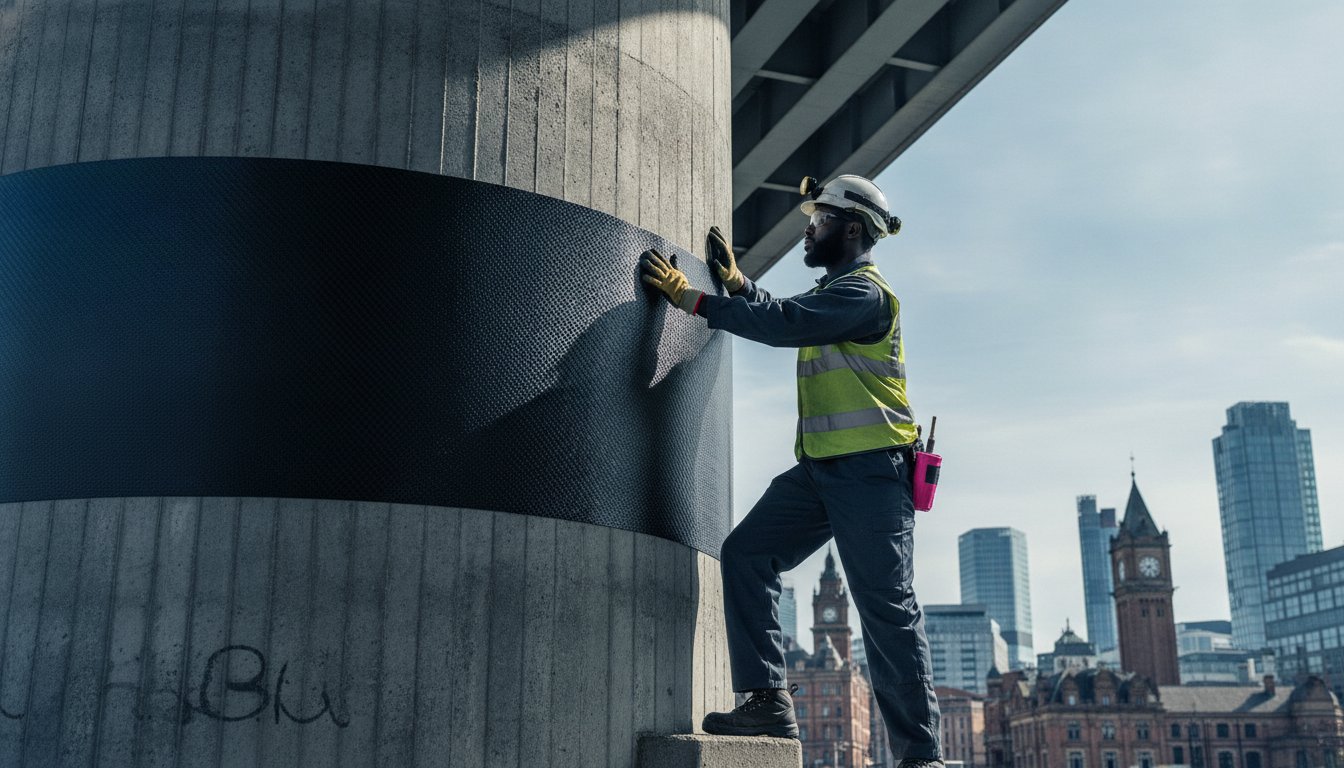
Whilst traditional steel plate bonding offers specific flexural advantages, the application of Carbon Fibre Reinforced Polymer (CFRP) wraps represents a paradigm shift in substructure remediation. Unlike rigid plates, flexible wrap systems provide continuous confinement, which is essential for restoring the structural integrity of circular and rectangular columns. The technical superiority of CFRP is evidenced by its exceptional 10:1 strength-to-weight ratio compared to conventional steel. This allows for significant bridge pier strengthening without increasing the dead load on existing foundations. The efficacy of these systems relies upon the interfacial bond strength between the composite and the concrete, necessitating precise surface preparation to ensure long-term adhesion and load transfer.
The Tyfo® Fibrwrap® Advantage for Bridge Piers
The Tyfo® Fibrwrap® system is engineered as a high-performance solution that addresses the unique geometric challenges of infrastructure assets. Its material specifications include a high tensile strength that remains unaffected by the corrosive environments often found beneath UK highway spans. This versatility is particularly evident when treating tapered or flared columns, where rigid materials would prove impractical. According to a Purdue University review of FRP strengthening methods, the ability of these composites to conform to complex shapes whilst maintaining material continuity is a primary driver for their adoption in bridge substructures. By utilising these advanced systems, asset managers can achieve a level of durability that far exceeds traditional concrete jacketing, especially in areas prone to chloride-induced corrosion.
If you’re currently evaluating the specific requirements of a sensitive infrastructure asset, you might find it useful to explore our bespoke design features for composite applications.
Enhancing Ductility and Seismic Resilience
The mechanics of bridge pier strengthening through CFRP wrapping are rooted in the principle of passive confinement. When the concrete core is subjected to axial loads, it attempts to expand laterally; the high-modulus CFRP wrap resists this expansion, generating a triaxial state of stress that significantly improves the concrete’s strain capacity. This process is vital for applying seismic retrofitting principles to UK infrastructure, ensuring that assets remain resilient during extreme loading events or unforeseen structural shifts. By providing this external reinforcement, the system effectively manages the internal pressures that would otherwise lead to catastrophic failure. Through the strategic application of these composites, the brittle failure mode of concrete is transformed into a predictable, ductile one. This enhancement in ductility ensures that the structure can undergo significant deformation without losing its load-bearing capacity, providing a critical safety margin for high-traffic bridge supports across the country.
Comparative Analysis: CFRP Wrapping vs Traditional Concrete Jacketing
The selection of a remediation strategy for bridge pier strengthening requires a rigorous evaluation of structural, logistical, and economic variables. Traditional concrete jacketing has long been the default methodology, involving the encasement of the existing pier with a new layer of reinforced concrete. Whilst effective in increasing cross-sectional area, this approach introduces significant dead load to the foundations, often necessitating additional piling or foundation reinforcement to accommodate the added mass. In contrast, Carbon Fibre Reinforced Polymer (CFRP) wrapping provides a negligible increase in weight, allowing the structure to achieve higher load capacities without compromising the existing foundation’s equilibrium. This distinction is critical when dealing with older assets where foundation records are incomplete or where the soil’s bearing capacity is limited.
Space constraints beneath UK highway spans often dictate the feasibility of a repair method. Concrete jacketing typically increases the column diameter by 150mm to 300mm, which can restrict hydraulic flow in watercourses or reduce essential clearance for traffic in underpasses. CFRP systems maintain the original geometry of the pier, ensuring that hydraulic and traffic envelopes remain unchanged. As detailed in a Federal Highway Administration report on bridge strengthening, the use of composites is particularly advantageous in scenarios where maintaining the original footprint is a non-negotiable requirement of the project brief.
Logistical and Programme Efficiency
The speed of execution remains a primary driver for the adoption of composite solutions. CFRP installation is typically 60% to 70% faster than traditional jacketing, as it eliminates the need for heavy shuttering, extensive steel fixing, and the curing periods associated with wet concrete. This efficiency translates to significantly reduced site downtime and fewer road closures, which is a vital consideration for the UK’s high-traffic strategic road network. Smaller site footprints and the absence of heavy plant machinery allow for bridge pier strengthening in restricted access environments, such as narrow embankments or densely populated urban areas, where traditional construction equipment cannot operate effectively. By reducing the total project duration, asset managers can achieve labour cost savings of 30% to 50% compared to conventional techniques.
Effective planning and efficient transport links are essential for any successful operation; for instance, when travelling for international site visits, using a dedicated service like Corralejo Transfers can streamline your journey from the airport.
Environmental and Sustainability Considerations
From a sustainability perspective, the focus is increasingly shifting towards the preservation of existing assets over demolition and replacement. Advanced structural repairs using CFRP contribute to the circular economy by significantly extending the functional lifespan of infrastructure with minimal material consumption. The carbon footprint associated with the production and transport of lightweight composites is considerably lower than that of large-scale concrete production. Furthermore, the application of CFRP is a dry process, which reduces the environmental risks to local watercourses by eliminating the potential for high-pH runoff often associated with wet concrete works. Over a 50-year lifecycle, the total expenditure (TOTEX) for CFRP-strengthened piers can be 40% to 60% lower than traditional methods, reflecting both reduced maintenance requirements and the avoidance of premature asset replacement.
The Engineering Process: From Structural Survey to Final Commissioning
Successful bridge pier strengthening requires a methodical, data-driven workflow that begins long before the first layer of composite is applied. It starts with a comprehensive structural survey to establish a baseline of the asset’s current health. Engineers perform carbonation depth testing and half-cell potential mapping to determine the extent of electrochemical degradation within the concrete. These diagnostic procedures are vital for verifying that the underlying substrate possesses the requisite integrity to support a bonded reinforcement system. Without this initial rigour, the long-term efficacy of the remediation remains speculative at best.
Bespoke Design and Design Features
Once the substrate’s health is validated, the engineering focus shifts to developing a tailored reinforcement plan. By utilising specialised design features, it’s possible to solve complex load-path challenges that standard, off-the-shelf solutions frequently overlook. This phase involves calculating the precise number of CFRP wraps and the specific orientation of the fibres; horizontal wraps are typically used for confinement and shear, whilst vertical layers address flexural deficiencies. The resulting bespoke design ensures full compliance with the original engineer’s intent whilst upgrading the pier’s capacity to meet modern National Highways requirements.
Following the design approval, substrate preparation commences. The concrete surface must be mechanically abraded, usually through grit blasting or needle scaling, to achieve the specific surface profile required for optimal resin adhesion. Substrate preparation is the most critical factor in the success of a bridge pier wrap because it dictates the efficacy of the load transfer between the composite and the parent structure.
On-Site Installation Rigour
The installation typically employs a precision wet-layup process. Technicians saturate the carbon fibre fabric with a high-performance epoxy resin using calibrated saturators to ensure a consistent resin-to-fibre ratio. During application, environmental conditions such as ambient temperature and humidity are monitored constantly to ensure the polymerisation occurs within the specified parameters. Any deviation from these conditions can compromise the material’s final mechanical properties.
Quality control remains paramount throughout the commissioning phase. Site teams conduct pull-off tests to verify that the interfacial bond strength meets the design’s minimum requirements. Furthermore, thermal imaging or acoustic sounding is often utilised to detect potential delamination or voids within the cured system. If you require a detailed assessment of a specific infrastructure asset, please contact our technical department to arrange a structural survey.
Strategic Asset Management: Enhancing Structural Longevity with CCUK
Effective infrastructure stewardship requires a transition from reactive maintenance to a strategic, whole-life approach. The role of a specialist engineering contractor is fundamental in this transition, providing the technical oversight necessary to identify vulnerabilities before they escalate into structural failures. By integrating bridge pier strengthening into long-term asset management plans, authorities can avoid the prohibitive costs and logistical chaos associated with emergency repairs or full-scale reconstruction. This proactive methodology aligns with modern Total Expenditure (TOTEX) models, where the primary objective is to maximise the functional utility of existing assets whilst minimising lifecycle costs.
Future-proofing the UK’s bridge network involves more than just addressing current load deficiencies. It requires a consideration of evolving traffic demands and the potential impacts of climate change, such as increased flood frequency and thermal expansion stresses. Advanced composite systems provide the resilience needed to withstand these variables. Because CFRP is inherently resistant to environmental degradation, it significantly reduces the future maintenance burden, ensuring that once a pier is strengthened, it remains robust for decades without the need for frequent re-intervention.
Sustainability Through Life-Extension
A comprehensive remediation strategy often necessitates that concrete repairs and structural strengthening are executed in tandem. Whilst concrete repair restores the substrate’s chemical and physical health, CFRP wrapping provides the mechanical enhancement required for modern load compliance. This dual approach can extend the functional life of existing piers by 30 years or more, representing a significant victory for both economic efficiency and environmental sustainability. By avoiding the carbon-intensive process of demolition and new-build construction, asset managers directly contribute to the circular economy and the UK’s broader net-zero infrastructure goals.
Collaborating for Infrastructure Excellence
Partnering with CCUK ensures that every phase of the project, from initial diagnostic testing to final commissioning, is managed with engineering precision. Early-stage involvement is particularly beneficial in complex bridge projects, where site-specific constraints require innovative solutions that standard methodologies cannot provide. Our team works closely with asset owners to ensure that bridge pier strengthening interventions are not only technically sound but also logistically viable. This collaborative framework allows for the seamless delivery of high-performance reinforcement systems that meet the most stringent safety and regulatory requirements. If you’re managing a portfolio of aging infrastructure, contact our engineering team to arrange a bespoke feasibility study tailored to your specific structural requirements.
Securing the Future of UK Bridge Infrastructure
The maintenance of the UK’s strategic road and rail networks requires a departure from traditional mass-based reinforcement in favour of precision-engineered composite solutions. As established throughout this guide, the adoption of Carbon Fibre Reinforced Polymer (CFRP) provides a definitive path for bridge pier strengthening that avoids the logistical and structural penalties of concrete jacketing. By prioritising rigorous substrate diagnostics and bespoke design, asset managers can achieve significant capacity upgrades whilst ensuring strict compliance with CS 453 and CD 371 standards. This scientific approach doesn’t just restore structural equilibrium; it secures the functional lifespan of essential infrastructure for decades to come.
CCUK operates as the exclusive UK licensee for the Tyfo® Fibrwrap® system, offering a comprehensive service that encompasses everything from technical design to professional installation. With extensive experience delivering complex projects for National Highways and Network Rail, our specialist team possesses the empirical knowledge required to address the most demanding structural challenges. Consult our specialist engineers for a bespoke bridge pier strengthening solution that prioritises safety, efficiency, and long-term asset security. We look forward to assisting you in safeguarding the integrity of your infrastructure assets.
Frequently Asked Questions
What are the primary causes of bridge pier deterioration in the UK?
Deterioration is predominantly driven by electrochemical processes, specifically chloride-induced corrosion from de-icing salts and atmospheric carbonation. These mechanisms lower the pH of the concrete, leading to the oxidation of internal steel reinforcement. The resulting expansive pressure causes significant spalling and a loss of cross-sectional area, which necessitates structural intervention to restore the pier’s original design capacity.
How does CFRP strengthening compare to steel jacketing for bridge piers?
Carbon Fibre Reinforced Polymer (CFRP) is technically superior to steel jacketing due to its 10:1 strength-to-weight ratio and inherent resistance to corrosion. Whilst steel jacketing adds significant dead load and requires a larger footprint, CFRP maintains the original pier geometry. Furthermore, the installation of composites is approximately 60% to 70% faster, which reduces the overall project programme and associated labour costs.
Can bridge pier strengthening be carried out whilst the bridge remains open to traffic?
Yes, bridge pier strengthening using composite wraps is typically performed without the need for full bridge closures. The process requires minimal heavy plant and smaller site footprints compared to traditional concrete jacketing. This efficiency allows for the maintenance of operational continuity on the road or rail network, significantly reducing the economic impact of traffic disruption during the remediation works.
What is the typical lifespan of a CFRP bridge pier wrap?
A professionally designed and installed CFRP system is engineered for a service life exceeding 50 years. Research indicates that the whole-life cost of this technology is 40% to 60% lower than traditional repair methods over a half-century period. This longevity is achieved because the materials don’t suffer from the corrosion or fatigue issues that typically affect steel or reinforced concrete in harsh environments.
How do engineers calculate the required number of CFRP layers for a pier?
Designers follow the rigorous guidelines established in Concrete Society Technical Report 55 (TR55) alongside Eurocode standards. The calculation process involves determining the deficit in axial, shear, or flexural capacity through finite element analysis and structural testing. The thickness and fibre orientation of the wraps are then tailored to provide the specific confinement pressure required to meet modern load specifications.
Is CFRP strengthening suitable for piers located in water or tidal zones?
Composites are exceptionally well-suited for piers in aquatic or tidal environments because they’re chemically inert and won’t corrode when exposed to moisture or salt. Specialised resins are utilised to facilitate application in high-humidity or splash-zone conditions. This makes CFRP a preferred solution for river crossings where traditional steel reinforcement would be highly vulnerable to accelerated environmental wear.
What UK regulations govern the use of composites in bridge strengthening?
The primary standards include CS 453 for the assessment of highway bridge supports and CD 371 for bridge pier strengthening using fibre-reinforced polymers. Additionally, the industry adheres to PAS 2000:2026, which provides a code of practice for the safety and due diligence of construction products. These regulations ensure that all composite interventions meet the stringent performance requirements of National Highways and other asset owners.
Can CFRP be used to repair piers already showing significant concrete spalling?
CFRP is an effective solution for piers with existing damage, provided the substrate is correctly prepared. All spalled or carbonated concrete must first be removed and replaced with high-strength repair mortars to restore the pier’s profile. Once the substrate’s integrity is re-established, the composite wrap is applied to provide the necessary structural enhancement and protect the underlying repair from further environmental ingress.