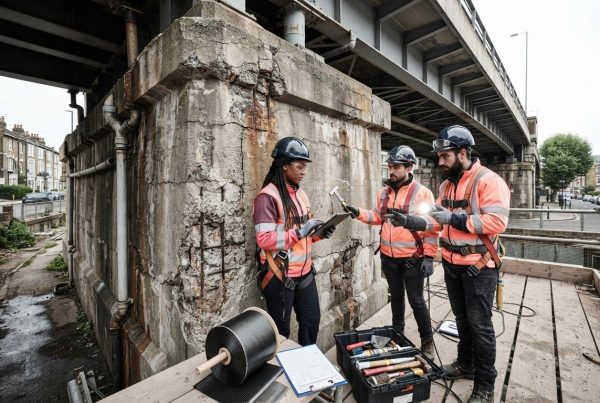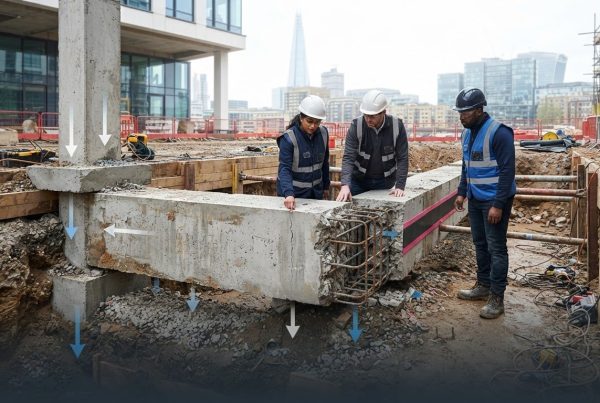

The assumption that full asset replacement provides the most predictable long-term value is increasingly challenged by the superior life-cycle performance of advanced composite interventions. It’s understood that technical professionals face immense pressure to mitigate high capital expenditure, particularly as steel prices are projected to rise by up to 35% in 2026, whilst managing the operational downtime that often accompanies traditional repair methodologies. This technical guide delivers a rigorous cost-benefit analysis of structural strengthening, offering an expert-led examination of the engineering variables required to justify life-extension over demolition.
By evaluating the empirical performance of Tyfo® Fibrwrap® systems and other proprietary technologies, we’ll demonstrate how repair-focussed strategies deliver superior ROI through enhanced durability and reduced environmental impact. You’ll gain a technical validation for choosing specialised repair over replacement, supported by data regarding material longevity and seismic resilience. A clear framework is established for asset controllers to validate these investments, ensuring that structural safety is maintained without the prohibitive costs and logistical complexity of total replacement.
Key Takeaways
- Learn how to transition from reactive maintenance to proactive life-extension strategies that prioritise the long-term security of essential infrastructure.
- Discover how to conduct a rigorous cost-benefit analysis of structural strengthening by quantifying indirect variables such as business interruption and traffic management.
- Evaluate the engineering advantages of Carbon Fibre Reinforced Polymer (CFRP) versus traditional steel, focusing on superior weight-to-strength ratios and reduced dead-load impact.
- Master risk-based decision-making frameworks, including break-even hazard models, to justify investments in seismic retrofitting and blast mitigation against epistemic uncertainties.
- Understand the necessity of early engagement with specialist contractors to ensure bespoke engineering designs align with accurate cost-forecasting and feasibility studies.
The Strategic Necessity of Cost-Benefit Analysis in Structural Asset Management
In the field of specialist structural engineering, a Cost-benefit analysis (CBA) represents more than a simple financial audit; it’s a multi-dimensional evaluation of material performance, risk probability, and operational continuity. For asset managers, the cost-benefit analysis of structural strengthening serves as the empirical foundation for justifying complex remediation projects to stakeholders who might otherwise default to the perceived simplicity of asset replacement. Amongst UK infrastructure owners, a definitive shift has been observed, moving away from reactive maintenance towards proactive structural life-extension. This transition is driven by the recognition that the functional utility of an existing bridge, tunnel, or industrial facility can be significantly prolonged through targeted structural repairs, thereby maintaining national infrastructure resilience without the exorbitant costs associated with new construction.
Risk Mitigation and the Cost of Inaction
Quantifying the cost of inaction is a critical component of any robust CBA. Whilst the immediate expense of preventative strengthening may appear substantial, it’s often a fraction of the costs incurred through catastrophic structural failure or emergency decommissioning. Accurate assessments rely upon the empirical data gathered during structural surveys and testing, which provide the necessary insights into carbonation depths, chloride ingress, or reinforcement corrosion. These technical findings allow engineers to model the probability of failure against the cost of intervention. Regulatory compliance also plays a decisive role; adhering to evolving health and safety standards isn’t merely a legal requirement but a financial safeguard against the liabilities associated with structural negligence.
Asset Life-Extension as a Financial Strategy
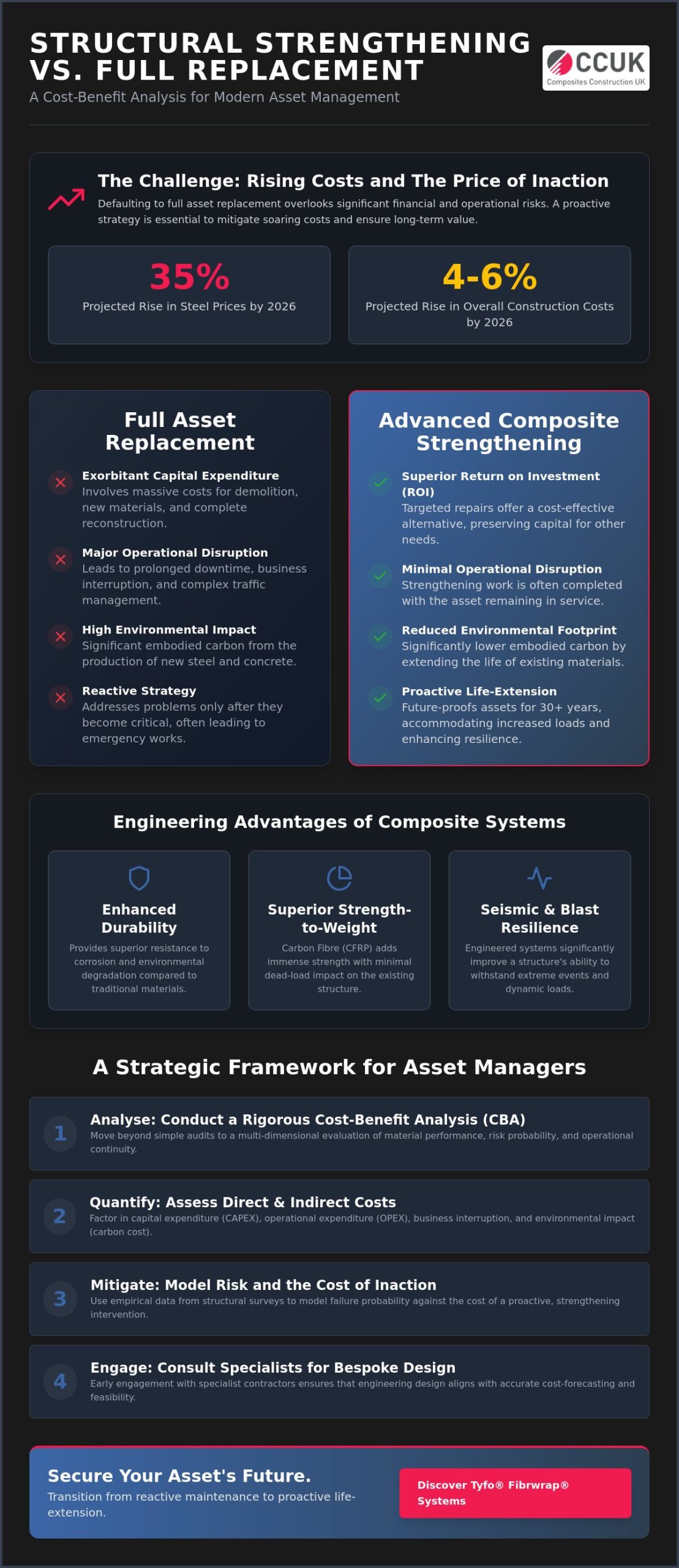
Modern engineering allows for the “future-proofing” of assets, enabling them to accommodate increased load requirements that weren’t anticipated during their original design phase. The economic logic of extending the lifespan of a structure by 30 or more years is compelling, particularly when considering that overall construction costs are projected to rise by 4-6% in 2026, with steel prices potentially increasing by up to 35%. By choosing advanced strengthening over replacement, asset managers avoid the logistical burden of demolition and the environmental impact of new material production. Asset life-extension is defined as the primary driver for infrastructure ROI in 2026, representing a strategic commitment to the functional longevity of existing systems over the capital-intensive cycle of demolition and reconstruction.
Quantifying Direct and Indirect Costs: A Framework for Infrastructure Strengthening
A comprehensive cost-benefit analysis of structural strengthening necessitates a granular division between immediate capital expenditure (CAPEX) and the projected operational expenditure (OPEX) required over the asset’s remaining service life. Whilst CAPEX covers the tangible elements of design and installation, a sophisticated probabilistic cost-benefit analysis must also incorporate the “carbon cost” associated with material procurement and site activities. Choosing to repair rather than replace aligns technical capabilities with broader environmental goals, as the embodied carbon of new concrete and steel significantly outweighs that of targeted composite reinforcement. In 2026, where overall construction costs are projected to rise by 4-6% and steel prices may increase by up to 35%, the financial burden of demolition becomes increasingly difficult to justify when compared to the precision of advanced material science.
Direct Costs: Materials, Labour, and Specialist Contracting
Primary direct costs are comprised of material procurement, skilled labour, and the fees associated with a specialist engineering contractor. These figures are heavily influenced by site-specific challenges, such as restricted access or the requirement for work within confined spaces, which can escalate the complexity of the intervention. Upfront investment in bespoke design capabilities is essential; it ensures that the strengthening solution is tailored to the specific structural deficiency, preventing the financial waste of over-engineering. Accurate forecasting at this stage is vital to ensure the cost-benefit analysis of structural strengthening remains valid throughout the project lifecycle.
Indirect Costs and Operational Downtime
Indirect costs often represent the most significant variable in the CBA model, yet they’re frequently underestimated during the initial planning phase. The daily economic impact of facility closures, bridge weight restrictions, or diverted traffic can quickly surpass the direct cost of the engineering works themselves. Advanced composites, specifically Tyfo® Fibrwrap® systems, offer a distinct “speed of application” advantage that minimises the duration of site presence. By avoiding the heavy plant and extensive temporary works required for traditional steel or concrete jackets, these systems reduce the overall site footprint and accelerate the return to full operational capacity. It’s this mitigation of business interruption that often provides the true break-even advantage for strengthening investments. If you’re currently evaluating the feasibility of a remediation project, you can consult with our technical team to obtain a preliminary assessment of potential operational savings.
Comparative Analysis: Advanced Composites versus Traditional Remediation Methods
A rigorous cost-benefit analysis of structural strengthening must account for the physical properties of the materials employed, as these dictate both the immediate installation complexity and the long-term maintenance liability. Whilst steel reinforcement has historically been the default remediation method, Carbon Fibre Reinforced Polymer (CFRP) offers a superior weight-to-strength ratio that eliminates the parasitic dead-load addition often associated with section enlargement or steel plate bonding. This is particularly critical when the existing foundations possess limited reserve capacity. A cost-effectiveness analysis of bridge strengthening highlights that the reduction in dead weight can prevent the need for costly substructure reinforcement, further tilting the economic balance in favour of advanced composites.
CFRP vs Steel Plate Bonding
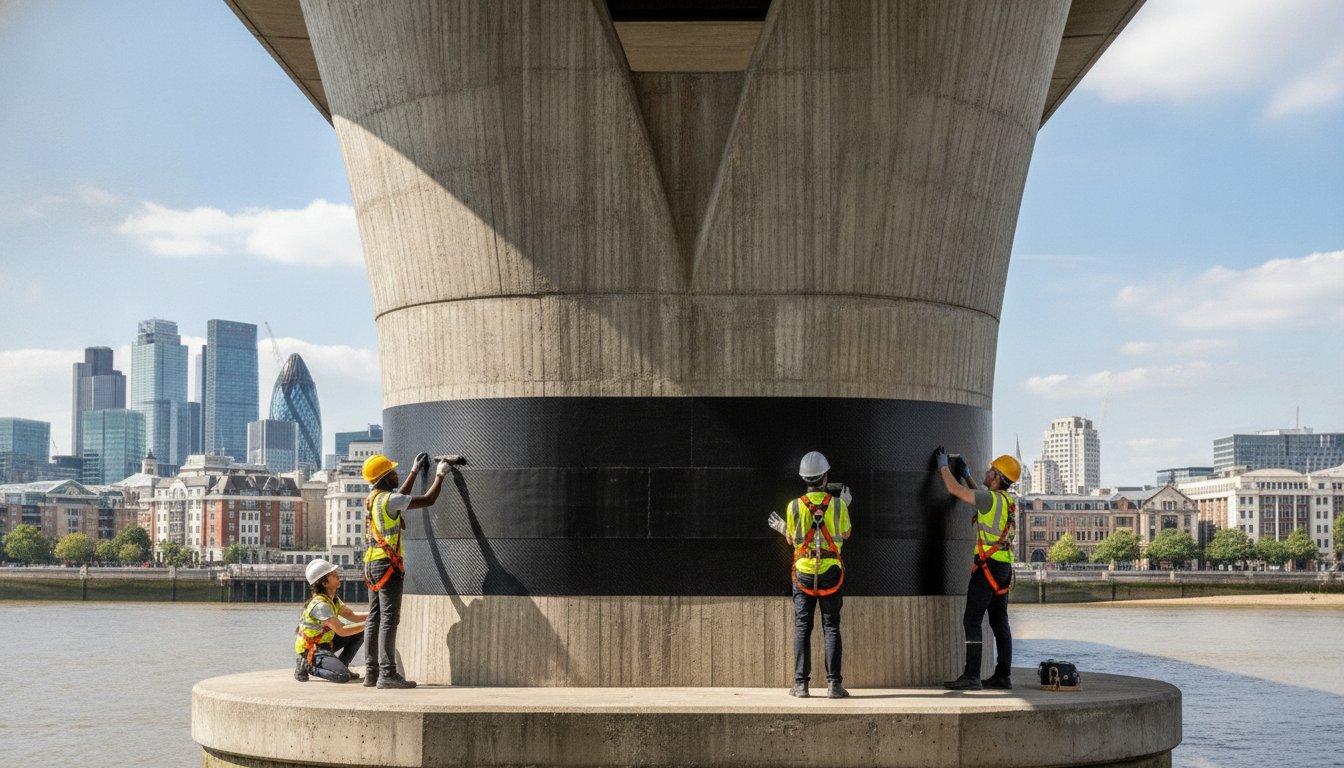
Steel plate bonding involves significant logistical challenges, requiring heavy lifting plant and mechanical anchoring that can induce localised stresses in the parent concrete. In contrast, CFRP systems are lightweight and easily handled amongst restricted access areas, facilitating a more efficient application process that reduces total site hours. Beyond these logistical benefits, steel is inherently susceptible to corrosion and interfacial debonding, necessitating a maintenance cycle of 15-20 years. Conversely, the 50-year durability of composites ensures that the initial capital investment is protected against the aggressive environmental factors that typically degrade traditional materials. For structures with complex geometries, such as circular columns or flared pier caps, Tyfo Fibrwrap installation provides a seamless, conformable solution that steel plates simply cannot replicate.
Strengthening vs Full Replacement
The “replacement paradox” refers to the reality that new construction projects often encounter significantly higher regulatory hurdles and environmental scrutiny than remediation works. A structural CBA must account for the substantial decommissioning and hazardous waste disposal costs incurred during demolition, which are entirely avoided through strengthening. Sustainability metrics further validate this approach; the embodied carbon of a composite-based life-extension project is a fraction of that required for new concrete and steel production. By prolonging the functional lifespan of an asset, managers don’t just satisfy economic requirements; they also align with corporate ESG mandates by reducing the demand for raw material extraction and the associated carbon footprint of the construction supply chain. This strategic focus on the functional longevity of existing assets ensures that infrastructure utility is maintained whilst minimising the financial and environmental volatility inherent in new builds.
Risk-Based Decision Making: Determining Break-Even Probabilities for Strengthening
Risk-based decision making shifts the cost-benefit analysis of structural strengthening from a static spreadsheet exercise to a sophisticated assessment of hazard probability and structural consequence. In commercial and industrial settings, this involves the adaptation of break-even hazard models to determine the specific point where the investment in preventative strengthening is financially justified by the reduction in potential failure costs. Addressing epistemic uncertainty, specifically the inherent gaps in our understanding of material degradation or future load demands, is critical when evaluating seismic retrofitting or blast mitigation. To mitigate these risks, structural surveys provide the empirical foundation required to reduce uncertainty and ensure the CBA model remains grounded in physical reality.
Evaluating Abnormal Loading and Blast Hazards
The economic justification for disproportionate collapse prevention or blast mitigation systems is often driven by the necessity to protect high-risk environments against extreme events. In many jurisdictions, this is further reinforced by the adoption of the 2024 International Building Code (IBC) and ASCE 7-22, which establish the current standards for structural resilience and design loads. A 2019 World Bank study found that in 96% of scenarios, the benefit-cost ratio of strengthening infrastructure assets exceeds one, with the median ratio doubling when climate-related hazards are considered. By determining the optimal level of strengthening required to meet these rigorous codified standards, asset managers can avoid the financial burden of over-engineering whilst ensuring the asset remains compliant and secure.
Sensitivity Analysis in Structural Engineering
Sensitivity analysis serves as a vital tool for identifying the tipping point where structural intervention becomes a mandatory requirement for financial security rather than a discretionary upgrade. By simulating variations in material costs, notably the projected 15-35% rise in steel prices and the 4-6% increase in overall construction costs for 2026, managers can understand how market volatility affects the long-term ROI of their projects. This data-led approach allows for the prioritisation of strengthening works across a diverse asset portfolio, ensuring that resources are directed toward the structures with the highest risk-to-reward profiles. Factors such as fluctuating interest rates and material availability are integrated into the cost-benefit analysis of structural strengthening to maintain its validity over multi-year project lifecycles. If you require technical assistance in quantifying these variables, you can examine our specialised design features to understand how precision engineering facilitates accurate life-cycle forecasting and risk mitigation.
Executing Feasibility Studies: Integrating Design and Specialist Contracting
The transition from a theoretical framework to physical execution represents the most critical phase in the lifecycle of a remediation project. Whilst the initial cost-benefit analysis of structural strengthening provides the economic justification for intervention, its ultimate accuracy is fundamentally dependent upon the integration of bespoke engineering design and specialist contracting expertise. Early engagement with a specialist contractor ensures that cost-forecasting remains precise, reflecting the logistical realities of the site and the specific performance characteristics of advanced materials. By utilising bespoke design services, asset managers can optimise material usage, ensuring that every layer of composite reinforcement is precisely calculated to meet the required load-bearing capacity without unnecessary expenditure. This level of precision is vital to maintaining the integrity of the original CBA as the project moves into the delivery phase.
The Role of Feasibility Studies
A structural feasibility study serves as the definitive validation of the assumptions made within the initial economic model. This process typically involves a suite of diagnostic procedures, including carbonation testing to determine the depth of concrete neutralisation and pull-off tests to assess the interfacial bond strength between the substrate and the proposed strengthening system. Detailed load-bearing assessments are conducted to verify the existing residual capacity of the structure, providing the empirical data required to refine the engineering design. These initial investigations are vital for preventing scope creep; they identify latent defects that could otherwise lead to unforeseen variations in the project budget. The design of temporary works must also be integrated into the overall budget at this stage, as the complexity of site access and support can significantly influence the total capital requirement.
Partnering for Long-Term Asset Security
Long-term asset security is best achieved through a partnership with a contractor possessing a proven track record in the application of Tyfo® Fibrwrap® and other advanced composite systems. The technical complexities of resin-to-substrate adhesion and the precision required in hand-layup or automated application demand a high level of technical proficiency that general contractors often lack. Selecting an end-to-end delivery partner allows for a seamless transition from feasibility and design through to professional installation, which minimises the risks associated with fragmented procurement. This holistic approach ensures that the cost-benefit analysis of structural strengthening is validated by engineering rigour at every milestone. To discuss a bespoke cost-benefit analysis for your infrastructure project, contact our engineering team today.
Strategic Life-Extension: Securing Infrastructure Longevity
A rigorous cost-benefit analysis of structural strengthening confirms that the strategic value of an intervention is found in the mitigation of operational downtime and the avoidance of capital-intensive replacement cycles. By integrating empirical data from structural surveys with precision engineering, asset managers achieve a predictable return on investment whilst ensuring compliance with modern standards such as ASCE 7-22. This technical approach prioritises the functional longevity of existing assets over the logistical volatility of demolition and new construction.
Since 2015, our team has focussed on infrastructure life-extension as the exclusive UK licensee for Tyfo® Fibrwrap® systems. We deliver end-to-end excellence through bespoke design and professional installation, ensuring that every project is backed by global technical authority and rigorous engineering standards. Consult our specialist engineers for a bespoke structural strengthening design to secure the future of your infrastructure. Your essential assets deserve a legacy of safety and reliability that only seasoned engineering specialists can provide.
Frequently Asked Questions
How does the cost of CFRP strengthening compare to steel plate bonding?
Whilst Carbon Fibre Reinforced Polymer (CFRP) often carries a higher initial material cost, the total project expenditure is typically lower than that of steel plate bonding due to significantly reduced installation requirements. The lightweight nature of CFRP eliminates the need for heavy lifting plant and complex mechanical anchoring, which reduces both labour hours and the duration of site presence. Furthermore, CFRP is inherently resistant to corrosion, which removes the long-term maintenance costs associated with the periodic repainting or protection of steel systems, making the cost-benefit analysis of structural strengthening more favourable over a 50-year lifecycle.
What are the primary indirect costs to consider in a structural CBA?
The primary indirect costs include business interruption, traffic management, and the economic impact of weight restrictions or facility closures on user productivity. In many infrastructure projects, these “hidden” costs can exceed the direct engineering fees, particularly for assets located in high-density urban centres or critical transport corridors. A rigorous CBA must quantify the daily financial burden of reduced asset utility to determine whether a rapid-application strengthening system provides a superior return on investment compared to more disruptive traditional methods.
Is structural strengthening more sustainable than replacing an asset?
Structural strengthening is inherently more sustainable than asset replacement because it preserves the embodied carbon of the existing structure whilst minimising the requirement for new raw materials. The production of conventional concrete and steel is a carbon-intensive process; therefore, extending the functional lifespan of an asset through targeted reinforcement directly supports corporate ESG goals. This approach avoids the environmental impact of large-scale demolition and reduces the volume of construction waste directed to landfill, aligning technical capabilities with broader environmental security.
How long does a Tyfo® Fibrwrap® system last compared to traditional methods?
A Tyfo® Fibrwrap® system is typically designed with a 50-year service life in mind, offering significantly greater longevity than traditional steel-based remediation, which often requires intervention within 15 to 20 years due to corrosion. The advanced composite materials used in these systems are resistant to environmental degradation, including chloride ingress and chemical attack, ensuring the reinforcement remains effective in aggressive conditions. This durability provides asset managers with long-term financial stability by extending the interval between major maintenance cycles.
Can a cost-benefit analysis justify blast mitigation for commercial buildings?
A cost-benefit analysis of structural strengthening can justify blast mitigation by comparing the upfront cost of preventative measures against the projected financial and human consequences of a hazard event. By utilising break-even hazard models, engineers can demonstrate the value of protecting high-occupancy assets and critical infrastructure against disproportionate collapse. When the probability of a threat exceeds the calculated break-even point, the investment in specialist mitigation systems becomes a mandatory component of a responsible risk-management strategy.
What data is required to perform an accurate structural feasibility study?
An accurate feasibility study requires empirical data derived from structural surveys and testing, including carbonation depths, chloride concentration levels, and reinforcement mapping. Engineers also require pull-off test results to verify the tensile strength of the concrete substrate and detailed load-bearing assessments to confirm the structure’s current residual capacity. This technical baseline ensures that the proposed strengthening design is bespoke to the asset’s specific deficiencies, preventing the financial waste associated with over-engineering or scope creep.
How does structural strengthening affect the operational downtime of a bridge or pipeline?
Advanced structural strengthening systems are designed for rapid installation, which significantly minimises the operational downtime of essential infrastructure compared to traditional section enlargement or replacement. Because materials like CFRP are applied using hand-layup or automated techniques that don’t require extensive temporary works or heavy plant, assets can often remain partially or fully operational during the works. This reduction in service interruption is a critical variable in the CBA, as it preserves the revenue-generating capacity of the asset during the remediation phase.
What is the “break-even point” in a risk-based cost-benefit analysis?
The break-even point represents the threshold where the cost of a structural intervention is exactly equal to the expected loss from a hazard event, which is the product of the event’s probability and its total economic consequence. If the probability of an event, such as a seismic tremor or structural failure, is higher than this threshold, the strengthening project is considered a financially sound investment. This model allows asset controllers to prioritise capital expenditure across a portfolio by identifying the structures where risk mitigation delivers the highest economic value.