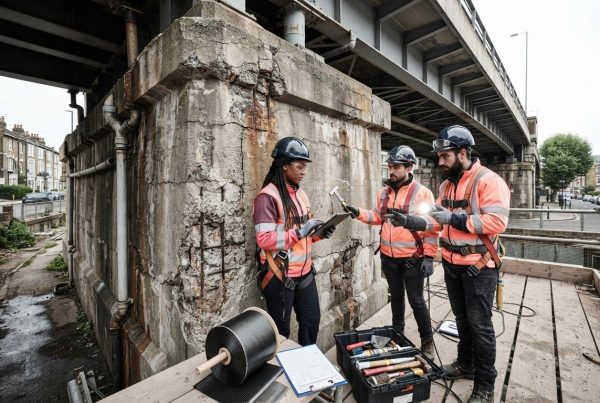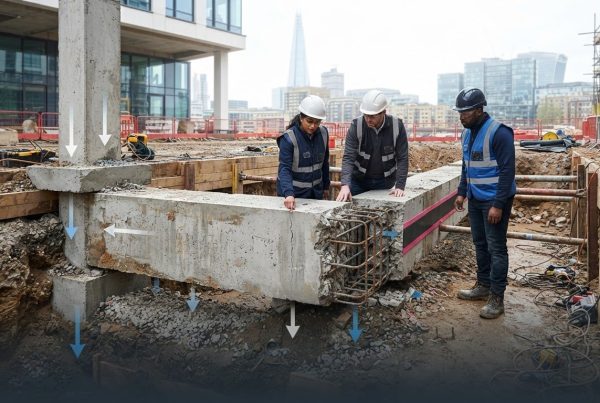


The pursuit of the lowest initial tender price is frequently the most expensive decision an asset manager can make when addressing structural deterioration. Whilst traditional steel plate bonding or section replacement might appear fiscally prudent on a quarterly balance sheet, these methods often ignore the compounding financial burden of corrosion and recurring maintenance cycles. Understanding the whole-life cost of CFRP repairs is essential for engineers who must reconcile immediate budgetary limits with the long-term integrity of critical infrastructure. It’s a shift from viewing repair as a one-time expense to managing it as a strategic investment in asset longevity.
This analysis provides a technical justification for Carbon Fibre Reinforced Polymer (CFRP) as the primary solution for modern structural strengthening. You’ll discover how specialised systems, such as Tyfo® Fibrwrap®, facilitate a 60-70% reduction in installation time compared to conventional methods, significantly mitigating the costs associated with structural downtime. We’ll outline a clear framework for evaluating the economic performance of composites against traditional materials. This includes an examination of how CFRP’s immunity to electrochemical corrosion ensures a maintenance-free service life exceeding 50 years, ultimately securing the functional lifespan of the structure whilst delivering a superior return on investment.
- How to establish a strategic framework for evaluating the whole-life cost of CFRP repairs, as it’s essential to prioritise long-term asset utility and OPEX over deceptive initial capital expenditure metrics.
- The technical drivers that facilitate economic superiority, specifically how the immunity of composites to electrochemical corrosion eliminates the financial burden of recurring maintenance cycles.
- A comparative analysis of CFRP strengthening against traditional steel plate bonding and concrete section enlargement, focusing on the reduction of structural downtime and site plant requirements.
- The methodology for integrating composite design into strategic lifecycle planning to ensure asset controllers can justify the selection of advanced materials through engineering rigour.
- Why Tyfo® Fibrwrap® Systems are recognised as the industry standard for structural life-extension, supported by a 30-year track record and comprehensive empirical testing in global infrastructure projects.
Defining the Whole-Life Cost Framework for Structural Repairs
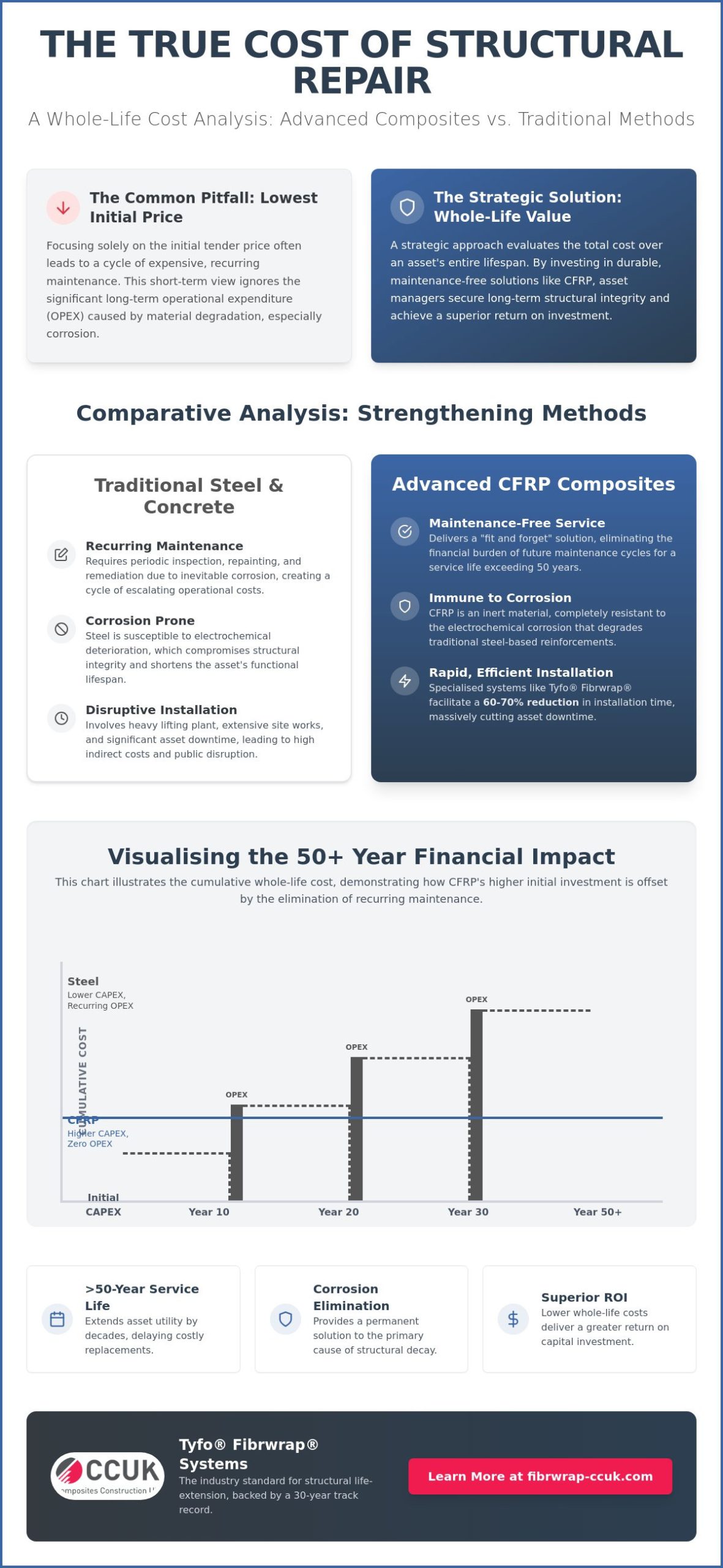
Strategic asset management requires a departure from short-term procurement models that over-prioritise initial Capital Expenditure (CAPEX). For technical professionals responsible for bridge decks, industrial facilities, or marine structures, the true measure of fiscal efficiency is the whole-life cost of CFRP repairs. This methodology integrates the initial costs of design and installation with the projected Operational Expenditure (OPEX) and eventual decommissioning or replacement expenses. Whilst traditional materials like steel or reinforced concrete sections may offer a lower procurement price, they frequently introduce a legacy of recurring remedial interventions that drain long-term budgets. In the context of structural integrity, whole-life cost represents a multi-decade financial commitment that encompasses every expenditure from the initial engineering specification to the final cessation of the asset’s utility.
Carbon-fiber reinforced polymer (CFRP) systems represent a fundamental shift towards high-performance materials that align with modern sustainability goals. By extending the functional lifespan of an existing asset rather than opting for energy-intensive demolition and reconstruction, engineers can significantly reduce the carbon footprint of their projects. This durability is central to reducing the frequency of future remedial interventions, ensuring that once a repair is executed, it remains effective for the remainder of the structure’s design life.
CAPEX vs OPEX in Composite Strengthening
Initial investment in CFRP includes specialised material costs and precision engineering design, yet it avoids the hidden burdens associated with traditional repairs. Steel plate bonding, for instance, requires heavy lifting plant and extensive temporary works, which inflate the CAPEX beyond the mere cost of the metal. More critically, the OPEX for steel is dictated by the inevitability of corrosion, requiring periodic inspection and repainting. In an inflationary environment, these future maintenance cycles represent a volatile and escalating liability that the whole-life cost of CFRP repairs effectively eliminates by providing a corrosion-immune solution.
The Economic Impact of Asset Service Life Extension
The primary value proposition of composite strengthening lies in its ability to delay asset replacement by several decades. Industry data suggests that a maintenance-free service life of over 50 years is achievable when using high-quality systems, provided the application adheres to strict engineering standards. By facilitating “repair over replace” strategies, asset controllers can preserve capital for other critical projects whilst ensuring the structure remains compliant with relevant safety standards. This extension of utility is not merely a technical success but a fundamental pillar of strategic financial planning for national and private infrastructure, where the goal is to maximise the functional value of every kilogram of material installed.
Technical Drivers of CFRP Economic Superiority
The technical superiority of Carbon Fibre Reinforced Polymer is rooted in its inherent material properties, which directly translate into tangible economic benefits for the asset owner. Unlike traditional ferrous reinforcements, CFRP is fundamentally inert, meaning it doesn’t suffer from the electrochemical deterioration that plagues steel-based interventions. This characteristic is the cornerstone of the whole-life cost of CFRP repairs, as it removes the requirement for periodic anti-corrosion treatments or the eventual replacement of degraded sections. By providing a solution that is immune to the primary causes of structural decay, engineers can ensure that the initial repair remains the final intervention required for the duration of the asset’s design life.
Its high strength-to-weight ratio allows for structural enhancement without the addition of significant dead load, which is particularly advantageous for ageing structures where reserve capacity is limited. By utilising lightweight composites, the need for heavy lifting plant and extensive temporary works is mitigated, reducing both the site footprint and the associated logistical expenditure. The ability to conform to complex geometries further distinguishes CFRP from rigid steel plates, which often require bespoke fabrication and precise site measurements to ensure a flush fit. This versatility reduces the engineering hours spent on tailoring solutions for non-standard structural elements, further streamlining the procurement process.
Installation Speed and Possession Costs
Installation speed is a critical factor in the possession costs of any infrastructure project. Traditional steel plate bonding involves drilling, anchoring, and the use of heavy-duty adhesives, often requiring weeks of site presence and substantial scaffolding. In contrast, CFRP application is significantly more efficient, with industry data indicating that installation can be 60-70% faster than traditional methods. This efficiency dramatically reduces the duration of site possessions and accelerates project handover. For asset owners, this means reduced structural downtime and, in commercial or transport environments, the avoidance of substantial revenue loss whilst the asset remains operational. Engineers seeking to optimise their asset management strategies should consider how these efficiencies align with their specific structural challenges by exploring advanced composite design features.
Performance in Aggressive Environments
The resilience of CFRP in aggressive environments provides a robust technical justification for its selection over conventional materials. In marine or industrial settings, where high humidity and chloride exposure accelerate the deterioration of reinforced concrete, CFRP maintains its structural properties without the need for cathodic protection or specialised protective coatings. A report by the Virginia Department of Transportation highlights the long-term cost advantages of composites in such conditions, noting the significant reduction in lifecycle maintenance compared to conventional steel reinforcement. By eliminating the risk of electrochemical corrosion and carbonation-induced failure, the whole-life cost of CFRP repairs remains predictable and stable over the asset’s extended service life, protecting the controller from the volatility of future remedial costs.
Comparative Analysis: CFRP Strengthening vs Traditional Methods
To accurately assess the whole-life cost of CFRP repairs, engineers must evaluate the material against traditional remediation techniques such as steel plate bonding and concrete section enlargement. Section enlargement, whilst effective for increasing axial capacity, significantly increases the dead load and geometry of a member, often necessitating secondary foundation strengthening. This cascading engineering requirement often renders the initial low material cost of concrete irrelevant. Conversely, a comprehensive whole-life cost analysis reveals that the predictability of CFRP performance mitigates the financial risks associated with structural uncertainty. By maintaining the original structural profile, composites allow for targeted reinforcement without the unintended consequences of mass addition.
CFRP vs Steel Plate Bonding
Steel plate bonding remains a common alternative, yet its lifecycle is marred by the requirement for periodic inspection and remedial repainting to prevent interfacial corrosion. The weight of steel plates requires mechanical anchoring, which creates stress concentrations and potential ingress points for moisture. CFRP’s superior resistance to debonding, especially in the volatile UK climate, ensures the bond-line remains intact without the need for mechanical fasteners. This eliminates the risk of “hidden” corrosion between the plate and the substrate, a failure mode that often leads to unexpected and costly secondary repairs in steel-strengthened structures. Because composites don’t require the same level of invasive anchoring, the structural integrity of the original concrete is better preserved, reducing the likelihood of future spalling or crack propagation.
Demolition and Replacement: The True Cost
For many ageing UK assets, the threshold between remediation and demolition is often dictated by the indirect economic impact of asset closure. Demolishing a bridge or industrial facility incurs massive expenditures in waste management, structural demolition, and the social cost of disrupted transport or production networks. Choosing structural repairs over replacement provides a more sustainable financial path by avoiding the high carbon footprint of new concrete and steel production. By extending the utility of the existing structural fabric, asset controllers can maintain operational continuity whilst adhering to stringent environmental targets. The whole-life cost of CFRP repairs is therefore fundamentally linked to the avoidance of the catastrophic capital outlay required for complete asset replacement, making it the most fiscally responsible choice for essential infrastructure management.
Strategic Lifecycle Planning for Asset Controllers
Strategic asset management demands that technical professionals move away from reactive maintenance towards a proactive, data-driven lifecycle approach. The integration of composite design at the earliest stages of an asset management strategy allows for the most accurate modelling of the whole-life cost of CFRP repairs. By conducting comprehensive structural surveys, asset controllers can pinpoint the precise moment when CFRP intervention will yield the maximum benefit, often before the structural degradation necessitates more invasive and expensive remedial measures. This methodical approach ensures that the chosen solution is grounded in empirical evidence, with bespoke engineering calculations providing the technical justification required for the adoption of advanced composite materials over conventional alternatives.
The Role of Bespoke Design in Cost Optimisation
Efficiency in structural strengthening is achieved through the precise application of materials to meet specific load requirements. By utilising bespoke design solutions, engineers can tailor the thickness, orientation, and layering of carbon fibre sheets to address the unique stresses acting upon a structural member. This level of customisation prevents the over-engineering and material waste that often characterise traditional steel plate bonding or section enlargement. Collaborating with specialist engineers ensures that the final design meets all relevant regulatory standards whilst maintaining strict control over project expenditure. This tailored approach not only optimises material usage but also minimises the additional weight added to the structure, preserving its original design intent and reserve capacity.
Building the Business Case for CFRP
Securing stakeholder approval for advanced material interventions requires a clear presentation of financial metrics that move beyond simple CAPEX comparisons. Key indicators such as Internal Rate of Return (IRR) and Net Present Value (NPV) are essential for demonstrating the long-term fiscal benefits of choosing composites. It’s vital to frame the discussion around the “cost of inaction,” highlighting how delaying a repair can lead to a significant escalation in future costs as structural health continues to decline. Robust Life-Cycle Cost Analysis (LCCA) data provides the empirical evidence required to secure long-term infrastructure funding by demonstrating that higher initial material costs are offset by the elimination of future maintenance liabilities. To begin the process of optimising your asset’s financial performance, you can contact our technical team for a structural survey and feasibility assessment.
Tyfo® Fibrwrap®: Maximising Value through Specialist Systems
The selection of a proprietary system such as Tyfo® Fibrwrap® is a critical factor in ensuring that the calculated whole-life cost of CFRP repairs is realised in practice. Unlike generic carbon fibre materials, which are often procured as commodities, the Tyfo® system represents a fully engineered solution backed by over 30 years of empirical testing and global implementation. This extensive track record provides asset controllers with the absolute assurance that the material properties assumed during the design phase will be maintained throughout the structure’s extended service life. The system’s versatility allows it to address diverse engineering challenges, including blast mitigation, seismic retrofitting, and pipeline rehabilitation, making it the industry standard for critical infrastructure life-extension.
The reliability of these systems is grounded in a rigorous testing regime that accounts for long-term environmental exposure, fatigue, and fire resistance. For technical professionals, this data is essential for justifying the selection of composites in high-consequence environments where failure is not an option. By utilising a system with verified performance characteristics, engineers can eliminate the uncertainties associated with unproven materials, ensuring that the structural intervention remains effective for the remainder of the asset’s functional lifespan.
Engineered Reliability with Tyfo® Systems
The long-term performance of any composite repair is fundamentally dependent on the precision of the application process. Rigorous quality control measures during Tyfo Fibrwrap installation ensure that system-tested components achieve their theoretical design strength on-site. Using authorised installers is not merely a matter of procedural compliance; it is a prerequisite for maintaining the structural warranty and verifying that the installation will resist environmental degradation over several decades. Professional application mitigates the risk of interfacial voids or inadequate resin saturation, factors that could otherwise compromise the bond-line and lead to premature failure, thereby inflating the lifecycle expenditure.
Partnering with CCUK for Asset Remediation
CCUK provides a comprehensive end-to-end service that bridges the gap between theoretical engineering and practical application. By managing the entire process from initial feasibility and structural surveys to bespoke design and professional installation, we ensure that every project is optimised for durability. Our national expertise allows us to solve complex structural challenges across the UK, providing asset controllers with a single point of accountability for the performance of their infrastructure. To ensure your strategic planning is grounded in technical rigour, you should contact our technical team for a project-specific evaluation of the whole-life cost of CFRP repairs. This collaborative approach ensures that the chosen remediation strategy is both technically robust and fiscally sustainable, preserving the utility of essential assets for future generations.
Securing Infrastructure Longevity through Strategic Composite Integration
The transition towards advanced composite materials is more than a technical preference; it’s a fundamental requirement for sustainable asset management. By prioritising the whole-life cost of CFRP repairs over deceptive initial capital expenditure, asset controllers can effectively eliminate the recurring financial and operational burdens associated with corrosion and structural downtime. The engineering evidence confirms that specialised systems, when integrated through a design-led approach, offer a maintenance-free service life that traditional steel and concrete interventions cannot match.
As the exclusive UK licensee for the Tyfo® Fibrwrap® system, CCUK provides the technical rigour and bespoke engineering calculations necessary to secure critical infrastructure. Our proven track record across national bridge networks and complex pipeline systems ensures that every intervention is grounded in empirical success and regulatory compliance. We invite you to request a technical consultation for your structural strengthening project to evaluate the specific economic and structural benefits for your essential assets. Implementing a high-performance remediation strategy today ensures the functional security and fiscal stability of your infrastructure for decades to come.
Frequently Asked Questions
How does the initial cost of CFRP compare to traditional steel strengthening?
CFRP typically entails higher material procurement costs but lower total installation expenditure. Savings are realised through the elimination of heavy lifting plant, reduced temporary works, and a smaller site footprint. Whilst steel appears cheaper per tonne, the ancillary costs of mechanical anchoring and site logistics often equalise the initial capital outlay, making composites a competitive alternative from the outset.
What is the typical maintenance schedule for a CFRP-strengthened structure?
CFRP-strengthened structures require minimal maintenance beyond standard periodic visual inspections. Unlike steel, which requires regular grit-blasting and repainting to manage corrosion, composites are chemically inert. Asset controllers should include the whole-life cost of CFRP repairs in their long-term budgets, noting that remedial interventions are virtually eliminated after the initial application is completed.
Can CFRP repairs be used on assets that are already showing signs of significant corrosion?
Yes, provided the underlying substrate is remediated to ensure effective bond transfer. Corroded reinforcement must be treated, and spalled concrete repaired using compatible resin injection or mortar systems before the composite is applied. The CFRP then acts as supplementary reinforcement, significantly slowing the ingress of chlorides and oxygen to prevent future deterioration of the internal rebar.
How long does a Tyfo® Fibrwrap® repair system last in a marine environment?
The Tyfo® Fibrwrap® system is engineered for a service life exceeding 50 years, even when subjected to aggressive marine conditions. Its immunity to chloride-induced corrosion and saltwater degradation ensures structural performance remains stable without the need for cathodic protection. This durability is verified through extensive accelerated ageing tests and successful implementation in tidal zones globally.
Is CFRP strengthening suitable for historic or masonry structures in the UK?
CFRP is highly effective for masonry reinforcement due to its low profile and high tensile capacity. It allows for the strengthening of historic arches, vaults, and facades without altering the aesthetic or geometric profile of the structure. This is particularly valuable for UK heritage assets where traditional heavy steelwork would be visually intrusive or structurally incompatible with the original fabric.
Does the use of CFRP reduce the overall carbon footprint of a repair project?
CFRP significantly reduces the carbon footprint by facilitating structural life-extension over energy-intensive replacement. The embodied carbon of the composite is offset by the avoidance of new concrete and steel production required for demolition and rebuild. The reduced requirement for heavy construction machinery and plant on-site further lowers the project’s overall emissions profile.
What are the possession costs, and how does CFRP help minimise them?
Possession costs encompass the financial penalties and lost revenue associated with asset closure or restricted access during construction. CFRP minimises these costs through rapid application and curing times, which allow structures to return to service much faster than traditional methods. This efficiency is a primary component in reducing the whole-life cost of CFRP repairs for transport and utility providers.
How does the design process for CFRP differ from traditional structural engineering?
CFRP design requires a specialised understanding of anisotropic material properties and bond-line mechanics. Unlike isotropic steel, the strength of a composite is directional, requiring precise calculations for fibre orientation and layering based on specific stress paths. Engineers follow rigorous standards, such as ACI 440.2R, to ensure the externally bonded system functions harmoniously with the existing concrete substrate.