
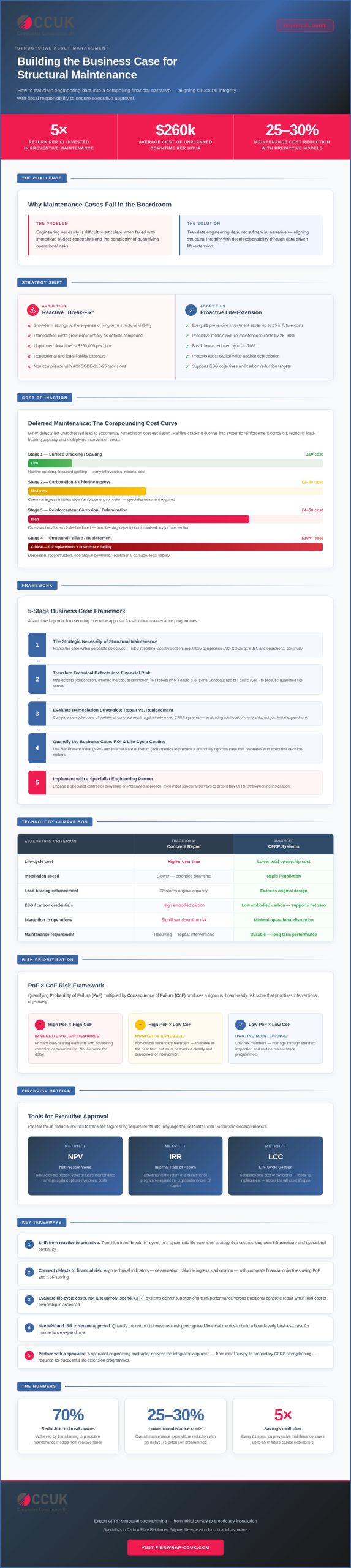
Did you know that every pound invested in preventive maintenance can yield a five-fold saving in future capital expenditure? For asset managers overseeing infrastructure that is rapidly approaching the end of its design life, the challenge lies not in identifying the engineering requirements, but in building a business case for structural maintenance that survives the scrutiny of the Boardroom. It is often difficult to articulate the technical necessity of life-extension programmes when faced with immediate budget constraints and the complexity of quantifying operational risks.
This technical guide provides a structured framework for translating engineering data into a compelling financial narrative that aligns structural integrity with fiscal responsibility. You’ll learn how to justify the adoption of advanced Carbon Fibre Reinforced Polymer (CFRP) systems by contrasting their long-term performance against the catastrophic costs of unplanned downtime, which currently averages $260,000 per hour for industrial manufacturers. By shifting the conversation from reactive repair to data-driven life-extension, you can secure the necessary approval to prolong the functional lifespan of critical assets through sophisticated engineering and empirical evidence.
Key Takeaways
- Transition from reactive “break-fix” cycles to a proactive life-extension strategy that ensures long-term infrastructure security and operational continuity.
- Master the process of building a business case for structural maintenance by aligning technical indicators, such as delamination and chloride ingress, with corporate financial objectives.
- Evaluate the total life-cycle costs of remediation strategies, contrasting traditional concrete repair with the enhanced performance of Carbon Fibre Reinforced Polymer (CFRP) systems.
- Quantify the return on investment for maintenance programmes using Net Present Value (NPV) and Internal Rate of Return (IRR) metrics to secure executive approval.
- Recognise the critical importance of a specialist engineering contractor in delivering an integrated approach that spans from initial structural surveys to proprietary strengthening installations.
The Strategic Necessity of Structural Maintenance in 2026
In the current industrial climate, building a business case for structural maintenance requires more than a simple identification of technical defects. It necessitates a formalised document that justifies capital expenditure by aligning engineering requirements with corporate financial objectives. This transition marks a departure from historical “break-fix” mentalities, which often prioritise short-term savings at the expense of long-term structural viability. Instead, modern asset controllers are adopting a systematic approach to asset management that prioritises proactive life-extension strategies over reactive remediation.
Structural integrity is no longer viewed in isolation; it’s now a fundamental pillar of ESG (Environmental, Social, and Governance) reporting. Maintaining existing infrastructure through the application of advanced composites, such as Carbon Fibre Reinforced Polymer (CFRP) Strengthening, is significantly more sustainable than total demolition and reconstruction. This approach directly supports carbon reduction targets by minimising the embodied carbon associated with new concrete and steel production, whilst ensuring the continued safety and utility of essential assets.
The Cost of Inaction: A Financial Perspective
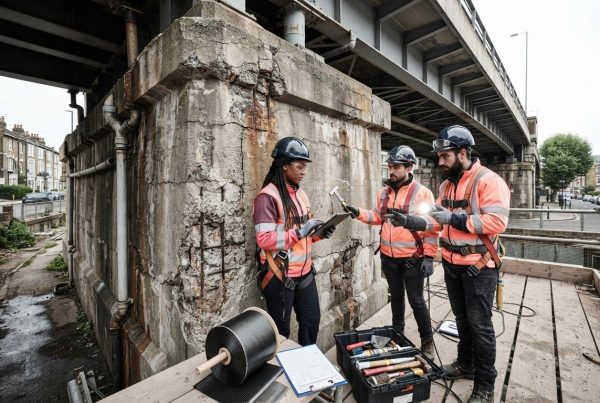
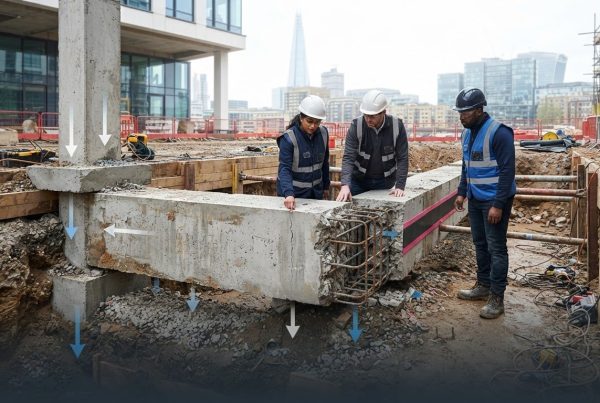
The financial implications of deferred maintenance are rarely linear. Minor surface defects, such as hairline cracking or localised spalling, can rapidly evolve into systemic reinforcement corrosion if left unaddressed. As the cross-sectional area of steel reinforcement is reduced through oxidation, the load-bearing capacity of the structure is compromised, leading to an exponential increase in remediation costs. Industry data indicates that every pound invested in preventive measures can save up to five pounds in future repair and replacement costs. The urgency is compounded by the adoption of the ACI CODE-318-25, which introduces revised provisions for structural concrete that asset managers must navigate to maintain regulatory compliance. Beyond the direct engineering expenditure, the potential for structural failure introduces profound risks to corporate reputation and substantial legal liabilities.
Maintenance as a Value-Driver, Not a Cost Centre
A shift in perspective is required to view maintenance as a driver of asset value rather than a drain on resources. Ensuring high levels of asset availability is critical for operational efficiency and the overall valuation of commercial property portfolios. When building a business case for structural maintenance, it’s essential to highlight that transitioning to predictive models can reduce overall maintenance costs by 25-30% whilst decreasing breakdowns by 70%. When a structure’s functional lifespan is extended through precise engineering, the underlying capital value is protected against depreciation. Structural maintenance is the preservation of capital through engineering rigour. By utilising specialised design features and materials, asset managers can transform the perception of maintenance from a necessary burden into a strategic investment in durability.
Translating Technical Defects into Financial Risk
Effective risk management within the built environment begins with the precise quantification of structural degradation. When building a business case for structural maintenance, technical observations must be synthesised into a risk-based framework that resonates with executive decision-makers. Chemical processes such as carbonation and chloride ingress are not merely engineering concerns; they represent leading indicators of future capital liability and operational interruption. By mapping these defects to asset reliability scores, managers can transition from qualitative descriptions to a quantitative assessment of risk.
The quantification of the Probability of Failure (PoF) and the Consequence of Failure (CoF) provides a rigorous basis for prioritising interventions. A high PoF in a non-critical secondary member may be tolerable, whereas even a marginal increase in the PoF of a primary load-bearing element necessitates immediate action. By leveraging the design-feature of advanced composite materials, these identified risks can be mitigated with surgical precision, often without the need for the intrusive methodologies associated with traditional reconstruction.
Data Acquisition: The Role of Structural Surveys
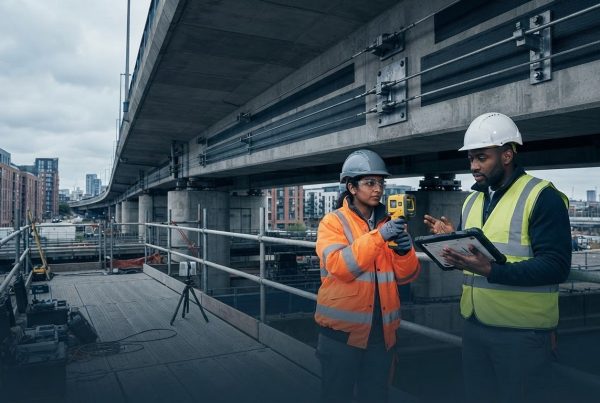
Empirical evidence is the bedrock upon which a successful business case is constructed. Bespoke engineering calculations, derived from high-fidelity data, allow for a nuanced understanding of an asset’s current state. The use of non-destructive testing (NDT), including ultrasonic pulse velocity and half-cell potential mapping, provides a non-invasive means of identifying internal degradation before it manifests as visible surface failure. It’s essential to conduct professional structural surveys to establish a baseline of asset health. This data-driven approach ensures that the proposed remediation is neither under-engineered nor excessively specified, optimising the allocation of capital. For those requiring a detailed assessment of their current asset portfolio, consulting with a specialist engineer can provide the necessary technical validation.
Communicating with the Board: The Language of Finance
A primary barrier to securing approval for life-extension projects is the linguistic gap between the engineering department and the finance office. Technical terminology such as “loss of section” must be translated into “reduction in asset utility” to illustrate the impact on the balance sheet. Presenting technical engineering data to non-technical stakeholders requires a focus on outcomes rather than processes. When building a business case for structural maintenance at the executive level, one effective method is the creation of a “Risk Heat Map,” which visualises the structural health of assets amongst a broader portfolio. This allows the Board to identify high-risk assets that require immediate investment to avoid the catastrophic costs of unplanned failure or regulatory non-compliance.
Evaluating Remediation Strategies: Repair vs. Replacement
The selection of a remediation strategy is a pivotal decision-point when building a business case for structural maintenance. Asset managers must weigh the immediate capital expenditure of traditional concrete repair against the long-term performance benefits of advanced composite systems. Whilst total asset replacement may seem like a definitive solution for structures approaching their design life, the associated costs of demolition, waste disposal, and extended operational downtime often render it fiscally unviable. Targeted remediation, conversely, focuses on restoring structural integrity whilst preserving the original asset, offering what is frequently termed a “Sustainability Dividend.” This approach significantly reduces the embodied carbon footprint by avoiding the intensive energy requirements of new steel and concrete production.
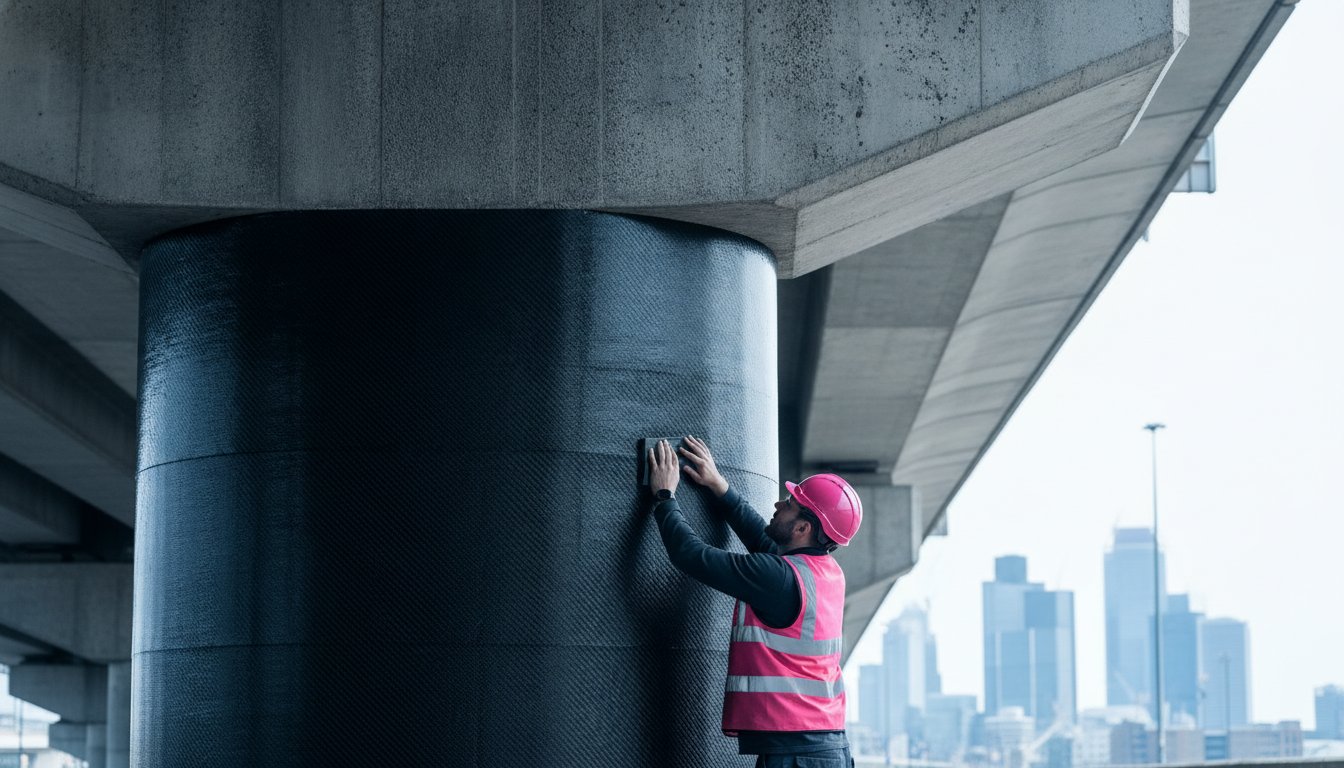
Proprietary systems, such as Tyfo® Fibrwrap® Systems, provide a sophisticated middle ground between localised patch repairs and total reconstruction. These systems allow for the restoration of load-bearing capacity and the mitigation of seismic or blast-related risks through a non-intrusive application process. By utilising the design-feature of high-strength composites, engineers can tailor the reinforcement to the specific stress profiles of the structure, ensuring that the intervention is both technically precise and economically optimised.
The CFRP Advantage in Business Cases
The primary financial driver for Carbon Fibre Reinforced Polymer (CFRP) Strengthening is the dramatic reduction in project duration. Because these materials are lightweight and require minimal heavy machinery, they can be installed with significantly less disruption to facility operations. This is critical for industrial environments where unplanned downtime can cost an average of $260,000 per hour. From a life-cycle perspective, CFRP offers a superior ROI over a 30-year horizon; its inherent resistance to corrosion and chemical attack ensures that the structure remains functional without the need for recurring interventions.
Assessing Traditional Concrete Repair
Traditional mortar-based repairs are often insufficient in aggressive environments where chloride ingress or carbonation is widespread. Such methods frequently lead to a “Repair-to-Repair” cycle, where patch repairs fail within 5 to 10 years due to the “incipient anode effect” or ongoing substrate degradation. When building a business case for structural maintenance, relying on these low-cost initial fixes can prove to be a false economy. Whilst traditional methods remain appropriate for minor aesthetic or non-structural remediation, they lack the durability required for critical life-extension programmes in high-stress infrastructure.
Quantifying the Business Case: ROI and Life-Cycle Costing
Securing executive approval for structural interventions requires the application of rigorous economic modelling to engineering data. To master the analytical techniques required for such high-level decision-making, you can discover Financial Modelling University and their specialised courses for investment professionals. When building a business case for structural maintenance, the Net Present Value (NPV) serves as the primary metric for investment appraisal. By discounting future cash flows, including the avoided costs of catastrophic failure and emergency remediation, asset managers can demonstrate the true value of early intervention. The Internal Rate of Return (IRR) further reinforces this by illustrating the efficiency of the capital deployed to extend the asset’s utility beyond its original design life.
A critical component often overlooked in standard financial assessments is the “Downtime Delta.” This represents the quantified financial impact of asset unavailability, whether it involves the closure of a strategic bridge, an industrial facility, or a critical pipeline. Unlike traditional methods that may require weeks of site preparation and temporary works, advanced composite solutions minimise this delta. Building in a robust contingency for unforeseen structural conditions is equally vital; structural engineering often reveals hidden substrate defects only once works commence, and a well-structured business case anticipates these variables to maintain fiscal credibility.
Life-Cycle Costing (LCC) Frameworks
The distinction between initial capital expenditure (CAPEX) and ongoing operational expenditure (OPEX) is fundamental to long-term asset health. Preventative maintenance strategies are designed to front-load investment to suppress the exponential growth of OPEX associated with ageing infrastructure. Life-cycle costing methodologies empower asset managers to justify a higher initial capital expenditure for premium materials by demonstrating significant reductions in future operational liabilities and maintenance frequency. This holistic view ensures that the selection of materials is based on durability and performance rather than the lowest immediate tender price.
Risk-Adjusted Return on Investment
ROI calculations must be adjusted to reflect the severity of the structural risks being mitigated. In high-risk environments, the financial benefits of Seismic Retrofitting or Blast Mitigation Systems are measured against the potential for total asset loss and catastrophic business interruption. Presenting a “Best Case” versus “Worst Case” financial scenario allows the Board to visualise the volatility of deferred maintenance. This risk-based approach clarifies that the cost of the project is a fraction of the potential liability. To refine these financial models for your specific infrastructure, request a technical consultation to align your engineering requirements with precise fiscal projections.
Implementing the Case with a Specialist Engineering Partner
The transition from sophisticated financial modelling to physical site implementation requires a high degree of technical synergy. The ultimate success of building a business case for structural maintenance is predicated upon the selection of a specialist engineering contractor capable of delivering a seamless end-to-end service. This integrated approach, encompassing initial structural surveys, bespoke design, and precision installation, ensures that the proposed life-extension programme remains technically robust and fiscally predictable. When the same entity manages the trajectory from diagnostic testing to final validation, the risk of miscommunication between disparate consultants and contractors is eliminated.
Compliance with stringent regulatory frameworks remains a non-negotiable requirement for any infrastructure project. All remediation strategies must align with UK engineering standards and relevant Eurocodes, such as BS EN 1504 for the protection and repair of concrete structures, to ensure long-term safety and legal compliance. By partnering with CCUK, asset managers can leverage extensive expertise in advanced material science to develop bespoke composite solutions that address unique structural challenges whilst adhering to the highest industry benchmarks. This technical rigour is essential for maintaining the integrity of the systematic approach to asset management required for high-consequence infrastructure.
Collaborative Design and Feasibility
Early contractor involvement (ECI) is a critical factor in strengthening the technical validity of a business case. By engaging a specialist partner during the feasibility phase, asset managers can develop tailored strengthening solutions that align with specific budgetary constraints without compromising on performance. This collaborative process allows for the integration of the design-feature capabilities of high-performance polymers into the earliest stages of planning. The use of proprietary systems, such as Tyfo® Fibrwrap® Systems, provides guaranteed mechanical properties and proven durability, which are essential for securing Board-level confidence in the longevity of the intervention.
Finalising the Proposal and Next Steps
The final stage of the process involves distilling complex engineering data into a concise executive summary that focuses on high-level outcomes. This summary should highlight five key financial takeaways: the projected ROI, the mitigation of identified risks, the reduction in operational downtime, the sustainability gains through carbon reduction, and the enhancement of long-term asset security. Common Board-level objections regarding the relative novelty of composites can be addressed through empirical evidence and successful project histories. Stakeholders are invited to contact our technical team for a comprehensive feasibility review to initiate the process of building a business case for structural maintenance that is grounded in engineering excellence.
Advancing Towards Structural Resilience and Fiscal Security
Successfully building a business case for structural maintenance requires this methodical alignment of engineering rigour with precise life-cycle costing, a strategic focus shared by industry leaders at Construction Technology ConFeX KSA when discussing the digital and sustainable transformation of the built environment.
As specialists in national infrastructure life-extension since 2015, Composites Construction UK offers the technical validation required for complex capital projects. Our expert team provides bespoke engineering design and installation, operating as the exclusive UK licensee for Tyfo® Fibrwrap® systems to ensure guaranteed mechanical performance. Contact Composites Construction UK for a bespoke structural feasibility study to secure the long-term integrity and economic viability of your essential infrastructure. Proactive management today ensures a resilient and secure future for your entire asset portfolio.
Frequently Asked Questions
How do I start building a business case for structural maintenance?
The process begins with an empirical assessment of the asset’s current state through a comprehensive structural survey and testing programme. This baseline allows you to transition from anecdotal observations to data-driven risk profiles. By identifying specific technical defects early, you can align engineering requirements with the organisation’s broader risk appetite and financial objectives.
What is the most important financial metric for structural repairs?
Net Present Value (NPV) is typically the most critical metric for Board-level approval because it accounts for the time-value of money and the avoided costs of future failure. Whilst initial costs are important, demonstrating a high Internal Rate of Return (IRR) through extended asset utility often provides the necessary justification for capital expenditure. This fiscal rigour is essential when building a business case for structural maintenance in a competitive budget environment.
Is CFRP strengthening more cost-effective than traditional concrete repair?
Carbon Fibre Reinforced Polymer (CFRP) strengthening is often more cost-effective when considering the total life-cycle cost and operational impact. Traditional patch repairs frequently suffer from the “incipient anode effect,” leading to recurring failures within five to ten years. Composites offer superior durability and a significantly reduced site footprint, which minimises the expensive temporary works and heavy machinery required for traditional methods.
How much does a structural survey contribute to the business case?
A professional structural survey provides the technical validation that moves a proposal from a speculative estimate to a formalised investment grade document. Utilising non-destructive testing (NDT) ensures that the remediation strategy is based on actual substrate conditions rather than assumptions. This accuracy reduces the likelihood of unforeseen costs during the construction phase, protecting the credibility of the financial narrative.
Can structural maintenance improve the ESG score of my organisation?
Life-extension projects directly support ESG goals by prioritising the sustainability of repair over the carbon-intensive process of demolition and replacement. By extending the functional lifespan of existing infrastructure, organisations significantly reduce their embodied carbon footprint. This alignment of technical engineering with environmental responsibility is a recurring thematic signature of modern building a business case for structural maintenance.
What happens if the business case for maintenance is rejected?
Rejection typically forces the asset into a reactive “break-fix” cycle where the cost of eventual remediation grows exponentially as defects worsen. Beyond the financial escalation, the organisation assumes a higher Probability of Failure (PoF), which can lead to increased insurance premiums and potential legal liabilities. Postponing critical maintenance often results in unplanned downtime that far exceeds the cost of the original proposed intervention.
How do I quantify the cost of operational downtime in my proposal?
Quantifying downtime requires a detailed analysis of the revenue lost per hour of asset unavailability and the subsequent impact on supply chain throughput. In industrial sectors, unplanned outages can cost an average of $260,000 per hour. By contrasting the rapid installation time of proprietary systems like Tyfo® Fibrwrap® against the lengthy programmes of traditional reconstruction, you can clearly illustrate the “Downtime Delta” to stakeholders.
What is the lifespan of a CFRP structural strengthening system?
CFRP systems are engineered for exceptional long-term durability and are inherently resistant to environmental degradation and chemical attack. When designed and installed by a specialist engineering partner, these systems often possess a service life that matches or exceeds the remaining design life of the host structure. This longevity ensures a superior return on investment over a 30 to 50-year horizon compared to traditional mortar repairs.