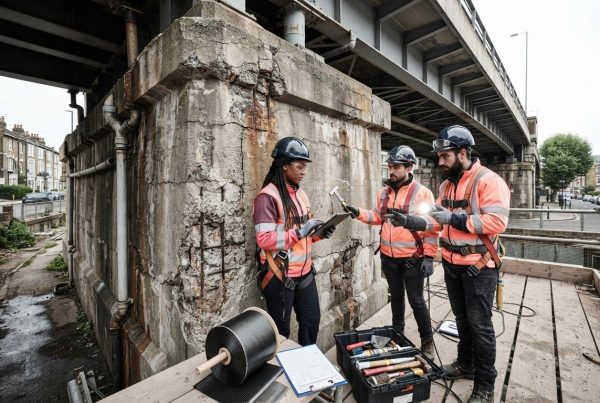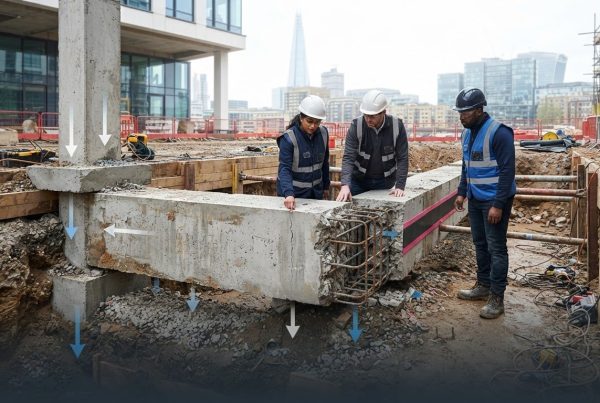

The traditional reliance on reactive crack-stitching is no longer sufficient to meet the rigorous demands of the second-generation Eurocode 6 standards, particularly as the industry moves toward the March 2028 withdrawal of first-generation codes. You likely recognise that the structural integrity of many UK assets is increasingly compromised by the corrosive expansion of legacy wall ties and complex thermal movement that often outpace standard remediation efforts. This expert engineering appraisal provides a detailed evaluation of the modern masonry reinforcement techniques UK professionals require to ensure long-term structural stabilisation and technical compliance. It’s a critical period for asset controllers to move beyond cosmetic repairs; the 2022 study by the UK Concrete Society highlighting foundation failures underscores the necessity for empirical, evidence-based interventions. This guide compares the mechanical performance of traditional helical systems against advanced Carbon Fibre Reinforced Polymer (CFRP) strengthening, specifically Tyfo® Fibrwrap® systems, to establish a clear framework for selecting the most appropriate strategy for mitigating lateral displacement and vertical cracking in complex infrastructure.
Key Takeaways
- Identify specific masonry failure modes, including tensile stress concentrations and lateral load deficiencies, to facilitate the selection of a precise remediation strategy.
- Evaluate the technical efficacy of various masonry reinforcement techniques UK professionals employ, ranging from traditional helical crack-stitching to advanced bed joint reinforcement.
- Examine the structural advantages of Tyfo® Fibrwrap® systems for high-tensile strengthening in scenarios requiring seismic retrofitting or blast mitigation.
- Establish a robust framework for lateral restraint, utilising specialised straps and remedial wall ties to address cavity wall delamination and facade displacement.
- Ensure regulatory alignment by integrating Eurocode 6 (BS EN 1996) standards into the design phase of structural life-extension projects.
Structural Diagnostics: Categorising Masonry Failure Modes in UK Infrastructure
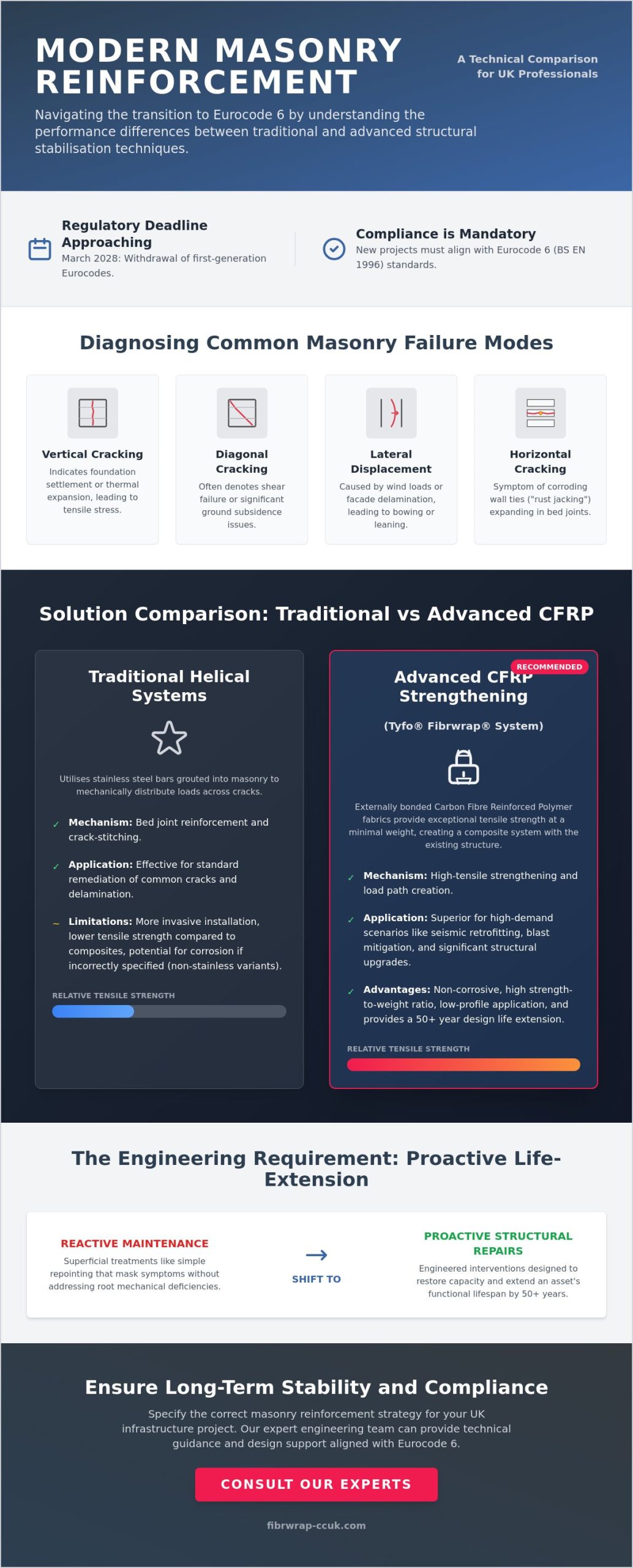
Accurate structural diagnostics form the essential foundation of any effective remediation strategy. Masonry failure is rarely a singular aesthetic concern; it is a complex mechanical symptom of underlying distress. Tensile stress concentrations are frequently manifested as vertical or diagonal cracking, which serve as primary indicators of movement direction. Vertical cracks typically suggest foundation settlement or thermal expansion, whilst diagonal cracking often denotes shear failure or significant subsidence. Identifying these patterns is the first step in the selection of the precise masonry reinforcement techniques UK engineers must deploy to restore structural equilibrium.
Lateral load deficiencies present a significant risk to multi-storey masonry facades. These structures are frequently subjected to wind-induced pressure and suction forces that exceed their original design capacity. Without adequate restraint, the masonry leaves may delaminate, leading to significant bowing or leaning. This loss of planarity is particularly dangerous in unreinforced masonry (URM) walls, which possess negligible flexural strength. Diagnostics must be empirical. Engineers must quantify the degree of lateral displacement to determine if the asset requires simple stabilisation or a more intensive strengthening intervention.
Environmental degradation remains a pervasive cause of failure in legacy infrastructure. The carbonation of mortar and the ingress of chlorides accelerate the corrosion of legacy mild steel wall ties. As these ties oxidise, they expand to several times their original volume. This phenomenon, known as rust jacking, induces internal pressure that results in characteristic horizontal cracking along the bed joints. If left unaddressed, the total failure of these ties can lead to the catastrophic collapse of the outer masonry leaf, necessitating a sophisticated approach to masonry reinforcement techniques UK asset controllers can rely upon for long-term security.
Mechanical Indicators of Masonry Distress
Differentiating between settlement-induced cracking and thermal expansion is critical for correct specification. Settlement tends to produce wider cracks at the top or bottom of a wall, whilst thermal movement is often cyclical and more uniform. Mortar joint deterioration further complicates this, as it reduces the overall shear strength of the wall. To assess remediation urgency, pull-off testing is utilised to quantify bond strength, alongside carbonation analysis to determine the depth of chemical neutralisation. The historic use of rebar in reinforced masonry has evolved significantly, yet older, unprotected steel remains a primary point of vulnerability in many 20th-century assets.
The Engineering Requirement for Life-Extension
Simple repointing is a superficial treatment that fails to address underlying structural instability. It masks the symptoms without resolving the mechanical deficiencies that lead to wall displacement. There is a necessary transition within the industry from reactive maintenance toward proactive structural repairs. These interventions are designed to extend the functional lifespan of an asset by 50 years or more, ensuring long-term utility. In the current regulatory environment, establishing a target functional lifespan is essential for ensuring that any selected masonry reinforcement techniques UK projects implement remain compliant with the updated Eurocode 6 standards through 2026 and beyond.
Traditional Bed Joint Reinforcement and Helical Stitching Techniques
The application of steel-based masonry reinforcement techniques UK engineers have traditionally utilised is predicated on the mechanical distribution of tensile forces across masonry units. Helical bars and Bed Joint Reinforcement (AMR) function by bridging discontinuities, such as cracks or joints, and transferring loads into the surrounding stable masonry. Whilst these systems are highly effective for standard remediation, it’s critical that the material grade is correctly specified for the environment. Grade 304 stainless steel is generally sufficient for most UK exposure classes; however, Grade 316 must be specified for coastal environments or assets subjected to high levels of industrial pollutants. In highly corrosive or chemically aggressive environments, even high-grade stainless steel may eventually succumb to degradation, which is why a transition toward advanced composite systems is often required for extreme conditions.
Helical Bar Stitching: A How-To for Crack Remediation
Helical stitching provides a non-disruptive method for restoring the structural integrity of cracked masonry by creating a masonry beam within the existing wall. The process begins with the precision chasing of horizontal bed joints, typically to a depth of 35-40mm. Following the thorough removal of debris to ensure an optimal bond, the slot is primed and partially filled with a high-performance, non-shrink thixotropic resin or cementitious grout. When evaluating masonry reinforcement techniques UK specialists often prioritise the mechanical bond created by the helical profile. The bar is embedded into the grout, with a minimum of 250mm of reinforcement extending beyond either side of the crack to achieve the required tensile bond. For complex projects requiring bespoke engineering calculations, asset controllers often consult with specialists to ensure technical specification accuracy and long-term asset security.
Bed Joint Reinforcement (AMR) for Lateral Load Resistance
Ancillary Masonry Reinforcement (AMR) is integrated into the mortar beds to significantly enhance the flexural strength of masonry panels against lateral wind loads. Compliance with BS EN 845-1:2013 is mandatory for these components, ensuring they meet the necessary performance criteria for load-bearing applications. The UK design guidance for reinforced masonry provides the technical framework for calculating the required cross-sectional area of steel relative to specific wind load demands. By integrating AMR, the structural capacity of a masonry wall can be increased without the need for additional thickness, providing a methodical solution for multi-storey facades where space and weight are primary constraints. It’s a reliable approach that manages the eccentric loading often found in aging infrastructure whilst maintaining the original aesthetic of the masonry facade.
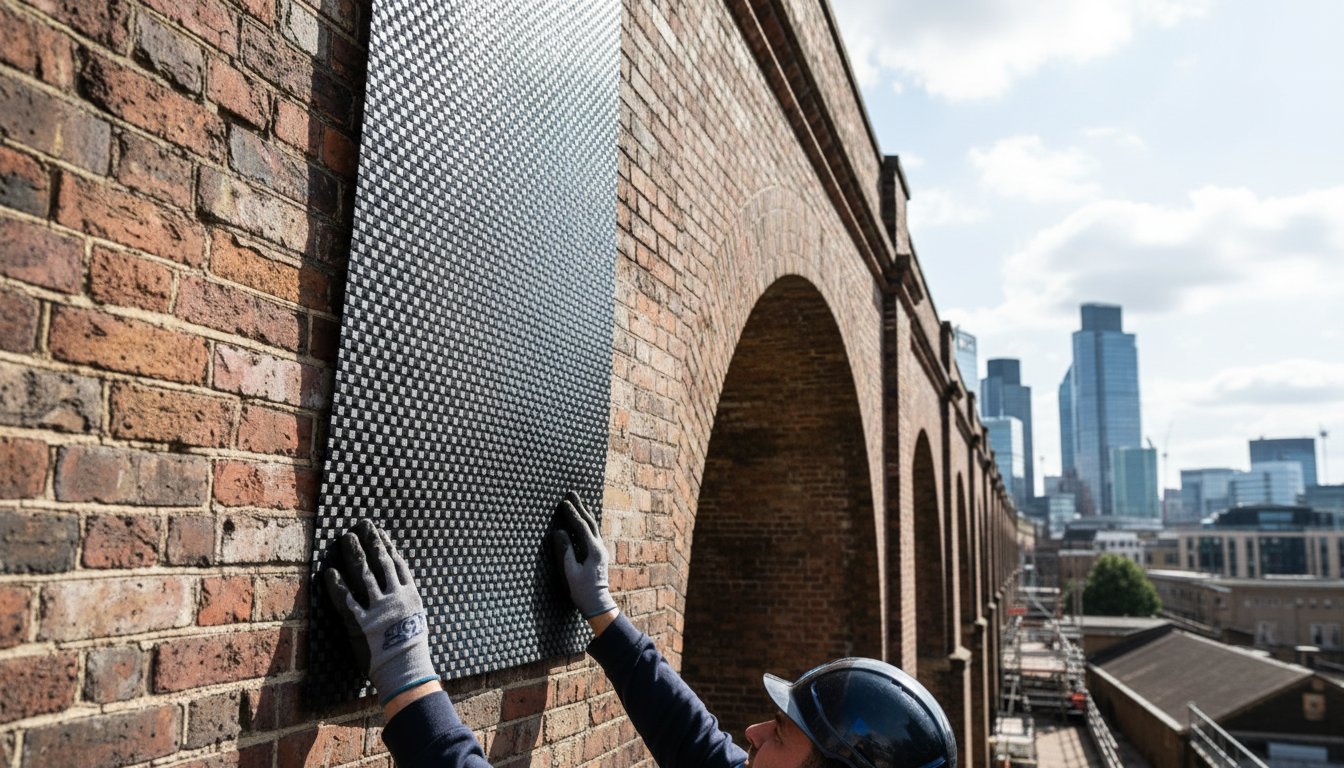
Advanced CFRP Strengthening: Utilising Tyfo® Fibrwrap® for Masonry Upgrades
The integration of Carbon Fibre Reinforced Polymer (CFRP) represents a paradigm shift in the remediation of masonry assets, particularly where traditional steel interventions prove insufficient or physically intrusive. Within the suite of masonry reinforcement techniques UK engineers utilise, the Tyfo® Fibrwrap® system is distinguished by its ability to provide exceptional high-tensile reinforcement whilst maintaining a negligible profile. This characteristic is essential for addressing out-of-plane bending and eccentric loading in multi-storey structures, where the addition of significant mass or thickness is often structurally or architecturally prohibited. By bonding high-strength carbon fibres directly to the masonry substrate, a composite action is created that significantly enhances the flexural and shear capacity of the wall, providing a robust solution for seismic retrofitting and blast mitigation.
Preserving the aesthetic integrity of heritage masonry facades is a recurring challenge in UK infrastructure projects. Traditional methods often require invasive chasing or the installation of visible external plates, which can compromise the historical value of a building. CFRP overlays offer a sophisticated alternative; they’re thin enough to be concealed beneath a traditional line render or targeted finish. This allows for the structural life-extension of essential assets without altering their external appearance. The application of these advanced masonry reinforcement techniques UK wide ensures that historic structures meet modern safety requirements, including the stringent demands of Eurocode 6 compliance, without sacrificing their architectural heritage; once the structure is secured, you can learn more about First4Frames Gallery for bespoke framing solutions that help preserve and display the fine art within these heritage spaces.
Composite Reinforcement vs Traditional Steel
When comparing materials, the strength-to-weight ratio of CFRP far exceeds that of traditional stainless steel. This makes it the preferred technique for assets with restricted access or those where additional dead weight must be minimised. Unlike steel, CFRP is inherently non-corrosive, eliminating the risk of rust jacking or bond failure due to environmental moisture ingress. The specification of these materials is often guided by bespoke design features, which allow engineers to tailor the fibre orientation and resin properties to the specific mechanical demands of the project. This level of customisation ensures that the reinforcement is as efficient as it is durable, providing a long-term stabilisation solution that traditional metals cannot match. Engineers working across mixed-material infrastructure may also benefit from reviewing the principles of structural strengthening design for concrete structures UK-wide, where analogous CFRP methodologies are applied to address deficiencies in reinforced concrete elements.
Installation Methodology for Masonry Composites
The performance of any CFRP system is entirely dependent on the quality of the substrate bond. Surface preparation is therefore the most critical phase, typically involving grit blasting or mechanical grinding to achieve a clean, open-pore texture. The Tyfo® systems are applied using a wet-lay process, where the carbon fabric is saturated with a proprietary epoxy resin before being consolidated onto the masonry surface. Quality assurance is maintained through rigorous testing protocols. Pull-off testing is conducted to verify the bond strength between the composite and the masonry, whilst interlaminar shear strength verification ensures the internal integrity of the cured laminate. This methodical approach provides technical validation for the remediation strategy, ensuring the asset is successfully reinforced against future structural demands.
Lateral Restraint and Movement Stabilisation Methodologies
Lateral instability in commercial masonry facades typically arises from insufficient connectivity between the masonry leaf and the internal structural diaphragms. This deficiency leads to bowing and potential delamination, particularly under significant wind loading or seismic events. Implementing robust lateral restraint methodologies is a cornerstone of the masonry reinforcement techniques UK engineers employ to stabilise large-scale assets. These interventions focus on creating a unified structural response, ensuring that lateral forces are effectively transferred from the facade into the floor and roof planes. By establishing these mechanical links, the effective slenderness ratio of the wall is reduced, thereby increasing its resistance to buckling and out-of-plane failure.
Lateral Restraint Systems for Large-Scale Assets
Selecting between tension straps and heavy-duty restraint plates depends on the specific failure mode and the condition of the internal substrate. Tension straps are typically installed across at least three joists to distribute loads effectively, whereas restraint plates provide a concentrated anchor point for addressing severe displacement. During the installation of these systems, the use of temporary propping is essential to manage existing load paths and prevent further movement whilst the permanent restraint is being secured. This methodical approach ensures that disparate structural elements in aging infrastructure are properly integrated, extending the functional life of the asset without necessitating a full rebuild. It’s a precise engineering requirement that demands careful coordination between the masonry remediation and the existing internal frame.
Remedial Wall Tie Specification
Addressing cavity wall delamination requires the precise specification of remedial wall ties to restore the connection between the inner and outer leaves. When evaluating masonry reinforcement techniques UK specialists must choose between mechanical expansion ties and resin-fix anchors based on the compressive strength of the masonry units. Mechanical ties are often suitable for hard, dense substrates, whilst resin-fix systems are preferred for friable or hollow materials to ensure a reliable, stress-free bond. Spacing patterns and density requirements must be calculated to meet modern safety factors, often requiring a higher concentration of ties than was originally specified in legacy codes. In maritime or industrial environments, the use of high-grade stainless steel is imperative to prevent the recurrence of tie failure due to environmental carbonation or chloride ingress.
For facades showing significant leaning or lateral displacement, bow-ties and bespoke anchors are utilised to provide a direct mechanical link to internal timber joists or concrete slabs. This stabilisation must be balanced with the integration of movement joints, which accommodate the inevitable thermal expansion and contraction of the masonry. Without these joints, even the most robust reinforcement can fail as internal stresses accumulate over time. To ensure your remediation strategy meets the highest engineering standards and Eurocode 6 requirements, contact our technical team for a detailed structural appraisal and bespoke specification.
Technical Specification and Professional Installation Framework
The successful execution of structural remediation depends on a rigorous transition from diagnostic analysis to a formalised technical specification. Whilst the selection of masonry reinforcement techniques UK engineers specify is critical, the efficacy of these systems is ultimately governed by the precision of the installation framework. Engaging a specialist engineering contractor is essential for managing the complexities of substrate preparation and material integration. This is particularly true when navigating the requirements of Eurocode 6 (BS EN 1996), which underwent significant amendments in April 2026. Compliance with these updated standards ensures that any intervention, whether utilising traditional helical systems or advanced composites, meets the necessary safety factors and performance criteria for modern UK infrastructure.
A site-specific Method Statement and Risk Assessment (RAMS) must be developed prior to the commencement of works. This document serves as the operational blueprint, detailing the sequence of interventions and the specific quality control measures required at each stage. Validation of the structural upgrade is achieved through independent testing and certification. This includes interlaminar shear strength verification for CFRP systems and load-testing for remedial anchors. By adhering to a methodical framework, asset controllers are provided with the empirical evidence needed to confirm that the structural integrity of the masonry has been restored and the functional lifespan of the asset successfully extended.
The Specification Process for Engineers
Precision in specification reduces the risk of premature failure and ensures cost-effective lifecycle management. The process should follow a logical problem-to-solution trajectory:
- Step 1: Conduct a comprehensive structural survey, including borescope inspections and material testing, to identify the root cause of distress.
- Step 2: Define the load-bearing requirements and performance criteria, accounting for lateral wind loads and potential seismic or blast demands.
- Step 3: Select the optimal masonry reinforcement techniques UK projects require based on asset constraints, such as weight limits or heritage status.
- Step 4: Produce detailed technical drawings and specification documents that clearly outline embedment depths, material grades, and bond requirements.
Ensuring Long-Term Asset Integrity
The longevity of a structural repair is inextricably linked to the quality of artisanry. Even the most advanced materials cannot compensate for poor installation. Skilled technicians ensure that resins are correctly mixed, substrates are properly primed, and reinforcement is placed with absolute accuracy. Post-installation inspections and the creation of a structural health record are vital components of this process, providing a baseline for future asset monitoring. Professional masonry reinforcement doesn’t just address immediate cracks; it contributes to a broader strategy of sustainable infrastructure by prioritising the reinforcement of existing assets over carbon-intensive replacement. This disciplined approach ensures that essential UK infrastructure remains secure, compliant, and functional for decades to come.
Advancing Structural Resilience Through Engineering Rigour
The successful remediation of aging UK infrastructure requires a methodical transition from legacy repair methods toward evidence-based engineering interventions. Asset controllers must prioritise the integration of advanced masonry reinforcement techniques UK projects demand to address complex failure modes such as lateral displacement and delamination whilst ensuring full compliance with Eurocode 6 and BS EN 845 standards. As the exclusive UK licensee for Tyfo® Fibrwrap® systems, our approach is defined by a commitment to extending the functional lifespan of essential assets through sophisticated science and proven results. A significant track record in national infrastructure life-extension has been established, providing technical validation for even the most challenging structural upgrades. By selecting specialised composite strengthening over carbon-intensive replacement, technical professionals can achieve long-term stabilisation that balances mechanical performance with economic efficiency. We invite you to contact our specialist engineering team for a bespoke masonry reinforcement design to secure the future of your structural assets.
Frequently Asked Questions
What are the primary masonry reinforcement techniques used in the UK?
Primary masonry reinforcement techniques UK specialists deploy include helical crack-stitching, bed joint reinforcement (AMR), and advanced Carbon Fibre Reinforced Polymer (CFRP) strengthening. These methodologies are selected based on the specific failure mode, such as tensile stress or lateral displacement. Traditional steel systems are often utilised for standard crack remediation, whilst proprietary systems like Tyfo® Fibrwrap® are reserved for high-performance applications requiring significant structural life-extension.
How does Eurocode 6 impact the specification of masonry reinforcement?
Eurocode 6 (BS EN 1996) serves as the definitive design standard for both reinforced and unreinforced masonry structures. The 2026 amendments to Part 1-1 and Part 2 have introduced rigorous requirements for material selection and execution. Engineers must navigate these standards to ensure that remedial interventions meet modern safety factors, particularly during the current transitional period before the full withdrawal of first-generation codes in 2028.
When should I choose CFRP over traditional helical bars for masonry strengthening?
Advanced masonry reinforcement techniques UK engineers specify often favour CFRP when structural requirements exceed the capacity of traditional helical bars, particularly in seismic or blast mitigation scenarios. It’s the optimal choice for assets with restricted access or weight limits, as it provides exceptional tensile strength without adding dead weight. Because CFRP is non-corrosive, it’s also preferred in aggressive maritime or industrial environments where stainless steel might fail.
Can masonry reinforcement techniques be used on historic or listed buildings?
Remedial interventions are frequently applied to historic or listed buildings to ensure their continued stability without compromising architectural integrity. Low-profile systems, such as CFRP or concealed helical bars, allow for significant strengthening whilst remaining virtually invisible. It’s essential that these materials are compatible with the original substrate, often requiring the use of specific lime-based grouts to prevent long-term damage to fragile or heritage masonry units.
What is the typical lifespan of a retrofitted masonry reinforcement system?
A professionally specified and installed masonry reinforcement system is typically designed to match the remaining functional lifespan of the asset, often targeting 50 years or more. The durability is largely determined by the material properties; for instance, Grade 316 stainless steel or advanced composites like Tyfo® Fibrwrap® offer superior resistance to environmental degradation. Regular post-installation inspections help to maintain the structural health record and ensure the system’s long-term performance.
How do I determine if my building requires lateral restraint straps?
The necessity for lateral restraint is typically indicated by visible bowing, leaning, or the separation of the masonry leaf from internal floor and roof diaphragms. If a facade shows signs of out-of-plane movement, a technical appraisal is required to quantify the displacement. Remediation involves installing tension straps or bespoke anchors to tie the masonry back to the internal structure, which effectively reduces the wall’s slenderness ratio and prevents catastrophic delamination.
What is the difference between bed joint reinforcement and crack stitching?
Bed joint reinforcement (AMR) involves the horizontal integration of steel mesh or bars within the mortar to enhance a panel’s flexural strength against lateral loads. Conversely, crack stitching is a targeted remedial technique where helical bars are grouted across existing fractures to restore tensile continuity. Whilst AMR is often used in new-build or large-scale panel stabilisation, crack stitching specifically addresses localised mechanical failures and prevents the further propagation of existing masonry cracks.
Is a structural survey mandatory before installing masonry reinforcement?
A comprehensive structural survey is an absolute requirement before any reinforcement is specified or installed. Empirical data from borescope inspections, pull-off testing, and material analysis are necessary to identify the underlying failure mode accurately. Without this diagnostic phase, the risk of mis-specification is high, potentially leading to inadequate stabilisation or the masking of more severe structural deficiencies that could compromise the long-term safety of the asset.