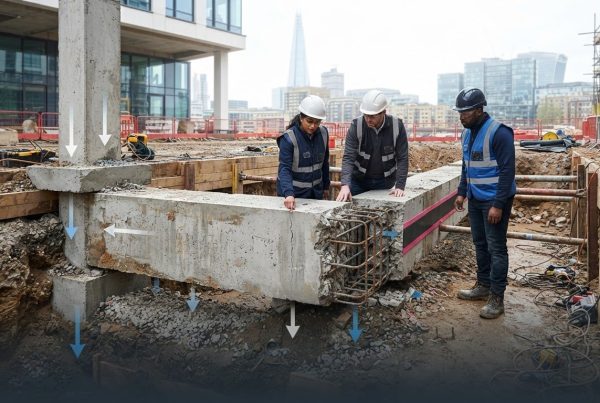


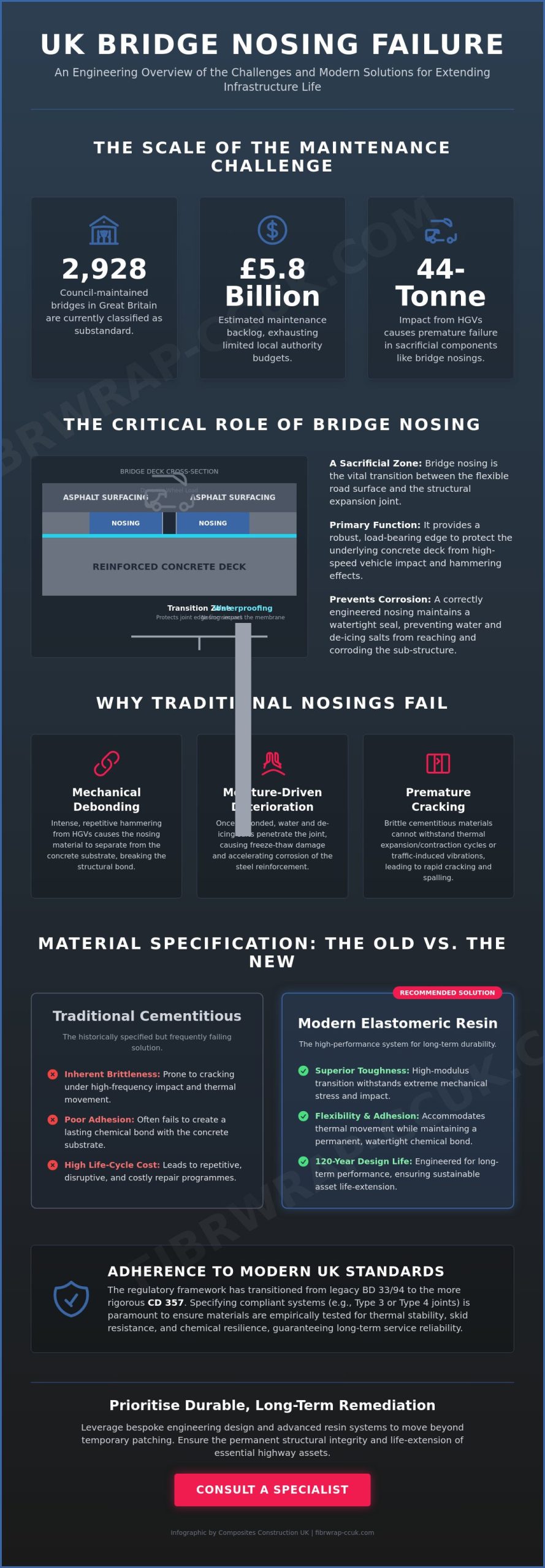
With 2,928 council-maintained bridges in Great Britain currently classified as substandard and a maintenance backlog estimated at £5.8 billion, can the industry afford to continue specifying sacrificial components that fail prematurely under 44-tonne HGV loading? It is recognised that the recurrent degradation of traditional cementitious nosings facilitates accelerated water ingress and subsequent sub-structure corrosion, often necessitating repetitive and costly bridge deck concrete repair UK interventions that exhaust limited local authority budgets. Whilst the recently launched £1 billion Structures Fund provides a necessary capital injection, the prioritisation of durable, long-term remediation over temporary patching remains a critical engineering imperative.
This technical guide provides a comprehensive engineering overview of advanced nosing specifications and remediation strategies designed to achieve 120-year design life compatibility whilst minimising traffic disruption. You will gain an understanding of how to specify systems that withstand modern mechanical stresses and remain compliant with the updated Manual of Contract Documents for Highway Works (MCHW) and CD 358 version 2.5.1. We shall examine the selection of high-performance resinous materials and professional installation standards to ensure the permanent structural integrity and life-extension of essential highway assets.
Key Takeaways
- Define the mechanical function of bridge nosing as a critical sacrificial transition zone designed to protect the primary structural asset from impact-induced spalling and environmental ingress.
- Compare the performance characteristics of modern elastomeric resin systems against traditional cementitious alternatives to enhance the efficacy of bridge deck concrete repair UK programmes.
- Identify common failure mechanisms, including mechanical debonding and moisture-driven deterioration, to implement more robust remediation strategies for high-load highway environments.
- Establish the technical standards for substrate preparation and traffic management required to ensure compliant installation and maximise the design life of expansion joint interfaces.
- Leverage the benefits of bespoke engineering design and proprietary structural strengthening technologies, such as the Tyfo® system, to facilitate sustainable asset life-extension.
Understanding Bridge Nosing and its Structural Function
Bridge nosing represents the essential transition zone situated between the flexible road surfacing and the primary structural bridge expansion joint. Its primary function is to provide a robust, load-bearing edge that protects the underlying concrete deck from the extreme mechanical stresses imposed by high-speed vehicle transitions. In the context of bridge deck concrete repair UK, the specification of high-performance nosing is a fundamental requirement for ensuring the long-term integrity of the structure. Without a correctly engineered nosing system, the concrete edge remains vulnerable to spalling and disintegration, which subsequently compromises the adjacent waterproofing layers and leads to accelerated sub-structure corrosion. These systems are engineered to maintain a watertight seal whilst accommodating the continuous thermal expansion and contraction cycles that characterise the UK’s climate.
The Primary Purpose of Nosing Systems
The integrity of the deck termination is maintained through the effective distribution of dynamic wheel loads across the joint interface. Nosing systems are designed to absorb the intense hammering effects caused by heavy HGVs, which would otherwise lead to rapid mechanical debonding of the surfacing material. By providing a rigid yet resilient boundary, these systems ensure that the structural waterproofing is terminated securely, preventing the ingress of water and de-icing salts into the bridge’s sub-structure. This protective layer is vital for maintaining the 120-year design life compatibility required for modern infrastructure. Failure at this critical interface doesn’t just damage the surfacing; it allows moisture to bypass the primary protection, leading to carbonation and chloride-induced corrosion within the reinforced concrete deck.
The Evolution of UK Bridge Joint Standards (CD 357)
The regulatory framework governing bridge joints has undergone significant modernisation, transitioning from the legacy BD 33/94 standards to the current CD 357 requirements. This shift reflects a more rigorous approach to performance and durability in high-traffic environments. Under CD 357, nosing joints are typically classified as Type 3 (poured sealant) or Type 4 (preformed seal), with each requiring specific SA1 registration for use on the UK strategic road network. Selecting an approved system is paramount as it ensures the material properties have been empirically tested for thermal stability, skid resistance, and chemical resilience. For complex bridge geometries or non-standard movements, bespoke design solutions are often required to ensure the remediation strategy aligns with the specific load requirements of the asset. It’s through this disciplined adherence to current standards that bridge deck concrete repair UK projects achieve the necessary reliability for long-term service.
Material Specifications: Resinous vs Cementitious Nosing Systems
The selection of appropriate materials for bridge nosing is a critical engineering decision that directly impacts the longevity of the structure. Historically, cementitious or mortar-based systems were widely utilised; however, their inherent brittleness frequently results in premature cracking and debonding under the high-frequency impact of 44-tonne HGVs. Modern specifications for bridge deck concrete repair UK increasingly favour elastomeric resin systems due to their superior mechanical toughness and ability to accommodate differential thermal movement. These resinous materials provide a high-modulus transition that remains resilient whilst maintaining an airtight chemical bond with the concrete substrate. Adherence to current concrete highway structure repair standards is essential when evaluating these material properties to ensure they meet the rigorous demands of the strategic road network.
Elastomeric and Resinous Nosing Properties
Polyurethane-based nosing materials are distinguished by their exceptional impact resistance and flexibility. Whilst some epoxy resins can become overly rigid and prone to stress-cracking over time, polyurethane systems offer a coefficient of thermal expansion that aligns more closely with both concrete and asphaltic substrates. This thermal compatibility prevents delamination during the UK’s fluctuating temperature cycles. These systems are also engineered for rapid-cure performance, which allows full mechanical strength to be achieved within narrow overnight maintenance windows. Such efficiency is vital for minimising traffic disruption on critical infrastructure routes where bridge deck concrete repair UK must be executed with precision. The chemical bond strength achieved between these resins and a correctly prepared substrate often exceeds the tensile strength of the concrete itself, ensuring a permanent remediation solution.
Compression Seals and Waterproofing Integrity
The efficacy of Type 4 joints relies upon the synergy between the resin nosing edge and a preformed, load-bearing compression seal. This seal is bonded to the nosing using high-strength adhesives, creating a watertight barrier that prevents the ingress of moisture and corrosive de-icing salts into the bridge abutments. Maintaining this integrity is vital for preventing the long-term deterioration of the structural deck. The seal must remain functional throughout the full range of the joint’s designed movement, resisting both compression set and mechanical wear from debris. For engineers managing complex remediation projects, a bespoke design approach ensures that material specifications are tailored to the specific movement characteristics and loading profiles of the asset. This methodical selection of components is what separates a temporary patch from a sustainable, engineered life-extension strategy.
Common Failure Mechanisms and Deterioration of Bridge Nosings
Mechanical debonding is the dominant failure mechanism for bridge nosing systems situated within high-traffic highway environments. When the interface between the nosing material and the concrete substrate is compromised, the structural integrity of the entire joint is jeopardised. This process is frequently accelerated by the UK’s climatic conditions, where freeze-thaw cycles exert significant internal pressure on moisture-compromised interfaces. Once water penetrates a micro-crack, the expansion of ice during sub-zero temperatures forces the nosing material away from the deck termination. This failure path allows de-icing salts to reach the underlying reinforcement, triggering rapid chloride-induced corrosion. The performance of the joint is also intrinsically linked to the condition of the adjacent road surface; rutting in the asphalt creates uneven transitions that subject the nosing to eccentric dynamic loads it wasn’t designed to withstand.
Impact Loading and Mechanical Wear
The fatigue induced by repetitive heavy goods vehicle (HGV) axle loads represents a relentless mechanical challenge for any transition joint. Each 44-tonne transition delivers a high-frequency shock pulse through the nosing and into the primary structure. In winter, surface-mounted nosings face additional risk from snow plough damage, where direct mechanical impact can shear the material from its bedding. Excessive horizontal movement of the bridge deck, often exceeding the joint’s original design capacity, can also lead to the failure of the bond between the nosing and the compression seal. These mechanical failures necessitate immediate bridge deck concrete repair UK to prevent catastrophic structural decline of the deck edge. It’s not just the surface that suffers; the energy from these impacts is transferred directly into the concrete, leading to subsurface micro-fracturing.
Chemical Attack and Environmental Degradation
Following a nosing failure, the exposed concrete deck edge is highly susceptible to carbonation, which lowers the alkalinity of the concrete and destroys the passive protective layer around the steel reinforcement. UV exposure also plays a significant role in the long-term degradation of certain resinous materials, leading to embrittlement and a loss of the elasticity required to accommodate thermal movement. Because these environmental factors often affect the surrounding structure, comprehensive concrete repairs are typically required in conjunction with nosing replacement. Addressing the root cause through professional bridge deck concrete repair UK ensures that the remediation isn’t merely cosmetic but restores the structural strength of the asset. We’ve seen that neglecting these chemical triggers leads to a much more expensive structural strengthening requirement in later years. Where adjacent masonry elements are also affected by environmental degradation, engineers should consider advanced masonry reinforcement techniques UK professionals now employ to address corrosive wall tie expansion and thermal movement that standard remediation efforts frequently fail to resolve.
The Installation and Remediation Process: Ensuring Longevity
The successful remediation of bridge nosing systems is fundamentally dependent upon the rigour of the installation methodology. Whilst material selection is a vital prerequisite, even the most advanced elastomeric resin will fail prematurely if the substrate interface isn’t prepared to exacting engineering standards. This process requires a methodical approach to surface preparation and environmental monitoring to ensure that 120-year design life compatibility is achieved. Within the context of bridge deck concrete repair UK, the execution phase must be managed with precision to balance structural integrity with the necessity of maintaining highway network availability. Longevity isn’t merely a product of the material; it’s a result of disciplined site practice.
Critical Surface Preparation Requirements
Optimal resin adhesion is only possible when the concrete nosing pocket is entirely free from laitance, dust, and previous joint residues. Grit blasting is utilised to achieve a specific surface profile, which provides the mechanical interlock required for high-modulus resins to bond effectively. Following the mechanical removal of contaminants, specialised primers are applied to consolidate the concrete surface and act as a moisture barrier. This step is critical to prevent osmotic blistering, a phenomenon where moisture vapour pressure from the underlying concrete causes delamination of the newly applied nosing material. The substrate must be verified as dry, typically with a moisture content below 4%, before any resin application commences.
Minimising Disruption through Rapid-Cure Solutions
Modern cold-cure resin technology has transformed the feasibility of overnight maintenance windows. Unlike traditional cementitious mortars that require extended periods to reach full strength, these advanced resins allow for full traffic loading within hours of installation. In instances of severe structural degradation where the deck edge requires a full-depth reconstruction, the use of temporary propping or bespoke formwork ensures the asset remains stable whilst the repair cures. This disciplined approach to scheduling ensures that joint replacements are completed between peak traffic periods, significantly reducing the economic impact of road closures. Setting the expansion joint gap width also requires a calculated adjustment based on the ambient temperature at the time of installation to ensure the joint functions correctly throughout the seasonal cycle.
Quality control is maintained through continuous environmental monitoring and pull-off testing on representative trial areas. These tests verify that the bond strength exceeds the thresholds required for bridge deck concrete repair UK infrastructure, typically reaching values where the concrete substrate fails before the resin bond. For technical assistance with your next infrastructure project, contact our specialist engineering team to discuss bespoke remediation strategies that prioritise both speed and structural integrity.
Selecting a Specialist Engineering Contractor for Bridge Rehabilitation
The selection of a specialist contractor for bridge deck concrete repair UK projects requires an assessment of both technical capability and engineering rigour. It’s insufficient to treat nosing replacement as an isolated maintenance task; it must be viewed as a critical component of a wider structural strengthening programme. By engaging specialists during the initial phases of asset assessment, asset managers can leverage structural surveys and testing to identify latent defects before they compromise the new installation. This proactive approach ensures that the remediation strategy is tailored to the specific mechanical requirements of the structure, avoiding the pitfalls of generic specifications that fail to account for site-specific loading conditions.
Integrating Nosing Repairs with Structural Strengthening
The long-term success of bridge remediation is often predicated on the condition of the deck edge prior to nosing application. In scenarios where the concrete has suffered significant section loss or reinforcement corrosion, the Tyfo® Fibrwrap® system is employed to provide high-modulus carbon fibre reinforced polymer (CFRP) reinforcement. This composite solution restores structural integrity whilst providing a stable foundation for the nosing material. A holistic remediation strategy typically incorporates resin injection for crack sealing and cathodic protection to mitigate future corrosion. These comprehensive structural repairs are essential for achieving sustainable asset life-extension and reducing the frequency of future maintenance interventions. It’s this integration of advanced materials that ensures the transition joint remains functional throughout the bridge’s service life.
The Value of Specialist Accreditations
Infrastructure safety is non-negotiable. Therefore, the necessity of bespoke design solutions for complex bridge geometries cannot be overstated. Contractors with national coverage and exclusive system licensing provide a level of technical assurance that is vital for large-scale B2B infrastructure projects. This expertise is reflected in the provision of detailed technical documentation and long-term warranties that project absolute reliability to engineers and asset managers. When managing the complexities of bridge deck concrete repair UK, the focus remains on extending the life of essential assets through sophisticated engineering science. Engineers seeking to align their remediation programmes with BS EN 1992 compliance and advanced composite intervention should consult the comprehensive guidance available on structural strengthening design for concrete structures UK, which details the systematic framework for deploying CFRP technologies to achieve asset life-extension. We invite stakeholders and principal contractors to contact our engineering team to conduct feasibility studies and develop tailored remediation specifications that prioritise structural integrity and long-term security.
Advancing Infrastructure Resilience through Engineered Remediation
The transition from legacy standards to modern, high-performance nosing systems represents a fundamental shift in how the UK’s highway infrastructure is maintained. Specifying elastomeric resins over traditional cementitious materials ensures that transition joints withstand the relentless mechanical fatigue of HGV loading whilst maintaining a watertight seal. This approach, combined with disciplined site preparation, isn’t just a maintenance preference; it’s the only viable method for ensuring 120-year design life compatibility during bridge deck concrete repair UK programmes.
As the exclusive UK licensee for Tyfo® Fibrwrap® systems, Composites Construction UK provides a specialist engineering team with national coverage and a proven track record in major infrastructure life-extension projects. By integrating bespoke nosing solutions with broader structural strengthening strategies, the integrity of essential assets is secured for decades to come. Consult with our engineering specialists for bespoke bridge nosing solutions to ensure your next remediation project delivers lasting structural reliability. We’re ready to support your infrastructure goals with science-led engineering excellence.
Frequently Asked Questions
What is the difference between Type 3 and Type 4 bridge nosing?
Type 3 joints utilise a poured sealant whilst Type 4 joints incorporate a preformed, load-bearing compression seal. Type 4 systems are generally specified for higher movement requirements and provide enhanced durability in high-traffic highway environments. Both systems must comply with CD 357 standards to ensure structural integrity and effective load distribution at the deck termination.
How long does bridge nosing installation typically take?
Installation is typically executed within narrow overnight maintenance windows to minimise traffic disruption. Through the application of modern cold-cure resin technology, full mechanical strength is often achieved within 2 to 4 hours of placement. This rapid-cure performance allows for the reopening of the strategic road network by morning peak hours, provided the environmental conditions remain within specified parameters.
Can bridge nosing be installed in wet weather conditions?
Installation can’t be performed during wet weather conditions as moisture negatively impacts resin adhesion and chemical bonding. The concrete substrate must be verified as dry, typically maintaining a moisture content below 4%, to prevent osmotic blistering and subsequent delamination. If bridge deck concrete repair UK is required during inclement weather, the work area must be fully encapsulated and heated to ensure a controlled environment.
What are the most common causes of bridge nosing failure in the UK?
Mechanical debonding and impact fatigue from 44-tonne HGV axle loads are the primary causes of failure in the UK. These stresses are exacerbated by freeze-thaw cycles, where moisture ingress leads to internal pressure that compromises the nosing-to-concrete interface. Chemical attack from de-icing salts also plays a significant role in the degradation of the underlying structural deck edge once the nosing seal has been breached.
Is bridge nosing compatible with asphaltic plug joints?
Bridge nosing systems are compatible with asphaltic plug joints and are frequently used to provide a rigid boundary at the joint termination. This configuration protects the adjacent road surfacing from spalling whilst ensuring the flexible plug material remains contained. Proper material specification is essential to ensure that the thermal expansion coefficients of the resinous nosing and the asphaltic material are compatible.
How often should bridge nosing systems be inspected?
Systems should be inspected in accordance with National Highways requirements, typically involving general inspections every two years and principal inspections every six years. Routine visual checks should also be conducted following extreme weather events or if there is evidence of surfacing rutting. Early detection of micro-cracking at the nosing interface is vital for preventing the need for extensive bridge deck concrete repair UK interventions.
What is the design life of a modern resinous bridge nosing system?
Modern resinous nosing systems are engineered for a service life of 15 to 25 years, although they’re designed to be compatible with a 120-year structural design life. Whilst the nosing is a sacrificial component, its longevity is significantly extended through the use of high-performance polyurethanes and precise substrate preparation. The actual durability is influenced by HGV traffic volumes and the quality of the initial installation.
Does bridge nosing require specific maintenance after installation?
Maintenance requirements are minimal once the resin has fully cured and the compression seal is bonded. Periodic clearing of debris from the joint gap is necessary to ensure that thermal movement isn’t restricted by incompressible materials. It’s also recommended that the integrity of the seal-to-nosing bond is verified during routine bridge inspections to maintain the watertight integrity of the structural deck.