
The structural integrity of a major remediation project is frequently compromised not by the final design, but by the failure to treat temporary propping as a primary structural element in its own right. Within this concrete repair specification guide, the necessity for rigorous engineering in temporary works is examined, particularly where invasive hydro-demolition or the removal of load-bearing sections threatens to induce unforeseen movement. It’s widely acknowledged amongst civil engineers that the period between the initial structural compromise and the final curing of repair materials represents the highest risk profile for any asset.
You’ll find a detailed technical examination of how to maintain zero-deflection during the repair phase whilst ensuring absolute compliance with the December 2024 updates to BS 5975-1 and BS 5975-2. By prioritising engineered stability, the risks of HSE non-compliance and programme delays are significantly mitigated. This guide provides a methodical overview of integrating sophisticated propping solutions with permanent CFRP strengthening systems, facilitating a seamless transition that extends the functional lifespan of essential infrastructure through empirical rigour and precise design management.
Key Takeaways
- Evaluate the technical distinction between standard construction shoring and the engineered temporary works required to maintain structural equilibrium during invasive hydro-demolition.
- Establish a framework for full regulatory compliance by implementing the updated management and design procedures mandated by BS 5975:2024.
- Utilise this concrete repair specification guide to master the transition from temporary load-bearing supports to permanent structural reinforcement using specialised CFRP systems.
- Mitigate the risk of inducing unintended stresses or structural movement through rigorous axial load analysis and bespoke Temporary Works Design.
- Learn the methodical sequence for conducting structural surveys and carbonation testing to ensure the accuracy of engineered propping calculations.
The Critical Role of Temporary Propping in Concrete Remediation
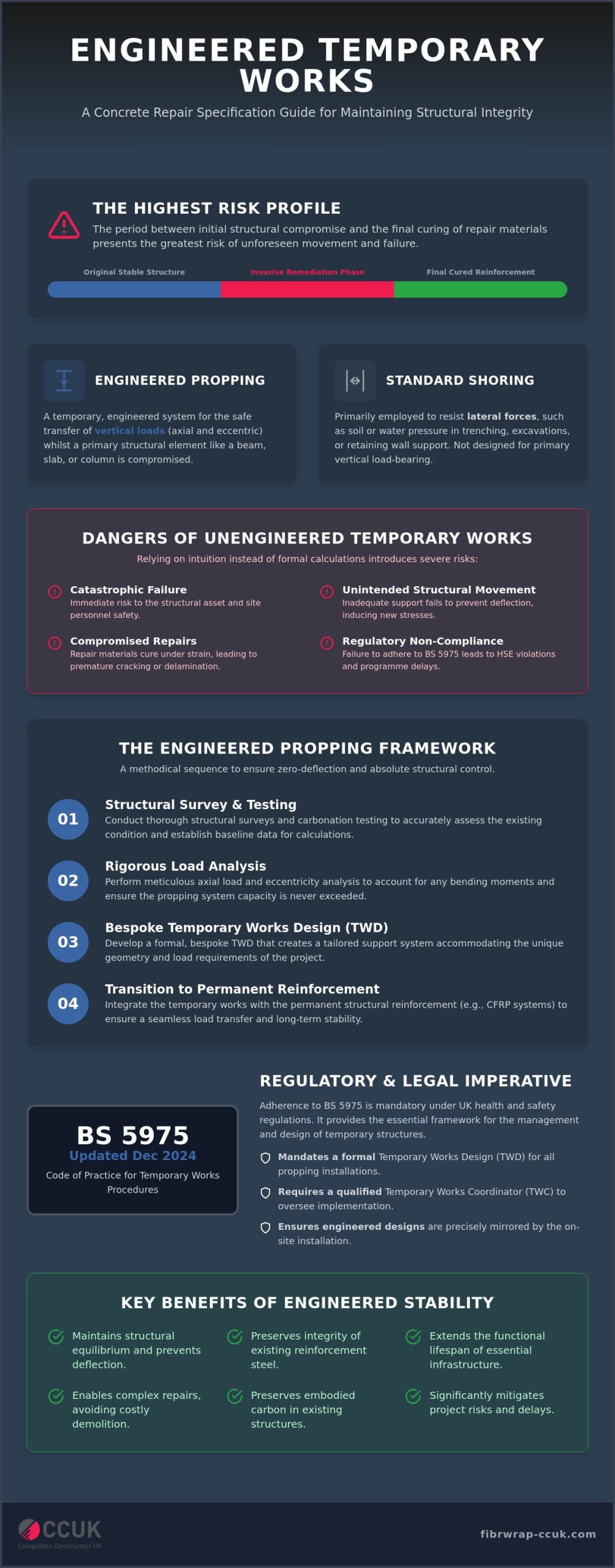
Temporary propping is defined as a temporary, engineered system designed specifically to facilitate the safe transfer of axial and eccentric loads whilst the primary load-bearing capacity of a concrete element is compromised. In any comprehensive concrete repair specification guide, the transition from a stable structure to one undergoing invasive remediation must be managed with absolute precision. This is particularly critical during processes such as hydro-demolition or intensive grit blasting, where the removal of spalled or carbonated concrete results in a significant reduction of the cross-sectional area and the temporary loss of bond between the concrete and reinforcement steel.
Unengineered temporary works represent a catastrophic risk to both the structural asset and site personnel. Relying on the intuitive placement of props without formal calculations often leads to localised over-stressing or, conversely, inadequate support that fails to prevent deflection. Within the context of the UK’s ageing infrastructure, the strategic use of engineered propping is a fundamental component of sustainable asset management. By enabling complex repairs rather than total demolition, these systems preserve the embodied carbon within existing structures, aligning technical interventions with broader environmental and environmental goals.
The Functional Necessity of Temporary Support
Maintaining structural equilibrium is the primary challenge when removing contaminated concrete. As original cover is stripped away, the integrity of the reinforcement steel must be preserved to prevent buckling or shear failure in the remaining section. The primary objective of temporary propping is the maintenance of the original load path during structural alteration. This ensures that the redistribution of stresses doesn’t exceed the capacity of the weakened element or its foundations. Without this stability, the repair material may be forced to cure under unintended strain, leading to premature delamination or cracking.
Propping vs. Shoring: Distinguishing Methodologies
Whilst often used interchangeably, a distinction must be made between vertical load transfer and lateral pressure resistance. Shoring is typically employed to resist lateral forces, such as those found in trenching or basement excavations, whereas propping focuses on the vertical support of beams, slabs, and columns. Selecting the appropriate configuration depends entirely on the specific structural defects identified during the initial survey, a process that remains a core pillar of any robust concrete repair specification guide. The integration of bespoke design features allows for the creation of tailored support systems that accommodate the unique geometry and load requirements of complex infrastructure projects.
Engineering Rigour: Load Transfer Mechanics and BS 5975 Compliance
Technical rigour in temporary works is established through a precise understanding of load transfer mechanics, particularly the relationship between axial load capacities and the potential for load eccentricity. In a high-stakes concrete repair specification guide, the engineer must account for the fact that props rarely experience perfectly centred loads. Any slight misalignment or structural shift during the removal of defective concrete introduces bending moments that can drastically reduce the effective capacity of the support system. This makes axial analysis a critical prerequisite for any intervention, ensuring that the propping configuration remains stable under both static and dynamic influences.
The legal imperative for a formal Temporary Works Design (TWD) is absolute under UK health and safety regulations. This design process is governed by the BS 5975:2019 Code of Practice, which has recently evolved into the BS 5975:2024 standard to further refine management procedures and falsework implementation. Adherence to these protocols is overseen by the Temporary Works Coordinator (TWC), whose role is to ensure that the physical installation on site mirrors the engineered design exactly. If you require assistance with the technical nuances of load path analysis for a specific asset, you may contact our engineering team for a detailed consultation.
Calculating Load Requirements for Concrete Repair
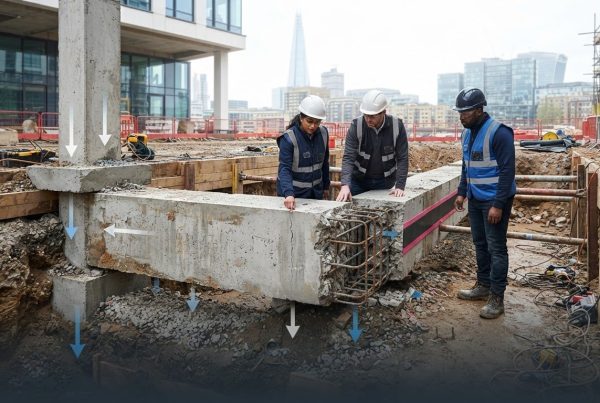
Determining the required propping capacity involves a multi-layered calculation that factors in the dead weight of the structural elements alongside construction-imposed loads. During the repair phase, the system must support not only the static mass of the concrete but also the dynamic loads generated by heavy hydro-demolition machinery and the movement of site personnel. Failure to account for these transient forces often results in micro-deflections that compromise the bond of new repair materials. Eccentric loading remains the most significant risk factor; even a minor offset in prop placement can induce structural instability if not accounted for in the initial TWD.
Regulatory Frameworks and HSE Expectations
Full compliance with the Management of Health and Safety at Work Regulations 1999 requires a robust paper trail that documents every stage of the temporary works lifecycle. The Health and Safety Executive (HSE) expects clear documentation, including stamped design drawings and comprehensive calculation sheets that justify the chosen propping intervals. BS 5975 serves as the industry benchmark for preventing structural failure in temporary works by standardising the management and design procedures required for safe implementation. This methodical approach ensures that structural stability is maintained through empirical evidence rather than conservative estimation, protecting both the asset and the workforce throughout the remediation programme.
Mitigating Risk: Engineered Propping vs. Standard Construction Shoring
A prevalent misconception within the industry suggests that standard Acrow props are sufficient for all forms of structural support. Whilst these components are suitable for general construction tasks, they frequently lack the axial stiffness and load-bearing capacity required for complex infrastructure repairs. An effective concrete repair specification guide must distinguish between basic shoring and engineered load-transfer systems. In specialist remediation, firms like TRD Remedial demonstrate that the objective isn’t merely to “hold up” a beam, but to maintain the structural equilibrium of an asset whose load paths are being actively altered through material removal.
The danger of over-propping is a technical risk that is often underestimated. Inducing excessive upward force can result in unintended stresses, such as “hogging” in floor slabs or the reversal of moments in continuous beams, which may cause structural cracking in previously sound areas. Furthermore, any propping system is only as reliable as the surface it bears upon. Foundation and ground conditions must be rigorously assessed before installation to prevent settlement. This level of oversight is a primary reason why the role of a specialist engineering contractor is essential in identifying latent risks that could compromise the entire project lifecycle.
The Hazards of Unengineered Shoring
Case studies of structural failures often highlight inadequate temporary support as a primary cause of movement during repair. A significant risk in these scenarios is punching shear, which occurs when props are not correctly seated on suitable sole plates designed to distribute the load across a larger surface area. Engineers should refer to the American Concrete Institute’s Repair Guide for a comprehensive methodology on avoiding these common pitfalls. Identifying early signs of distress, such as eccentric tilting or localized crushing at the bearing points, is vital for preventing a total collapse of the temporary works.
Precision Load Transfer Systems
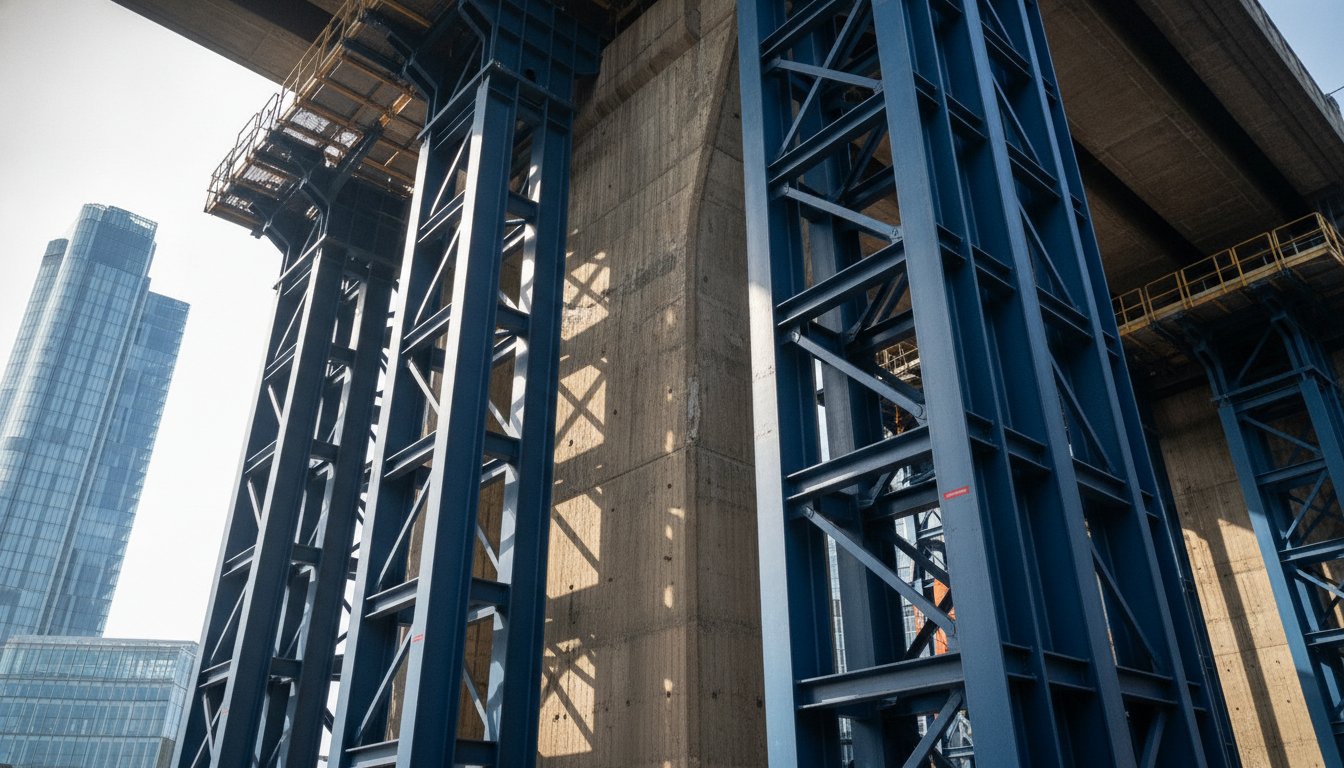
Modern remediation projects increasingly utilise hydraulic flat jacking for controlled load transfer and monitoring. These systems allow for the incremental application of force, ensuring that the prop takes the load without shocking the structure or inducing sudden movement. Proprietary heavy-duty propping systems offer distinct advantages for high-load infrastructure, providing the modularity and strength that standard equipment cannot match. By integrating real-time sensor technology, engineers can monitor prop loads throughout the remediation lifecycle, allowing for immediate adjustments if the structural behaviour deviates from the predicted model. If your project requires this level of technical oversight, you can explore our design features for more information on bespoke support configurations.
Methodological Framework for Implementing Temporary Works
The execution of temporary works requires a disciplined, five-stage methodology to ensure that structural equilibrium is maintained throughout the remediation process. It’s essential that this sequence is documented within a concrete repair specification guide to provide clear instructions for site teams. The framework follows a logical progression from investigation to the eventual removal of supports:
- Step 1: Conduct a comprehensive structural survey and carbonation testing to assess the current asset condition.
- Step 2: Develop a bespoke Temporary Works Design (TWD) based on precise engineering calculations and load path analysis.
- Step 3: Professional installation and bracing of the propping system prior to any concrete removal.
- Step 4: Continuous monitoring and inspection throughout the invasive repair phase, particularly during high-vibration activities.
- Step 5: Systematic de-propping only after the permanent repair has achieved the required design strength, verified through site testing.
Structural Surveys and Asset Investigation
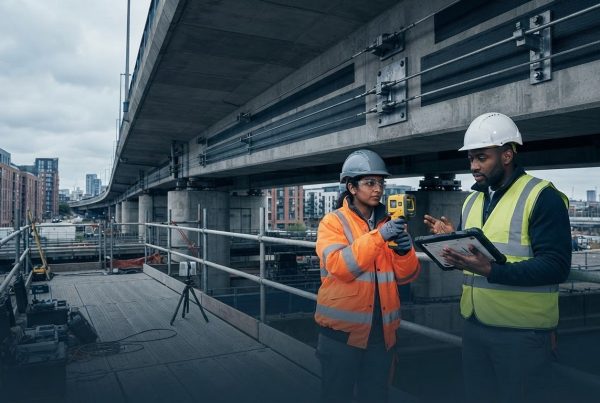
Initial investigations must involve more than a visual assessment. Pull-off tests and rebar corrosion surveys are required to determine the residual strength of the concrete and the extent of reinforcement loss. This data informs the TWD, ensuring that the propping system accounts for the actual state of the asset rather than its original design intent. By utilising 3D laser scanning technology, engineers can achieve sub-millimetre accuracy in prop placement, which is vital for calculating eccentric load risks. For a deeper look at long-term asset management, you can read about the role of concrete repairs in life-extension.
Monitoring and Quality Control
Hydro-demolition introduces specific challenges that standard shoring guides often overlook. The process generates significant dynamic vibrations and localised section loss that can cause props to shift if they aren’t properly braced against lateral movement. A rigorous inspection regime must be implemented as part of the temporary works permit system, where each prop is checked for plumb and tightness at the start of every shift. Managing the transition between temporary support and permanent structural strengthening is a delicate phase that requires the coordination of the Temporary Works Coordinator and the lead engineer. All site operatives must be briefed on the limitations of the propping design to prevent accidental overloading during the repair cycle. If you require technical assistance with your project’s support requirements, you can request a structural survey and testing consultation from our engineering team.
Systematic de-propping is the final, critical step. It shouldn’t occur until repair materials have reached their full design strength, verified through cube testing or non-destructive methods. This ensures the load is transferred back to the primary structure without inducing sudden stresses that could lead to micro-cracking in the new repair material.
Strategic Asset Care: Integrating Propping with Tyfo® Fibrwrap®
Engineered propping is not merely a safety precaution during the removal of defective concrete; it is the fundamental enabler for advanced structural strengthening. Within this concrete repair specification guide, it’s established that the performance of Carbon Fibre Reinforced Polymer (CFRP) systems depends heavily on the structural state of the asset at the point of application. If a structure is allowed to remain in a deflected state whilst the composite is bonded, the CFRP will only assist with additional live loads. To ensure the composite material shares the existing dead load, the structure must be propped back to its original design profile, effectively “unloading” the element before the strengthening phase begins.
The transition from temporary works to permanent Tyfo Fibrwrap installation requires a methodical approach to load management. Once the concrete repairs have achieved their required compressive strength, the propping system provides a stable platform for the precision application of the composite layers. This integration ensures that the final remediation doesn’t just patch a defect but restores or enhances the original load-bearing capacity of the asset. Opting for this engineered repair and strengthening route offers significant economic and environmental advantages over complete replacement, as it avoids the massive carbon expenditure associated with new-build concrete and the logistical disruption of total demolition.
Preparing for Carbon Fibre Reinforcement
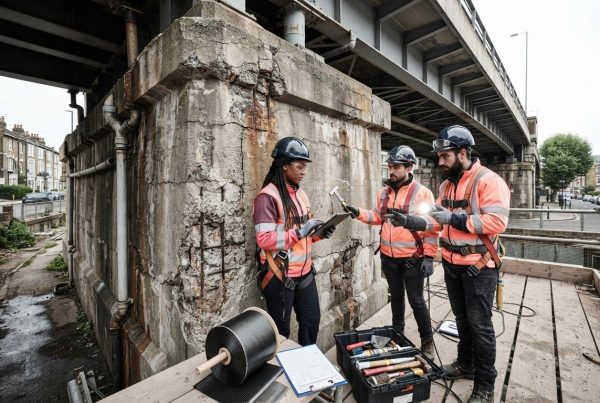
Before the application of CFRP, the concrete substrate must be stabilised and correctly profiled whilst under the continuous support of the temporary works. This phase often involves specialised resin injection and leak sealing to address internal voids or hydrostatic pressure that could compromise the bond of the composite system. The Tyfo® Fibrwrap® system integrates with the repaired substrate to restore structural capacity by providing high-tensile reinforcement that functions in unison with the existing concrete matrix. Maintaining the propping until the epoxy resins have fully cured is a non-negotiable requirement for achieving the design-specified bond strength.
The Future of Structural Asset Care
By July 2026, the integration of digital twin monitoring with composite remediation has become a standard requirement for Tier 1 infrastructure projects in the UK. These advancements allow engineers to track the performance of both the temporary propping and the permanent CFRP strengthening in real-time. A holistic approach that views propping as the first stage of strengthening is essential for the long-term security of critical infrastructure. If you are managing an asset that requires a transition from stabilisation to permanent reinforcement, you can contact the experts at Composites Construction UK for a bespoke structural strengthening consultation to ensure your project meets the highest standards of engineering rigour.
Securing Infrastructure Longevity Through Engineered Stability
The preservation of critical infrastructure relies upon the seamless integration of temporary stabilisation and permanent remediation. As outlined in this concrete repair specification guide, the success of advanced strengthening is predicated on the precision of the initial propping phase and strict adherence to the management procedures within BS 5975:2024. By maintaining structural equilibrium through the invasive repair cycle, engineers ensure that every intervention contributes to the long-term resilience and safety of the asset.
Since 2015, Composites Construction UK has delivered specialist engineering design and installation services across major infrastructure projects, building a proven track record in structural life-extension. As the exclusive UK licensee for Tyfo® Fibrwrap® systems, the firm provides an integrated approach that bridges the gap between complex temporary works and high-performance composite strengthening. Discuss your structural propping and repair requirements with our engineering team to initiate a methodical, expert-led remediation strategy for your essential assets.
Frequently Asked Questions
What is the difference between propping and shoring in concrete repair?
Propping is specifically designed for the transfer of vertical axial loads, whilst shoring is utilised to resist lateral pressures, such as those encountered in excavations or basement retaining walls. In a comprehensive concrete repair specification guide, propping is the essential mechanism for maintaining structural equilibrium in beams and slabs during invasive remediation. Shoring is typically reserved for scenarios where the primary forces are horizontal rather than vertical.
Is a formal Temporary Works Design (TWD) always required for propping?
A formal Temporary Works Design is a legal requirement under UK health and safety regulations for any project where the primary structure’s stability is compromised. This design must include detailed engineering calculations, drawings, and a thorough assessment of load paths. Even for minor repairs, a TWD ensures that the propping configuration is capable of managing both static dead loads and dynamic construction forces without risking structural failure.
How long does temporary propping need to remain in place during concrete repair?
Temporary supports must remain in position until the repair materials have achieved their full design strength, which is typically verified through site-cured cube testing. Removing props prematurely can lead to micro-cracking or delamination of the new repair material as it is subjected to loads it cannot yet sustain. The de-propping sequence should always follow a methodical plan to ensure the gradual and safe redistribution of stresses.
Can I use standard Acrow props for heavy-duty infrastructure strengthening?
Standard Acrow props are generally unsuitable for high-load infrastructure projects due to their limited axial stiffness and lack of capacity for eccentric loading. Heavy-duty infrastructure strengthening requires proprietary modular propping systems that offer significantly higher load-bearing capabilities and greater stability. These engineered systems are specifically designed to withstand the intensive dynamic forces generated by hydro-demolition and the massive dead weights found in bridges and industrial assets.
How do you ensure zero-deflection during the concrete remediation process?
Zero-deflection is achieved through the use of hydraulic flat jacking systems that allow for the controlled and incremental transfer of loads into the temporary supports. This precision prevents the structure from sagging as compromised concrete is removed. When combined with real-time digital monitoring sensors, engineers can track structural behaviour and adjust prop tensions immediately if any movement is detected, ensuring the asset remains in its original design profile.
What are the risks of over-propping a concrete structure?
Over-propping occurs when excessive upward force is applied, potentially inducing unintended stresses such as moment reversal or “hogging” in floor slabs. This can cause structural cracking in previously sound areas of the asset. A precise concrete repair specification guide emphasises that the objective is to support the existing load without forcing the structure into an unnatural state, which requires accurate calculations of the actual dead loads present.
How does BS 5975:2019 impact temporary works on UK construction sites?
BS 5975:2019 provided the definitive code of practice for temporary works, but it has recently been superseded by the BS 5975:2024 two-part standard. These updates refine management procedures and falsework implementation, ensuring that responsibilities are clearly defined amongst all parties. This standard is critical for preventing structural failure by mandating rigorous risk assessments and formal design checks, creating an environment of absolute reliability for complex engineering projects.
What role does a Temporary Works Coordinator (TWC) play in concrete repair?
The Temporary Works Coordinator is responsible for overseeing the entire temporary works lifecycle, from the initial design brief to the final removal of supports. Their role involves ensuring that the physical installation on site matches the engineered design exactly and that all necessary permits are in place. In concrete repair, the TWC coordinates between the design engineers and site operatives to ensure that propping remains stable during invasive demolition.