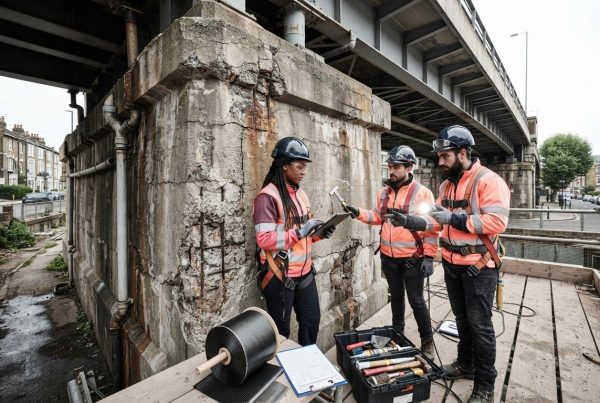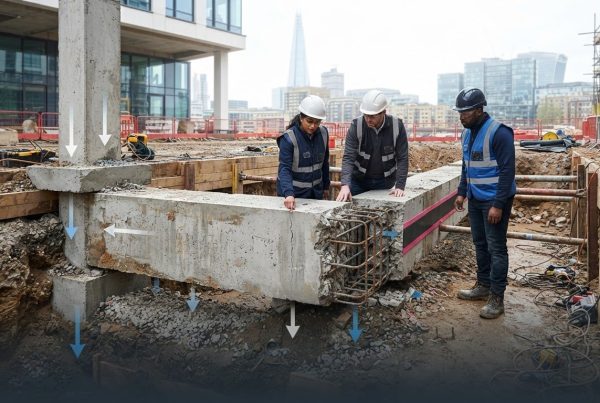


The most technically sound repair strategy will inevitably fail if it is presented as an isolated cost rather than a strategic investment in risk mitigation and asset longevity. For many asset managers, the transition from a comprehensive commercial building structural survey checklist to an authorised capital expenditure budget represents the most significant hurdle in a project’s lifecycle. It’s natural to anticipate resistance from board members who may prioritise short-term liquidity over the documented, incremental degradation of structural elements; this tension often leads to a justifiable fear of being interrupted or dismissed during high-stakes capital expenditure meetings.
This technical guide provides the methodology required to translate complex engineering data into high-impact boardroom proposals that secure immediate approval for critical interventions. You’ll master the art of communicating the superior ROI of advanced composite solutions, such as Carbon Fibre Reinforced Polymer (CFRP) strengthening, which offers a sophisticated alternative to traditional and more disruptive replacement methods. By framing structural integrity through the lens of long-term asset guardianship, you’ll build enduring trust with stakeholders whilst ensuring the continued safety and performance of your infrastructure portfolio.
Key Takeaways
- Learn to bridge the significant disconnect between empirical engineering data and executive financial priorities, ensuring that critical structural interventions are recognised as strategic investments in asset longevity.
- Discover how to transform a commercial building structural survey checklist into a structured traffic light framework that clearly communicates the urgency of intervention and the specific risks associated with deferred maintenance.
- Evaluate the comparative long-term ROI of advanced strengthening systems versus traditional replacement, accounting for hidden factors such as operational downtime and the environmental impact of demolition.
- Identify how 3D visualisations and detailed technical case studies can be utilised to render complex engineering solutions tangible and persuasive for non-technical board members.
- Understand the role of early contractor involvement in providing the technical validation and cost certainty required to de-risk high-stakes capital expenditure proposals.
Navigating the Boardroom: How a Commercial Building Structural Survey Checklist Informs Executive Decisions
The transition from technical site observations to an approved remediation budget is frequently hindered by a fundamental misalignment between engineering rigour and executive decision-making priorities. Whilst an asset manager relies upon a comprehensive commercial building structural survey checklist to identify physical vulnerabilities, the board of directors is primarily concerned with the mitigation of corporate liability and the optimisation of capital expenditure. This “Boardroom Gap” occurs when technical data is presented without being translated into financial risk or operational impact. Directors don’t require an exhaustive lecture on the microscopic mechanisms of chloride ingress; they require an objective assessment of how these factors influence the building’s functional lifespan.
A foundational understanding structural integrity is essential for any presenter, yet technical detail must be framed within the context of the board’s fiduciary duties. Under the Construction (Design and Management) Regulations 2015 (CDM 2015), the board holds significant legal responsibility for ensuring that assets are maintained safely. Failure to act on survey findings isn’t merely a maintenance oversight; it is a potential breach of statutory health and safety obligations. When proposals are buried under impenetrable jargon, decision paralysis often ensues, leaving the organisation exposed to both physical failure and legal repercussions.
The Psychology of the Asset Controller
Asset controllers and board members typically operate within a framework of CAPEX efficiency. They prioritise long-term risk reduction over the immediate technical elegance of a solution. To secure approval, structural repairs should be aligned with broader corporate ESG goals. For instance, utilising Carbon Fibre Reinforced Polymer (CFRP) strengthening is often significantly more sustainable than traditional demolition and replacement. This shift in perspective transforms structural remediation from a burdensome cost centre into a strategic asset life-extension strategy that preserves the embedded carbon of the existing structure.
Common Pitfalls in Technical Proposals
One of the most frequent errors in technical presentations is an over-reliance on complex CAD drawings that lack concise executive summaries. Whilst these documents are vital for the execution phase, they can obscure the primary objectives during a high-stakes meeting. Another critical failure is the omission of the “cost of inaction”. If the board isn’t presented with a quantified trajectory of structural degradation, the perceived urgency of the repair is diminished. A robust proposal must explicitly detail how project risks will be mitigated through specialist contractor involvement, rather than attempting to hide potential complications from the decision-makers.
A Decision Framework for Structural Remediation: Beyond the Basic Checklist
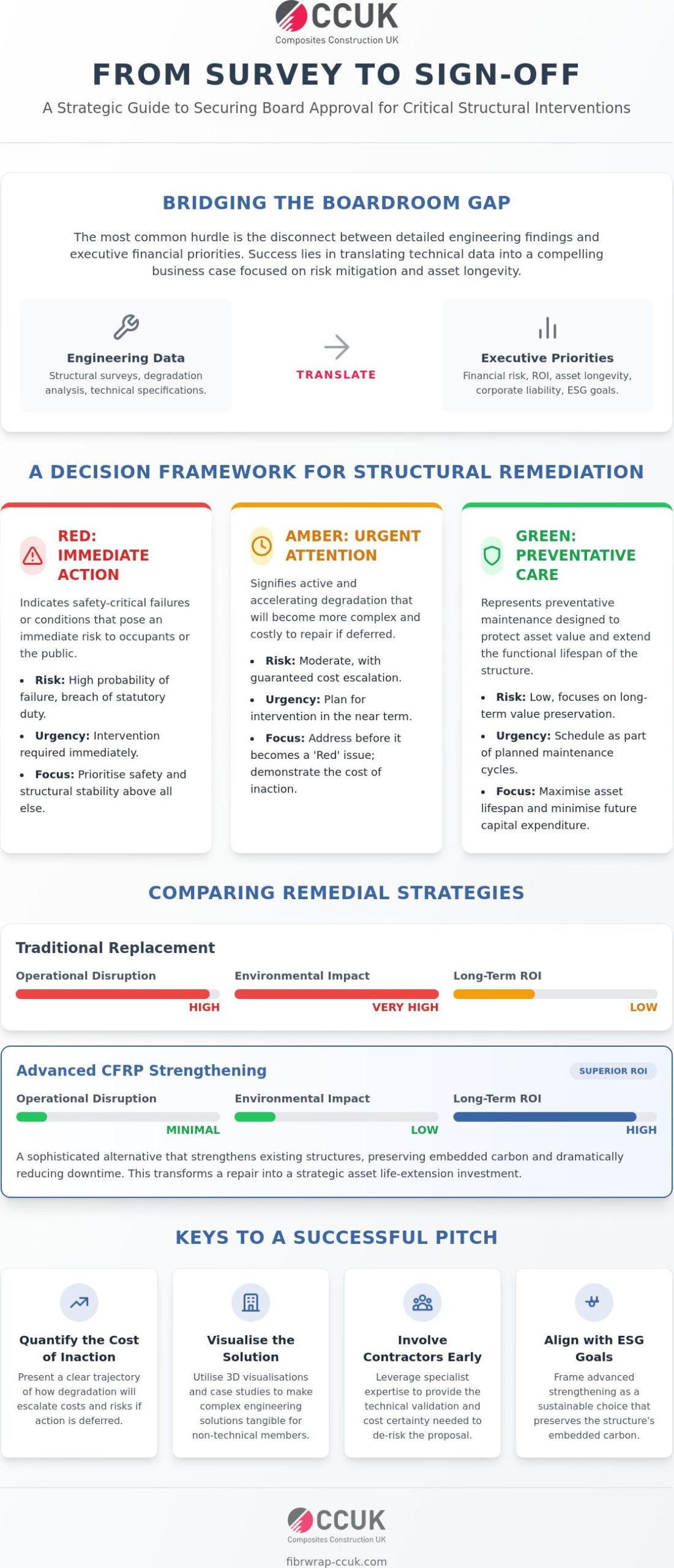
A raw commercial building structural survey checklist provides the empirical foundation for a proposal, yet it rarely offers the nuanced categorisation required for executive decision-making. To bridge this gap, a structured framework must be adopted that evaluates remediation options through the prisms of risk, duration, and functional life-extension. This approach facilitates a more sophisticated dialogue than a binary “repair or ignore” scenario. By utilising a standardised Traffic Light system, the urgency of intervention is immediately apparent to non-technical stakeholders. Red indicates immediate safety-critical failures; amber signifies active degradation that will escalate in cost if deferred; and green represents preventative maintenance designed to protect asset value.
This systematic approach to maintenance is not limited to primary structural elements; for those overseeing broader site assets and seeking expert roofing or driveway care, you can discover McCready Home Improvements to ensure high standards of property upkeep.
The efficacy of this framework is enhanced by the “Three-Option Rule”. This involves presenting a range of solutions: a minimum essential repair to satisfy safety requirements, a strategic strengthening intervention for medium-term durability, and a full replacement for maximum life-extension. This methodology shifts the focus towards the Triple Bottom Line: safety, cost-efficiency, and operational continuity. It allows the board to weigh the immediate financial outlay against the long-term protection of the asset’s physical integrity.
Quantifying Structural Risk and Liability
Technical data, such as carbonation depths and pull-off test results, must be translated into projected failure timelines to be meaningful at the executive level. When professional commercial inspection checklists are utilised, the findings should be mapped against British Standards and regulatory requirements to illustrate legal exposure. Probability of failure isn’t merely an engineering concern; it is a business continuity risk that encompasses potential disruption, loss of revenue, and severe liability under health and safety legislation. Presentation of these risks should be grounded in empirical evidence, ensuring that the board understands the specific consequences of deferred maintenance.
The Life-Extension Metric
A critical component of any proposal is the clear definition of residual life. Asset managers must contrast the Net Present Value (NPV) of a 20-year repair strategy with the substantial capital expenditure required for a 50-year replacement project. This comparison often highlights the economic advantages of specialised strengthening systems that offer significant life-extension without the prohibitive costs of demolition. Life-extension remains the primary boardroom value driver for infrastructure, as it aligns technical remediation with the overarching goal of sustainable capital management. For those seeking to refine these proposals, exploring bespoke design features can provide the technical validation needed to secure board confidence.
Comparing Remedial Strategies: Repair, Strengthen, or Replace?
Once the empirical data from a commercial building structural survey checklist has been synthesised, the asset manager faces a critical juncture: whether to repair, strengthen, or entirely replace the failing element. This decision is frequently oversimplified in boardroom discussions, yet the choice between these strategies dictates the long-term viability and Total Cost of Ownership (TCO) of the asset. Whilst replacement might seem like a definitive solution, it carries significant hidden costs that are often omitted from initial estimates. These include the financial burden of demolition, the escalating costs of waste disposal and landfill taxes in the UK, and the severe operational downtime that can paralyse a facility’s revenue stream.
Remediation is increasingly recognised as the superior choice for boards focused on Environmental, Social, and Governance (ESG) criteria. By opting for sophisticated structural repairs rather than full reconstruction, an organisation preserves the embodied carbon within the existing concrete. This approach aligns technical engineering requirements with corporate sustainability mandates, presenting a narrative of responsible asset guardianship. When comparing strategies, the TCO must account for the extended functional lifespan provided by modern interventions versus the repetitive maintenance cycles associated with lower-specification repairs.
The Case for Composite Strengthening
Advanced composite systems, specifically Tyfo® Fibrwrap® Systems, offer a transformative alternative to traditional steel plate bonding or reconstruction. The installation speed of Carbon Fibre Reinforced Polymer (CFRP) is a primary advantage; it allows for significant load-capacity upgrades without the heavy plant or prolonged site presence required by conventional methods. These materials are exceptionally lightweight and possess a low profile, ensuring that the building’s aesthetics and clear headrooms are maintained. For the board, the most compelling factor is often the minimal business interruption. Strengthening works can frequently be executed whilst the building remains operational, avoiding the catastrophic costs of a full facility shutdown.
Traditional Methods vs. Modern Innovation
Traditional concrete repair is often sufficient for localised, non-structural spalling where the primary goal is to prevent further rebar corrosion. However, relying on basic patch repairs for major load-bearing deficiencies can lead to a “patchwork failure” cycle, where the underlying structural cause remains unaddressed. Standard resin injection and leak sealing are vital for maintaining water tightness, yet they have technical limitations when a significant load-bearing upgrade is required. A robust proposal should include a comparison that weighs the initial capital outlay of these methods against their projected durability and the potential for future disruption. Decisions shouldn’t be based on the lowest quote, but on the method that provides the most reliable life-extension for the specific structural challenge identified.
Engineering the Pitch: Visualising Solutions and Mitigating Risk
The successful communication of a structural proposal depends upon the asset manager’s ability to render technical complexities into a visual narrative that directors can readily digest. Whilst the commercial building structural survey checklist provides the empirical foundation, the boardroom presentation requires a shift towards visualisation and risk management. Utilising 3D models and bespoke design features allows the board to perceive “invisible” repairs, such as internal CFRP strengthening, as tangible physical assets. This clarity is reinforced by the strategic use of case studies, which provide empirical validation by demonstrating successful outcomes on infrastructure with similar degradation profiles. By ensuring the data captured in the commercial building structural survey checklist is reflected in these visuals, you provide the board with the confidence to approve necessary capital expenditure.
Preparing for the inevitable technical prosecution by sceptical directors is a critical component of the pitch. Managing the subsequent Q&A session requires a “United Front” approach where the project team and executive leadership are aligned on the preferred strategy before the meeting commences. This internal cohesion prevents contradictory statements that could undermine the perceived reliability of the engineering data. A unified presentation suggests that the proposed solution has been rigorously vetted, leaving little room for the board to question the underlying technical assumptions.
Data Visualisation for Non-Engineers
To maintain boardroom engagement, technical metrics must be translated into business-critical outcomes. Complex stress-strain curves should be converted into clear capacity-increase percentages that illustrate the enhanced safety factor of the structure. Time-lapse visualisations or phased project plans are effective tools for demonstrating minimal operational impact, directly addressing concerns regarding downtime. Every technical chart should adhere to the “One Slide Rule”; it should feature a concise “so what?” headline that distils the engineering data into a strategic conclusion. This ensures that the board remains focused on the decision at hand rather than becoming lost in technical minutiae.
Addressing the Elephant in the Room: Risks
Transparency regarding structural risk is not a liability; it is a mechanism for building boardroom trust. A robust proposal must explicitly detail how site risks will be mitigated during the repair phase, particularly regarding the management of temporary works and structural stability. Specialist engineering contractors play a pivotal role here, ensuring that the integrity of the building is maintained whilst specialised materials are applied. Proactively identifying these risks and presenting a validated mitigation plan demonstrates a level of professional sobriety that reassures the board of the project’s viability. If you require technical validation or a preliminary assessment for your next proposal, contact our specialist engineering team to discuss your specific requirements.
Securing Approval: Leveraging Specialist Expertise for Board Confidence
Authorisation for a major capital expenditure project necessitates the backing of external, proven authority. Whilst the initial commercial building structural survey checklist identifies the physical symptoms of degradation, a specialist engineering contractor provides the technical validation required to confirm that the proposed solution is both feasible and cost-effective. By facilitating Early Contractor Involvement (ECI), asset managers can effectively de-risk the proposal before it reaches the boardroom. This collaborative approach allows for the identification of potential site constraints and material requirements early in the process; this prevents the budgetary overruns that frequently cause executive friction and decision-making delays.
Objective second opinions are often the final catalyst for board approval. Third-party feasibility studies serve to validate the internal findings derived from the commercial building structural survey checklist, providing a layer of professional sobriety that reassures non-technical directors. This external verification demonstrates that the recommendation isn’t merely an internal preference, but a scientifically grounded necessity for the continued safety and functional utility of the asset. When the board sees that the proposed intervention has been scrutinised by specialists, the perceived risk of the project is significantly diminished.
Building the Expert-Led Proposal
A high-impact proposal should incorporate specialist design calculations within the technical appendix to satisfy the due diligence requirements of the most analytical board members. Opting for Design and Build contracts is a strategic move that transfers the technical and operational risk away from the client and onto the specialist contractor. This contractual structure is highly attractive to boards because it provides cost certainty and a single point of accountability. Leveraging a specialist’s extensive track record on similar infrastructure acts as a safety net, allowing the board to rely upon historical success as a predictor of project outcomes.
Next Steps: From Approval to Execution
Once the board grants authorisation, the roadmap from approval to execution must be clearly defined to maintain momentum. This includes the immediate procurement of specialised materials, such as Tyfo® Fibrwrap® Systems, and the finalisation of site-specific health and safety protocols. A post-repair monitoring plan should be established from the outset to provide empirical evidence of the repair’s performance, effectively proving the ROI of the intervention over time. Engaging the board doesn’t end at approval; inviting stakeholders to a technical briefing or a controlled site visit can foster long-term trust in your capacity as a guardian of the organisation’s physical assets. If you are ready to transition from survey findings to a validated remediation strategy, contact our engineering specialists to begin the technical consultation process.
Future-Proofing Infrastructure through Strategic Boardroom Alignment
Securing authorisation for structural remediation requires a shift from technical observation to strategic risk management. Whilst the commercial building structural survey checklist identifies the immediate physical requirements of an asset, the successful manager translates this data into a narrative of long-term life-extension and corporate liability mitigation. By utilising a structured decision framework and visualising solutions for non-technical stakeholders, the perceived gap between engineering necessity and financial priority is effectively bridged. This approach ensures that critical repairs are recognised as essential investments in the organisation’s future rather than mere maintenance costs.
As the exclusive UK licensee for Tyfo® Fibrwrap® systems with over 10 years of experience in UK infrastructure life-extension, we provide the specialist design and build capability required for complex structural repairs. Our expertise allows for the transfer of technical risk, providing the board with the empirical validation needed to move forward with confidence. Contact our specialist engineering team for a board-ready technical assessment to ensure your next proposal is grounded in engineering rigour and financial clarity. With the right technical partnership, the delivery of a safer and more resilient asset is well within reach.
Frequently Asked Questions
How do I explain CFRP technology to a board member with no engineering background?
Frame Carbon Fibre Reinforced Polymer (CFRP) as a high-performance “structural wrap” that adds significant load capacity without the weight or bulk of traditional steel. It’s helpful to compare it to a specialised fabric that, when bonded with resin, becomes stronger than steel whilst remaining thin enough to be nearly invisible. Focus on the outcome: it provides the same structural reinforcement as heavy plate bonding but without the need for intrusive mechanical fixings or prolonged facility shutdowns.
What are the most common reasons boards reject structural repair proposals?
Rejection typically stems from a perceived lack of urgency or a failure to translate technical data into financial risk. If the commercial building structural survey checklist findings aren’t mapped to a clear trajectory of asset degradation, directors may view the repair as a deferrable maintenance cost. Proposals also fail when they don’t adequately address the hidden costs of operational downtime, which often outweigh the direct capital expenditure of the repair itself.
How much detail should I include about the technical design in the main presentation?
The main presentation should focus on conclusions, risk mitigation, and the strategic ROI of the intervention. Limit technical design data to high-level capacity-increase percentages and safety factors that demonstrate compliance with British Standards. Detailed design calculations, material properties, and specific resin specifications should be relegated to a technical appendix. This allows analytical directors to perform due diligence without distracting the broader board from the primary decision-making criteria.
Should I present the cheapest repair option if I know it won’t last as long?
Presenting the lowest-cost option is only advisable when it serves as a baseline for a “minimum safety” requirement. You must explicitly contrast this with a more robust life-extension strategy, highlighting the Total Cost of Ownership (TCO). Explain that cheaper, traditional patch repairs often lead to a cycle of repetitive failure. This approach ensures the board understands that a higher initial investment in advanced strengthening actually reduces long-term capital expenditure.
How can I quantify the cost of doing nothing for a deteriorating structure?
Utilise a “Cost of Inaction” model that projects the exponential increase in repair costs as structural degradation accelerates. For instance, if carbonation reaches the reinforcement, the transition from simple protective coatings to full concrete removal represents a massive jump in expenditure. By presenting this data as a financial liability that grows every month, you transform the commercial building structural survey checklist from a passive document into a compelling trigger for immediate executive action.
What is the best way to handle a board member who is sceptical about new technologies like Tyfo® Fibrwrap®?
Address scepticism by providing empirical evidence of the system’s global track record and third-party certifications. Highlight that Tyfo® Fibrwrap® is a mature technology used extensively in high-stakes seismic retrofitting and blast mitigation projects. Presenting case studies of similar UK infrastructure projects provides the necessary validation. Directors are rarely sceptical of the science itself; they’re sceptical of being the first to adopt a solution, so showing established success is vital.
How do I manage a board’s expectations regarding the timeline of structural remediation?
Provide a phased project plan that clearly differentiates between site preparation, specialised application, and final curing times. Emphasise that composite solutions are typically installed significantly faster than traditional reconstruction or steel plate bonding. This speed is a major selling point for boards concerned with operational continuity. By defining clear milestones from the outset, you prevent the frustration that arises from perceived delays in returning the asset to full service.
Is it better to present a fixed-price contract or a range of estimated costs?
A fixed-price Design and Build contract is almost always preferred in the boardroom because it provides absolute budgetary certainty. This structure transfers the risk of technical complications and material price fluctuations from the client to the specialist contractor. Whilst a range of costs might feel safer during early deliberations, it often leads to indecision; to learn more about how professional construction firms like HMJ Contracting manage these requirements, asset managers can study their approach as a benchmark for quality. A single, validated figure backed by an expert-led proposal demonstrates professional sobriety and simplifies the final approval process.