
Does the detection of a longitudinal fracture or a 0.3mm shear crack in a primary load-bearing element automatically mandate the total decommissioning of the asset? While the immediate instinct in asset management might lean towards replacement, the reality is that sophisticated structural remediation provides a more sustainable and cost-effective path. For engineers tasked with maintaining the integrity of UK infrastructure, understanding how to repair cracked concrete columns through precise technical intervention is essential for avoiding the disruption of total reconstruction. You’re likely aware that even minor fissuring leads to reinforcement corrosion and eventual failure if it isn’t addressed according to BS EN 1504 specifications.
This guide provides a technical framework for diagnosing and remediating these critical defects, ensuring that structural integrity is restored while operational downtime is kept to a minimum. Safety remains the absolute priority. You’ll discover the methodologies required to execute high-pressure resin injections and the application of Carbon Fibre Reinforced Polymers (CFRP) to achieve long-term asset life-extension. We’ll examine the specific performance characteristics of the proprietary Tyfo® system and how these advanced materials facilitate structural strengthening that meets the most rigorous UK building standards.
Key Takeaways
- Establish the critical distinction between non-structural superficial cracking and significant structural defects through a rigorous diagnostic survey and site-specific assessment.
- Evaluate the engineered methodologies for how to repair cracked concrete columns, focusing on the precision of resin injection and the high-tensile performance of Carbon Fibre Reinforced Polymers (CFRP).
- Analyse the technical limitations of conventional remediation techniques compared to advanced composite systems that restore structural integrity and long-term load-bearing capacity.
- Identify the economic benefits of adopting a strategic asset management approach, prioritising structural strengthening and life-extension over the significant capital expenditure of total demolition.
- Understand the disciplined application process required to ensure optimal bond integrity between the existing substrate and proprietary material systems such as the Tyfo® range.
Understanding the Mechanics and Causes of Concrete Column Cracking
Structural column cracking isn’t merely an aesthetic blemish; it’s a critical indicator of compromised load-bearing capacity or material degradation within a building’s primary frame. Within the context of UK infrastructure, where many assets now exceed a 50-year design life, these fissures often signify that internal stresses have surpassed the tensile strength of the concrete. Understanding the root cause is the first step in determining how to repair cracked concrete columns while ensuring long-term safety. Failure is typically precipitated by excessive axial loading or eccentric forces, where the load path isn’t perfectly aligned with the column’s vertical axis, leading to unanticipated bending moments and tensile stresses that the original design may not accommodate.
Identifying Structural vs. Non-Structural Cracks
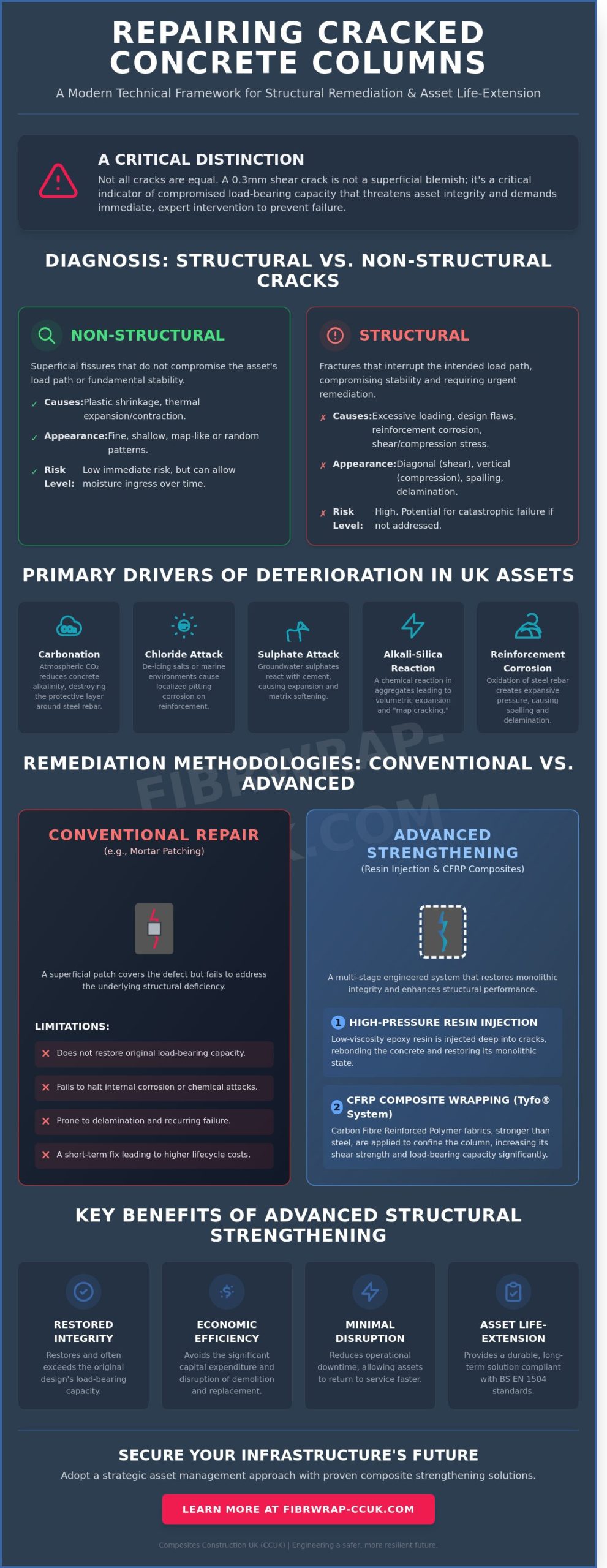
Distinguishing between types of distress is essential for risk mitigation. Non-structural cracks, such as those caused by plastic shrinkage or thermal expansion, usually present as fine, shallow patterns that don’t immediately threaten the asset. Conversely, structural cracks demand immediate remediation and specialized how to repair cracked concrete columns protocols to prevent catastrophic failure. Shear cracks often manifest diagonally at a 45-degree angle, indicating a deficiency in transverse reinforcement. Compression cracks appear as vertical fissures or surface spalling, suggesting the column is nearing its ultimate load capacity. Structural cracking is defined as a fracture that interrupts the intended load path and compromises the fundamental stability of the element.
Primary Drivers of Deterioration in UK Assets
The longevity of concrete columns is frequently undermined by chemical and environmental mechanisms specific to the British climate. Carbonation occurs as atmospheric CO2 penetrates the cement matrix, lowering the alkalinity and stripping the protective passivation layer from the steel reinforcement. This process is often accelerated by the various causes of concrete degradation found in dense urban environments. In coastal regions or on highway structures, chloride attack from de-icing salts triggers localized pitting corrosion, leading to expansive pressures that force the concrete to delaminate.
- Sulphate Attack: Groundwater sulphates react with hydrated cement paste, causing expansion and eventual softening of the concrete matrix.
- Alkali-Silica Reaction (ASR): A chemical reaction between highly alkaline cement paste and reactive silica in aggregates, resulting in volumetric expansion and “map cracking.”
- Reinforcement Corrosion: The primary cause of spalling, where the oxidation of steel creates internal pressure exceeding the concrete’s tensile limits.
Addressing these issues requires a strategy focused on structural strengthening and asset life-extension. Utilizing advanced solutions like the Tyfo® system allows engineers to restore integrity through bespoke composite applications. This methodical approach ensures that the remediation doesn’t just mask the symptom but addresses the underlying mechanical failure, providing a permanent solution for the UK’s aging infrastructure.
Diagnostic Procedures for Assessing Column Integrity
Before determining how to repair cracked concrete columns, a comprehensive structural survey is mandatory. This initial audit ensures that the chosen remediation strategy addresses the underlying pathology rather than merely concealing superficial symptoms. Engineers must evaluate original design specifications against contemporary load requirements, particularly where changes in building use or increased traffic volumes have occurred since the original construction. Identifying the root cause, whether it’s carbonation-induced corrosion or chloride ingress, is critical to preventing recurring defects. Empirical data collected during this phase provides the technical justification for the subsequent ACI Concrete Repair Guide compliant methodology, ensuring the proposed solution meets BS EN 1504 standards.
Non-Destructive Testing (NDT) and Material Analysis
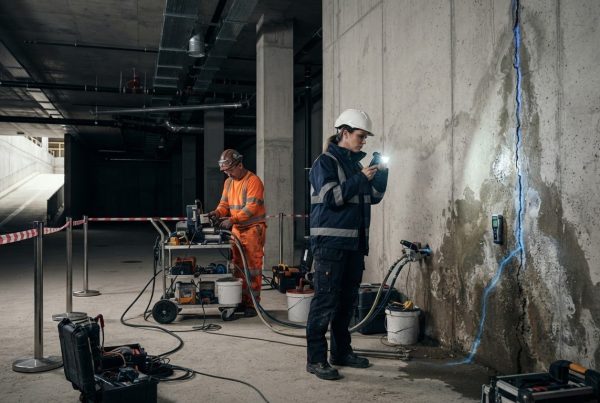
Precision in structural assessment is achieved through several NDT protocols. Covermeter surveys are utilised to determine the exact depth and condition of reinforcement bars, ensuring they meet the 40mm to 50mm minimums often required in aggressive UK environments. Half-cell potential testing provides a quantitative assessment of active corrosion risks by measuring the electrical potential between the steel and the concrete surface. Additionally, Ultrasonic Pulse Velocity (UPV) measurements allow technicians to detect internal voids, honeycombing, or delamination that isn’t visible to the naked eye. These data points are essential for designing a bespoke Tyfo® system application that targets specific zones of weakness.
Determining Residual Load-Bearing Capacity
When evaluating how to repair cracked concrete columns, engineers must quantify the exact degree of structural decline. Calculations are performed to account for cross-sectional loss caused by spalling or advanced corrosion; a loss of 20% in steel area can necessitate immediate intervention. Particular attention is paid to “necking” in the reinforcement; this reduction in the steel’s diameter significantly lowers the column’s safety factor and ductility. Structural modelling is then employed to simulate the column’s performance under peak loads, identifying whether the asset requires standard repair or advanced structural strengthening to regain its integrity. This methodical approach ensures that the life-extension of the asset is grounded in engineering rigour and proven results, providing long-term security for infrastructure owners.
Comparing Conventional and Advanced Repair Methodologies
Selecting the appropriate methodology for structural remediation depends on a precise analysis of the asset’s remaining service life and the required load-bearing capacity. Traditional “patch and paint” repairs often fail to address the underlying causes of deterioration; this leads to recurring maintenance costs that can exceed the initial repair value by 300% over a ten-year cycle. For high-consequence assets, the selection of a repair system is governed by its ability to provide measurable structural gain rather than simple surface restoration. The Engineered Process for Structural Column Remediation outlines that the primary objective must be the restoration of structural integrity. Determining how to repair cracked concrete columns effectively involves weighing the immediate capital expenditure against the long-term durability and safety of the intervention.
Resin Injection and Mortar Remediation
Structural integrity is often restored through the targeted use of epoxy resins. Low-viscosity resins are utilised for gravity-fed or low-pressure injection into hairline cracks to ensure deep penetration, while high-modulus resins are reserved for wider apertures where structural bonding is critical for restoring monolithic behaviour. To source specialist bonding agents and professional application equipment for these technical requirements, learn more about Bondrite Adhesives Ltd.
CFRP Strengthening and the Tyfo® Fibrwrap® System
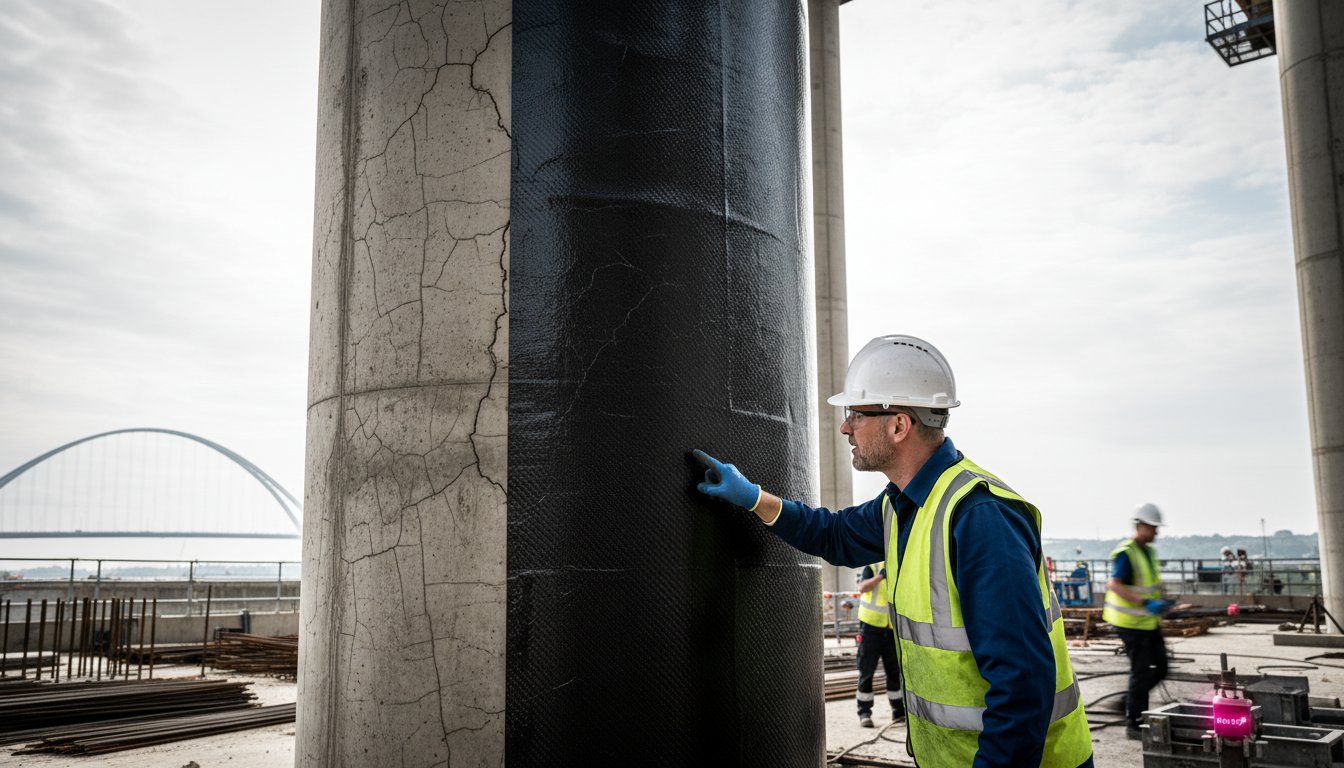
The introduction of Carbon Fibre Reinforced Polymer (CFRP) has fundamentally changed the approach to column remediation. By applying the Tyfo® Fibrwrap® system, a “confinement” effect is created that significantly enhances the axial and shear strength of the concrete member. This system effectively wraps the column in a high-strength composite jacket that resists lateral expansion under load. Unlike traditional steel jacketing, which is heavy and requires extensive mechanical fixing, CFRP is lightweight and entirely non-corrosive. It’s particularly effective for seismic and blast mitigation, where the ductility of the column is paramount. Installation speeds are often 50% faster than steel alternatives, which significantly reduces site downtime for critical UK infrastructure projects. When considering how to repair cracked concrete columns in high-traffic or industrial environments, the minimal profile of CFRP ensures that the original architectural dimensions are maintained without sacrificing performance.
- Weight: CFRP adds negligible dead load compared to 100kg+ steel plates.
- Corrosion: Composite materials are immune to the carbonation and chloride attacks that plague steel.
- Versatility: Bespoke wrap configurations allow for the strengthening of circular, square, and rectangular profiles.
The Engineered Process for Structural Column Remediation
The remediation of load-bearing elements requires a methodical sequence to ensure the restoration of structural capacity. Before any physical intervention begins, temporary propping or shoring must be installed to support the dead and live loads currently carried by the column. This phase is critical; it ensures that the structural integrity isn’t compromised while the existing concrete is being treated. Engineers must calculate these temporary loads precisely, often adhering to BS 5975:2019 standards for falsework. Achieving a high-quality bond between the original substrate and the remedial materials is the primary objective of this phase. The methodology provides a clear framework for how to repair cracked concrete columns while maintaining operational continuity within the facility.
Substrate Preparation and Reinforcement Treatment
Effective repair begins with the mechanical removal of all carbonated or chloride-contaminated concrete. Technicians utilize high-pressure water jetting or pneumatic tools to expose a sound, aggregate-interlocked surface. Any exposed steel reinforcement undergoes abrasive blasting to achieve an SA 2.5 cleanliness standard, ensuring all oxidation is eliminated. Following this, a zinc-rich epoxy primer or a migratory corrosion inhibitor is applied to the rebar. This creates a sacrificial layer that prevents future galvanic corrosion, which is a common cause of recurring cracks. When considering how to repair cracked concrete columns, these preparatory steps are non-negotiable for long-term durability and the prevention of latent defects.
Application of Tyfo® Fibrwrap® Composite Systems
The installation of the Tyfo® system involves the saturation of carbon fibre fabrics with bespoke, high-performance epoxy resins. This process, often performed using a mechanical saturator, ensures a uniform resin-to-fibre ratio, which is vital for achieving the designed tensile strength. The fabrics are then applied using precision wrapping techniques, where fibre orientation is strictly controlled to meet the specific confinement requirements of the column. Once the composite has cured under controlled temperature conditions, a protective top-coat is applied. This coating provides essential resistance against UV radiation and can be specified to meet stringent UK fire safety regulations. This comprehensive approach to structural strengthening ensures that the asset’s life is extended without the need for total replacement.
For expert guidance on your next infrastructure project, consult with our engineering team today.
Strategic Asset Management: The Case for Structural Strengthening
Asset managers often perceive structural deterioration as a series of isolated failures rather than a systemic challenge to be managed through life-extension strategies. Understanding how to repair cracked concrete columns through the lens of strategic asset management allows for a transition from reactive maintenance to proactive structural remediation. This shift isn’t merely technical; it’s a financial imperative. The economic argument for structural strengthening is compelling. Demolition and reconstruction of a typical reinforced concrete bridge or commercial column network can exceed the cost of composite remediation by over 60% when accounting for material disposal, site preparation, and new construction materials.
Sustainability plays an increasingly central role in UK infrastructure projects. The construction industry is under significant pressure to meet Net Zero targets, and the embodied carbon associated with new concrete production remains a primary hurdle. By opting for structural strengthening over demolition, engineers significantly reduce the carbon footprint of a project. According to data from the Global Cement and Concrete Association, cement production accounts for approximately 8% of global CO2 emissions. Retaining existing structural elements through advanced repair techniques directly aligns with the principles of the circular economy, preserving the energy and materials already invested in the built environment.
Extending Asset Life-Cycles via Advanced Composites
The application of Carbon Fibre Reinforced Polymers (CFRP) represents a paradigm shift in structural remediation. These materials add decades of service life to bridges, multi-storey car parks, and industrial facilities without the weight penalties or corrosion risks associated with traditional steel jacketing. Operational downtime is minimized because CFRP systems are lightweight and require no heavy machinery for installation. This is critical in commercial environments where a single day of closure can result in substantial revenue loss for a facility. Beyond simple repair, these systems future-proof structures, allowing them to withstand the increased load demands required by modern traffic or updated building codes. The high strength-to-weight ratio of carbon fibre ensures that the original footprint of the column is maintained, which is vital in space-constrained urban environments.
Selecting a Specialist Engineering Partner
Successful remediation requires a rigorous approach that begins with bespoke design and structural feasibility studies to ensure the chosen solution addresses the root cause of failure. It’s not enough to simply apply a patch; the solution must be engineered to restore or enhance the structural integrity of the entire asset. Asset managers must verify that installers are certified for proprietary systems, such as the Tyfo® Fibrwrap® range, to guarantee the long-term performance of the composite. Selecting a partner with a proven track record in the UK market ensures compliance with local safety standards and engineering regulations. For those seeking professional guidance on the most effective remediation strategy, you should Consult with Composites Construction UK for a structural assessment to determine the optimal path for asset life-extension. Identifying the correct methodology for how to repair cracked concrete columns early in the deterioration cycle prevents localized damage from escalating into a catastrophic structural failure.
Securing the Future of UK Structural Infrastructure
Effective structural remediation requires more than surface-level patching; it demands a rigorous diagnostic approach to identify underlying causes like carbonation or chloride ingress. Understanding how to repair cracked concrete columns involves transitioning from conventional grout injection to high-performance composite solutions that restore load-bearing capacity. By prioritizing carbon fibre reinforced polymers (CFRP), asset managers achieve long-term durability while adhering to 100% of stringent UK safety standards. This shift from reactive maintenance to strategic asset management ensures that vital structures remain operational for decades to come.
Composites Construction UK serves as the exclusive UK licensee for Tyfo® Fibrwrap® systems, providing access to internationally recognized material technology that’s been proven in seismic and high-load environments. Our specialist engineering team brings decades of composite experience to every project, ensuring that bespoke structural strengthening designs are executed with technical precision. We’ve delivered critical remediation works across major UK infrastructure networks, focusing on extending the operational lifespan of essential assets through science-led engineering and empirical performance data.
Partner with Composites Construction UK for Expert Structural Strengthening and Repair
Ensuring the future stability of your structure starts with a commitment to proven engineering excellence.
Frequently Asked Questions
Can cracked concrete columns be repaired without replacement?
Structural remediation allows for the restoration of compromised elements without the necessity of full demolition and replacement. By utilizing advanced composite materials such as the Tyfo® system, the service life of a column is often extended by 30 to 50 years. This approach is effective for addressing issues like carbonation or chloride-induced corrosion, which are common in UK infrastructure built between 1960 and 1980. It’s a sustainable method for long-term asset life-extension.
What is the difference between epoxy injection and CFRP wrapping?
Epoxy injection is a method used to seal internal fissures and restore the monolithic state of the concrete, whereas CFRP (Carbon Fibre Reinforced Polymer) wrapping provides external confinement and tensile reinforcement. While epoxy addresses the symptoms of cracking, CFRP wrapping acts as a comprehensive structural strengthening solution that enhances the overall load-bearing capacity. These techniques are frequently used in tandem to ensure both the internal and external integrity of the structural member.
How long does a carbon fibre column repair typically last?
A professionally installed CFRP repair using the Tyfo® system is designed to have a design life exceeding 50 years, mirroring the expected lifespan of the original structure. The durability of these materials is documented in technical standards such as ACI 440.2R, which outlines the performance of composite systems in varied environmental conditions. Because CFRP is non-corrosive, it eliminates the risk of future spalling caused by oxidising internal steel reinforcement, ensuring permanent stability.
Is it necessary to prop a column during the repair process?
Propping is required during the structural remediation process to relieve the dead load from the column while repairs are executed. This ensures that the new reinforcement materials, such as carbon fibre wraps, are engaged as part of the load-sharing mechanism once the temporary supports are removed. Failure to prop means the repair only carries future live loads rather than contributing to the existing structural equilibrium. It’s a critical safety step for engineering precision.
How much does it cost to repair a cracked structural column in the UK?
The cost of structural remediation varies based on the extent of the damage and the required strengthening capacity. According to industry data from the Spon’s Civil Engineering and Highway Works Price Book 2024, specialized concrete repairs range from £500 to over £5,000 per linear metre depending on complexity. These figures exclude site-specific costs like temporary works, access requirements, and the specific volume of Tyfo® composite materials needed for the bespoke engineering design.
What are the signs that a concrete column is nearing structural failure?
Critical indicators of impending failure include shear cracks wider than 0.3mm, significant concrete spalling that exposes corroded reinforcement, and visible lateral deflection. When determining how to repair cracked concrete columns, engineers look for diagonal 45-degree cracking which often signals a severe shear deficiency. The presence of rust staining on the surface suggests that the internal steel has lost its passivity, leading to a 10% to 15% reduction in the cross-sectional area.
How does CFRP strengthening improve the load capacity of a column?
CFRP strengthening improves load capacity by providing high-tensile confinement that restricts the lateral expansion of the concrete under axial compression. This triaxial stress state can increase the compressive strength of the concrete core by 20% to 40% depending on the specific wrap configuration. By applying the Tyfo® system, the column’s ductility is also enhanced, which is vital for seismic retrofitting and meeting modern safety standards in high-density UK urban environments.
Does concrete column repair require building regulation approval?
Structural repairs to load-bearing elements must comply with Part A (Structure) of the Building Regulations 2010 in England and Wales. When considering how to repair cracked concrete columns in a commercial or residential setting, a chartered structural engineer must certify that the proposed solution meets current safety factors. This professional oversight ensures that the structural strengthening measures are sufficient to maintain the building’s stability and satisfy the legal requirements of the local authority.