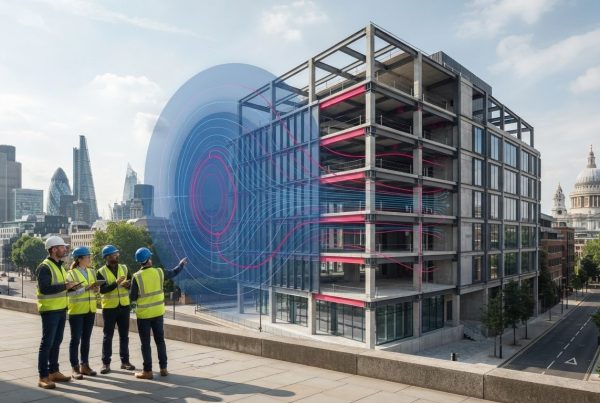

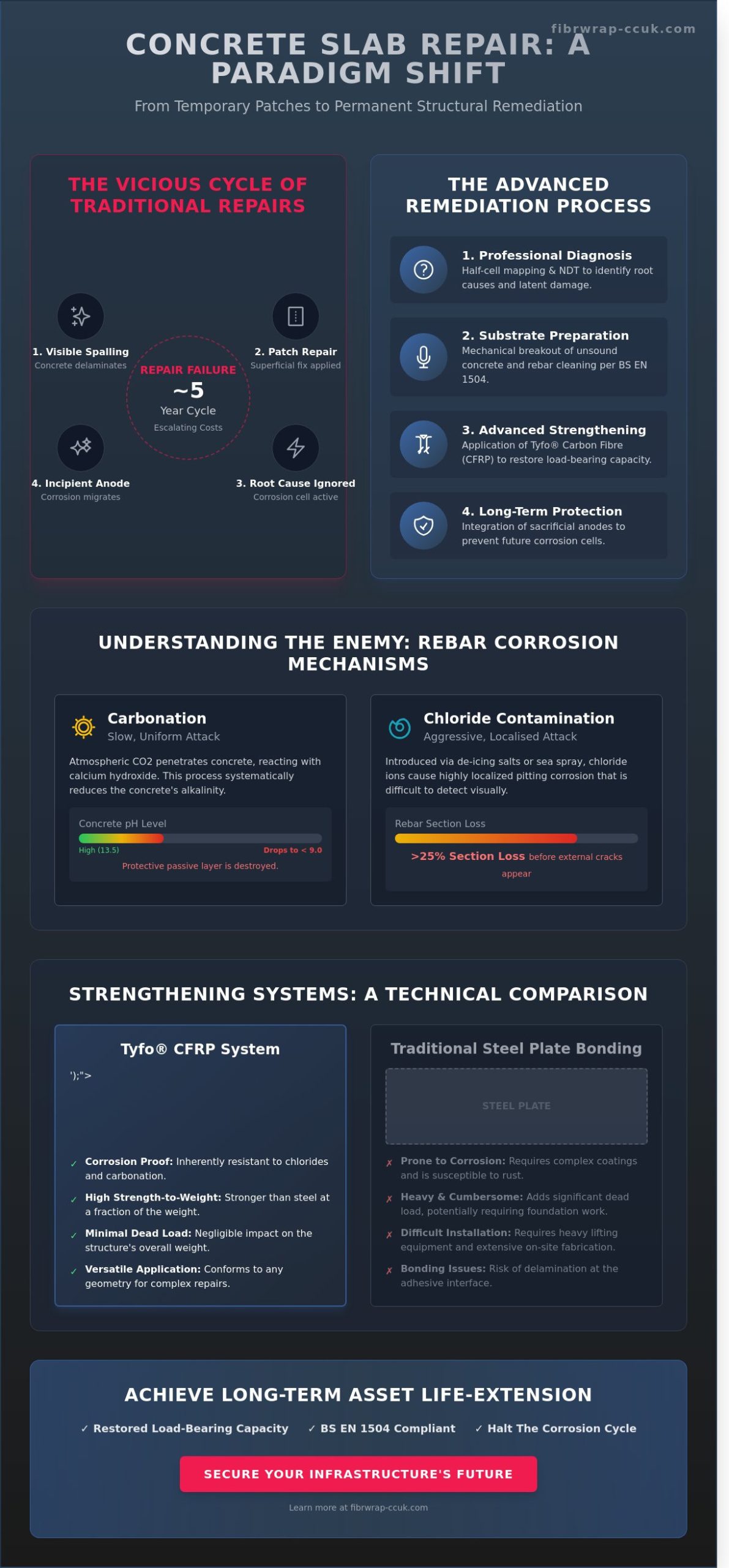
Traditional patch repairs for reinforced concrete frequently fail within a five-year cycle because they treat the visible spalling while neglecting the underlying electrochemical corrosion cell. For asset managers, the sight of recurring delamination on a slab previously “repaired” isn’t merely an aesthetic concern; it’s a signal of ongoing structural section loss that threatens the long-term safety of the infrastructure. When addressing corroded rebar in concrete slab repair, a failure to account for the chloride-induced degradation of the steel reinforcement leads to a cycle of escalating maintenance costs that industry data indicates can exceed £50,000 for mid-sized UK facilities.
It’s recognized that a permanent solution requires a shift from superficial patching to advanced structural remediation. This guide provides a comprehensive framework for diagnosing reinforcement loss and implementing the Tyfo® system to ensure long-term asset life-extension. We’ll examine the technical methodologies for achieving compliance with BS EN 1504 standards through carbon fibre reinforced polymers, providing a roadmap for structural strengthening that restores load-bearing capacity with minimal impact on the slab’s dead-weight.
Key Takeaways
- Identify the specific electrochemical mechanisms of structural deterioration by employing professional diagnostic protocols, including half-cell potential mapping and non-destructive testing (NDT) methods.
- Understand the critical requirements for mechanical breakout and temporary propping to maintain structural integrity during the remediation of delaminated concrete substrates.
- Evaluate the technical advantages of Carbon Fibre Reinforced Polymer (CFRP) systems over traditional steel plate bonding, specifically when addressing corroded rebar in concrete slab repair where reinforcement section loss has occurred.
- Secure long-term asset life-extension by integrating cathodic protection and sacrificial anodes to mitigate the risk of the incipient anode effect in chloride-contaminated environments.
The Mechanism of Rebar Corrosion in Structural Concrete Slabs
Understanding the degradation of reinforced concrete requires a rigorous analysis of the electrochemical environment within the cementitious matrix. Under normal conditions, the high alkalinity of concrete, typically maintaining a pH between 12.5 and 13.5, facilitates the formation of a microscopic gamma-ferric oxide layer on the steel surface. This passive film acts as a barrier that prevents oxidation. However, the ingress of moisture and oxygen initiates a corrosion cell when this passivity is compromised. The Mechanism of Rebar Corrosion involves the flow of electrons from the anode to the cathode, facilitated by the concrete acting as an electrolyte. When the protective layer fails, the iron atoms lose electrons and react with the surrounding environment to form rust.
As the steel oxidises, the resulting corrosion products occupy a volume significantly greater than the original metal, often expanding by a factor of six to ten. This expansion generates internal radial pressures that quickly exceed the inherent tensile strength of the concrete, which typically ranges between 2 MPa and 5 MPa. Consequently, internal stresses lead to delamination and the eventual ejection of the concrete cover, a process known as spalling. Engineering teams must recognise that identifying corroded rebar in concrete slab repair projects early is vital for maintaining structural integrity. Early indicators include:
- Ferrous oxide staining appearing as brown or orange streaks on the slab soffit.
- Hairline longitudinal cracking that follows the exact path of the underlying reinforcement.
- A distinct hollow resonance when the surface is subjected to hammer sounding or chain dragging.
- Visible delamination where the concrete cover has begun to separate from the main structural body.
Carbonation and the Loss of Passivity
Atmospheric carbon dioxide penetrates the concrete pores and reacts with calcium hydroxide to form calcium carbonate. This chemical reaction systematically reduces the alkalinity of the pore solution to a pH level below 9.0, where the protective passive layer can’t be maintained. The rate of this carbonation front is heavily influenced by the concrete cover depth; many UK structures built between 1950 and 1980 exhibit inadequate cover by modern standards. This makes carbonation a primary driver for structural remediation in older British infrastructure, especially in urban environments with high CO2 concentrations.
Chloride Contamination and Pitting Corrosion
Chloride ions, introduced via de-icing salts on UK highways or sea spray in coastal regions, represent a more aggressive threat to slab integrity. Unlike carbonation, which affects large areas uniformly, chlorides cause highly localised pitting corrosion. These pits can significantly reduce the cross-sectional area of a rebar element by 25% or more before any external cracking is visible. The presence of chloride-induced corroded rebar in concrete slab repair scenarios requires immediate intervention because it compromises the load-bearing capacity of the slab without providing the usual visual warnings associated with general oxidation.
Professional Diagnostic Protocols for Slab Assessment
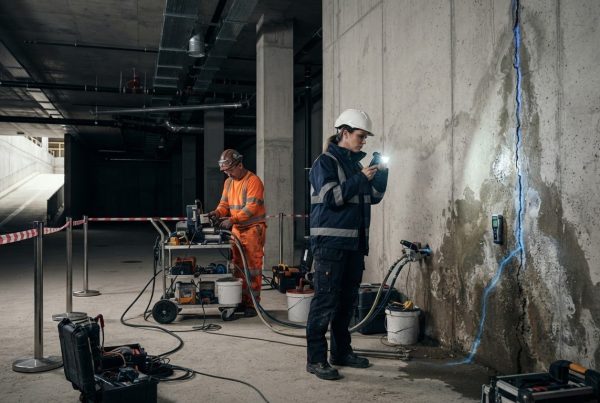
Before any specification for corroded rebar in concrete slab repair is finalised, a rigorous structural survey is mandatory. This process ensures that the underlying cause of deterioration is addressed rather than merely the symptomatic spalling. A failure to identify the latent extent of corrosion often leads to the “incipient anode” effect, where new repairs inadvertently accelerate corrosion in adjacent, untreated zones. Professional assessment protocols are designed to mitigate this risk by providing a data-driven map of the slab’s internal health.
A comprehensive survey typically incorporates the following diagnostic stages:
- Cover meter surveys to map reinforcement depth and verify compliance with original design specifications.
- Half-cell potential mapping to identify electrochemical activity before physical damage occurs.
- Chloride ion analysis from drilled dust samples to determine the risk of pitting corrosion.
- Visual inspection and measurement of exposed rebar to quantify actual section loss.
Non-destructive testing (NDT) provides the initial layer of intelligence. Cover meter surveys establish the depth of concrete cover, which is a primary factor in carbonation-induced corrosion. Simultaneously, electrochemical analysis is supported by research into FHWA Corrosion Control Methods, which details how these mechanisms affect long-term asset life. To determine the remaining structural capacity, engineers must calculate the section loss of the reinforcement. For example, if a 16mm diameter bar has been reduced to 12mm through oxidation, the resulting 43% reduction in cross-sectional area must be factored into the slab’s load-bearing calculations to ensure the integrity of the structure remains within safe limits.
Half-Cell Potential and Resistivity Testing
Electrochemical measurements are used to locate active corrosion zones before they manifest as visible cracks or spalls. By measuring the potential difference between the rebar and a reference electrode, engineers can map the probability of active corrosion across the entire slab surface. Resistivity data helps predict the future rate of corrosion by measuring the concrete’s moisture content and ion mobility. This mapping defines the true extent of the repair zone; it’s common to find that the area requiring intervention is 35% larger than the visible damage suggests.
Carbonation Depth and Pull-Off Testing
The application of a phenolphthalein indicator to fresh concrete breaks allows for the precise measurement of the carbonation front. When the pH of the concrete drops below 9.0, the protective passive layer on the steel is compromised. Pull-off tests, conducted in accordance with BS EN 1542, assess the tensile strength of the concrete substrate. This data is critical to verify if the concrete can sustain the bond of advanced carbon fibre reinforced polymers, such as the Tyfo® system, which is frequently used in structural strengthening projects to extend the service life of critical infrastructure.
The Structural Remediation Process: A Step-by-Step Guide
The execution of a successful corroded rebar in concrete slab repair requires a disciplined, multi-stage engineering approach. Before any physical intervention begins, a comprehensive temporary works design’s implemented to ensure the structural integrity of the slab’s maintained throughout the project. Propping is installed according to precise load-bearing calculations, often following the BS 5975:2019 code of practice. This stage is vital to mitigate risks when the load-bearing capacity of the concrete’s temporarily reduced during the breakout phase. It’s a fundamental safety requirement that precedes any mechanical removal of material.
Breakout and Substrate Preparation
Mechanical breakout methods are used to remove delaminated concrete until a sound, non-carbonated substrate’s reached. A ‘square-cut’ technique is strictly applied to the repair perimeters to avoid feather-edging, which frequently leads to delamination and future failure in corroded rebar in concrete slab repair projects. To facilitate a robust mechanical bond, the concrete’s removed to expose at least 20mm behind the reinforcement bars. This clearance allows the repair mortar to fully encapsulate the steel, ensuring the repair isn’t just a surface patch but a structural integration. Surface cleaning’s achieved through high-pressure water jetting at 10,000 psi or grit blasting to eliminate carbonated material and chlorides.
Steel Treatment and Priming
Reinforcement preparation involves abrasive blasting to achieve a ‘near-white’ metal finish, specified as the SA 2.5 standard. Zinc-rich epoxy primers are applied to provide immediate cathodic protection, acting as a sacrificial anode to prevent further oxidation. Cementitious bonding agents are then utilized to ensure monolithic behaviour between the legacy concrete and the new repair mortars. A passivating primer is a chemical barrier that restores the alkaline environment around the steel. To enhance asset life-extension, migratory corrosion inhibitors are applied to the substrate, penetrating the concrete to protect reinforcement beyond the immediate repair zone. This methodical process provides the foundation for subsequent structural strengthening using advanced materials like the Tyfo® system, ensuring the long-term integrity of the infrastructure.
Advanced Strengthening with Tyfo® Fibrwrap® Systems
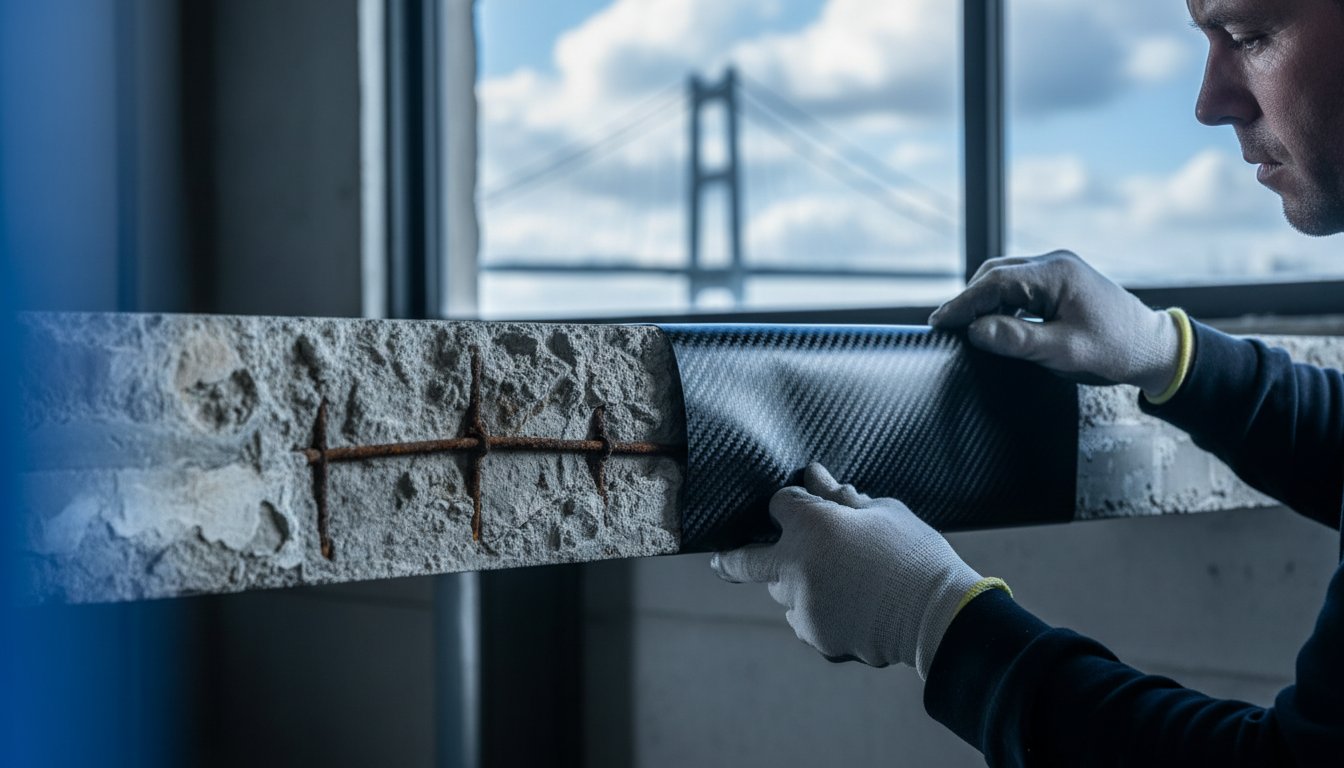
When addressing corroded rebar in concrete slab repair, engineers must determine if the damage is purely aesthetic or fundamentally structural. If the oxidation process has resulted in significant section loss, typically exceeding 10% of the original bar diameter, a standard mortar patch cannot restore the lost tensile capacity. The Tyfo® Fibrwrap® system is deployed in these scenarios to provide supplemental reinforcement that compensates for the compromised internal steel. This approach ensures the slab meets its original design loads or accommodates increased service requirements without the need for invasive reconstruction.
The design process for these composite systems is entirely bespoke. Each layer of Carbon Fibre Reinforced Polymer (CFRP) is calculated based on the specific deficit in kilonewtons (kN) identified during the structural assessment. By applying high-modulus carbon fibres in the direction of the primary tensile stresses, the structural integrity of the slab is reinstated. This method allows for asset life-extension while maintaining the original architectural profile of the structure.
CFRP vs. Steel Plate Strengthening
Traditional methods often involved bonding heavy steel plates to the underside of slabs. However, CFRP offers a superior strength-to-weight ratio that simplifies the logistics of overhead repairs. Steel plates are susceptible to the same electrochemical corrosion that destroyed the original rebar, whereas Tyfo® composites are chemically inert and immune to chloride attack. Installation is significantly faster; CFRP materials are lightweight enough to be handled without heavy lifting equipment or complex propping. This reduces asset downtime, which is a critical metric for commercial and infrastructure projects across the United Kingdom.
The Tyfo® Fibrwrap® Installation Sequence
Success in structural remediation depends on the precision of the application process. The sequence follows a disciplined engineering protocol:
- Surface Preparation: The concrete substrate is ground to a CSP 3 or 4 profile to ensure a mechanical bond. Any voids or pores are filled with structural epoxy resins to create a level interface.
- Lamination: The carbon fibre fabric is saturated with Tyfo® S Epoxy. This creates a high-strength laminate that is hand-applied to the prepared slab.
- Quality Control: We implement rigorous testing to validate the installation. This includes the creation of witness panels for laboratory analysis and performing on-site pull-off tests to confirm the bond strength meets the required 1.5 MPa threshold.
Our methodology prioritises safety and verified performance. We don’t guess the outcome; we engineer it through empirical data and proven material science.
Long-Term Protection and Asset Life Extension
Successful structural remediation doesn’t end with the physical patch; it requires a strategy to address the electrochemical imbalances that follow a corroded rebar in concrete slab repair. Once the contaminated concrete is removed and the steel is cleaned, the surrounding parent concrete remains a potential risk. This is particularly true in high-risk chloride environments like coastal infrastructure or car parks where de-icing salts are prevalent. Without secondary protection, the difference in electrical potential between the new repair mortar and the original concrete can trigger the incipient anode effect. This phenomenon accelerates corrosion in the areas immediately adjacent to the repair zone, often leading to secondary spalling within 24 to 36 months.
Asset life-extension is achieved by shifting from reactive maintenance to a proactive preservation model. This involves a combination of electrochemical barriers and surface treatments designed to isolate the reinforcement from environmental catalysts. For critical assets, establishing a structural health monitoring (SHM) regime is recommended. These systems utilise embedded sensors to track corrosion currents and moisture ingress in real-time. By monitoring these variables, asset managers can verify the performance of the repair and identify potential issues before they manifest as visible cracks.
Sacrificial Anodes and Electrochemical Protection
Discrete galvanised anodes are a standard requirement for preventing the halo effect in concrete repairs. These units consist of a zinc core encased in a highly alkaline mortar shell. When tied to the cleaned reinforcement, the science of the galvanic series takes over. Zinc is more chemically active than steel; it becomes the anode and corrodes preferentially. This sacrificial process generates a small electrical current that keeps the steel reinforcement in a cathodic state, effectively halting the oxidation process. While passive sacrificial anodes require replacement once the zinc is consumed, typically every 10 to 20 years, they offer a low-maintenance alternative to impressed current cathodic protection (ICCP) systems, which require an external power source and regular electrical testing to remain effective.
Anti-Carbonation and Hydrophobic Coatings
Protective coatings represent the final line of defence for the concrete matrix. Engineers specify anti-carbonation paints to block the ingress of carbon dioxide, which otherwise reacts with calcium hydroxide to lower the concrete’s pH. It’s vital to select breathable coatings. These products allow internal moisture vapour to escape while preventing liquid water from entering. For horizontal slabs exposed to the elements, silane-based water repellents are often applied. These silanes penetrate the surface pores to create a hydrophobic lining. This treatment can reduce the intake of water-borne chlorides by more than 90%, significantly extending the time until the next corroded rebar in concrete slab repair is required.
The principle of proactive surface protection is not limited to reinforced concrete; it is equally vital for maintaining the longevity of decorative outdoor areas. To support property owners, Regal Group offers comprehensive guidance on how to clean and maintain resin-based surfacing, ensuring these horizontal assets remain resilient against environmental stressors.
To ensure the longevity of your infrastructure, Contact Composites Construction UK for a bespoke structural survey and design solution. Our team provides the technical expertise necessary to implement comprehensive structural strengthening and protection systems tailored to the specific demands of your asset.
Securing Structural Integrity through Advanced Remediation
Addressing the degradation of reinforced concrete requires a methodical approach that prioritizes empirical data over surface-level assessments. Effective corroded rebar in concrete slab repair starts with rigorous diagnostic protocols to quantify chloride levels and carbonation depth before any physical intervention occurs. By integrating advanced Carbon Fibre Reinforced Polymer (CFRP) technologies, such as the Tyfo® Fibrwrap® system, load-bearing capacities are restored and significant asset life-extension is achieved. This method offers a sustainable alternative to traditional demolition, aligning with modern UK construction standards and environmental mandates.
Composites Construction UK serves as the exclusive UK licensee for Tyfo® Fibrwrap® systems, bringing decades of global engineering expertise to local infrastructure challenges. Our team provides comprehensive asset inspection and diagnostic services, ensuring that every bespoke design meets the exacting requirements of complex structural remediation. Whether managing a single slab or a large-scale industrial facility, the focus remains on delivering long-term security through proven material science. It’s a commitment to engineering excellence that ensures the continued safety of the built environment.
Request a Technical Consultation for Your Structural Repair Project to discuss your specific engineering requirements with our specialists. We’re ready to help you safeguard your assets for the decades ahead.
Frequently Asked Questions
How do you know if corroded rebar has compromised the structural integrity of a slab?
Structural integrity is deemed compromised when rebar section loss exceeds 20% of the original bar diameter or when delamination covers more than 15% of the total surface area. Engineers utilize non-destructive testing, such as half-cell potential mapping or ultrasonic pulse velocity, to quantify the extent of internal degradation. If the cross-sectional area of the reinforcement is reduced, the slab’s load-bearing capacity no longer meets the original design specifications outlined in BS EN 1992.
Can you repair corroded rebar without breaking out the concrete?
A permanent corroded rebar in concrete slab repair requires the removal of carbonated or chloride-contaminated concrete to expose the steel reinforcement for treatment. While surface-applied corrosion inhibitors offer some protection, they don’t address the underlying oxidation of the steel. The breaking out process ensures all corrosion products are removed and the rebar is treated with a zinc-rich primer, preventing the incipient anode effect from damaging adjacent areas.
What is the difference between a cosmetic concrete repair and a structural remediation?
Cosmetic repairs involve the application of non-structural mortars to fill shallow voids or improve the visual appearance of the concrete surface. Structural remediation utilizes high-strength materials like the Tyfo® system to restore or enhance the load-carrying capacity of the element. These structural solutions are engineered to handle specific 50-year design life requirements, ensuring the asset remains safe for its intended occupancy or industrial traffic load under UK building regulations.
How long does a CFRP slab strengthening repair typically last?
The Tyfo® Fibrwrap® system is engineered for a service life exceeding 50 years when installed according to manufacturer specifications and protected from direct UV degradation. This longevity is supported by accelerated ageing tests that demonstrate minimal loss of tensile properties even after 10,000 hours of environmental exposure. Ongoing maintenance typically involves simple visual inspections every 5 to 10 years to ensure the protective topcoat remains intact against environmental stressors.
Is it necessary to use cathodic protection alongside patch repairs?
Cathodic protection is necessary when chloride levels exceed 0.4% by weight of cement to prevent the continued electrochemical corrosion of the steel. In environments with high chloride concentrations, such as coastal structures or car parks, patch repairs alone often fail to halt the corrosion process. Installing sacrificial anodes within the repair zone provides a preferential site for corrosion, protecting the remaining steel reinforcement as governed by BS EN ISO 12696:2022 standards.
What are the common causes of repair failure in reinforced concrete slabs?
The most frequent cause of repair failure is the incipient anode effect, which accounts for approximately 50% of premature patch degradation in contaminated structures. Failure occurs when the repair area creates a high electrochemical potential difference between the new patch and the original concrete. Additionally, poor substrate preparation, where the concrete’s pull-off strength is less than 1.5 N/mm², results in debonding and subsequent moisture ingress that restarts the oxidation cycle within 2 to 5 years.
How does the Tyfo® Fibrwrap® system compare to traditional concrete jacketing?
The Tyfo® Fibrwrap® system provides a high strength-to-weight ratio that adds negligible mass to the structure compared to the 100mm thickness required for concrete jacketing. Traditional jacketing increases the dead load of the slab and reduces overhead clearance, which is often problematic in UK basement car parks. This composite solution utilizes advanced carbon fibre reinforced polymers that are only 2mm to 5mm thick, allowing for rapid installation without the need for heavy formwork or extensive curing.