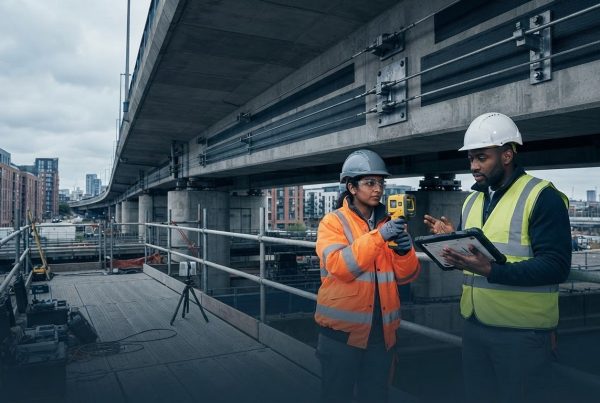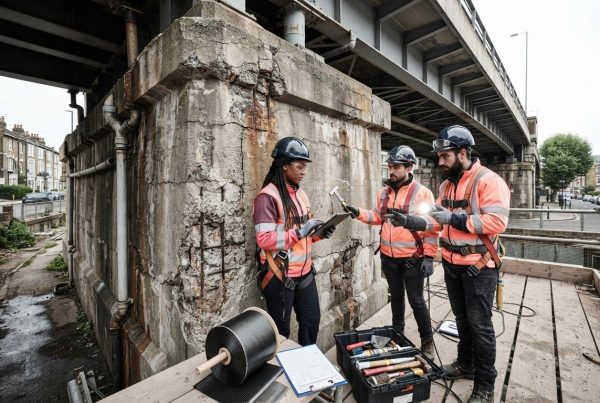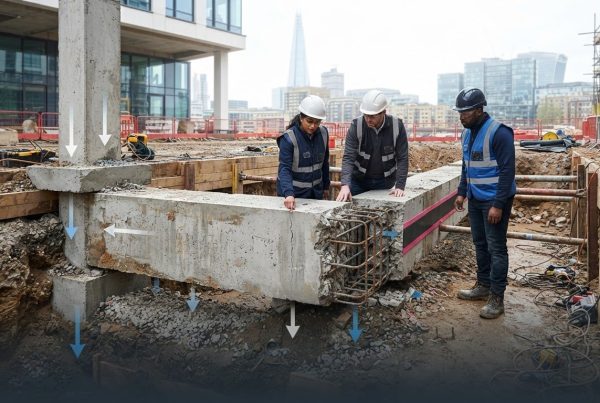


Carbon Fibre Reinforced Polymer (CFRP) possesses a strength-to-weight ratio approximately 10 times greater than structural steel, yet many asset managers still default to traditional patching methods that inevitably fail within a few years. It’s widely understood that recurring concrete degradation and the escalating costs of total asset replacement present significant challenges for those overseeing critical infrastructure. You’re likely seeking a solution that moves beyond temporary fixes to provide genuine, long-term structural security without the prohibitive downtime associated with conventional reconstruction.
This article demonstrates how specialist engineering and advanced composite technologies extend the functional lifespan of critical concrete infrastructure across the UK. By engaging expert concrete repair contractors London based or national, asset controllers can achieve compliance with BS EN 1504 and the rigorous oversight of the Building Safety Regulator. We’ll explore the application of proprietary systems like Tyfo® Fibrwrap®, which facilitate a 60-70% faster installation than traditional methods. This guide outlines a methodical approach to structural life-extension, prioritising empirical evidence and engineering rigour to ensure your assets remain safe, compliant, and operational whilst reducing long-term maintenance expenditure.
Key Takeaways
- Understand the technical drivers of concrete degradation and the necessity of a data-driven structural survey to ensure long-term repair efficacy.
- Evaluate the mechanical advantages of Carbon Fibre Reinforced Polymer (CFRP) systems which provide a superior strength-to-weight ratio compared to traditional steel-based remediation.
- Identify the specific technical competencies required when appointing concrete repair contractors London or national, prioritising those with in-house structural design capabilities.
- Discover how specialist engineering interventions can significantly extend the functional lifespan of critical infrastructure whilst minimising operational downtime and lifecycle costs.
- Ensure all remedial works align with current structural safety standards, including BS EN 1504 and the requirements of the Building Safety Regulator.
The Challenge of Concrete Degradation in Metropolitan Infrastructure
Structural concrete repair is defined as a precise technical intervention designed to restore the mechanical integrity and long-term durability of a structure. It extends far beyond superficial aesthetic remediation; it involves a systematic restoration of the chemical environment necessary to protect internal reinforcement and maintain structural capacity. In high-stress metropolitan environments, infrastructure is subjected to aggressive atmospheric conditions that accelerate Concrete degradation. For asset managers, identifying competent concrete repair contractors London based or national is essential for navigating the complexities of urban decay and ensuring the safety of critical assets.
Common Pathologies in Structural Concrete
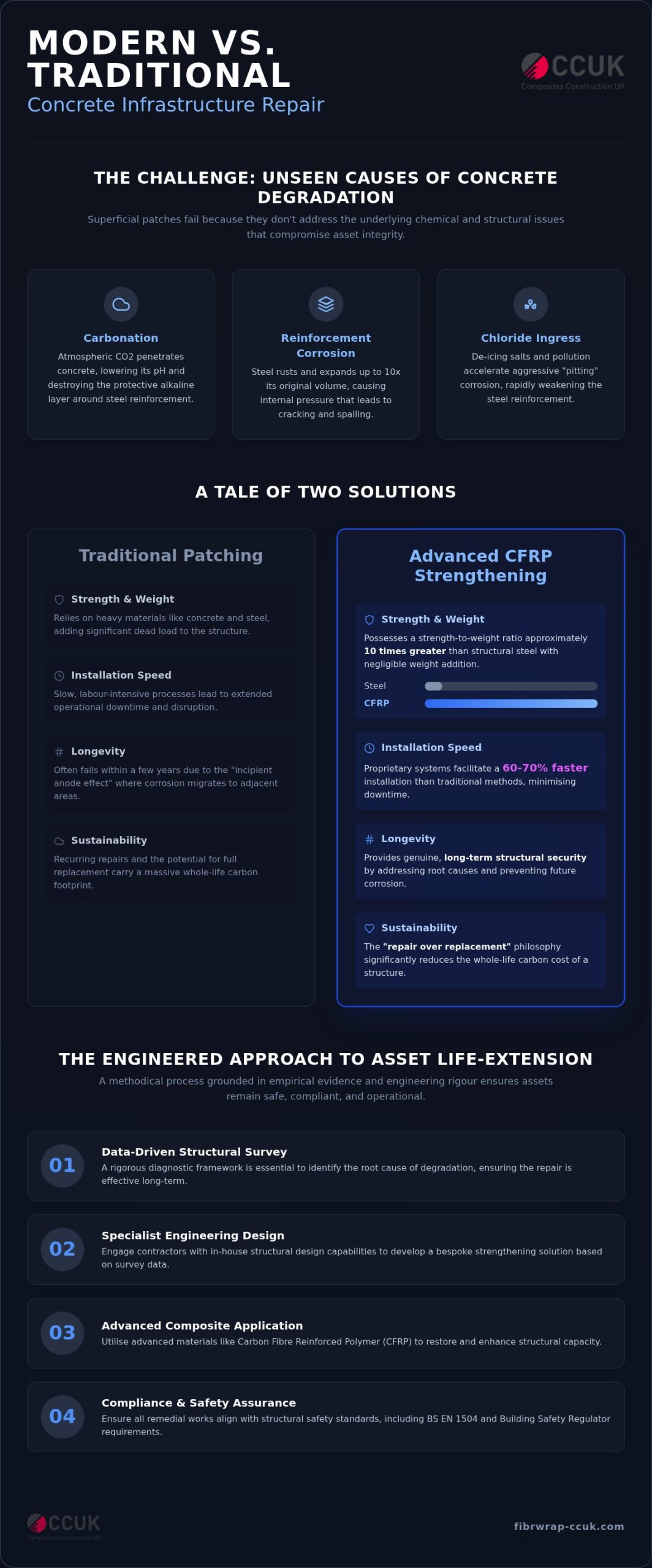
The primary driver of structural failure in reinforced concrete is the corrosion of the internal steel reinforcement. This process is typically initiated by carbonation, where atmospheric carbon dioxide penetrates the concrete’s pores, lowering the pH and destroying the alkaline passivating layer that protects the steel. In urban centres, elevated pollution levels and high concentrations of CO2 significantly accelerate this ingress. Once the steel begins to oxidise, the resulting rust expands to occupy up to ten times its original volume. This internal pressure causes spalling and delamination; these aren’t merely surface defects but clear indicators of compromised structural capacity that require immediate engineering attention.
Chloride ingress represents another significant threat, particularly for infrastructure exposed to de-icing salts or industrial runoff. Chlorides act as a catalyst for “pitting” corrosion, a localized and aggressive form of degradation that can rapidly reduce the cross-sectional area of reinforcement without showing obvious external symptoms. Without a data-driven diagnostic approach, these underlying chemical imbalances remain unaddressed, leading to recurring failures even after visual repairs are completed.
The Sustainability of Asset Life-Extension
Traditional repair methods often fail in metropolitan settings because they rely on localized patching that doesn’t address the underlying electrochemical environment. This frequently results in the “incipient anode effect,” where corrosion simply migrates to the area adjacent to the new repair. Modern engineering prioritises structural life-extension through advanced materials, which aligns with rigorous ESG (Environmental, Social, and Governance) requirements. By opting for sophisticated remediation, asset controllers can significantly reduce the whole-life carbon cost of a structure.
Full demolition and reconstruction carry a massive carbon footprint; the production of cement is one of the most energy-intensive industrial processes globally. Choosing to rehabilitate existing infrastructure is a fundamentally more sustainable path. This “repair over replacement” philosophy transforms the role of concrete repair contractors London from simple maintenance providers into guardians of infrastructure. It’s a strategic shift that ensures essential assets remain functional for decades whilst meeting modern sustainability mandates and reducing overall lifecycle expenditure. For those requiring a detailed technical consultation on these processes, you can contact our engineering team directly.
Diagnostic Procedures for Structural Concrete Assessment
Effective remediation is impossible without a comprehensive understanding of the substrate’s current state. Relying on visual assessments often leads to the failure of repairs within five years, as the underlying chemical drivers remain active. Professional concrete repair contractors London must employ a rigorous, data-driven diagnostic framework to identify the root cause of degradation rather than simply treating visible spalling. This methodology ensures that any specified remedial works are grounded in empirical evidence, providing a predictable outcome for asset controllers. Many concrete repair contractors London prioritise speed over accuracy, but a failure to diagnose root causes invariably leads to project overruns and recurring maintenance cycles.
Non-Destructive and Intrusive Testing Methods
A multi-faceted testing regime is required to map the extent of chemical change within the structure. Carbonation testing, using phenolphthalein indicators, determines the depth at which the concrete’s alkalinity has been compromised, leaving reinforcement vulnerable. For assets in coastal or industrial environments, chloride ion content analysis is vital to quantify the risk of localized pitting corrosion. These findings are supplemented by cover meter surveys to establish reinforcement depth and half-cell potential mapping to identify active corrosion sites before they manifest as cracks. These principles align with established best practices found in the official guide to concrete repair.
Justifying Remedial Works through Engineering Data
Once the chemical profile is established, physical properties must be verified through intrusive sampling to ensure the structure can support its design loads. Core sampling provides a definitive measure of compressive strength, whilst pull-off tests are essential for validating the tensile capacity of the substrate. This data is critical when designing composite strengthening systems, as the bond between the original concrete and the new material must be capable of transferring calculated stresses without delamination.
Structural engineers then interpret this diagnostic data to produce bespoke calculations, ensuring the proposed solution is technically sound and regulatory compliant. For those managing complex infrastructure, commissioning detailed structural surveys and testing is the first step in moving from reactive maintenance to strategic asset life-extension. This rigorous approach differentiates a specialist engineering contractor from a labour-only provider, ensuring that every intervention is both necessary and permanent.
Comparing Traditional Remediation with Advanced CFRP Strengthening
Traditional remediation typically focuses on restoring the alkaline environment and replacing lost concrete volume using polymer-modified mortars. These materials are engineered for low shrinkage and high bond strength, making them suitable for surface restoration and the protection of internal reinforcement. For cracks that haven’t compromised the overall structural capacity, resin injection techniques are employed to seal the substrate against further moisture and chloride ingress. These methods align with the codes of practice established by the Concrete Repair Association, ensuring a baseline of quality in protection. However, when diagnostic testing reveals a significant loss of reinforcement cross-section or a requirement for increased load-bearing capacity, these traditional interventions often prove insufficient.
In contrast, Carbon Fibre Reinforced Polymer (CFRP) strengthening represents a shift from passive protection to active structural enhancement. CFRP systems, such as the Tyfo® Fibrwrap® system, offer a strength-to-weight ratio approximately 10 times greater than that of structural steel. This allows concrete repair contractors London to restore or even exceed the original design strength of a component without the massive weight penalties or geometric changes associated with steel plate bonding or concrete section enlargement. The material’s low profile, typically only a few millimetres thick, ensures that existing clearances and architectural lines remain unaffected, which is particularly critical in dense urban environments where space is at a premium.
The Tyfo® Fibrwrap® Advantage
The Tyfo® Fibrwrap® system is a proprietary composite solution consisting of high-strength fibres saturated with specialised epoxy resins. Unlike generic carbon wraps, it is an engineered system designed for seismic retrofitting, blast mitigation, and structural strengthening of bridges, buildings, and pipelines. Its “wet-lay” application process allows it to be tailored to complex geometries, such as circular columns or irregular beam sections, where traditional rigid materials would fail to provide a uniform bond. This versatility ensures that concrete repair contractors London can address unique structural challenges that standard materials cannot accommodate.
This system’s versatility is matched by its efficiency; CFRP installation is documented to be 60-70% faster than traditional structural repair methods. By reducing the reliance on heavy lifting equipment and extensive temporary works, asset managers can achieve structural life-extension with minimal operational disruption. For a detailed breakdown of the application methodology and performance metrics, refer to the Tyfo® Fibrwrap® installation guide. This engineering-led approach ensures that the rehabilitation is not just a temporary patch but a permanent structural upgrade that significantly lowers the lifecycle cost of the asset.
Criteria for Appointing Concrete Repair Contractors in London and the UK
Selecting concrete repair contractors London requires a rigorous evaluation framework that prioritises engineering depth over simple labour availability. Many firms offer basic cementitious patching, yet few possess the technical infrastructure to manage complex structural life-extension projects. A primary indicator of reliability is the presence of in-house structural design and consultancy capabilities. This ensures that the contractor takes full responsibility for the design-to-delivery cycle. It reduces procurement friction and guarantees that remedial works are grounded in precise engineering calculations rather than generic manufacturer data sheets. Relying on labour-only contractors often introduces significant risks, as they may lack the expertise to adapt to unforeseen structural challenges during the installation phase.
Engineering Competence and Design Responsibility
A specialist contractor should provide bespoke feasibility studies and structural calculations as part of their core offering. This technical oversight is essential when dealing with critical load-bearing elements where the safety of the public and the asset is at stake. Verification of professional indemnity insurance is mandatory; it provides the necessary commercial security for both the design and the subsequent installation. Additionally, the ability to manage complex temporary works and shoring is a vital competency. Without this, the structural integrity of the asset may be compromised during the remediation process itself. A contractor’s ability to provide end-to-end design responsibility ensures that the final solution is both technically sound and fully insured.
Health, Safety, and Regulatory Compliance
Adherence to BS EN 1504 is the fundamental requirement for any concrete repair project in the UK. This standard governs the selection of materials and the execution of repairs, ensuring that the chosen methods are compatible with the existing substrate and intended performance. When evaluating concrete repair contractors London, asset managers must also verify manufacturer-approved installer status for proprietary systems, such as Tyfo® Fibrwrap®. This ensures that the workforce has received specific training in advanced technologies and advanced material science.
High-risk urban sites demand a proven track record in complex infrastructure. A contractor’s history with bridges, pipelines, and industrial facilities serves as a testament to their ability to navigate stringent safety regulations whilst maintaining operational continuity. For those seeking technical guidance on procurement and specification, it’s advisable to contact CCUK for a professional consultation on contractor selection and structural strengthening requirements. This engineering-led approach ensures that your asset remains a safe, functional, and compliant part of the national infrastructure.
CCUK: Specialist Engineering for Critical Asset Rehabilitation
Composites Construction UK (CCUK) operates as a premier specialist engineering contractor, distinguished by a comprehensive “design, supply, and install” service model that addresses the inherent limitations of standard concrete repair contractors London often provides. By maintaining an in-house structural design and consultancy department, the firm ensures that every intervention is tailored to the specific mechanical requirements and environmental stressors of the asset. This integrated approach eliminates the technical fragmentation typically found in large-scale remediation projects, where design and execution are often handled by disconnected entities. It’s this commitment to a single point of responsibility that provides asset controllers with the reassurance of technical success and regulatory compliance.
The firm’s status as the exclusive UK licensee for Tyfo® Fibrwrap® systems is a cornerstone of its technical authority. This proprietary composite technology allows for the precise application of advanced material science to structures that have suffered significant loss of integrity. As a guardian of infrastructure, CCUK prioritises the sustainability of repair over replacement, framing every project through the concept of prolonging the functional lifespan of essential UK assets. This focus aligns technical capabilities with broader environmental goals, ensuring that the carbon footprint associated with demolition and reconstruction is avoided through sophisticated engineering.
Bespoke Solutions for Complex Infrastructure
The firm’s project history encompasses bridge rehabilitation, pipeline strengthening, and building retrofits, often within the logistical constraints of dense metropolitan environments. Operating in these settings requires a methodical approach to installation to ensure minimal disruption to surrounding operations. CCUK’s composite systems facilitate rapid application, which is vital for maintaining the utility of critical infrastructure whilst structural integrity is restored. Understanding the role of a specialist engineering contractor in structural life-extension is essential for asset managers who value permanence and engineering rigour over temporary aesthetic fixes.
Innovation in Structural Resilience
Beyond standard concrete remediation, CCUK provides advanced capabilities in blast mitigation and seismic retrofitting. These specialist services are grounded in empirical evidence and rigorous testing, ensuring that structures remain resilient against extreme loading events and unforeseen environmental shifts. The focus remains squarely on the performance of specialized materials and the precision of the engineering solution. Partnering with a specialist composite expert provides long-term economic benefits, as the lifecycle cost of the asset is significantly reduced through the elimination of recurring maintenance cycles. This methodical, problem-to-solution trajectory ensures that every project delivers a sequence of technical success, securing the future of the UK’s built environment.
Securing the Future of Critical UK Infrastructure
The transition from reactive patching to strategic asset life-extension requires a fundamental shift in how structural remediation is procured and executed. Long-term durability depends on rigorous diagnostic testing and the application of advanced material science to address the root causes of degradation. By engaging specialist concrete repair contractors London based or national, asset managers can move beyond temporary fixes and implement permanent structural upgrades that align with modern safety and sustainability mandates. This methodical approach ensures that critical assets remain functional and compliant whilst reducing overall lifecycle expenditure.
Composites Construction UK (CCUK) acts as a guardian of infrastructure, offering a design-to-delivery model that reduces technical risk and procurement friction. As the exclusive UK licensee for Tyfo® Fibrwrap® systems and specialists in high-performance CFRP strengthening, our in-house structural design and engineering consultancy provides the empirical validation necessary for complex rehabilitation. Consult with our specialist engineers on your next structural remediation project to ensure your infrastructure receives the expert attention it requires. We look forward to securing the long-term resilience of your essential assets.
Frequently Asked Questions
How long do professional concrete repairs typically last?
Professional concrete repairs executed using traditional patching methods typically offer a service life of five to ten years before further intervention is required. In contrast, engineered solutions incorporating advanced composite materials are designed to provide structural life-extension for fifty years or more. Longevity is contingent upon a rigorous diagnostic phase and adherence to BS EN 1504 standards, ensuring that the underlying causes of degradation are mitigated rather than merely masked.
What is the primary difference between CFRP and traditional steel plate strengthening?
The move towards high-durability, maintenance-free materials is also relevant for residential property upkeep; for those looking to secure garden boundaries with steel fencing that fits into existing concrete posts, read more.
The primary distinction lies in the strength-to-weight ratio; Carbon Fibre Reinforced Polymer (CFRP) is approximately ten times greater than structural steel. Unlike steel plates, CFRP is entirely resistant to corrosion, eliminating the risk of future debonding due to rust at the interface. The lightweight nature of composite materials allows for installation without heavy lifting equipment, significantly reducing the structural dead load and the complexity of the temporary works required during the strengthening process.
Is concrete spalling always a sign of structural failure?
Spalling isn’t a definitive indicator of immediate structural failure, but it serves as a critical symptom of advanced reinforcement corrosion and compromised durability. It occurs when the internal pressure from oxidising steel exceeds the tensile strength of the concrete cover. Whilst the structure might remain stable in the short term, the loss of section in the reinforcement necessitates an urgent assessment by qualified concrete repair contractors London to prevent eventual collapse.
Can Tyfo® Fibrwrap® be applied to wet or submerged concrete structures?
Specialist formulations of the Tyfo® Fibrwrap® system are specifically engineered for application in wet or submerged environments, including bridge piers and marine pipelines. Proprietary resins are designed to displace water at the substrate interface, ensuring a high-strength bond is achieved even under saturated conditions. This capability is vital for maintaining critical infrastructure where dewatering is technically unfeasible, allowing for effective structural strengthening without the need for expensive cofferdams or dry-habitat construction.
How do you determine the cost-effectiveness of repair versus replacement?
Cost-effectiveness is determined through a whole-life cost analysis that considers initial capital expenditure alongside long-term maintenance and operational downtime. Research indicates that the lifecycle cost of CFRP-led remediation is 40-60% lower than traditional methods over a fifty-year period. By extending the functional utility of the existing asset, managers avoid the massive environmental and economic costs associated with demolition, waste disposal, and the procurement of new structural materials in a volatile market.
What accreditations should I look for in a concrete repair contractor?
Asset controllers should prioritise concrete repair contractors London that demonstrate compliance with BS EN 1504 and hold manufacturer-approved installer status for proprietary composite systems. Membership in professional bodies such as the Concrete Repair Association (CRA) provides additional validation of technical competence. It’s also essential to verify that the contractor possesses adequate professional indemnity insurance covering both structural design and installation, ensuring that full design responsibility is maintained throughout the project lifecycle.
How does CFRP strengthening affect the aesthetics of a building?
CFRP strengthening has a minimal impact on the aesthetics of a structure due to its exceptionally low profile, typically adding only a few millimetres to the thickness of the structural element. This allows the original architectural lines and clearances to be preserved, which is a significant advantage over bulky steel sections. Once the installation is complete, the composite wrap can be coated with protective finishes to match the surrounding substrate, rendering the intervention virtually invisible.
What is the typical downtime for a structural CFRP installation project?
Operational downtime is significantly reduced when using composite technologies; CFRP installation is typically 60-70% faster than traditional structural repair methods. Because the materials are lightweight and require minimal mechanical fixings, large areas can be reinforced with fewer personnel and less heavy equipment. This efficiency is particularly advantageous for critical infrastructure, such as bridges or industrial facilities, where minimising the duration of service interruptions is a primary economic and logistical requirement.