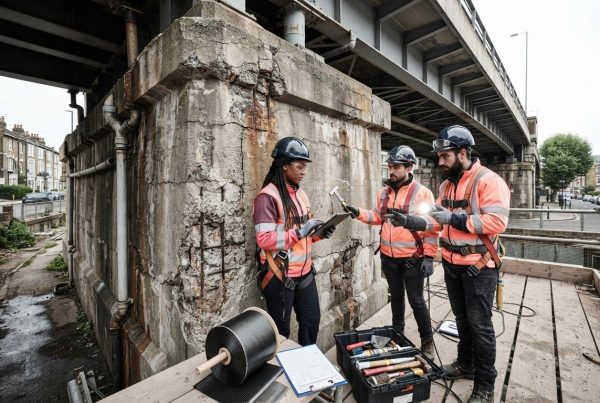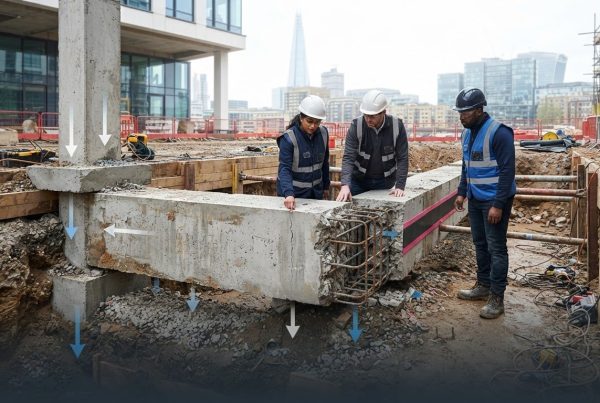


The structural integrity of a life-extension project is frequently determined not by the raw capacity of the materials used, but by the precision with which existing loads are managed during the intervention phase. Whilst the UK carbon fibre market continues to expand as a sustainable alternative to carbon-intensive demolition, the successful application of CFRP masonry reinforcement requires a sophisticated understanding of in-situ stress states. It’s widely recognised that restricted site access often prevents the use of standard hydraulic equipment, creating a significant risk of structural damage when attempting to transfer loads within sensitive or historic masonry environments.
This guide serves as a technical resource for mastering the principles of flat jacking for controlled load transfer and permanent pre-loading. You’ll gain a detailed understanding of the mechanical limitations of these precision-engineered steel envelopes and the design requirements necessary to satisfy standards such as the Concrete Society Technical Report 55. We will examine the specific applications where flat jacking is essential for maintaining structural stability, providing you with the criteria needed to select a specialist contractor for complex temporary works design and execution.
Key Takeaways
- Understand the mechanical advantages of low-profile hydraulic capsules for achieving high-capacity load transfer in restricted-access masonry environments.
- Recognise the critical role of bespoke engineering calculations and Temporary Works Design (TWD) in ensuring structural safety during load induction.
- Identify strategic applications for flat jacking, including the pre-loading of structural steelwork and the facilitation of bridge bearing replacements without disrupting infrastructure flow.
- Master the technical integration of flat jacking as a precursor to CFRP masonry reinforcement, ensuring optimal load distribution before secondary strengthening phases.
- Learn the precise methodological requirements for site preparation and installation to maintain permanent induced loads and protect structural integrity.
Understanding Flat Jacking: Mechanics and Structural Fundamentals
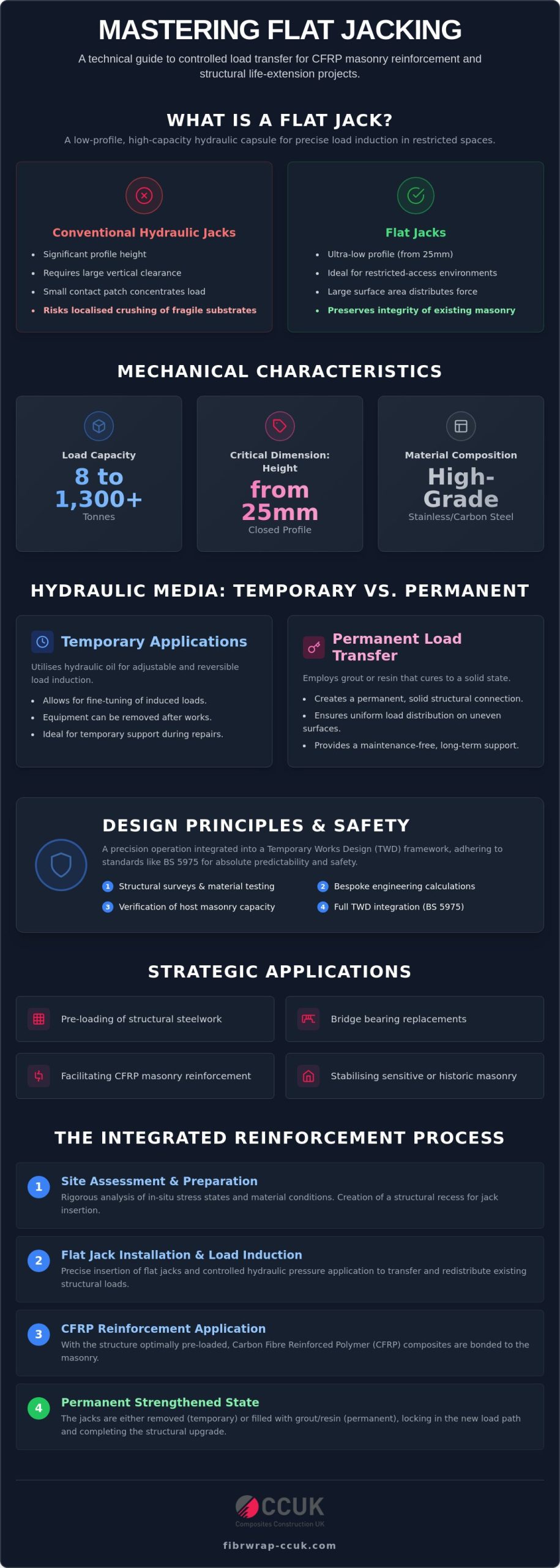
The flat jack is characterised as a low-profile, high-capacity hydraulic capsule, specifically engineered for deployment within restricted structural apertures. Unlike standard hydraulic cylinders that require significant vertical clearance, these precision-engineered units are designed to operate in gaps as narrow as 25mm. They are essential when preparing a substrate for CFRP masonry reinforcement, as they allow for the precise induction of loads without the need for extensive demolition or invasive temporary propping. The primary function of the jack is to provide a controlled expansion that translates fluid pressure into mechanical force.
Material composition typically involves high-grade stainless or carbon steel, selected for its ability to withstand extreme internal pressures without catastrophic deformation. The hydraulic mechanism relies on the controlled expansion of the capsule walls under internal fluid pressure. This expansion is uniform across the entire surface area. It ensures that the force applied to the masonry or structural element remains consistent, which significantly reduces the risk of localised crushing or stress concentrations. It’s a method that prioritises the preservation of existing material integrity whilst facilitating necessary structural adjustments.
Conventional hydraulic jacks possess a significant profile height and a relatively small contact patch, which can be detrimental to fragile substrates. In contrast, flat jacks provide a large surface contact area. This is vital when dealing with the lower compressive strengths of existing brickwork or stone. By distributing the load across a wider footprint, the risk of substrate failure is mitigated. This precise load management is a prerequisite for any successful CFRP masonry reinforcement scheme, ensuring the structure is correctly stressed before the composite materials are bonded.
Mechanical Characteristics and Load Capacities
Typical capacities range from 8 tonnes for small-scale remediation to over 1,300 tonnes for major infrastructure projects. The load induction capability is directly proportional to the surface area of the jack; a larger footprint allows for higher force at lower internal pressures. The closed height remains the most critical dimension. It dictates whether a jack can be inserted into a specific structural recess without further compromising the masonry’s stability during the installation phase.
Hydraulic Media: Oil vs Resin and Grout
The choice of hydraulic media depends on the intended duration of the load. Temporary applications utilise hydraulic oil, allowing for adjustment and eventual removal of the equipment once the primary works are complete. For permanent load transfer, grout-filled or resin-filled units are deployed. These materials transition from a fluid state, which ensures uniform distribution over uneven masonry surfaces, to a solid-state support during the curing phase. This creates a permanent, maintenance-free structural connection that supports the long-term utility of the asset.
Design Principles for Flat Jacking in Structural Engineering
Successful structural remediation begins with a rigorous analytical phase, where bespoke engineering calculations dictate the parameters of any hydraulic intervention. It’s insufficient to treat flat jacking as a commodity service; it is a precision operation that must be fully integrated into a Temporary Works Design (TWD) framework. In the UK, these designs typically adhere to BS 5975, ensuring that every load induction or structural movement is managed with absolute predictability. Before pressure is introduced, the host masonry’s capacity to withstand concentrated point loads must be verified through structural surveys and material testing. This ensures that the substrate remains stable throughout the life-cycle of the CFRP masonry reinforcement project.
The synergy between initial load management and secondary strengthening is critical. By using flat jacks to redistribute stresses, engineers can ensure that the subsequent application of CFRP masonry reinforcement occurs under optimal conditions. This methodology is particularly relevant for complex remediation projects where bespoke design features are required to address unique structural geometries or historic material constraints. For technical professionals seeking to integrate these systems into a broader programme, early engagement with a specialist regarding temporary works design is recommended.
Thrust Plates and Load Dispersion
Thrust plates are essential components that facilitate the even distribution of force from the jack into the masonry. Circular steel plates, typically 12mm thick, are utilised to prevent localised crushing or “spalling” of the brickwork. Achieving absolute parallelism between the plates is a non-negotiable requirement; any misalignment can lead to eccentric loading, which compromises both the safety of the operation and the accuracy of the load transfer. The plates act as a vital interface, ensuring the high-grade steel of the jack interacts safely with the relatively lower compressive strength of the host masonry.
Calculating Stroke and Expansion Requirements
Engineers must carefully manage the inherent 25mm stroke limitation of standard flat jacks. When structural deflections exceed this limit, a methodical shimming process is employed to maintain the induced load whilst the jack is reset. In scenarios requiring larger lifts or complex load paths, multiple jacks are arranged in series or parallel circuits. This allows for a synchronised lift, controlled via a central manifold to prevent uneven stress distribution. The calculation of induced force versus the required structural lift is performed with precision to avoid over-stressing the existing asset during the transition phase.
If you require technical assistance with the integration of these systems into your next project, you may contact our engineering team for a detailed consultation.
Primary Applications in UK Infrastructure and Masonry Remediation
The versatility of flat jacking extends across various sectors of the UK built environment, from heritage masonry remediation to the maintenance of critical national infrastructure. A primary application involves the pre-loading of new structural steelwork. When a new lintel or beam is introduced into an existing masonry opening, a period of settlement typically occurs as the new member engages with the load. By deploying flat jacks, engineers can induce this load immediately. This ensures the structural engagement is instantaneous, effectively preventing the development of settlement cracks that often plague traditional installations. This proactive load management is particularly vital when the project involves subsequent CFRP masonry reinforcement, as it guarantees the substrate is correctly stressed before the composite system is bonded.
In the context of bridge maintenance, flat jacks are indispensable for bearing replacements. Their low profile allows them to be inserted into the narrow gaps between the bridge deck and the pier, facilitating a controlled lift whilst traffic flow is maintained above. Similarly, the technology is essential during complex subsidence repair programmes. It enables the precise transfer of structural weight onto new underpinning or foundation systems. Beyond simple load transfer, these units are used to induce stress in masonry reinforcement systems, actively stabilising movement and preventing further propagation of structural defects. It’s a method that provides certainty in environments where traditional hydraulic cylinders simply cannot fit.
Permanent vs Temporary Structural Interventions
The operational lifespan of a flat jack is determined by the specific requirements of the structural repairs being undertaken. Temporary installations are frequently used for propping and shoring, where the jacks are removed once the permanent structure is self-supporting. However, permanent interventions are becoming more common in UK infrastructure, particularly for capping beam props or in locations where future access is restricted. These permanent units are typically grout-filled to ensure long-term stability, though they require specific inspection intervals to monitor for any pressure loss or material degradation over decades of service.
Load Monitoring and Calibration
Precision is maintained through the integration of pressure gauges and digital transducers, which provide real-time data during the jacking event. This data is critical for sensitive masonry structures where even minor over-stressing could cause irreversible damage. Every jack used in these high-stakes environments undergoes rigorous laboratory calibration to ensure the force-to-pressure relationship is accurately mapped. In some sophisticated asset management schemes, flat jacks are left in-situ to function as permanent load cells. This allows asset controllers to monitor the long-term health and behaviour of the structure, providing an early warning system for any unexpected shifts in load distribution.
The Flat Jacking Procedure: A Methodological Overview
The execution of a flat jacking operation begins with meticulous site preparation, ensuring that all contact surfaces are clean, level, and structurally sound. Any irregularities in the masonry substrate must be addressed to prevent localised stress concentrations that could lead to material failure. Once the aperture is prepared, the flat jack and its associated thrust plates are carefully positioned within the calculated structural gap. This precision placement is a fundamental prerequisite for any project involving CFRP masonry reinforcement, as it ensures the structure is correctly aligned before the secondary strengthening phase begins.
Controlled inflation is conducted using a specialised hydraulic pump unit, following a predetermined pressure sequence defined by the Temporary Works Design. This is not a rapid process; it requires the methodical monitoring of load and deflection increments at every stage of the jacking cycle. Engineers use this data to confirm that the structure’s response aligns with theoretical models, ensuring compliance with safety standards. Once the target load is achieved, the system is either locked off mechanically or prepared for transfusion to secure the induced load permanently.
The Transfusion Technique for Permanent Loads
The transfusion technique is utilised to convert a temporary hydraulic load into a permanent structural support. This involves replacing the hydraulic oil within the capsule with high-strength epoxy resin or cementitious grout under constant pressure. A rigorous bleed process is essential to ensure zero air entrapment, which would otherwise compromise the stiffness of the permanent support. Maintaining constant pressure during the curing phase is critical to prevent any load loss, ensuring the long-term stability required for CFRP masonry reinforcement schemes.
Safety Protocols and Risk Mitigation
Safety protocols focus on mitigating the risks of eccentric loading and jack instability, which are heightened in the restricted environments where flat jacks excel. The use of secondary support, such as precision-machined steel shims or packing, is mandatory to provide a fail-safe mechanism against hydraulic failure. The presence of a specialist engineering contractor is vital for supervising these high-risk lifts, providing the technical oversight necessary to manage complex load transfers safely. For projects requiring these advanced techniques, you can contact our technical team for expert guidance.
Strategic Asset Life-Extension: Integrating Flat Jacking and CFRP Masonry Reinforcement
The integration of flat jacking with CFRP masonry reinforcement represents a sophisticated approach to structural life-extension that transcends traditional repair methods. Whilst CFRP provides exceptional tensile strength and durability, it remains a passive system until a strain is induced within the composite matrix. By utilising flat jacks to pre-load a structure, engineers ensure that the existing masonry is stabilised and correctly stressed before the composite system is bonded. This synergy allows the reinforcement to engage immediately with structural loads, rather than waiting for further movement to trigger the material’s performance. It’s a proactive methodology that transforms a reactive repair into a precision-engineered structural upgrade.
From an economic perspective, the combination of pre-loading and composite strengthening offers significant advantages over total demolition and reconstruction. Research indicates that total project costs are often 30% to 50% lower than traditional steel-based interventions, primarily due to reduced labour requirements and the elimination of heavy lifting equipment. Beyond the financial rationale, this approach aligns with the UK’s Net Zero 2050 targets. By extending the functional lifespan of essential assets through CFRP masonry reinforcement, the carbon-intensive process of demolition is avoided, significantly reducing the embodied carbon associated with infrastructure maintenance.
Specialist Contracting and Engineering Rigour
Executing these complex interventions requires a high degree of engineering rigour and a deep understanding of material behaviour. Navigating UK regulatory standards, including Eurocode compliance for both hydraulic systems and composite materials, demands a specialist partner capable of providing end-to-end design and installation services. This integrated approach reduces project risk and ensures clear accountability from the initial Temporary Works Design through to the final lock-off. It’s essential to select a partner with proven expertise in advanced material science and the mechanical intricacies of hydraulic load transfer to ensure long-term structural security.
Future-Proofing Infrastructure with Innovative Engineering
The industry is shifting toward proactive asset management, where integrated sensor technology and automated monitoring are becoming standard components of structural remediation. Future-proofing infrastructure involves the use of synchronised hydraulic systems that can adjust loads in real-time based on digital feedback from the structure. This predictive approach ensures that masonry stabilisation is not just a one-time event but a long-term strategy for asset health. For technical professionals facing complex structural challenges involving CFRP masonry reinforcement, we recommend contacting our engineering team for a detailed consultation on bespoke remediation strategies.
Advancing Structural Longevity through Precision Engineering
Mastering the technical nuances of flat jacking is essential for any engineer tasked with the remediation of complex masonry assets. By ensuring precise load induction and structural alignment, these low-profile systems provide the necessary foundation for high-performance CFRP masonry reinforcement. The methodical transition from temporary hydraulic pressure to permanent solid-state support, particularly through advanced transfusion techniques, remains a cornerstone of modern structural life-extension. This integrated approach ensures that reinforced structures engage with design loads immediately, mitigating the risks of settlement and further material degradation.
As the exclusive UK licensee for Tyfo® Fibrwrap® systems, our specialist engineering team provides national coverage and deep expertise in both temporary works and permanent remediation. We prioritise safety and empirical rigour in every intervention, ensuring your assets meet current regulatory standards whilst minimising environmental impact. Consult our engineering team for bespoke flat jacking and CFRP masonry reinforcement solutions to discuss your project’s specific requirements. We look forward to helping you extend the functional lifespan of your essential infrastructure through sophisticated science and engineering.
Frequently Asked Questions
What is the maximum stroke of a standard flat jack?
The maximum stroke of a standard flat jack is typically limited to 25mm. If a structural lift or deflection greater than this dimension is required, a methodical shimming and resetting process must be implemented to maintain load control. This limitation is a characteristic of the capsule’s design, which prioritises a low profile over extensive vertical travel to facilitate access in restricted apertures.
Can flat jacks be used for permanent load induction in masonry?
Flat jacks are frequently utilised for permanent load induction through the application of transfusion techniques. By replacing temporary hydraulic fluid with high-strength epoxy resin or cementitious grout, the jack is transformed into a permanent structural support. This ensures that the induced force is maintained indefinitely, providing a stable substrate for subsequent CFRP masonry reinforcement applications where long-term stress management is critical.
How does a flat jack differ from a standard hydraulic cylinder?
A flat jack differs from a standard hydraulic cylinder primarily in its profile height and surface contact area. Whilst conventional cylinders require significant clearance and apply concentrated point loads, flat jacks operate in gaps as narrow as 25mm and distribute force across a large surface area. This distribution is vital when working with existing masonry to prevent localised crushing or material failure during the jacking event.
What materials are flat jacks typically manufactured from for UK projects?
Flat jacks for UK structural projects are typically manufactured from high-grade stainless steel or carbon steel. These materials are selected for their high tensile strength and resistance to deformation under extreme internal pressures. The choice of material ensures the capsule maintains its integrity during both temporary jacking events and long-term permanent installations within critical infrastructure assets.
Is flat jacking suitable for historic masonry structures?
Flat jacking is highly suitable for historic masonry due to its non-invasive nature and low-profile requirements. It allows for the induction of loads and structural stabilisation without the extensive demolition often required for traditional propping. This makes it an ideal precursor to CFRP masonry reinforcement in heritage environments where preserving the original architectural fabric is a primary conservation objective.
What is the transfusion process in flat jacking?
The transfusion process involves the pressurised replacement of hydraulic oil with a curing medium such as epoxy resin or grout. This procedure is performed whilst the target load is maintained, ensuring no loss of structural engagement during the transition. It requires a rigorous bleed process to eliminate air entrapment, resulting in a solid-state, high-stiffness support within the structural gap.
How are loads monitored during the flat jacking process?
Loads are monitored using calibrated pressure gauges and digital transducers that provide real-time data to the engineering team. These instruments allow for the precise tracking of force-to-pressure ratios and structural deflections throughout the jacking cycle. In complex projects, these units can be integrated with automated data loggers to provide a continuous record of structural behaviour during the intervention.
Do I need a specialist engineer for flat jacking and CFRP masonry reinforcement design?
A specialist engineer is essential for the design and supervision of flat jacking and composite reinforcement schemes. These operations require bespoke Temporary Works Design (TWD) and detailed structural analysis to ensure safety and compliance with UK standards like BS 5975 and Technical Report 55. Engaging a specialist ensures that the load transfer is controlled and that the reinforcement system is correctly specified for the asset’s requirements.