
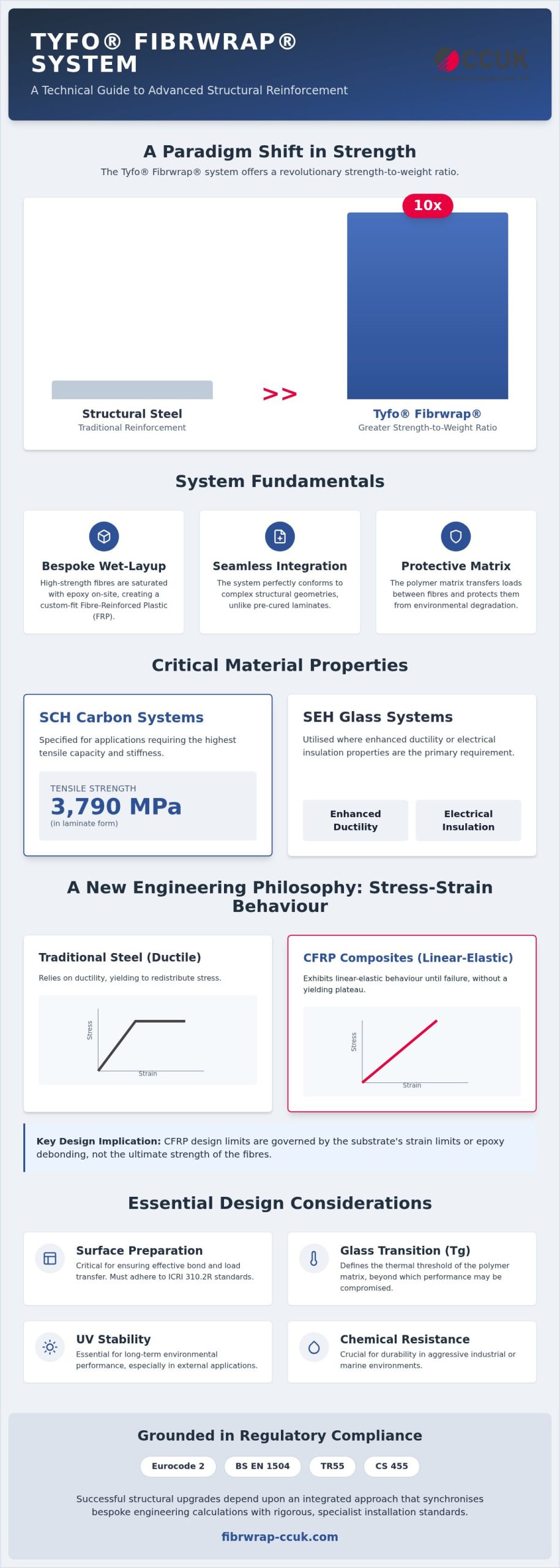
With a strength-to-weight ratio approximately ten times greater than that of structural steel, the Tyfo® Fibrwrap® system represents a paradigm shift in how we approach the reinforcement of the United Kingdom’s ageing infrastructure. You likely recognise that whilst the theoretical benefits of Carbon Fibre Reinforced Polymer (CFRP) are undeniable, the practical application within the constraints of Eurocode requirements and unpredictable UK environmental conditions presents a significant technical challenge. This technical guide provides a rigorous framework for addressing Tyfo Fibrwrap design considerations, ensuring that bespoke engineering calculations remain grounded in empirical performance data and regulatory compliance.
We’ll examine the essential interaction between composite overlays and existing masonry or concrete, the critical importance of surface preparation according to ICRI 310.2R standards, and the methodologies required to align proprietary system data with CS 455 and TR55 benchmarks. By establishing a clear methodology for material property verification and bond performance, engineers can specify these advanced composites with absolute confidence. The focus remains on extending the functional lifespan of essential assets through sophisticated science, prioritising safety and structural integrity above all else.
Key Takeaways
- Understand the technical mechanics of Tyfo® Fibrwrap® as a bespoke wet-layup composite and the critical role of the polymer matrix in ensuring effective load transfer.
- Evaluate the distinct material properties of SCH Carbon and SEH Glass systems to determine the most appropriate specification for tensile strength, stiffness, or ductility.
- Establish a methodology for structural enhancement that addresses flexural strengthening and shear reinforcement through precision-engineered U-wraps and full encasement.
- Navigate essential Tyfo Fibrwrap design considerations regarding long-term environmental performance, including UV stability and chemical resistance in aggressive industrial environments.
- Recognise why successful structural upgrades depend upon an integrated approach that synchronises bespoke engineering calculations with rigorous, specialist installation standards.
The Fundamentals of Tyfo® Fibrwrap® Structural Design
The Tyfo® Fibrwrap® system is defined as a bespoke, site-applied wet-layup composite, where high-strength fibres are saturated with a proprietary epoxy resin on-site to create a tailored Fibre-Reinforced Plastic (FRP). Unlike pre-cured laminates, this wet-layup methodology allows for seamless integration with complex structural geometries, ensuring that the reinforcement conforms precisely to the substrate’s profile. A critical component of this system is the polymer matrix; it performs the essential function of transferring loads between individual fibres whilst protecting them from environmental degradation. In the context of Tyfo Fibrwrap design considerations, the composite must be analysed as a distinct structural element that acts in composite action with the existing concrete or masonry. The selection between unidirectional and bidirectional fibre orientation is dictated by the specific load requirements of the asset, where unidirectional fibres provide maximum efficiency for flexural or axial loads, whilst bidirectional weaves offer multi-axis reinforcement for complex shear or seismic applications.
The Philosophy of Composite Strengthening
Engineering practitioners must recognise the fundamental shift from passive reinforcement to active structural enhancement when specifying these systems. Traditional steel reinforcement relies on the redistribution of stresses through ductility, whereas CFRP systems exhibit a linear-elastic stress-strain behaviour until failure. This lack of a yielding plateau means that design limits are often governed by the strain limits of the substrate or the debonding characteristics of the epoxy, rather than the ultimate tensile strength of the carbon fibres themselves. Consequently, a comprehensive structural survey is mandatory before design commences. The interaction between the existing substrate and the new composite overlay determines the efficacy of the load transfer, making the initial assessment of the parent material’s tensile strength a non-negotiable prerequisite for successful implementation.
Regulatory Compliance and Standards
Adherence to established regulatory frameworks is paramount to ensure the long-term security of any structural intervention. Designs are typically aligned with Eurocode 2 and relevant British Standards, such as BS EN 1504, alongside the rigorous guidance provided in Concrete Society Technical Report 55 (TR55), which remains the industry benchmark in the United Kingdom. These standards dictate the partial safety factors and material properties used in bespoke engineering calculations. By utilising Technical Data Sheets (TDS) for baseline properties, engineers can establish a design feature that meets specific service life requirements. These Tyfo Fibrwrap design considerations ensure that the chosen solution provides the necessary safety margins whilst promoting the sustainability of repair over the excessive costs and environmental impact of total replacement.
Critical Material Properties for Engineering Calculations
The engineering efficacy of Tyfo® systems is fundamentally predicated on precise material characterisation. For structural upgrades requiring high tensile capacity, SCH Carbon systems are typically specified; these can reach a tensile strength of up to 3,790 MPa in laminate form. In contrast, SEH Glass systems are utilised where enhanced ductility or electrical insulation is required. A critical element in Tyfo Fibrwrap design considerations is the Glass Transition Temperature (Tg) of the polymer matrix. This property defines the thermal threshold beyond which the resin softens, potentially compromising the load transfer between the fibres and the substrate. Designers must accurately determine the effective thickness of the cured laminate to perform rigorous cross-sectional analysis, ensuring the composite’s contribution is correctly accounted for in the final structural model.
Fibre vs Matrix Performance
The performance of the Tyfo® S Epoxy is as vital as the fibres it encapsulates. This resin system must be evaluated for its ability to maintain structural integrity under long-term creep and fatigue loading. The fibre volume fraction, which represents the ratio of fibre to resin within the cured laminate, directly influences the final design strength. Citing the ACI 440.2R-08 Design Guide provides a robust framework for these calculations, allowing engineers to account for environmental reduction factors and long-term durability. Engineers requiring precise data for bespoke calculations can consult our technical team for project-specific design support.
Bond Strength and Substrate Interaction
The integrity of the structural upgrade is entirely dependent on the bond between the FRP and the parent material. Calculations must determine the effective bond length required to prevent premature debonding failures, which often occur at stresses far below the ultimate capacity of the carbon fibres. It’s common practice to specify a minimum pull-off strength exceeding 1.5 MPa to validate the substrate condition. These on-site tests ensure that the design assumptions regarding the concrete’s tensile capacity are met in practice. Without a verified bond, even the highest specification carbon fibres cannot contribute to the asset’s load-bearing capacity.
Design Considerations for Specific Structural Elements
Structural strengthening requires a granular approach to individual element geometry and load paths. The application of Tyfo® systems to specific structural components is predicated on a precise understanding of the existing performance gaps and the ultimate design objectives. Whether the goal is to rectify a deficiency in flexural capacity or to provide seismic ductility, the geometry of the element dictates the configuration of the composite overlay. In the context of Tyfo Fibrwrap design considerations, the transition from material selection to structural integration involves a rigorous analysis of the interaction between the FRP and the parent substrate.
Flexural and Shear Strengthening
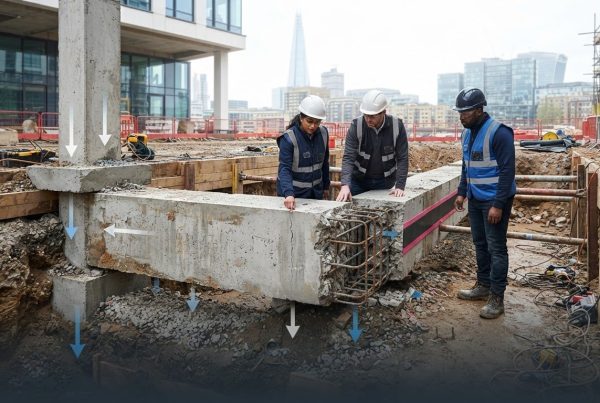
For reinforced concrete beams and slabs, the design process involves calculating the required number of layers based on the deficient moment capacity identified during the initial survey. Designers must address the risk of peeling or delamination at the laminate terminations, where high interfacial shear stresses are concentrated. To mitigate these risks, the following techniques are frequently employed:
- Tyfo® Fiber Anchors: These are integrated to provide mechanical anchorage and improve bond reliability, particularly in shear applications where the load must be transferred into the compression zone.
- Transverse U-wraps: These are specified to secure the ends of flexural reinforcement and provide additional shear enhancement.
- Extended Development Lengths: Laminates are extended beyond the points of zero moment to ensure the composite is fully developed before the peak stress regions.
These interventions ensure that the composite acts as a reliable tensile reinforcement, effectively enhancing the element’s ultimate limit state capacity whilst maintaining the necessary safety margins.
Seismic and Blast Mitigation Design
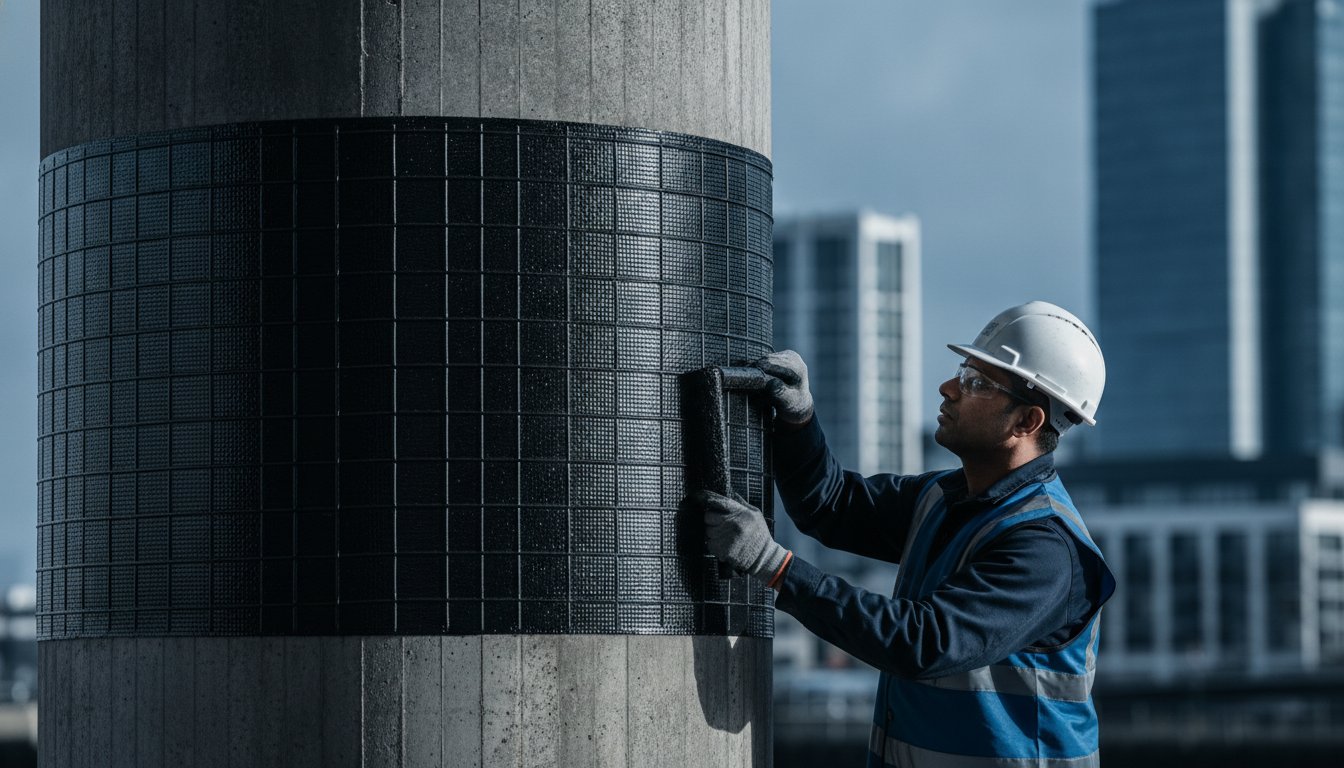
Seismic retrofitting and blast mitigation projects require a shift in focus from pure strength to energy absorption and ductility. Column confinement is achieved through continuous wrapping, which provides passive pressure to the concrete core, significantly increasing axial load capacity and strain tolerance. This confinement is vital for preventing the brittle failure of columns during lateral loading events. For blast mitigation, the system is designed to provide membrane action, helping to prevent progressive collapse by maintaining the structural integrity of primary load-bearing members. The ductility provided by the Tyfo® system allows the structure to undergo significant deformation without total loss of stability, which is a critical factor in protecting human life and essential infrastructure.
Masonry reinforcement strategies similarly rely on the system’s ability to provide lateral load resistance and crack control. By applying the composite to unreinforced masonry walls, engineers can introduce a reliable tensile component that resists out-of-plane forces. This is particularly relevant for heritage assets in the United Kingdom where traditional replacement is not a viable option. By integrating the composite with the existing masonry, the functional lifespan of the asset is extended, aligning technical performance with the broader economic goals of asset preservation.
Environmental and Situational Factors in Design
The long-term efficacy of a structural upgrade is as dependent on its environmental resilience as it is on its initial mechanical capacity. Environmental variables represent a primary category of Tyfo Fibrwrap design considerations, particularly in the United Kingdom where assets are frequently exposed to saline spray, industrial pollutants, and significant thermal cycling. Unprotected epoxy resins are susceptible to UV degradation, which can lead to matrix embrittlement and a subsequent reduction in the efficiency of load transfer between the fibres. Consequently, the specification of high-performance protective topcoats is a functional necessity to ensure the system maintains its design properties throughout its intended service life. In industrial contexts, the chemical resistance of the polymer matrix must be evaluated against specific pH levels and solvent exposures to prevent premature material degradation.
Fire Performance and Thermal Protection
Fire safety is a critical constraint when designing CFRP strengthening systems for buildings and enclosed infrastructure. The structural integrity of the Tyfo® S Epoxy matrix is fundamentally compromised once temperatures exceed the glass transition temperature, leading to a loss of composite action. To mitigate this risk, designers must specify secondary thermal protection systems, such as intumescent coatings or cementitious fireproofing. These systems are engineered to maintain the temperature of the FRP below its critical threshold for durations of 60, 90, or 120 minutes, depending on the specific fire rating requirements of the structure. Designers must also consider the risk of toxic smoke emission in confined spaces, ensuring that all specified materials comply with relevant UK fire safety regulations and building codes.
Durability in Aggressive Environments
In marine and coastal infrastructure, the Tyfo® system performs a dual role by providing both structural enhancement and a robust moisture barrier. This barrier is essential for preventing the ingress of chlorides and sulphates, which are the primary catalysts for reinforcement corrosion in concrete. The longevity of structural repairs is significantly enhanced when specialised finishes are used to shield the composite from aggressive saline environments. Beyond chemical resistance, the physical conditions during the installation phase are equally vital. Ambient temperature and relative humidity must be strictly monitored, as high moisture levels can interfere with the resin’s bond to the substrate, whilst extreme temperatures can alter the viscosity and curing profile of the epoxy. If your asset is located in a challenging industrial or coastal environment, consult our technical department to ensure your design accounts for these specific situational stressors.
The Integrated Design and Installation Approach
A successful structural intervention requires that Tyfo Fibrwrap design considerations are meticulously synchronised with site-specific operational realities. It’s a fundamental engineering principle that the theoretical capacity of a composite system is only realised through precise application. If a design assumes a specific development length or bond strength but fails to account for restricted access or low overhead clearance, the structural integrity of the final installation may be compromised. Therefore, the design phase must incorporate a feasibility study that evaluates the physical environment alongside the structural requirements, ensuring that the proposed solution is physically deliverable within the constraints of the existing asset.
From Specification to Execution
The transition from a technical specification to a completed project involves a rigorous, collaborative workflow between asset owners and specialist contractors. By utilising the design features provided by Composites Construction UK, engineers can optimise material usage, ensuring that the quantity and orientation of the carbon fibres are precisely matched to the load-bearing requirements of the asset. This precision reduces material waste and ensures that the intervention is as cost-effective as it is structurally sound. Quality control remains central to this process; protocols typically include on-site pull-off testing and the collection of laminate coupon samples for independent laboratory verification. These samples confirm that the cured composite achieves the tensile strength and modulus specified in the original engineering calculations.
The Composites Construction UK Advantage in Tyfo® Fibrwrap® Projects
As the exclusive licensee for the United Kingdom, Composites Construction UK provides a level of technical security that’s unavailable through non-certified providers. This exclusivity ensures a transparent supply chain of genuine Tyfo® materials, which is vital for maintaining the validity of proprietary design data and long-term performance warranties. Our expertise in Tyfo Fibrwrap installation allows us to bridge the gap between complex engineering theory and practical site application. By choosing a licensed specialist, asset controllers gain the assurance that every phase of the project, from initial testing to final protective coating, is executed to the highest industry standards. This integrated approach not only secures the long-term utility of the structure but also supports broader environmental goals by prioritising the reinforcement of existing assets over the carbon-intensive process of demolition and reconstruction. For professional assistance with your next project, contact our engineering team for a bespoke design consultation.
Securing the Future of Structural Infrastructure
The successful implementation of composite strengthening depends on a rigorous alignment between material science and site-specific engineering. We’ve explored how Tyfo Fibrwrap design considerations must account for the complex interplay of tensile capacity, bond reliability, and environmental stressors like UV exposure and thermal cycling. By synchronising bespoke calculations with proven installation methodologies, asset controllers can significantly extend the functional lifespan of critical infrastructure whilst meeting the stringent requirements of Eurocode 2 and British Standards. This methodical approach ensures that structural interventions are both sustainable and reliable.
As the exclusive UK licensee for Tyfo® Fibrwrap®, Composites Construction UK provides a comprehensive design, supply, and installation service grounded in empirical evidence and technical rigour. Our expertise in complex structural strengthening calculations ensures that every intervention is tailored to the unique performance demands of your specific asset. We invite you to consult Composites Construction UK for bespoke Tyfo® Fibrwrap® design solutions to ensure your project benefits from industry-leading engineering and proven material performance. Securing the long-term resilience of our built environment is a collaborative effort rooted in sophisticated science and professional accountability.
Frequently Asked Questions
How does Tyfo Fibrwrap design differ from traditional steel plate bonding?
Tyfo Fibrwrap offers a superior strength-to-weight ratio and eliminates the corrosion risks inherent in traditional steel plate bonding. Whilst steel plates are cumbersome and require mechanical fixings, this wet-layup composite is lightweight and conforms to complex structural geometries. This reduces the added dead load on the asset and simplifies installation in restricted environments. It’s an ideal solution for projects where structural weight and access constraints are primary engineering concerns.
Can Tyfo Fibrwrap be designed for use on masonry and timber structures?
The system is highly effective for reinforcing masonry and timber structures through bespoke engineering calculations. For masonry, it provides lateral resistance and crack control, whilst for timber, it can significantly enhance flexural capacity. The design must account for the specific elastic modulus of the substrate to ensure compatible load sharing. This allows for the preservation of heritage assets by providing modern structural performance without compromising the original material.
What are the fire safety requirements for CFRP strengthening in the UK?
UK fire safety regulations require that structural composites maintain integrity for specified periods, typically 60 to 120 minutes. Since the epoxy matrix is sensitive to elevated temperatures, intumescent coatings or cementitious barriers are mandatory in buildings. These systems ensure the temperature of the FRP remains below its glass transition threshold during a fire event. Compliance with these standards is a non-negotiable aspect of any design involving Carbon Fibre Reinforced Polymer in habitable spaces.
How is the design life of a Tyfo Fibrwrap system determined?
The design life is determined by applying environmental reduction factors to the material properties as per Concrete Society Technical Report 55 (TR55). These factors account for long-term exposure to moisture, UV, and chemical pollutants. By selecting appropriate protective finishes and safety margins, Tyfo Fibrwrap design considerations can align with the 50-year or 120-year requirements typical of UK infrastructure. This methodical approach ensures the long-term security of the structural intervention.
What surface preparation is required to ensure the design bond strength?
Achieving the design bond strength requires the substrate to be prepared to a specific Concrete Surface Profile (CSP) as defined by ICRI 310.2R. This involves removing laitance and contaminants to expose the aggregate through grit blasting or grinding. A minimum pull-off strength of 1.5 MPa is usually specified to confirm that the substrate is capable of supporting the intended load transfer between the parent material and the composite.
Are there specific seismic design considerations for UK infrastructure?
Whilst the UK is not a high-seismic zone, certain critical infrastructure and nuclear facilities require seismic design as per Eurocode 8. Tyfo Fibrwrap is utilised in these contexts to provide ductility and confinement to columns and shear walls. This ensures the structure can undergo controlled deformation without brittle failure. The focus is on energy dissipation and maintaining structural stability during low-probability but high-consequence seismic or blast events.
Can the Tyfo system be used for underwater structural strengthening?
Specialised Tyfo® systems are engineered for underwater application using moisture-tolerant resins that cure effectively in submerged conditions. These systems allow for the rehabilitation of bridge piers and marine piles without the need for expensive cofferdams. The design must account for the challenges of saturated substrates and the specific application techniques required to ensure a high-quality bond is achieved despite the presence of water during installation.
How do temperature fluctuations affect the design performance of the polymer matrix?
Temperature fluctuations affect both the resin’s viscosity during application and its mechanical stiffness once cured. Tyfo Fibrwrap design considerations must account for the maximum service temperature relative to the Glass Transition Temperature (Tg) of the polymer matrix. If the operating temperature approaches the Tg, the resin’s ability to transfer load between fibres is diminished. This requires the specification of thermal shielding or resins with a higher thermal threshold to maintain structural integrity.