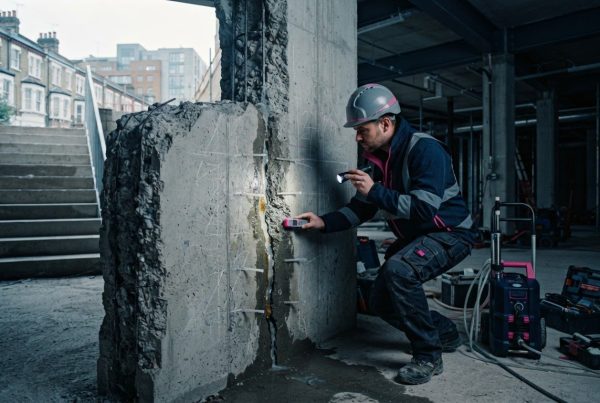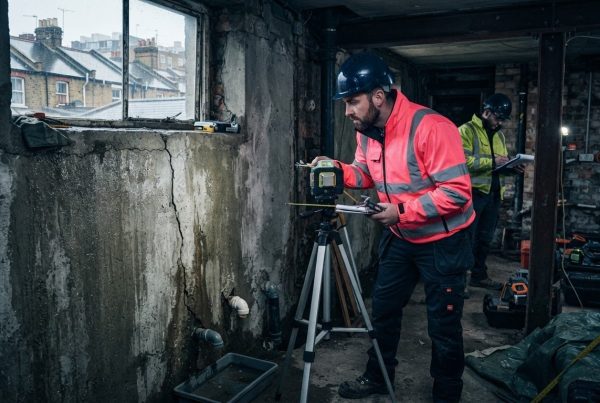

The most expensive material on a bill of quantities is frequently the one that secures the lowest total project expenditure. Whilst the initial carbon fibre strengthening cost UK engineers encounter may appear prohibitive when compared to traditional steel plate bonding, this narrow focus on material procurement often ignores the radical reduction in project preliminaries and logistical overheads. It’s a common frustration for asset controllers to see repair budgets inflated by the secondary costs of heavy lifting equipment, extensive scaffolding, and the prolonged operational downtime required for conventional structural interventions.
This engineering ROI analysis validates why a higher material spend on Carbon Fibre Reinforced Polymer (CFRP) systems, such as the proprietary Tyfo® Fibrwrap®, is a commercially prudent decision for ageing infrastructure. You will discover how the lightweight nature of advanced composites eliminates strict dead-load concerns whilst providing permanent resistance to the corrosion that plagues traditional reinforcement. By examining the lifecycle benefits of these systems, we provide the technical justification needed to extend asset lifespan by 30 years or more, effectively transitioning from a cycle of reactive maintenance to one of long-term structural security.
Key Takeaways
- Understand how to justify the carbon fibre strengthening cost uk asset managers encounter by calculating the radical reduction in site preliminaries and heavy plant requirements.
- Analyse the mechanical advantages of CFRP systems that provide tensile capacities exceeding 1000 MPa whilst maintaining a negligible impact on the structural dead load.
- Evaluate the logistical benefits of man-portable reinforcement materials that minimise operational downtime and eliminate the necessity for extensive road closures or scaffolding.
- Discover how permanent corrosion resistance and bespoke composite design can extend the functional lifespan of ageing infrastructure by more than three decades.
- Learn why end-to-end specialist design and installation are essential for ensuring the long-term performance and regulatory compliance of proprietary systems like Tyfo® Fibrwrap®.
Evaluating the Structural and Economic Value of Carbon Fibre Reinforcement
Carbon fiber reinforced polymer (CFRP) is a high-performance composite material consisting of exceptionally strong carbon filaments embedded within a specialised polymer resin matrix. Within the field of civil engineering, it’s utilised as an externally bonded reinforcement system to enhance the flexural, shear, or axial capacity of existing concrete, masonry, and steel structures. This technology represents a significant shift from traditional destructive repair methods, offering a non-invasive alternative that preserves the original architectural fabric whilst meeting modern safety requirements.
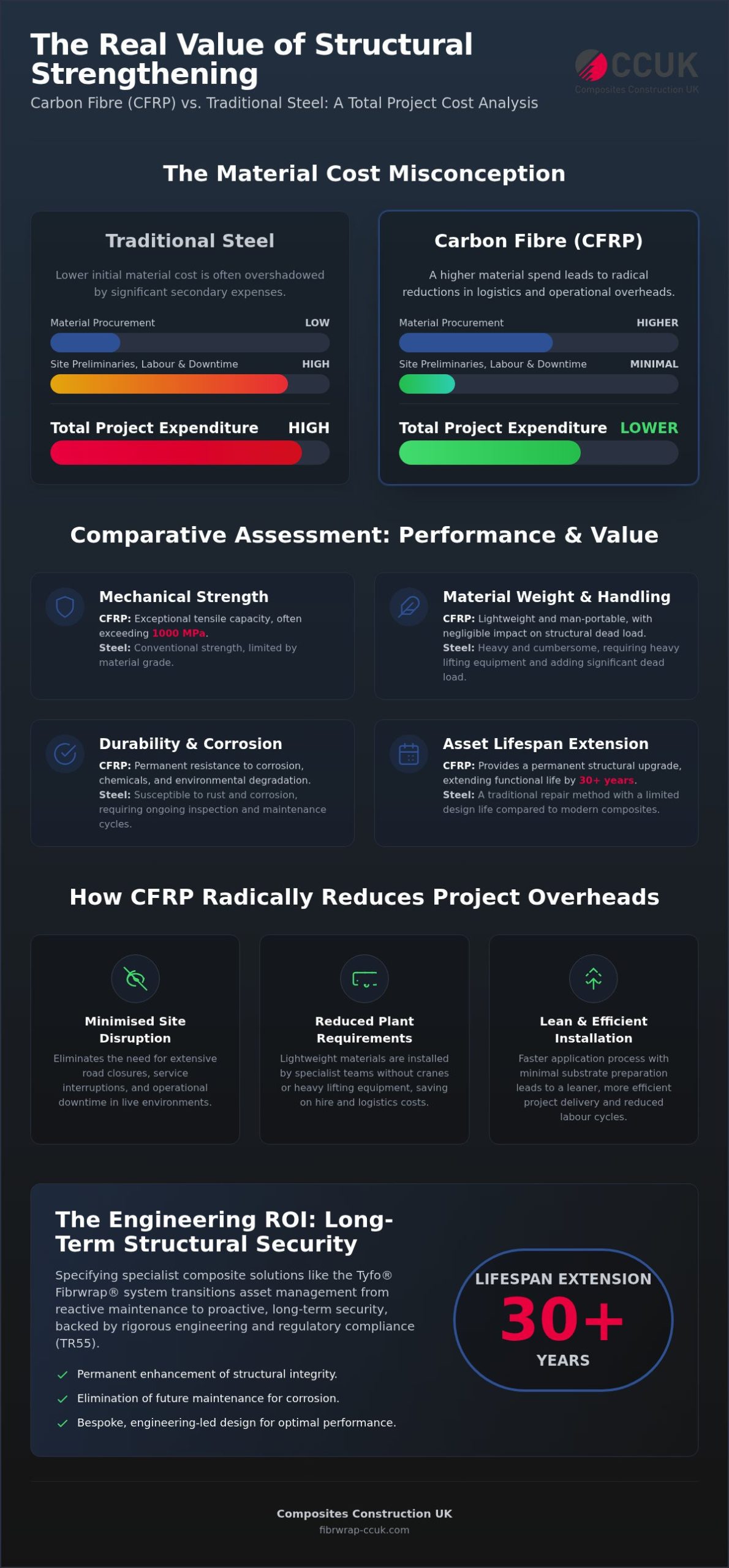
A fundamental material paradox exists within the UK construction industry. Whilst the initial carbon fibre strengthening cost uk engineers encounter is higher per kilogram than structural steel, the total project budget is frequently lower. This discrepancy occurs because the material procurement cost represents only a small fraction of the total expenditure. Traditional methods require heavy plant, extensive site preparation, and prolonged labour cycles that ultimately inflate the final invoice. By contrast, CFRP systems are man-portable and require minimal substrate preparation, leading to a leaner, more efficient project delivery.
The economic worth of CFRP is most evident in high-consequence sectors such as national highways, rail networks, and power generation facilities. In these environments, the cost of asset downtime or service interruption can exceed the cost of the structural repair itself. By employing lightweight, high-strength wraps like the Tyfo® Fibrwrap® system, infrastructure managers can achieve permanent life extension without the necessity for long-term road closures or the removal of critical equipment. This approach aligns with broader sustainability goals by prioritising the repair and retention of existing assets over demolition and replacement.
Defining Value Beyond the Procurement List
Distinguishing between the unit price of a material and its total installed cost is essential for accurate financial forecasting. The negligible weight of CFRP ensures that structural dead loads aren’t adversely affected, which often removes the need for secondary foundation strengthening or additional support pillars. CFRP value is defined as the intersection of high mechanical performance and low logistical impact on the existing asset. When these factors are quantified, the superior ROI of composites becomes clear, especially when accounting for the elimination of future maintenance cycles required by corrosion-prone steel.
The Engineering Decision Framework
The justification for specifying advanced composites rests on a framework of long-term durability and regulatory compliance. In the United Kingdom, adherence to the Concrete Society’s Technical Report 55 (TR55) ensures that interventions meet rigorous safety and performance standards. Successful implementation is dependent upon bespoke design features tailored to the specific substrate and loading requirements of the structure. This engineering-led approach guarantees that the intervention is a permanent enhancement of the asset’s structural integrity, providing a documented trail of safety and performance that reassures both clients and regulatory bodies.
The Technical Justification: Mechanical Properties and Durability
The technical superiority of Carbon Fibre Reinforced Polymer (CFRP) is rooted in its exceptional mechanical profile, specifically its uniaxial tensile strength. Proprietary systems like Tyfo® Fibrwrap® are engineered to deliver tensile capacities that often exceed 1000 MPa, providing a level of reinforcement that far surpasses conventional structural steel. This high performance isn’t merely a matter of peak strength; it’s the consistency of these properties across the entire installation that ensures structural safety. When evaluating the carbon fibre strengthening cost uk projects require, engineers must account for this material reliability, which significantly reduces the uncertainty often associated with traditional concrete repair or steel bonding.
Strength-to-Weight Ratio and Dead Load Considerations
Density comparisons reveal the stark efficiency of composites. Structural steel possesses a density of approximately 7850 kg/m3, whereas CFRP sits at roughly 1600 kg/m3. For ageing UK bridges, many of which are operating under strict weight restrictions or have reached their dead-load capacity, this weight differential is decisive. CFRP allows for significant load-bearing enhancement without adding substantial mass to the structure. These thin-profile wraps, often only millimetres thick, preserve essential head heights in tunnels and underpasses whilst maintaining the original architectural aesthetics of heritage assets.
Immunity to Environmental Degradation
Unlike metallic reinforcement, carbon filaments are chemically inert and don’t undergo oxidation. This immunity to corrosion is vital for salt-exposed concrete in marine environments or structures subjected to de-icing salts on the UK motorway network. Research into the long-term performance of CFRP suggests that these materials maintain their integrity over decades, effectively halting the “spalling cycle” that necessitates frequent remedial works. By eliminating the risk of rust, the frequency of future structural surveys is reduced, providing a permanent solution rather than a temporary patch.
Fatigue performance also plays a critical role in the life extension of industrial assets and rail infrastructure. CFRP demonstrates superior resilience under cyclic loading conditions compared to steel, which is prone to fatigue cracking over time. This durability ensures that the intervention remains robust under the dynamic stresses of modern transit. If your project requires high-performance reinforcement without the weight of steel, you can explore our bespoke design features to see how composite science is applied to specific structural challenges. The long-term security provided by these mechanical properties ensures that the carbon fibre strengthening cost uk is offset by the total elimination of recurring maintenance costs.
CFRP vs. Traditional Steel: A Comparative Assessment of Project Value
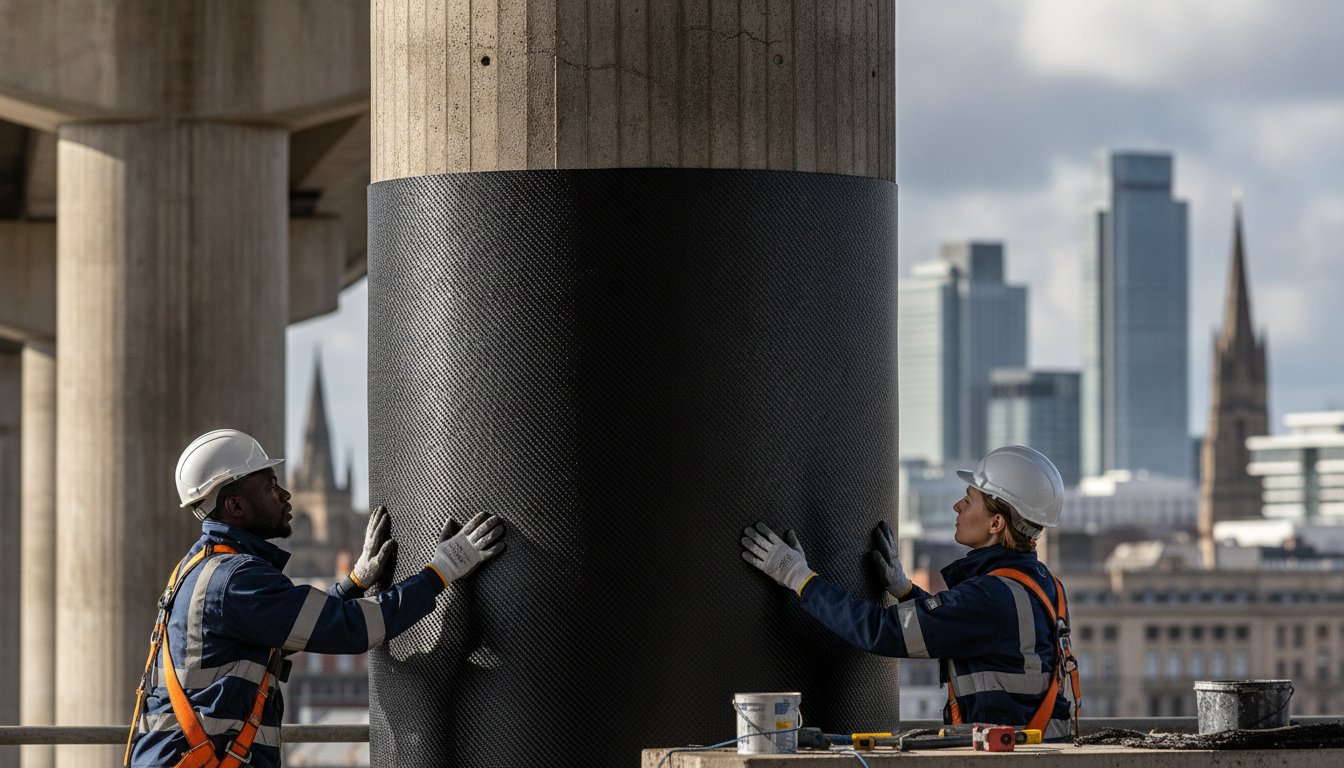
The transition from traditional steel plate bonding to Carbon Fibre Reinforced Polymer (CFRP) represents a fundamental change in structural intervention methodology. Whilst steel has historically been the default material for reinforcement, its application involves significant logistical complexity and secondary risk. Comparing the two requires an analysis that extends beyond the material invoice to the physical reality of the construction site. Steel sections are inherently heavy and rigid, necessitating the use of mechanical lifting equipment and specialised transport. By contrast, CFRP is supplied in man-portable rolls that can be easily manoeuvred by a small team without the need for cranes or heavy plant.
This portability doesn’t just reduce the carbon fibre strengthening cost uk contractors manage; it also minimises the physical footprint of the worksite, allowing other trades to continue their operations simultaneously. The installation of steel often requires “hot works” such as welding or the drilling of numerous anchor bolts. These processes introduce a risk of fire and the potential to accidentally sever existing internal reinforcement. CFRP systems eliminate these hazards entirely through a cold-applied, resin-bonded process. This chemical bond distributes loads more uniformly across the substrate than the point-loading created by mechanical fixings.
Adaptability is another critical factor where composites outperform metallic plates. Steel is difficult to apply to complex geometries or curved surfaces without expensive, bespoke fabrication. CFRP wraps are highly flexible during application, allowing them to conform to circular columns, arched soffits, and irregular beam profiles with ease. This versatility ensures that the reinforcement is continuous and effective regardless of the structural shape.
Installation Speed and Site Efficiency
The most significant differentiator is the impact on the project timeline. Evidence from industrial applications suggests that CFRP can reduce programme duration by up to 70% compared to traditional methods. For example, reinforcing a 1,000-square-metre floor slab typically requires only 7 to 10 days with carbon fibre, whilst bonded steel reinforcement would necessitate 20 to 30 days. This rapid deployment is detailed in the Tyfo® Fibrwrap® installation guide, which outlines the streamlined technical process. Reducing time on site directly translates to lower labour costs and less disruption to the facility’s primary function.
Maintenance and Long-Term Reliability
Traditional steel reinforcement creates a recurring maintenance liability. Exposed steel requires periodic inspection, cleaning, and repainting to prevent oxidation, particularly in humid or coastal environments. CFRP is an inert, “fit and forget” solution that doesn’t suffer from atmospheric degradation. This permanent nature supports the sustainability of repair over replacement, as it avoids the massive carbon expenditure associated with demolition and new-build reconstruction. When these lifecycle factors are integrated into the initial carbon fibre strengthening cost uk assessment, the long-term economic advantage of composites is undeniable.
Quantifying the Hidden Savings: Logistics, Access, and Operational Continuity
The financial viability of a structural intervention is often determined by the “preliminary” section of the tender rather than the material schedule. Whilst the unit price of high-performance composites is a known quantity, the radical reduction in site-based overheads often remains underestimated during the early design phases. In many UK infrastructure projects, the carbon fibre strengthening cost uk asset owners budget for is substantially offset by the elimination of heavy lifting equipment and extensive temporary works. Traditional steel or concrete interventions frequently necessitate heavy-duty cranes, specialised transport for oversized sections, and invasive propping that obstructs the primary function of the asset. Composites, being man-portable and thin-profile, require none of these, allowing for a much leaner site presence.
Working at height or in confined spaces provides a clear demonstration of these hidden savings. Where steel plates would require mechanical hoist systems and significant structural scaffolding to support the weight during installation, CFRP wraps can be applied using mobile elevated work platforms (MEWPs) or lightweight towers. This agility isn’t just a matter of convenience; it represents a significant saving in site preliminaries, which can constitute up to 50% of a traditional repair budget. When the logistical burden is removed, the engineering focus can remain on the quality of the substrate preparation and the precision of the resin application.
Maintaining Operational Continuity
For facility managers and asset controllers, the true value of CFRP lies in the preservation of revenue streams. Strengthening a motorway bridge can often be completed during off-peak hours without the requirement for total lane closures that disrupt national logistics. Similarly, industrial pipeline rehabilitation can be executed whilst maintaining internal flow and pressure, avoiding the catastrophic costs associated with total plant shutdowns. In the commercial sector, this means structural enhancements can occur without evacuating tenants, ensuring that the intervention doesn’t trigger a business interruption claim or a loss of rental income.
Reducing the Footprint of Remediation
A smaller site footprint directly correlates with a lower environmental and social impact. The absence of heavy plant and hydraulic breakers significantly reduces noise pollution and vibration, which is critical in urban centres or sensitive ecological areas. The reduced transport requirements for lightweight composites also contribute to a lower project carbon footprint. By minimising the volume of material delivered and the duration of site activity, the overall sustainability of the repair is enhanced compared to demolition and reconstruction. If your current project requires a solution that prioritises live environment safety and minimal disruption, you can contact our specialist engineering team to discuss a tailored approach. The efficiency gained through these logistical advantages ensures that the total carbon fibre strengthening cost uk remains highly competitive when measured against the full scope of conventional construction overheads.
Implementing Specialist Composite Solutions for Long-Term Asset Integrity
The successful deployment of Carbon Fibre Reinforced Polymer systems depends entirely upon the integration of specialist design and disciplined installation. Unlike traditional construction materials that can be applied by general contractors, advanced composites require a deep understanding of adhesive chemistry and substrate behaviour. As the exclusive UK licensee for Tyfo® Fibrwrap®, Composites Construction UK manages the end-to-end strengthening process, ensuring that the theoretical performance of the carbon filaments is fully realised in the physical structure. This methodical approach begins with comprehensive structural surveys and testing, which are essential for verifying the tensile capacity of the concrete substrate before any material is bonded.
The determination of whether the investment is definitively worth it depends on the specific operational constraints of the asset. Carbon fibre reinforcement is the optimal solution when the indirect costs of downtime, heavy plant access, or dead-load limits outweigh the material procurement expenditure. For critical infrastructure where a 30-year life extension is required without the burden of recurring maintenance, the carbon fibre strengthening cost uk projects incur is justified by the resulting asset security. It’s a strategic shift from reactive repair to a permanent life-extension strategy that preserves the utility of essential infrastructure.
The Importance of Bespoke Design and Engineering
Off-the-shelf solutions frequently fail in complex structural strengthening because they lack the necessary tailoring to specific loading conditions. Adherence to UK engineering standards, including Technical Report 55, is mandatory for ensuring regulatory compliance and structural safety. Every intervention must be a bespoke response to a documented deficiency, supported by rigorous quality control and pull-off testing to confirm bond integrity. This engineering-led approach prevents the premature degradation often seen in poorly designed repairs and ensures the long-term performance of the reinforcement system.
Your Next Steps in Asset Life-Extension
Initiating a feasibility study is the first stage in determining the suitability of composites for your specific structural challenge. Partnering with a specialist engineering contractor allows for the early identification of potential savings in site preliminaries and access equipment. If you require a technical assessment of an ageing asset or a detailed proposal for structural reinforcement, you can reach out through our contact page for a technical consultation. Taking a proactive approach to asset integrity ensures that the utility of essential infrastructure is preserved whilst minimising the economic and environmental impact of the intervention.
Securing the Future of UK Infrastructure Through Advanced Composites
The transition towards Carbon Fibre Reinforced Polymer (CFRP) represents a fundamental shift from reactive maintenance to strategic life extension. Whilst the initial carbon fibre strengthening cost uk asset controllers must justify is higher than that of structural steel, the total project value is secured through the radical reduction in site preliminaries and the elimination of future corrosion cycles. By prioritising the repair and retention of existing assets, engineers can achieve a permanent increase in load capacity whilst maintaining operational continuity in the most demanding environments. It’s a commercially prudent approach that aligns technical performance with long-term fiscal responsibility.
As the exclusive UK licensee for Tyfo® Fibrwrap® systems, Composites Construction UK provides the specialist design-and-build expertise required to execute high-performance structural interventions. With national coverage across the UK, our engineering team ensures that every project meets the most rigorous safety standards and regulatory requirements. It’s time to move beyond temporary patches and invest in the long-term integrity of your essential assets. Request a technical consultation for your structural strengthening project and discover how bespoke composite science can extend the functional lifespan of your structure by more than three decades. We look forward to securing your infrastructure.
Frequently Asked Questions
Is carbon fibre reinforcement more expensive than steel?
Whilst the unit cost of carbon fibre is higher than structural steel, the total project expenditure is frequently lower. Traditional steel reinforcement requires heavy lifting equipment, extensive scaffolding, and prolonged labour cycles. By contrast, lightweight CFRP systems reduce these hidden costs significantly. When evaluating the carbon fibre strengthening cost uk, asset managers must look beyond material procurement to the total installed cost, where composites often demonstrate superior economic value.
How long does carbon fibre structural strengthening last?
Carbon fibre reinforcement is designed to provide a permanent solution with a service life typically exceeding 30 years. Unlike metallic reinforcement, carbon filaments are chemically inert and immune to oxidation. This resistance to environmental degradation ensures that the strengthening remains effective without the recurring maintenance cycles required by traditional methods. When applied correctly by specialists, these systems effectively extend the functional lifespan of the asset for the remainder of its design life.
Can CFRP be used on masonry and timber as well as concrete?
CFRP systems are highly versatile and can be effectively applied to masonry and timber substrates in addition to reinforced concrete. In masonry applications, it’s frequently used for crack stitching or to enhance flexural capacity in heritage walls. For timber, it provides a non-invasive method to increase the load-bearing capacity of historic beams. Each application requires a bespoke resin formulation and specific surface preparation to ensure the bond integrity between the composite and the substrate.
What are the fire resistance properties of carbon fibre wraps?
Whilst carbon fibre itself is heat resistant, the polymer resin matrix typically has a glass transition temperature that requires protection in fire-critical environments. To meet UK Building Regulations, specifically Part B, CFRP systems are usually encapsulated with specialised fire protection. This may include intumescent coatings or fire-resistant boards that provide the necessary insulation to maintain structural integrity for the required duration, such as 60 or 120 minutes, during a thermal event.
Does carbon fibre reinforcement require specialist maintenance?
One of the primary advantages of CFRP is that it’s essentially a maintenance-free solution once installed. Because the material doesn’t rust or corrode, there is no requirement for the periodic repainting or protective treatments associated with structural steel. Standard structural inspections are still recommended as part of a broader asset management strategy, but the reinforcement itself doesn’t demand specific remedial works, significantly reducing the long-term operational expenditure for the asset owner.
How much time can CFRP save on a typical strengthening project?
CFRP installations typically reduce construction periods by 50% to 70% compared to traditional steel plate bonding. The lightweight nature of the material allows for rapid manual application without the logistical delays inherent in moving heavy steel sections. Reinforcing a standard floor slab can often be completed in a fraction of the time required for conventional methods. This speed is a critical factor in minimising the carbon fibre strengthening cost uk by reducing site labour and overheads.
Is carbon fibre reinforcement suitable for seismic or blast mitigation?
CFRP is an exceptional material for both seismic retrofitting and blast mitigation due to its high strength and energy absorption characteristics. When used for column wrapping, it provides significant confinement that prevents catastrophic failure during dynamic loading events. These systems are frequently specified for critical infrastructure and high-occupancy buildings to enhance resilience against explosive forces, providing a lightweight yet robust shield that doesn’t compromise the original structural dead load or architectural profile.
What is the typical cure time for a CFRP system like Tyfo® Fibrwrap®?
The initial cure of a Tyfo® Fibrwrap® system typically occurs within 24 hours at standard ambient temperatures, allowing for the removal of temporary supports. Full mechanical properties and ultimate strength are generally achieved within 7 to 10 days, depending on environmental conditions like temperature and humidity. This rapid strength gain is a primary reason why CFRP is preferred for projects where minimising operational downtime and returning the structure to service is a critical priority.