

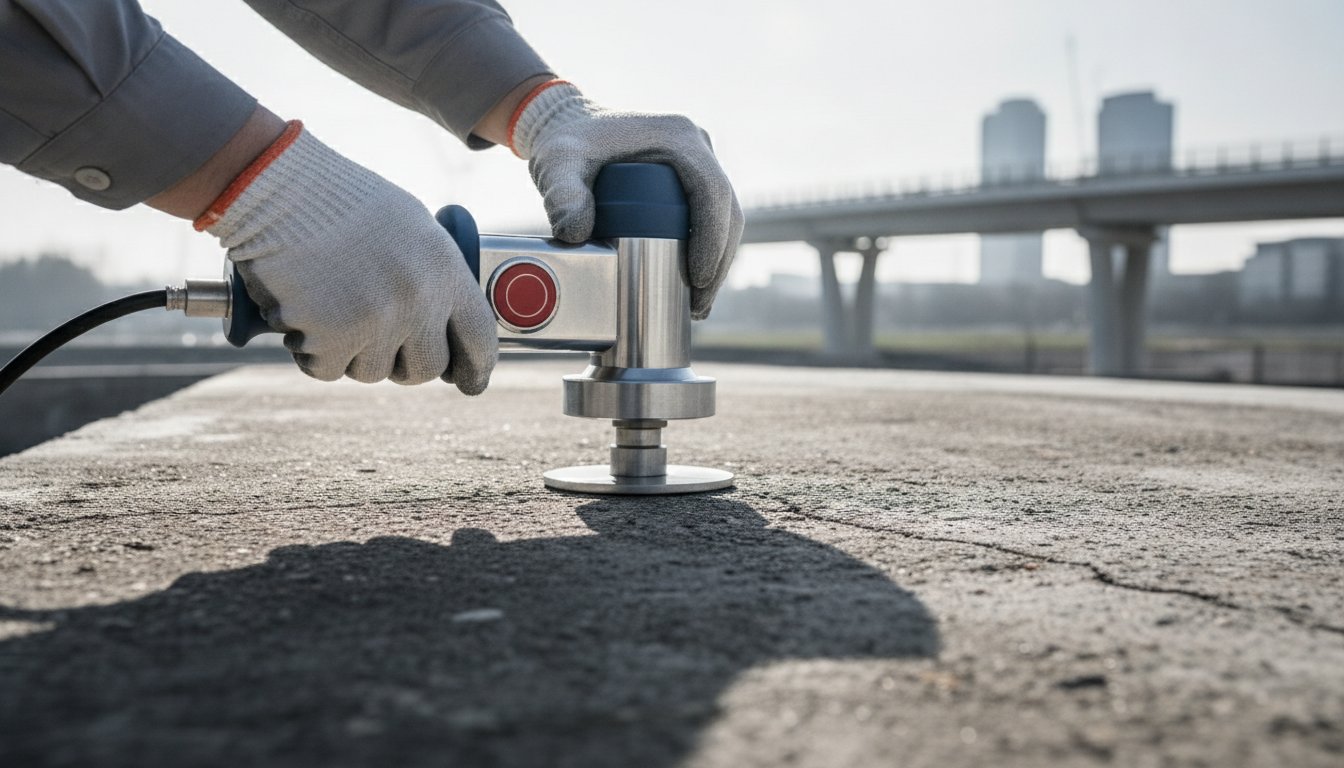
The long-term viability of a structural strengthening programme is fundamentally contingent upon the empirical validation of the substrate’s tensile capacity, rather than optimistic assumptions regarding legacy material performance. It is widely acknowledged amongst asset controllers that the risk of repair failure due to inadequate surface preparation or poor bond quality represents a significant liability for critical infrastructure. By following a standardised concrete pull-off test procedure, engineers can replace uncertainty with quantified data, ensuring that any subsequent intervention is grounded in structural reality.
This comprehensive guide details the technical methodology required to achieve compliance with BS EN 1542:1999, facilitating the accurate quantification of surface tensile strength for bespoke strengthening designs. You’ll gain a clear understanding of the equipment requirements, the step-by-step execution of the test, and the sophisticated interpretation of failure modes necessary for successful asset life-extension. This rigorous approach ensures that every strengthening project, particularly those involving advanced systems like Tyfo® Fibrwrap®, is supported by validated substrate performance data through methodical scientific assessment.
Key Takeaways
- Understand why near-surface tensile strength assessment is a critical precursor to the rehabilitation of ageing concrete infrastructure and long-term asset integrity.
- Master the technical concrete pull-off test procedure to ensure representative sampling and precise data collection across complex structural assets.
- Ensure full regulatory compliance by adhering to the specific requirements and testing methodologies outlined in BS EN 1542 and BS EN 13892-8.
- Learn to categorise failure modes accurately, distinguishing between cohesive substrate failure and adhesive bond failure to validate the reliability of test results.
- Discover how empirical pull-off data directly informs the bespoke design and anchorage requirements for advanced CFRP strengthening systems like Tyfo® Fibrwrap®.
The Role of Pull-Off Testing in Asset Integrity and Structural Surveys
A Pull-off test is widely regarded as the most reliable field method for determining the near-surface tensile strength of a concrete substrate. Unlike non-destructive methods that rely on ultrasonic pulse velocity or rebound hammers, this procedure provides a direct, empirical measurement of the force required to fracture the material. In the context of the UK’s ageing infrastructure, where legacy concrete may have suffered from decades of carbonation or chloride ingress, the concrete pull-off test procedure becomes a non-negotiable component of any structural survey. It serves as the primary diagnostic tool for validating whether a structure possesses the requisite integrity to support advanced reinforcement systems.
Data-driven asset life-extension programmes offer significant socio-economic advantages over wholesale replacement. By accurately quantifying the remaining capacity of a structure, engineers can design targeted interventions that prolong functional lifespans whilst minimising the carbon footprint associated with new construction. The precision of this data allows for a more efficient allocation of capital expenditure, as repairs are only specified where the substrate’s tensile properties are proven to be sufficient for effective load transfer. This methodical approach prioritises safety whilst supporting the sustainability of existing infrastructure.
Assessing Substrate Suitability for Strengthening
The identification of weak or degraded surface layers is paramount when considering the application of Carbon Fibre Reinforced Polymer (CFRP) systems. Carbonation or micro-cracking within the concrete cover can severely inhibit the bond performance of high-modulus composites like the Tyfo® Fibrwrap® system. By conducting a formal concrete pull-off test procedure, specialists can delineate areas where previous remedial interventions have failed or where the base material requires extensive mechanical preparation. This ensures that the strengthening system is anchored to a sound substrate, preventing premature debonding under service loads and ensuring the long-term reliability of the structural intervention.
The Objective of Tensile Strength Quantification
Establishing an empirical baseline is essential for the bespoke engineering design of composite wraps. The primary objective is to verify that the cohesive strength of the concrete exceeds the stresses imposed by the reinforcement. Ideally, failure should occur deep within the concrete substrate rather than at the adhesive interface, signifying a robust bond. Within the framework of BS EN 1542, tensile bond strength is defined as the maximum tensile stress which can be applied to a repair system before failure occurs at the weakest point within the test assembly. This quantification allows for the validation of the material’s performance under real-world conditions, far exceeding the reliability of theoretical calculations alone.
The Concrete Pull-Off Test Procedure: A Methodical Engineering Approach
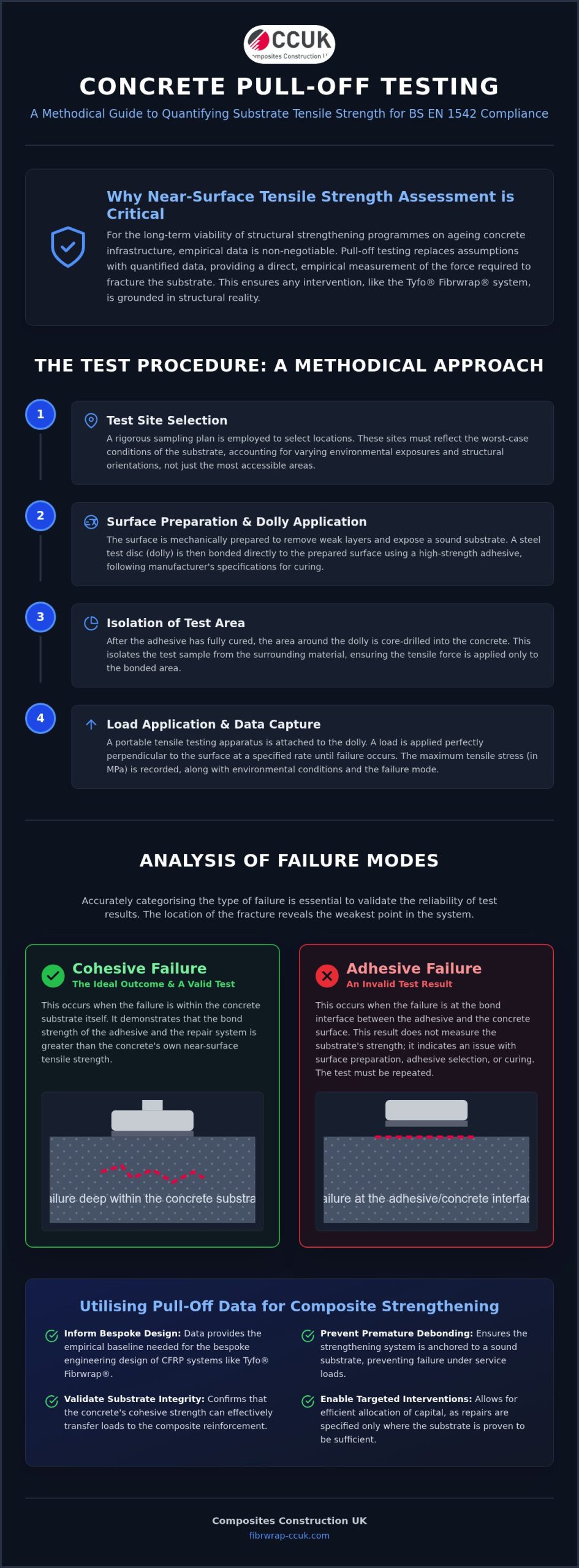
The execution of a concrete pull-off test procedure requires more than mere mechanical force; it demands a disciplined adherence to metrological standards to ensure that results are both repeatable and representative. To achieve statistical confidence across a large-scale asset, test locations must be selected through a rigorous sampling plan that accounts for varying environmental exposures and structural orientations. It’s essential that these sites reflect the worst-case conditions of the substrate rather than solely the most accessible areas. This ensures the data captured is indicative of the structural reality across the entire asset.
Environmental variables, including ambient temperature and relative humidity, are meticulously recorded, as these factors significantly influence the curing kinetics of the adhesives used. Deviations from the manufacturer’s specified curing window can lead to premature failure at the disc interface, thereby invalidating the data. Precision is further maintained by ensuring that the load is applied perfectly perpendicular to the concrete surface. Any misalignment introduces eccentric stresses that artificially lower the recorded tensile strength, leading to overly conservative and potentially costly design assumptions. Professional structural surveys often highlight how such procedural rigour differentiates reliable diagnostics from anecdotal observations.
Preparation and Adhesion of Test Discs
Once the adhesive has reached full maturity, a diamond-tipped core bit is used to drill through the adhesive layer and into the concrete substrate to a depth specified by Near-surface strength tests guidelines, usually between 5mm and 15mm. This isolation is critical, as it ensures that only the area directly beneath the disc is subjected to the tensile load. The calibrated pull-off tester is then coupled to the disc, and a constant rate of stress is applied, typically within the range of 0.05 ± 0.03 MPa/s. This steady increase in force continues until structural failure occurs, at which point the peak load is recorded for subsequent analysis. Adhering to this standardised concrete pull-off test procedure allows for the empirical validation of the substrate’s performance under real-world conditions.
Compliance with BS EN 1542 & BS EN 13892-8
Defensible structural engineering is underpinned by a strict adherence to established British and European standards. The concrete pull-off test procedure is primarily governed by BS EN 1542:1999, which provides the definitive methodology for measuring the bond strength of products and systems used in the protection and repair of concrete structures. Whilst this standard is the benchmark for repair systems, BS EN 13892-8:2002 is utilised specifically for assessing the bond strength of floor screeds. For global infrastructure projects, alignment with American standards such as ASTM D7234-21 is often required. This standard shares similarities with European methods but introduces specific variations in disc geometry and loading parameters that must be accounted for in the engineering design. Professional reports must be supported by UKAS-accredited testing to ensure that the data is admissible for insurance and regulatory validation.
Regulatory Frameworks for Structural Remediation
Alignment with Eurocode 8 requirements is essential for seismic and structural upgrades, where the reliability of the bond between the substrate and the reinforcement is a critical safety variable. Third-party validation is frequently mandated for high-stakes infrastructure assets, such as bridges and marine structures, to mitigate the risk of catastrophic bond failure. During the Tyfo® Fibrwrap® installation process, adherence to these regulatory frameworks ensures that the design assumptions for composite strengthening are fully realised in the field. This compliance provides asset controllers with the necessary assurance that the intervention will perform as intended over its projected service life. It’s a fundamental step in the bespoke design calculations required for complex structural challenges.
Equipment Calibration and Certification
Precision in measurement is achieved through the use of annually calibrated testing devices that feature digital readouts for enhanced accuracy. These instruments must maintain a precision of ± 1% to comply with technical specifications. Verification of core-drill diameters and disc dimensions is also required; for instance, a 50mm diameter stainless steel disc must be matched with a precisely cut 50mm core to isolate the test area correctly. Documentation of the rate of loading is equally vital. Technical standards specify a constant stress application of 0.05 ± 0.03 MPa/s to avoid the introduction of dynamic forces that could skew the results. By maintaining this level of metrological rigour, engineers can ensure that the concrete pull-off test procedure yields data that is both accurate and repeatable.
Analysis of Failure Modes: Quantifying Substrate and Adhesive Performance
The recording of a peak load value is merely the first stage of data acquisition; the subsequent visual assessment of the fracture surface is what determines the validity and structural implications of the concrete pull-off test procedure. Engineers must categorise the failure mode to understand the limiting factor of the bond. A cohesive failure within the concrete substrate, often designated as a Type A failure, indicates that the bond strength of the repair or strengthening system exceeds the tensile capacity of the base material. Conversely, failure at the interface between the substrate and the repair material suggests a deficiency in surface preparation or a chemical incompatibility between the two phases. This distinction is vital for determining whether the substrate is capable of transferring loads to a newly installed reinforcement system.
Analysing the adhesive performance between the metal disc and the test surface is equally critical for quality control. If the separation occurs entirely at the disc interface, categorised as a Type Y failure, the test is deemed invalid as the true capacity of the concrete has not been reached. Such results usually stem from inadequate cleaning of the disc or the use of an unsuitable adhesive resin. In these instances, the test must be discarded and repeated to ensure the integrity of the data. Consistent failure within the repair material itself, or cohesive failure of the overlay, may indicate that the specified material is insufficient for the intended structural load or has been incorrectly mixed on-site.
Interpreting Failures for Engineering Design
A Type A failure provides the most reassuring data for asset controllers. It confirms that the structural integrity of the concrete is the primary constraint, rather than the bond of the intervention. When failure occurs within the repair material, it necessitates a rigorous review of the material’s technical specifications and its suitability for the specific environmental conditions. For projects involving Tyfo® Fibrwrap®, achieving a substrate failure is the ultimate objective, as it validates the effectiveness of the mechanical preparation. If your project requires precise substrate validation, our specialist team can provide the necessary structural surveys and testing to ensure design accuracy.
Statistical Analysis of Test Data
Structural reliability is derived from a representative dataset rather than isolated points. Engineers must calculate the mean tensile strength and the standard deviation across a minimum of three to five test locations per representative area to achieve statistical confidence. A high standard deviation indicates a non-homogeneous substrate, which requires the adjustment of design safety factors to account for material uncertainty. This empirical data is then integrated into bespoke engineering calculations, ensuring that the final strengthening design is both safe and optimised for the specific conditions of the asset. By following this methodical approach, the risk of unforeseen bond failure is significantly mitigated, supporting the long-term sustainability of the structure.
Utilising Pull-Off Data for Composite Strengthening and Asset Life-Extension
The empirical data derived from a concrete pull-off test procedure provides the technical foundation upon which Carbon Fibre Reinforced Polymer (CFRP) designs are constructed. It’s established that the effective anchorage of the Tyfo® Fibrwrap® system is fundamentally limited by the tensile capacity of the concrete cover; therefore, these test results are used to determine the specific Concrete Surface Profile (CSP) required for the project. By identifying areas of low cohesive strength, engineers can specify targeted mechanical preparation, such as grit blasting or high-pressure water jetting, to expose sound aggregate. This ensures that the high-modulus composite reinforcement is bonded to a substrate capable of sustaining the calculated load transfers, thereby preventing premature debonding and ensuring the structural reliability of the intervention.
The integration of diagnostic testing with remediation execution allows for a more nuanced approach to asset management, particularly when dealing with the non-homogeneous nature of legacy concrete. A specialist contractor is required to bridge the gap between raw data and site-specific installation, ensuring that the design intent is fully realised under field conditions. This methodical process avoids the risks associated with generic repair specifications, allowing for bespoke solutions that address the unique structural challenges of each individual asset.
The Sustainability of Structural Repair
The decision to rehabilitate existing infrastructure rather than proceed with total demolition is a critical component of ESG-aligned asset management. Accurate diagnostics enable targeted strengthening, which significantly reduces the carbon footprint of an asset by minimising the requirement for new concrete and steel. By extending the functional lifespan of infrastructure through scientific validation, asset owners can meet environmental targets whilst deferring the substantial capital expenditure associated with reconstruction. Framing structural surveys as a proactive measure ensures that interventions are only applied where empirically justified, supporting a sustainable and circular approach to the built environment.
The Composites Construction UK Approach to Structural Integrity
This ethos of quality and durability is equally important in the commercial and residential sectors, where Scott Patterned Concrete provides expert decorative solutions that stand the test of time.
A specialist contractor provides the essential link between theoretical design and site-specific execution. Delivering end-to-end structural repairs requires a seamless integration of empirical testing and professional installation. At Composites Construction UK, the concrete pull-off test procedure is viewed as a non-negotiable precursor to any strengthening work, providing the validated data necessary for the engineering team to produce bespoke calculations. This rigorous process ensures that every installation of the Tyfo® Fibrwrap® system is supported by a substrate of proven quality, guaranteeing that design performance is met under service conditions. For asset controllers seeking long-term security, contacting specialist engineers for comprehensive inspection and testing is the first step towards a successful life-extension programme.
Advancing Structural Longevity Through Empirical Validation
The rigorous application of a concrete pull-off test procedure is the definitive method for ensuring that structural strengthening interventions are grounded in material reality. By transitioning from theoretical assumptions to quantified tensile data, asset owners can secure the long-term integrity of critical infrastructure whilst adhering to the strict requirements of BS EN 1542. This methodical approach doesn’t just validate the performance of advanced composite systems; it supports the sustainable rehabilitation of ageing assets across the United Kingdom. The precision of these diagnostics allows for a targeted engineering response that maximises the functional lifespan of essential infrastructure.
As the exclusive UK licensee for Tyfo® Fibrwrap® systems, Composites Construction UK provides a comprehensive service that integrates specialist engineering design with professional installation. Our nationwide support for infrastructure asset life-extension is built upon a foundation of empirical evidence and technical rigour. We’re committed to delivering solutions that prioritise safety and proven results above all else. By choosing a partner that values scientific accuracy, asset controllers can ensure their structural interventions are both resilient and cost-effective.
Contact our engineering team to discuss your structural testing and strengthening requirements.
Frequently Asked Questions
What is a concrete pull-off test?
A concrete pull-off test is a near-surface tensile strength measurement performed by bonding a metal disc to a prepared substrate and applying a perpendicular load until failure occurs. This procedure directly quantifies the cohesive strength of the concrete or the adhesive bond of a repair system. It’s considered more reliable than non-destructive methods because it provides empirical data regarding the material’s actual capacity to resist tensile stresses within a specific structural zone.
Why is pull-off testing required before CFRP strengthening?
Pull-off testing is essential before Carbon Fibre Reinforced Polymer (CFRP) strengthening to verify that the concrete substrate possesses sufficient tensile capacity to facilitate effective load transfer. Advanced systems, such as Tyfo® Fibrwrap®, require a robust bond to prevent premature debonding under service loads. Without this validated data, the bespoke engineering calculations for the strengthening design cannot be accurately finalised, potentially compromising the long-term integrity and performance of the structural intervention.
What standards govern pull-off testing in the UK?
In the United Kingdom, the primary standard governing the concrete pull-off test procedure for repair and protection systems is BS EN 1542:1999. For assessing the bond strength of floor screeds, BS EN 13892-8:2002 is utilised. These standards specify the methodology, equipment calibration requirements, and the constant stress rate of 0.05 ± 0.03 MPa/s necessary to ensure that results are repeatable and compliant with professional engineering reporting requirements.
How is the tensile bond strength calculated?
The tensile bond strength is calculated by dividing the maximum load at failure by the cross-sectional area of the test specimen. This is typically expressed in Megapascals (MPa) or Newtons per square millimetre (N/mm²). The calculation must account for the precisely measured diameter of the core-drilled area to ensure accuracy. This quantified value is then compared against the design requirements specified in the structural survey or the manufacturer’s technical data sheets.
What are the common failure modes in a pull-off test?
Failure modes are categorised based on where the fracture occurs within the test assembly. A cohesive failure within the concrete substrate (Type A) is often the desired outcome for strengthening projects. Other modes include failure at the bond interface (Type B), failure within the repair material itself (Type C), or failure at the adhesive disc interface (Type Y). Each mode provides specific insights into the limiting factors of the structural bond.
Can pull-off testing be performed on vertical and overhead surfaces?
Pull-off testing can be performed on vertical and overhead surfaces using portable, calibrated adhesion testers. These devices are designed to maintain a perpendicular load application regardless of the structural orientation. It’s critical that the testing equipment is securely supported to avoid eccentric loading, which could artificially lower the recorded tensile strength. This versatility allows for comprehensive assessments of soffits, columns, and beams during complex infrastructure surveys or seismic retrofitting projects.
How many tests are required for a representative structural survey?
The number of tests required is dictated by the complexity and scale of the asset, typically requiring a minimum of three to five tests per representative area. This sampling frequency ensures that the results are statistically significant and account for potential material variability across the structure. For larger infrastructure projects, a more extensive testing plan is often mandated by the project engineer to achieve the necessary confidence level for bespoke design calculations.
What happens if the concrete fails at a low tensile strength?
If the substrate fails at a tensile strength below the design threshold, the concrete pull-off test procedure serves as an early warning for structural designers. In such cases, additional mechanical surface preparation may be required to reach sounder concrete, or a remedial repair system must be applied before strengthening. If the substrate remains insufficient, the engineering team must adjust the design safety factors or consider alternative reinforcement strategies to ensure the asset’s long-term safety.