
The American Society of Civil Engineers (ASCE) 2025 Report Card recently assigned an overall grade of “C” to national infrastructure, highlighting a $3.7 trillion investment gap required to achieve a state of good repair. For asset controllers managing unreinforced masonry, this degradation presents a critical risk, particularly when traditional steel interventions impose prohibitive weight loads or require invasive installation. It’s understood that maintaining structural safety whilst minimising operational downtime is a complex engineering challenge. The adoption of carbon fibre reinforcement for masonry walls offers a high-modulus alternative that addresses these vulnerabilities without the architectural compromises associated with legacy methods.
This technical guide provides an expert engineering analysis of how Carbon Fibre Reinforced Polymer (CFRP) systems, such as Tyfo® Fibrwrap®, stabilise and upgrade masonry structures to meet the rigorous demands of the CNR DT 200 R2/2026 guidelines. We’ll examine the mechanisms by which these advanced materials increase shear and flexural capacity, ensuring compliance with the latest structural safety standards. By exploring the transition from brittle masonry to resilient composite systems, this article details the methodology for extending asset lifespans through non-invasive, scientifically proven strengthening solutions.
Key Takeaways
- Analyse the technical mechanics of the bond-slip relationship and the importance of effective bond length in ensuring full load transfer across masonry units.
- Compare the structural advantages of carbon fibre reinforcement for masonry walls over traditional steel, specifically regarding dead load reduction and environmental durability.
- Identify essential installation protocols, from conducting substrate pull-off tests to achieving a precise CSP 3 surface profile for optimal composite adhesion.
- Examine the role of bespoke engineering calculations and Tyfo® Fibrwrap® systems in providing tailored solutions for seismic and lateral loading challenges.
- Understand how to prolong the functional lifespan of masonry assets whilst ensuring compliance with the updated CNR DT 200 R2/2026 guidelines.
Structural Vulnerabilities of Unreinforced Masonry (URM) and the Role of CFRP
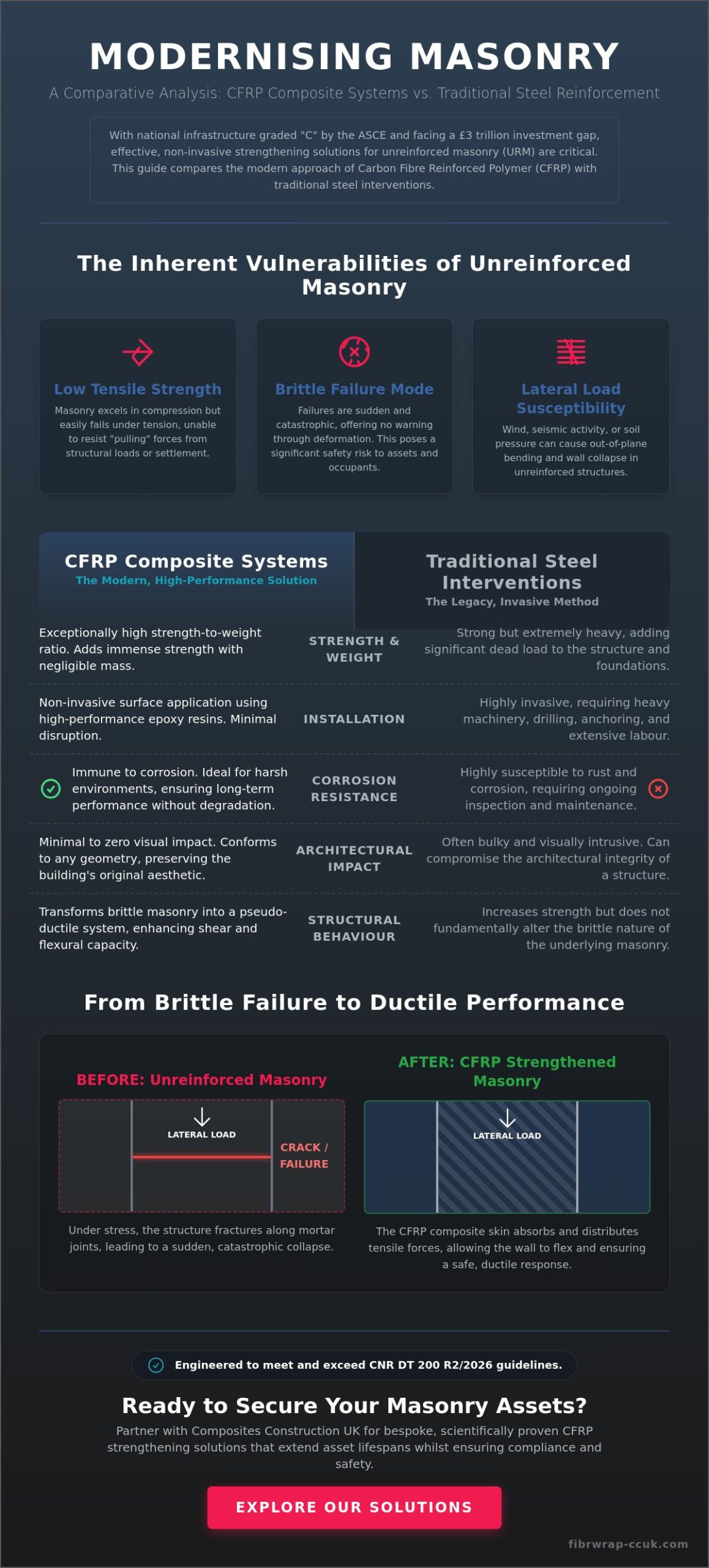
Unreinforced masonry (URM) structures, whilst historically significant and aesthetically enduring, possess inherent mechanical limitations that often necessitate structural intervention. The primary vulnerability lies in the material’s low tensile strength; while masonry excels under compressive loads, it remains susceptible to brittle failure when subjected to lateral forces, settlement, or seismic events. The application of carbon fibre reinforcement for masonry walls serves as a high-tensile composite intervention designed to mitigate these risks. By integrating Carbon-fiber reinforced polymer (CFRP) systems into the existing substrate, engineers can transform a structure’s response from a purely brittle state to a pseudo-ductile performance. This transition is vital for ensuring that assets can withstand dynamic loads without catastrophic collapse.
Traditional masonry often fails to meet modern safety standards, such as the updated CNR DT 200 R2/2026, because it lacks the internal reinforcement needed to manage shear and flexural stresses. When a structure is repurposed or subjected to increased load requirements, the original design parameters are frequently exceeded. This leads to a critical need for external strengthening that doesn’t compromise the building’s footprint or architectural integrity.
Mechanical Deficiencies in Traditional Masonry
Low tensile strength is the primary driver of structural instability in brickwork. Masonry units are essentially held together by gravity and friction; they don’t possess the capacity to resist “pulling” forces. Ageing mortar joints further exacerbate this issue, as chemical leaching and environmental exposure reduce the cohesion between units. This degradation compromises the wall’s ability to distribute loads uniformly, leading to stress concentrations. When lateral forces, such as wind pressure or earth pressure, act upon these weakened planes, they trigger out-of-plane bending. Without reinforcement, the masonry eventually reaches its limit, resulting in sudden, brittle failure modes that offer no prior warning through plastic deformation.
The CFRP Solution: Enhancing Flexural and Shear Capacity
The use of carbon fibre reinforcement for masonry walls functions as a non-invasive structural skin that effectively jackets the masonry. This system relies on the mechanics of tensile load transfer, where the high-modulus carbon fibres absorb the stresses that would otherwise cause the masonry to fracture. High-performance epoxy resins are critical here; they penetrate the porous surface of the masonry units to create a monolithic structural unit. This composite action ensures that the masonry and the CFRP work in unison. By bonding these high-tensile sheets to the tension face of a wall, the flexural capacity is significantly increased. It’s a method that provides a sophisticated alternative to invasive steel ties, allowing for the bespoke engineering of structural resilience in complex environments.
The Mechanics of Bonding: How Carbon Fibre Reinforces Masonry
The efficacy of carbon fibre reinforcement for masonry walls is fundamentally predicated on the integrity of the bond between the composite laminate and the masonry substrate. This relationship is governed by a complex bond-slip mechanism where the transfer of stress occurs through the adhesive interface. An ASCE experimental study highlights that the structural capacity of strengthened masonry is heavily influenced by the “effective bond length”. This is the specific length beyond which any further increase in the bonded area does not contribute to an increase in the ultimate load-carrying capacity. If the bond length is insufficient, the system risks premature debonding, which compromises the intended structural upgrade and the safety of the asset.
Masonry porosity and surface roughness play vital roles in ensuring a successful bond. High-performance epoxy resins must penetrate the pores of the brick or stone to create a robust mechanical interlock. A substrate that is too smooth or contaminated prevents this interlocking, leading to interfacial failure. When correctly applied, the CFRP manages crack propagation by distributing localised stresses across a significantly wider surface area. This prevents the concentration of strain that typically leads to brittle failure in unreinforced sections, allowing the masonry to maintain its structural integrity amongst varying load conditions.
Interfacial Stress Distribution
Shear stress transfer at the masonry-composite interface is the primary mechanism for load redistribution. As the masonry experiences tensile forces, the stress is transferred via the epoxy into the carbon fibres. Factors such as substrate tensile strength and the precise thickness of the adhesive layer remain critical. If the adhesive is too thick, it may introduce additional compliance; if too thin, it may not sufficiently bridge surface irregularities. Engineers must perform precise calculations to determine the necessary reinforcement areas based on the tensile modulus of the specific CFRP system. Ensuring these parameters are met is essential for achieving the pseudo-ductile performance required in modern engineering standards.
CFRP vs. Lateral Restraint Straps
While traditional lateral restraint straps provide essential localised mechanical fixing, they don’t offer the continuous reinforcement provided by carbon wraps. CFRP is often specified for seismic or blast protection where uniform stress distribution is required to prevent wall collapse. However, these technologies aren’t mutually exclusive. In many complex remediations, the synergy between composite reinforcement and existing masonry stabilisation techniques provides the most robust solution. For asset controllers managing ageing infrastructure, a bespoke design assessment is often the most reliable route to ensuring long-term structural security.
Comparative Analysis: CFRP vs Traditional Steel Masonry Reinforcement
The selection of carbon fibre reinforcement for masonry walls over traditional steel sections is often driven by the necessity to minimise dead load on ageing foundations. Structural steel, whilst providing high tensile capacity, introduces significant mass that can exacerbate settlement issues in compromised masonry assets. In contrast, Carbon Fibre Reinforced Polymer (CFRP) possesses a weight-to-strength ratio approximately five times greater than that of steel, allowing for substantial structural upgrades without a corresponding increase in gravity loads. This enables engineers to enhance the shear and flexural capacity of a wall whilst preserving the existing foundation’s equilibrium.
Site access and installation logistics represent another area where composites outperform metallic interventions. Traditional steel reinforcement typically requires heavy lifting equipment, invasive cutting of the masonry substrate, and hot works such as welding. These requirements often lead to significant operational disruption. CFRP systems are applied as flexible, lightweight sheets that conform to the geometry of the structure, requiring minimal plant and allowing for rapid deployment in confined spaces. This efficiency is a primary consideration for asset controllers who must maintain facility uptime during structural remediation.
The sustainability of repair over replacement is a recurring thematic signature of modern infrastructure management. Avoiding the demolition of masonry structures significantly reduces the carbon footprint of a project by sequestering the embodied energy of the original materials. Utilising advanced composites for life-extension aligns with broader environmental goals, as the energy required to produce and install a CFRP system is often lower than that associated with the fabrication and transport of heavy structural steel. Professional bespoke design ensures that these material benefits are maximised for every specific project requirement.
Durability and Life-Extension
Steel reinforcement remains inherently susceptible to corrosion, particularly in aggressive environmental conditions where carbonation or chloride ingress can occur. As steel rusts, it expands, exerting internal pressure that leads to ‘blown brickwork’ and spalling. CFRP is chemically inert and entirely resistant to corrosion, eliminating the risk of expansive damage. Once encapsulated or rendered, these systems are virtually maintenance-free, providing a permanent solution that contributes to the long-term structural life-extension of both modern and heritage assets.
Architectural and Aesthetic Preservation
The low-profile nature of carbon fibre reinforcement for masonry walls, typically featuring a thickness of less than 5mm, allows for discreet structural upgrades that preserve the original character of the building. Unlike bulky external shoring or visible steel plates, CFRP can be applied directly to the substrate and finished with specialist lime mortars or protective coatings. This compatibility makes it an ideal solution for listed buildings where aesthetic preservation is as critical as structural safety, ensuring that the intervention remains invisible to the casual observer.
A Specialist’s Guide to the Installation of Carbon Fibre Reinforcement
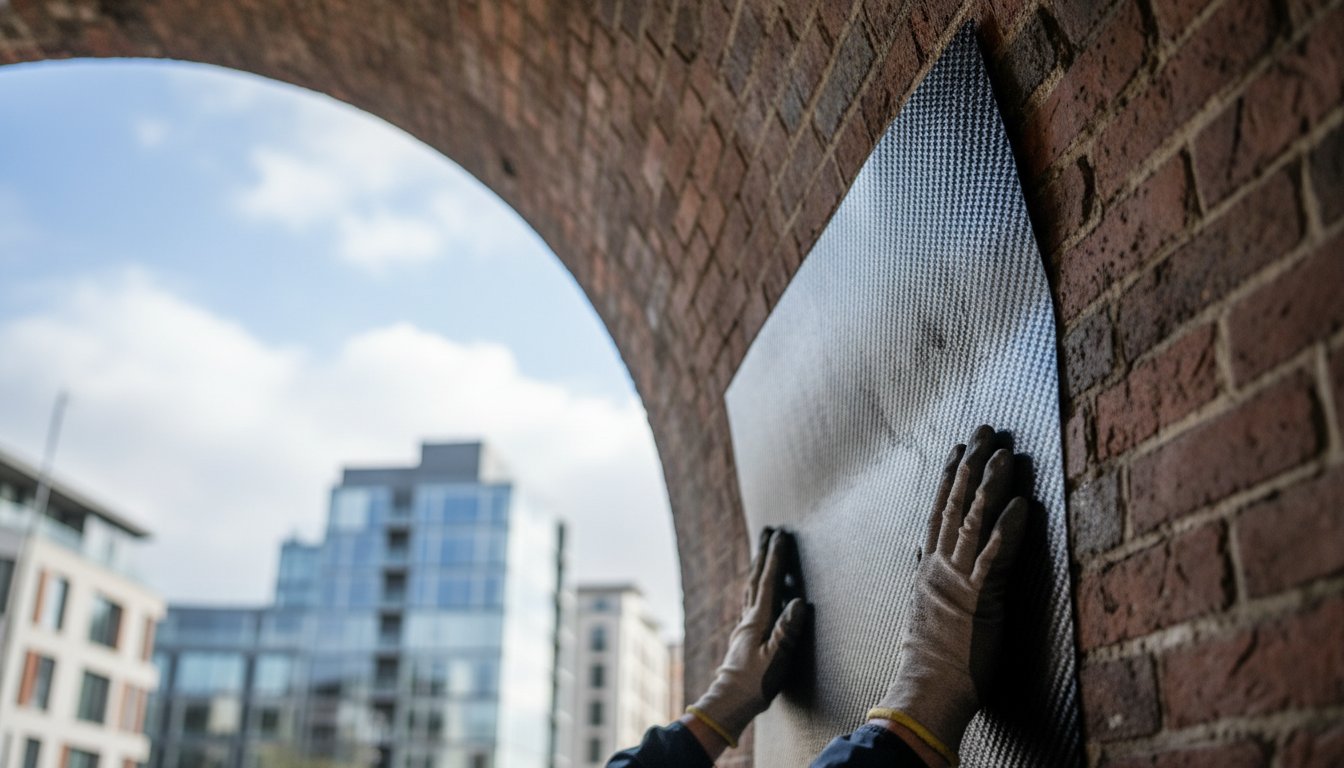
The successful deployment of carbon fibre reinforcement for masonry walls is predicated on the precision of the installation sequence. It begins with a rigorous structural survey and substrate pull-off testing to verify that the base material possesses sufficient tensile strength to support the composite system. If the masonry substrate is too weak, the risk of a shallow-depth concrete or brick failure increases, rendering the reinforcement ineffective. These preliminary tests ensure that the engineering assumptions regarding load transfer are valid before any materials are applied to the asset.
Surface preparation remains the most critical phase of the installation process. All contaminants, including legacy paints, bitumen, efflorescence, or loose mortar, must be removed to expose a clean, sound substrate. Achieving a ‘CSP 3’ (Concrete Surface Profile) through mechanical grinding or grit blasting is essential for ensuring the mechanical interlock of the epoxy resins. Once the surface is prepared, the application of primer and saturant resins must be handled with care to ensure full fibre impregnation. Any dry spots in the carbon fabric represent a point of potential failure where the load cannot be effectively transferred through the composite matrix.
Post-installation quality control is conducted to validate the integrity of the bond. Acoustic sounding, often performed by tapping the cured laminate, allows technicians to identify any hollow spots or delaminations that may require resin injection. Additionally, pull-off verification tests on witness panels provide empirical data on the bond strength achieved on-site. For complex infrastructure projects, you can enquire about our specialist installation services to ensure these technical standards are met.
Substrate Preparation Techniques
Masonry surfaces are often uneven, requiring careful levelling before the carbon fibre is applied. High-strength epoxy grouts are utilised to fill voids and cracks, creating a stable, planar base for the composite sheets. Managing moisture content within the brickwork is equally vital; excessive dampness can inhibit the curing of epoxy resins and lead to bond degradation. Professional installers utilise moisture meters to confirm that the substrate meets the manufacturer’s specified limits. By addressing these environmental factors, the longevity of the carbon fibre reinforcement for masonry walls is secured against interfacial debonding.
Application of the Tyfo® Fibrwrap® System
The Tyfo® Fibrwrap® system is typically applied via a wet-layup process, where the carbon fabric is saturated with resin before being positioned on the wall. It is imperative to ensure correct fibre orientation, aligning the high-tensile strands with the principal stress directions identified in the structural design. When multiple layers are required to achieve the specified structural capacity, precise overlap requirements must be maintained. These lap splices ensure continuity of the reinforcement across the entire treated area, allowing the masonry and composite to function as a unified, resilient structure.
Bespoke Design and Implementation: The CCUK Approach
The application of carbon fibre reinforcement for masonry walls isn’t a commodity service; it’s a precision engineering discipline that requires a high degree of technical authority. Every project necessitates bespoke engineering calculations to account for the specific compressive strength of the masonry units and the anticipated lateral or seismic loads. At CCUK, we integrate the Tyfo® Fibrwrap® system into our remediation strategies, providing a proven composite solution for complex structural challenges. This methodical approach ensures that every intervention is tailored to the asset’s unique requirements whilst maintaining strict compliance with the latest UK building regulations and structural codes.
Collaboration remains a cornerstone of our implementation strategy. By working closely with asset owners and technical professionals, we’re able to organise works in a manner that minimises operational downtime. This is particularly critical in industrial or commercial environments where structural failures must be addressed without halting production or public access. Our role as a specialist contractor is to provide the technical assurance that the structural safety of the building is restored through empirical evidence and rigorous engineering standards. It’s about providing a sense of absolute reliability during the most critical phases of an asset’s lifecycle.
Engineering Consultancy and Design
Utilising bespoke design features allows us to solve structural challenges that traditional methods cannot address. We conduct detailed feasibility studies to compare the cost-benefit ratio of composite repair versus full-scale replacement. Often, the sustainability of extending an asset’s life provides a superior economic and environmental outcome compared to demolition. To validate the performance of our systems, we employ independent testing protocols that confirm the installed CFRP meets the design specifications, ensuring long-term reliability for the structure. This evidence-based approach removes the ambiguity often associated with non-traditional repair methods.
Securing the Future of UK Infrastructure
Our project history includes successful masonry stabilisation across various industrial sectors, where carbon fibre reinforcement for masonry walls has been used to prevent collapse and restore load-bearing capacity. As a specialist engineering contractor, CCUK focuses on the structural life-extension of essential infrastructure, acting as a guardian for assets that would otherwise face demolition. This commitment to science-led remediation ensures that the UK’s built environment remains resilient and functional for decades to come. To discuss your specific structural requirements, please Contact our technical team for a project-specific consultation.
Advancing Asset Resilience Through Composite Engineering
The transition from traditional, invasive structural interventions to advanced composite systems represents a significant shift in infrastructure management. By addressing the inherent tensile deficiencies of unreinforced masonry, the application of carbon fibre reinforcement for masonry walls ensures that ageing assets can meet modern load requirements and seismic safety standards without the dead load penalties of steel. Success is predicated on rigorous substrate preparation and the execution of bespoke engineering designs that prioritise long-term bond integrity and structural coherence.
As the exclusive UK licensee for Tyfo® Fibrwrap®, CCUK provides specialist engineering expertise dedicated to the structural life-extension of critical infrastructure. Our proven track record across the UK built environment demonstrates a commitment to safety and innovation through empirical rigour. For technical professionals seeking to stabilise failing masonry whilst minimising operational disruption, specialist consultancy remains the most reliable path forward. We invite you to leverage our technical history to secure your essential assets.
Request a technical consultation for your masonry reinforcement project to ensure your structures are upgraded to meet the highest safety standards. We look forward to supporting your next engineering challenge.
Frequently Asked Questions
How do you reinforce a masonry wall with carbon fibre?
Carbon fibre reinforcement for masonry walls is achieved through a wet-layup process where high-tensile carbon sheets are bonded to the prepared substrate using epoxy resins. The procedure involves achieving a CSP 3 surface profile through mechanical grinding, followed by the application of a primer and saturant. The carbon fabric is then precisely oriented to align with the principal stress directions identified during the structural design phase to ensure optimal load transfer.
Is carbon fibre reinforcement more expensive than traditional steel methods?
While the raw material costs for Carbon Fibre Reinforced Polymer (CFRP) are typically higher than structural steel, the total project expenditure is often comparable or lower. This is due to the significant reduction in labour requirements, the absence of heavy lifting equipment, and the elimination of invasive structural cutting. Asset owners also benefit from reduced operational downtime, making it a highly cost-effective solution for complex remediations.
Can CFRP be used on historic or heritage brickwork?
CFRP is an ideal solution for heritage assets because it provides a low-profile, non-invasive structural upgrade that preserves the original architectural character. The systems are typically less than 5mm thick and can be encapsulated within specialist lime mortars or protective coatings. This allows for significant strengthening of historic masonry without the visual disruption or weight penalties associated with traditional steel shoring or external plates.
What is the typical lifespan of a carbon fibre masonry repair?
A professionally installed carbon fibre masonry repair is designed to last for the remaining service life of the structure, often exceeding 50 years. Unlike steel, carbon fibre is chemically inert and entirely resistant to corrosion, meaning it won’t degrade in aggressive environmental conditions. Its durability is further enhanced when protected from ultraviolet radiation through the application of suitable topcoats or renders.
How does CFRP improve the seismic resistance of masonry walls?
CFRP improves seismic resistance by increasing the shear and flexural capacity of unreinforced masonry, transforming its behaviour from brittle to pseudo-ductile. The composite jacket prevents the out-of-plane failure and diagonal cracking that typically occurs during seismic events. By distributing stresses across a wider surface area, the system maintains the structural integrity of the wall even under significant dynamic loading.
Do I need to render over the carbon fibre after installation?
Rendering isn’t strictly necessary for the structural performance of the system; however, it’s often recommended for aesthetic integration and ultraviolet (UV) protection. While epoxy resins are robust, prolonged exposure to direct sunlight can lead to surface degradation over several decades. Applying a render, specialist coating, or fire-resistant board ensures the long-term durability of the composite and allows it to blend seamlessly with the existing structure.
What are the primary advantages of CFRP over bed joint reinforcement?
The primary advantage of carbon fibre reinforcement for masonry walls over bed joint reinforcement is its ability to provide comprehensive flexural and shear strengthening across the entire wall surface. Bed joint reinforcement is limited to the horizontal mortar joints and doesn’t effectively address out-of-plane bending or complex stress distributions. CFRP acts as a continuous structural skin, offering significantly higher tensile capacity and more robust stabilisation for failing masonry.
How long does the installation process take for a typical masonry wall?
The installation process for a typical masonry wall is significantly faster than traditional steel interventions, often completed in a fraction of the time. While surface preparation and substrate testing are the most time-intensive phases, the actual application of the carbon fibre sheets is rapid and requires minimal plant. Most projects can be executed without major structural demolition, allowing facility operations to continue with minimal disruption.