
In the high-stakes environment of structural remediation, the distinction between successful asset life-extension and catastrophic site failure often rests upon the empirical rigour applied to temporary works design before a single permanent component is installed. For technical professionals, the management of the interface between compromised existing masonry and new reinforcement is inherently volatile. It’s a reality where regulatory non-compliance doesn’t just result in legal friction but invites the potential for total structural collapse. You’re likely aware that the margin for error has narrowed further with the 2026 increase in Building Safety Regulator oversight, especially for higher-risk buildings requiring robust safety cases.
This technical guide offers an expert-led analysis of how sophisticated engineering controls and strict adherence to the BS 5975-1:2024 and BS 5975-2:2024 standards can eliminate unforeseen delays and mitigate site-specific risks. We’ll examine the seamless integration of temporary and permanent works, focusing on the procedural discipline required to maintain structural stability during complex strengthening projects. By prioritising engineering science over convenience, you can ensure that infrastructure assets are protected throughout their most vulnerable phases of repair.
Key Takeaways
- Understand the 2024 transition of BS 5975 into separate management and design standards to ensure full regulatory compliance on higher-risk projects.
- Recognise why robust temporary works design requires the same engineering rigour as permanent works to prevent catastrophic structural failure during asset remediation.
- Learn how to categorise design checks from Category 0 to 3 to maintain essential independence and objectivity throughout the technical verification process.
- Identify the critical shoring and propping requirements necessary for complex structural interventions, such as bridge nosing and expansion joint remediation.
- Evaluate the operational benefits of an integrated contracting model that coordinates temporary and permanent design to streamline project delivery and enhance site safety.
Defining Temporary Works Design in Structural Engineering
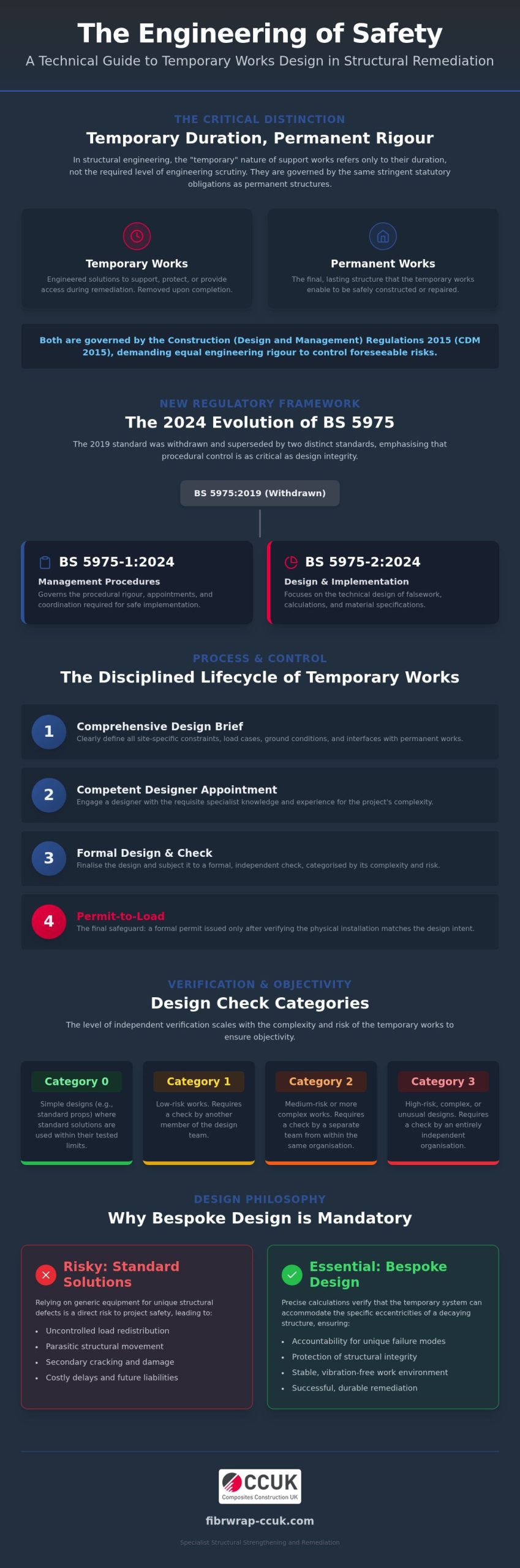
Temporary works are defined as engineered solutions utilised to support, protect, or provide access to an existing structure during construction, remediation, or demolition phases. Whilst these components are removed upon the completion of the permanent works, they are governed by the same statutory obligations under the Construction (Design and Management) Regulations 2015 (CDM 2015). The “temporary” designation refers only to the duration of use, not the level of engineering scrutiny required. In the context of asset life-extension, temporary works design is the primary mechanism for maintaining structural equilibrium whilst the host structure is intentionally weakened for repair or strengthening.
It’s a common misconception that the transient nature of these installations permits a reduction in the factor of safety. In reality, the temporary phase often introduces higher levels of uncertainty regarding load paths and material behaviour. Whether utilising Falsework and Centering to support a bridge deck or complex shoring to stabilise a masonry wall, the engineering rigour must be absolute. CDM 2015 mandates that all designers must eliminate, reduce, or control foreseeable risks; this applies equally to the temporary conditions that enable the permanent solution to be realised.
The Scope of Temporary Works on Strengthening Projects
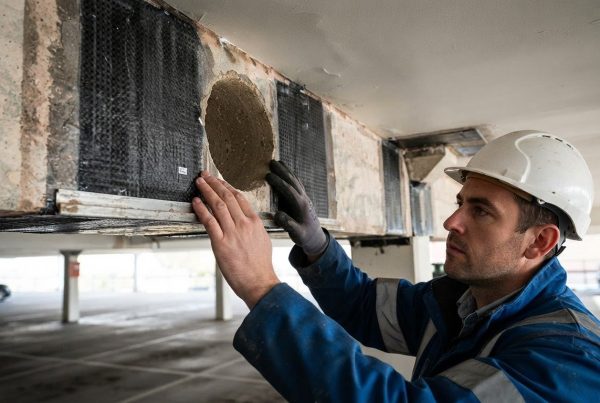
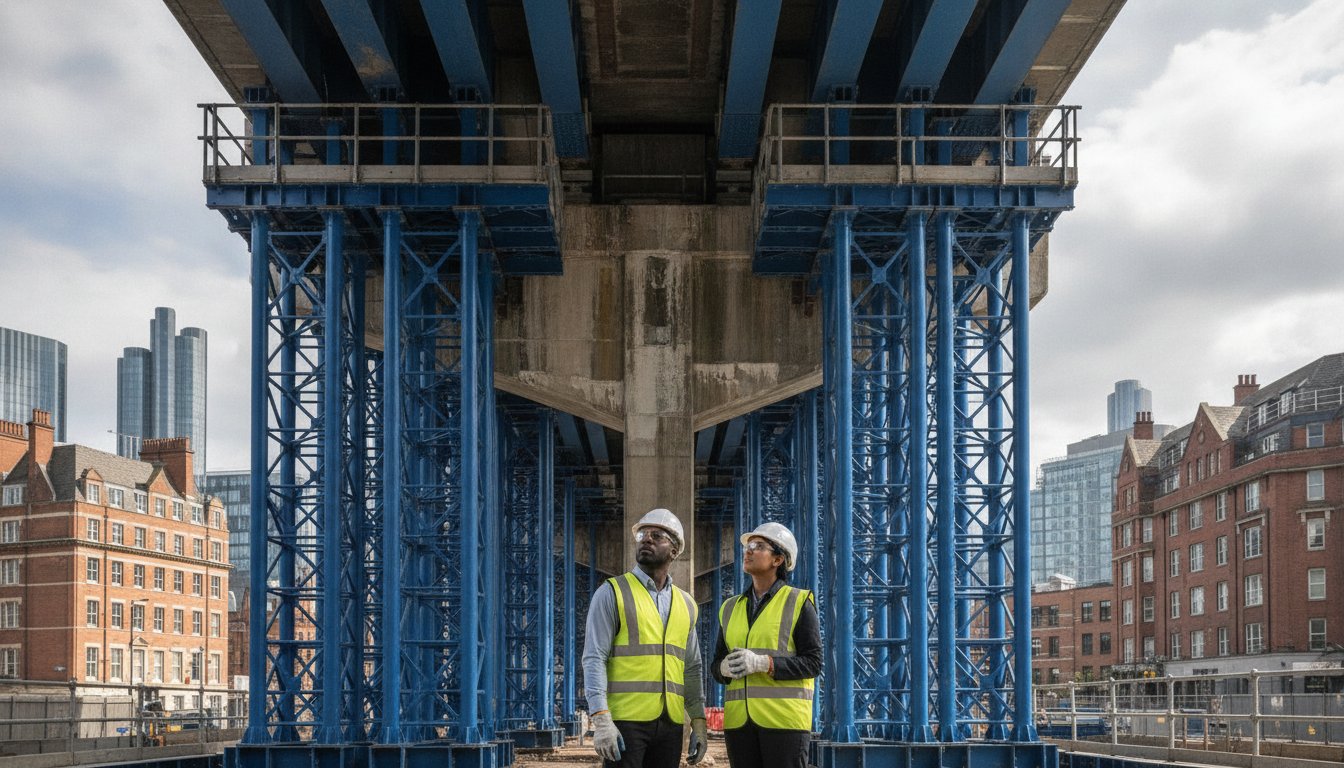
In specialist strengthening projects, the scope of temporary works extends far beyond simple scaffolding. It encompasses heavy-duty propping, lateral shoring, and bespoke access systems designed to facilitate the application of Carbon Fibre Reinforced Polymer (CFRP) or Tyfo® Fibrwrap® systems. These elements create the stable, vibration-free environment essential for the successful bonding of composite materials. They also manage the critical redistribution of loads. By providing alternative load paths, temporary works ensure that the remaining structural capacity of a compromised asset isn’t exceeded during the transitional phase before the new reinforcement becomes fully active.
Why Bespoke Design is Mandatory for Asset Remediation
Relying on “standard solutions” for non-standard structural defects represents a significant risk to project safety. Every compromised asset possesses unique failure modes and material degradations that generic equipment cannot account for. This is where bespoke design becomes essential. Precise calculations verify that the temporary system can accommodate the specific eccentricities and load concentrations of a decaying structure. This level of detail provides more than just safety; it delivers economic value by preventing parasitic structural movement. Even minor shifts during remediation can compromise the bond of new materials or cause secondary cracking, leading to costly delays and future maintenance liabilities. Precise temporary works design ensures the structural integrity of the asset is protected throughout its most vulnerable state.
The Regulatory Framework: BS 5975 and Procedural Control
The regulatory landscape for temporary works in the United Kingdom underwent a significant transition in late 2024. BS 5975:2019 was withdrawn and superseded by two distinct standards: BS 5975-1:2024, which governs management procedures, and BS 5975-2:2024, focusing on the design and implementation of falsework. This bifurcation underscores a critical engineering truth: the integrity of temporary works design is entirely dependent on the procedural rigour surrounding its implementation. Failures in temporary structures rarely stem from a lack of material strength; they are almost exclusively the result of management oversights, such as inadequate design briefs or a failure to coordinate complex interfaces between permanent and temporary elements. Ensuring these management procedures meet statutory requirements is often facilitated by expert consultancies like AFN Industrial Services Ltd, who specialise in health, safety, and environmental compliance.
A disciplined lifecycle is essential for every temporary installation. It begins with a comprehensive design brief that captures all site-specific constraints, followed by the appointment of a competent designer with the requisite specialist knowledge. Once the design is finalised, it must undergo a formal check—categorised by complexity—before a “permit-to-load” is issued. This permit is the final safeguard, ensuring that the physical installation matches the design intent and is safe to support the intended loads. For technical professionals, following this methodical trajectory is the only way to ensure structural stability throughout the remediation phase.
The Role of the Temporary Works Coordinator (TWC)
Procedural compliance isn’t a bureaucratic exercise; it’s a fundamental risk mitigation strategy. Maintaining a live Temporary Works Register is mandatory for specialist engineering projects to track every element from inception to removal. BS 5975 is the industry standard for managing the interface between temporary loads and permanent structures. By following these protocols, project teams can effectively eliminate the management-related failures that lead to site accidents. For projects involving complex structural strengthening, engaging with a specialist who understands these bespoke design requirements is vital for maintaining site stability and long-term asset security.
Critical Applications in Structural Strengthening and Repair
The practical execution of temporary works design is most critical during heavy structural interventions where the primary load paths of an asset are fundamentally altered. In projects involving the remediation of concrete beams or columns, the calculation of load transfers is a sophisticated engineering task that requires a deep understanding of the existing structure’s residual capacity. This is particularly evident in bridge nosing and expansion joint remediation, where temporary systems must provide both vertical support and lateral stability whilst the original joint is removed and the concrete substrate is prepared for new components. The engineering objective is to maintain structural equilibrium, ensuring that the removal of any structural element doesn’t lead to uncontrolled stress redistribution. Where these works interface with the public highway, it is also essential to engage a specialist NRSWA compliance consultancy to ensure that all street works and traffic management protocols are strictly observed.
Propping and Shoring for Load-Bearing Elements
When strengthening load-bearing concrete elements, the use of standard props is rarely sufficient without bespoke engineering calculations. A critical feature of specialist shoring is the requirement for “pre-loading” or pre-stressing props. This process ensures that the temporary support is active from the moment of installation, preventing any structural settlement or deflection that might occur if the prop only became loaded after the structure shifted. In complex scenarios, such as deep excavations or pipeline rehabilitation, the shoring must also account for hydrostatic pressures and varying soil conditions. This necessitates a rigid design that prevents the deformation of the host asset during the repair phase and protects the long-term utility of the infrastructure.
Access and Containment for Composite Application
A robust temporary works design also facilitates the precise installation of Tyfo® Fibrwrap® systems. The application of Carbon Fibre Reinforced Polymer (CFRP) requires a stable, vibration-free platform to ensure the integrity of the bond between the composite and the substrate. In many cases, specialised containment systems are integrated into the access design to provide the controlled environment necessary for resin injection and leak sealing. These systems protect the repair site from environmental contaminants and maintain the temperature and humidity levels required for the resin to cure to its full design strength. It’s essential that these temporary access structures are designed so they don’t impose detrimental secondary loads on the already compromised asset, particularly when containment sheeting increases the wind-load profile of the overall system.
Mitigating Risk Through Engineering Design Rigour
The mitigation of risk in structural remediation is fundamentally predicated on the objectivity of the design verification process. In the United Kingdom, this is formalised through a hierarchy of design checks that ensure every element of the temporary works design is scrutinised in proportion to its complexity and the potential consequences of failure. This rigour is necessary to account for environmental variables, such as peak wind loading on containment systems or the fluctuating bearing capacity of ground conditions, which can introduce lateral instability if not precisely calculated. Design rigour serves as the primary barrier against common failure modes, including buckling, overturning, or the catastrophic loss of structural equilibrium during the transitional phase of repair.
Understanding Design Check Categories (Cat 0-3)
The categorisation of design checks provides a structured approach to technical assurance, ensuring that the level of oversight matches the project’s risk profile. Category 0 and 1 checks are reserved for standard, low-risk designs and may be conducted by another member of the same design team. As complexity increases, Category 2 checks become mandatory, requiring a verification by an individual who wasn’t involved in the original design process to ensure an unbiased perspective. For highly complex or innovative schemes, a Category 3 check is performed by an independent third-party engineering firm. Category 3 checks are essential for any temporary works that support critical national infrastructure. This independent scrutiny ensures that even the most subtle technical oversights are identified before they can manifest as site failures.
The Consequences of Design Negligence
Negligence in the design phase can lead to progressive structural collapse, where a minor miscalculation in a single propping element triggers a chain reaction across the host asset. To prevent such outcomes, accurate temporary works design must be informed by comprehensive structural surveys and testing. These surveys provide the empirical data regarding material degradation and residual strength required to model load transfers with precision. Without this data, designers are forced to rely on assumptions that don’t reflect the physical reality of a compromised structure. By integrating forensic testing with rigorous design checks, the safety of the workforce and the long-term integrity of the asset are maintained. If you require technical assurance for a complex remediation project, contact our specialist engineering team to discuss your bespoke design requirements.
Integrating Temporary Works into Specialist Contracting
The traditional fragmentation of construction projects often leads to a disconnect between the design of temporary supports and the ultimate permanent works, resulting in technical friction that can jeopardise both project timelines and structural safety. Adopting an integrated approach, where a single specialist entity assumes responsibility for the entire structural lifecycle, effectively eliminates these procedural inefficiencies. By consolidating temporary works design within the broader permanent strengthening strategy, engineering teams can ensure that every propping sequence is meticulously synchronised with the phased application of reinforcement. This methodical co-ordination is fundamental for maintaining the equilibrium of essential infrastructure during remediation, significantly reducing the likelihood of unforeseen delays caused by conflicting design intents.
Streamlining the Strengthening Process
Technical friction between main contractors and specialist strengthening teams frequently stems from misaligned engineering priorities. An integrated model allows temporary works to be engineered with the specific requirements of the final CFRP finish in mind, ensuring that access and support systems don’t impede the precise application of composite materials. When the same specialist engineers perform the calculations for both the temporary propping and the permanent Tyfo® Fibrwrap® systems, the potential for over-engineering is minimised, which in turn reduces material waste and project costs. This synergy enables a seamless transition between project phases, as the temporary installations are designed to provide the optimal environment for specialist repairs without compromising the host structure’s residual capacity.
Expert Consultancy for Complex Assets
In high-stakes engineering environments involving historic masonry, industrial pipelines, or critical bridges, the requirement for technical sobriety and empirical rigour is absolute. CCUK utilises bespoke engineering consultancy to deliver end-to-end structural solutions that are grounded in scientific evidence rather than generic site assumptions. The long-term value of appointing a specialist engineering contractor lies in their ability to manage the complex interplay between temporary stability and permanent life-extension. This level of comprehensive oversight provides asset controllers with the reassurance that structural integrity is prioritised at every stage of the remediation process. To ensure your infrastructure project benefits from this integrated expertise, contact our engineering team to discuss your specific temporary works requirements.
Securing Structural Stability Through Technical Rigour
The preservation of critical infrastructure requires an unwavering commitment to engineering discipline, particularly during the high-risk transitional phases of remediation. It’s clear that successful asset life-extension depends on the seamless alignment of management procedures and technical execution. By prioritising bespoke temporary works design and adhering to the updated BS 5975:2024 standards, technical professionals can effectively mitigate the risks of structural instability and regulatory non-compliance. This methodical approach ensures that every propping sequence is precisely calibrated to the residual capacity of the host asset, preventing the progressive failures that stem from procedural oversight.
As the exclusive UK licensee for Tyfo® Fibrwrap® systems, CCUK provides a comprehensive end-to-end design and installation service that bridges the gap between temporary supports and permanent reinforcement. This integrated model ensures that every project benefits from specialist expertise in critical infrastructure life-extension, delivering long-term security for complex assets. You’re invited to consult with our specialist engineers on bespoke temporary works design to ensure your next project is underpinned by empirical rigour. Ensuring the safety of the built environment is a significant undertaking, but with the right technical partner, even the most challenging structural interventions can be executed with absolute confidence.
Frequently Asked Questions
What is the legal definition of temporary works in the UK?
Under the Construction (Design and Management) Regulations 2015, temporary works are defined as any parts of a construction project needed to enable the permanent works to be built. This includes engineered solutions used to support or protect an existing structure during remediation. It’s essential to recognise that these installations, though transient, are subject to the same legal scrutiny as permanent structures to ensure the safety of the workforce and the public.
Why is BS 5975 critical for temporary works design?
BS 5975 provides the primary procedural framework for the management of temporary works design and implementation. Following the 2024 update, the standard is split into BS 5975-1:2024 for management procedures and BS 5975-2:2024 for falsework design. Adhering to these standards is vital for eliminating management-related structural failures by ensuring clear roles, robust design briefs, and independent checking procedures are consistently applied across all specialist engineering projects.
Who is responsible for the safety of temporary works on a construction site?
Responsibility for temporary works safety is shared, but the Temporary Works Coordinator (TWC) holds the central role in managing the technical interface. The TWC ensures that a competent designer is appointed and that a formal design check is completed. Whilst the Temporary Works Supervisor (TWS) monitors the physical installation on-site, the Principal Contractor remains legally accountable under CDM 2015 for ensuring that the entire management system is robust.
What are the different categories of temporary works design checks?
Design checks are categorised by complexity to ensure objective verification. Category 0 and 1 represent simple designs checked by another team member. Category 2 requires a check by an individual not involved in the original design to maintain independence. Category 3 is reserved for highly complex or innovative structures, requiring a check by an independent third-party engineering firm. This hierarchy ensures that technical assurance is always proportional to the structural risk involved.
How do temporary works differ from permanent works in terms of factor of safety?
There is no reduction in the factor of safety for temporary works simply because they’re short-term. In fact, temporary conditions often require a more conservative approach due to the inherent uncertainties of load paths in a compromised host structure. Engineering rigour must be absolute to account for environmental factors like wind loading and ground stability, which can be more volatile during the transitional phases of a structural strengthening project.
Can a specialist contractor provide both temporary and permanent works design?
Yes, an integrated approach where a specialist engineering contractor manages both temporary and permanent design is often the most efficient model. By consolidating these services, technical friction between separate design teams is eliminated. This ensures that the temporary works design is perfectly synchronised with the permanent reinforcement phase, such as the application of Tyfo® Fibrwrap® systems, which effectively streamlines project timelines and enhances overall structural safety during the repair.
What happens if temporary works are not properly designed?
Inadequate design can lead to progressive structural collapse or significant movement within the host asset. Even minor miscalculations can compromise the bond of new materials like CFRP or lead to secondary cracking in masonry. Beyond the immediate physical risks, poor design results in regulatory non-compliance, project delays, and substantial legal liabilities. Rigorous calculations are essential to prevent the catastrophic failure of infrastructure during the most vulnerable phases of remediation.
How does temporary works design affect the cost of a structural strengthening project?
Whilst bespoke engineering design involves an initial investment, it significantly reduces the total cost of ownership by preventing over-engineering and material waste. Precise calculations ensure that the temporary system is exactly suited to the structural requirements, avoiding the expense of excessive propping. More importantly, it eliminates the financial burden of unforeseen site failures or project delays, which can far exceed the cost of professional engineering consultancy and technical assurance.