
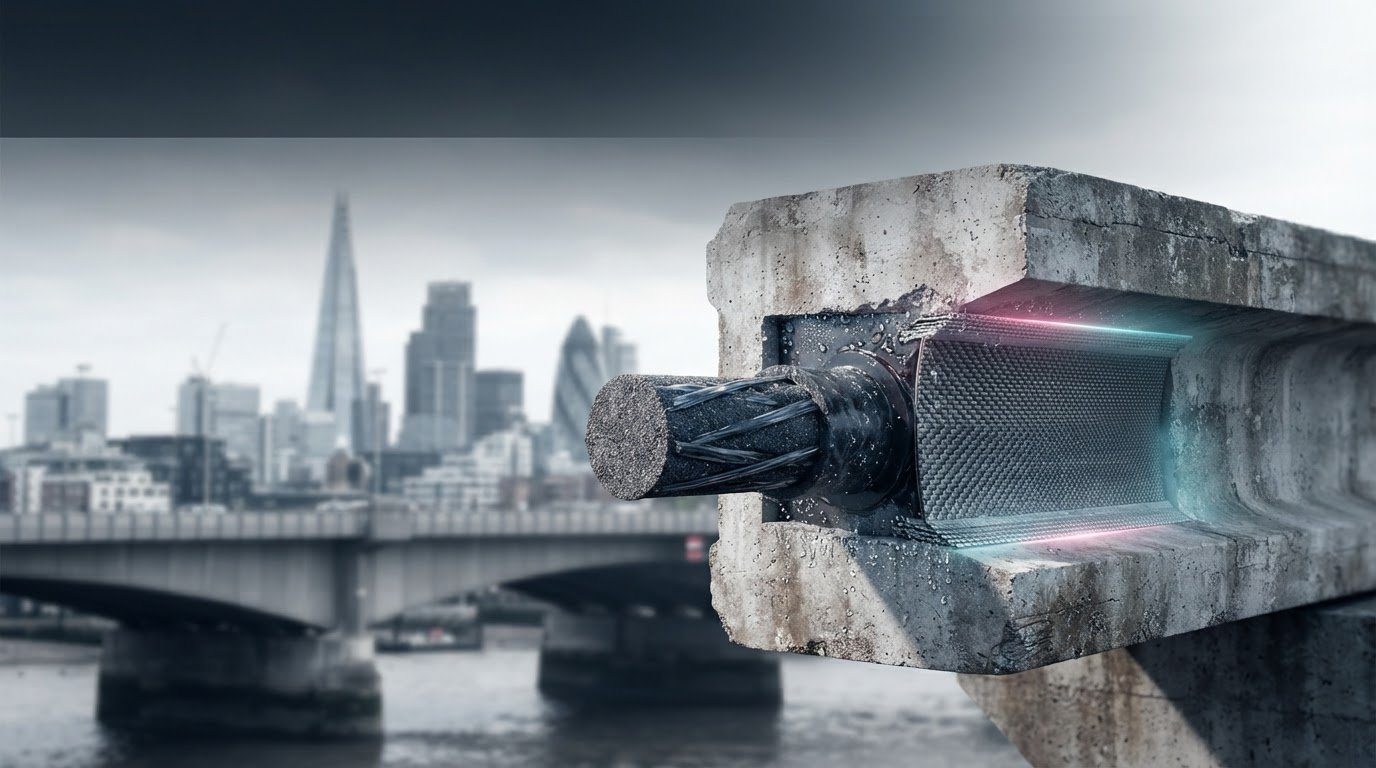
Corrosion resistance alone doesn’t determine the long-term performance of FRP systems. Fibre, matrix and fibre-matrix interface properties all matter, as do moisture and environmental exposure. In long-term durability testing of sand-coated basalt FRP bars, transverse shear strength decreased by 12%, flexural strength by 19%, and interlaminar shear strength retention by 21%. These results describe tested bars, not universal design values for every FRP system.
It is reasonable to expect a lightweight, corrosion-resistant strengthening material to retain its performance over time. In practice, exposure conditions and material behaviour shape how it performs in service. Understanding these influences helps engineers and asset managers assess degradation, structural performance and implications for an asset’s value.
This article explains how fibres, the resin matrix and their interface contribute to durability, and how moisture, ageing and environmental exposure can affect an FRP system. It also covers how testing and monitoring support structural assessment, and why material selection, design and protection matter when the aim is to extend a structure’s functional life.
Key Takeaways
- Assess fibres, matrix and fibre-matrix interfaces together, as their properties all influence composite durability.
- Use accelerated ageing tests alongside mechanical testing and monitoring to build a clearer picture of how performance may change.
- Account for moisture and environmental exposure when evaluating degradation and selecting design or protection measures.
- Distinguish between degradation mechanisms to understand their possible effects on structural performance and maintenance decisions.
- Relate condition assessments to asset value and consider CFRP strengthening when structural upgrades or rehabilitation are required.
Influence of fibres, matrix and fibre-matrix interfaces
FRP durability depends on the fibres, polymer matrix and the interface between them. Each component contributes to load transfer and resistance to environmental exposure in a different way. Fibres carry tensile forces, while the matrix binds them, transfers stress and helps protect them. The interface allows forces to pass between these phases. If one component deteriorates, the composite’s behaviour can change even when the others remain intact.
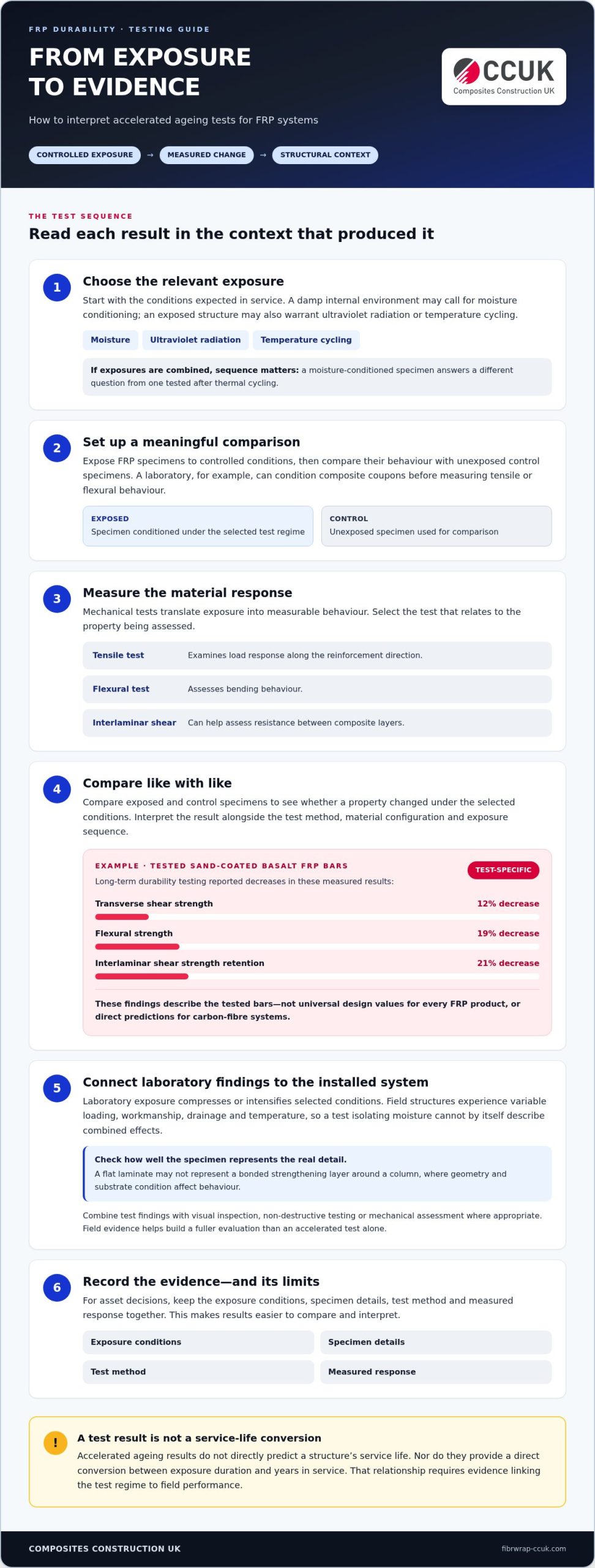
Test results illustrate why material-specific evidence matters. Long-term durability testing of sand-coated basalt FRP bars found a 12% decrease in transverse shear strength and a 19% decrease in flexural strength. It also found a 21% decrease in interlaminar shear strength retention. These figures apply to the tested bars; they should not be treated as universal values for every FRP product or as direct predictions for carbon-fibre systems.
Fibre type and orientation influence how a laminate responds to different loads. A unidirectional layer, for example, carries load most effectively along its fibres, so the design must account for the direction of structural forces. The matrix’s chemistry and condition matter too: cracking or softening can reduce protection and disrupt stress transfer. Weak adhesion or local separation at the interface can also prevent the fibres and matrix from working effectively as a composite.
Structural risk arises when damage interrupts the intended load path. Interface debonding can reduce force transfer between the strengthening layer and substrate, while matrix cracks may let moisture reach the fibres. Fibre damage can also reduce the reinforcement’s contribution. Engineers therefore assess the substrate, bond line, laminate edges and termination zones together. For example, a visible crack near a bonded edge warrants attention because it may indicate local damage or separation, not just a surface blemish.
Inspection and maintenance should focus on visible cracking, debonding, blistering, impact damage and changes near edges or joints. No single inspection interval suits every installation. Inspections should follow the asset’s established structural inspection regime, taking account of exposure, loading and the consequences of failure. After an impact or another event that could damage the strengthening, a targeted assessment can establish whether further investigation is needed.
Managing the interface starts before installation. The substrate must provide a suitable bond surface, and the specified system must suit the design loads and exposure conditions. During assessment, compare observed defects with installation records and baseline condition information, if available. Non-destructive examination or mechanical testing can support the investigation when visual observations alone cannot establish the extent of a suspected defect. This joined-up assessment helps distinguish local repair needs from wider structural concerns.
Accelerated ageing tests
Accelerated ageing tests expose FRP specimens to controlled conditions that represent damaging influences, such as moisture or temperature change. The aim is to observe how material properties respond under defined exposure and compare the results with unexposed specimens. For example, a laboratory can condition composite coupons before measuring tensile or flexural behaviour. The results show comparative changes under that test regime, not a direct prediction of a structure’s service life.
Test design starts with the exposure expected in service. For a damp internal environment, moisture conditioning may be relevant. For an exposed structure, ultraviolet radiation or temperature cycling may also warrant consideration. Combining exposures can help represent interacting effects, but the sequence matters. Testing a moisture-conditioned specimen answers a different question from testing one after thermal cycling.
Mechanical testing translates exposure into measurable material behaviour. Tensile tests examine load response along the reinforcement direction, while flexural tests assess bending behaviour. Interlaminar shear tests can help assess resistance between composite layers. Comparing exposed and control specimens shows whether a particular property changed under the selected conditions. Interpret the results in light of the test method, material configuration and exposure sequence.
Accelerated tests have limits. Laboratory exposure compresses or intensifies selected conditions, while field structures experience variable loading, workmanship, drainage and temperature. A test isolating moisture cannot, by itself, describe the combined effects of moisture, ultraviolet exposure and structural stress. Nor does a laboratory result provide a direct conversion between exposure duration and years in service. Establishing that relationship requires evidence linking the test regime to field performance.
Useful interpretation connects laboratory findings with the installed system. For example, test data for a flat laminate may not represent a bonded strengthening layer around a column, where geometry and substrate condition affect behaviour. Engineers can compare test specimens with installation materials and structural details, then combine the findings with visual inspection, non-destructive testing or mechanical assessment. This provides a more complete evaluation than an accelerated test alone.
For asset decisions, record the exposure conditions, specimen details, test method and measured response together. That sequence makes comparisons between test programmes more meaningful and helps identify which degradation mechanisms need closer attention. Monitoring and sensing can add information about an installed structure, whilst periodic assessments can relate field observations to laboratory findings. Project teams can apply these findings to project-specific FRP design considerations, including material selection and exposure management.
Effects of moisture and environmental conditions
Moisture exposure affects both an FRP composite and the surrounding structure. Water can diffuse through a polymer matrix, while cracks, joints and exposed edges provide local pathways. At a bridge deck, recurring wetting near a strengthening layer’s termination can create different conditions from those across its protected central surface. Assess the whole detail, not just the visible laminate.
At the material level, absorbed moisture can alter the matrix and the bond between fibres and resin. The extent depends on the resin formulation, laminate construction, temperature and exposure duration. A persistently damp soffit, for example, presents a different exposure pattern from a dry internal column. These differences matter because changes in the matrix or interface can affect stress transfer within the composite.
Water can also affect the concrete or masonry beneath bonded reinforcement. Leakage through a joint may carry moisture towards the substrate, where existing cracks or deterioration can affect the bond area. In a concrete beam, a laminate that looks sound does not establish that the concrete behind it is also sound. Assessment should relate surface observations to drainage, leakage paths and substrate condition.
Outdoor installations face more than moisture alone. Ultraviolet radiation can affect exposed polymer surfaces, while temperature variation can cause repeated movement in the composite and substrate. A south-facing external beam and a sheltered internal beam therefore experience different conditions. Protective finishes, detailing and drainage help manage exposure, but their suitability depends on the system and the structure’s setting.
Chemical exposure is another consideration for industrial structures. Depending on the asset’s use and containment, cleaning agents, process fluids or salts may contact FRP surfaces or nearby concrete. For example, assess a pipeline support in a process area against the substances that could reach its strengthening system. The key question is whether the materials and protective details suit the exposure.
Environmental assessment should link exposure sources to observable condition. Record where water collects, whether coatings are damaged, and whether staining or cracking follows a joint or edge. Compare these observations with the structure’s drainage and maintenance history. If adjacent concrete shows deterioration, consider whether concrete repair is needed alongside FRP assessment. This integrated approach helps distinguish surface weathering from changes that may affect the strengthening system’s function.
FRP composite degradation mechanisms
FRP degradation can develop through several mechanisms, each affecting a different part of the composite. Matrix cracking may allow moisture or chemicals to penetrate, while fibre-matrix debonding interrupts stress transfer. Delamination separates laminate layers, and fibre rupture directly reduces reinforcement capacity. These processes can occur together. For example, a local impact may first crack the matrix, creating a route for further deterioration.
Matrix cracking can result from mechanical strain, thermal movement or ageing. A crack across a bonded laminate may be local, but its position and direction matter. Cracks near edges, joints or penetrations can expose the composite more directly. Inspectors should record their location, pattern and relationship to the substrate, then compare them with previous condition records.
Debonding occurs when adhesion between the FRP and substrate, or between fibres and matrix, is impaired. On a strengthened concrete beam, separation at the bond line can prevent effective force transfer even if the laminate appears intact. A hollow response during a suitable sounding survey may indicate a suspected area. Further examination can establish its extent and whether the substrate is also damaged.
Delamination is an internal separation between composite layers. It may follow impact, manufacturing defects or repeated loading, and can be difficult to detect through surface inspection alone. Consider a column wrap struck by equipment: an intact outer surface does not rule out internal layer damage. Non-destructive testing can help investigate suspected delamination, while mechanical testing can characterise material behaviour where appropriate.
Repeated loading introduces fatigue, while sustained loading can contribute to time-dependent deformation in the polymer matrix. A bridge strengthening layer subject to recurring traffic loads experiences a different stress history from a lightly loaded internal element. Assessment should consider load direction, duration and cycling alongside observed defects. These mechanisms can reduce stiffness or load-transfer effectiveness without causing an immediately obvious surface change.
Diagnosing degradation means distinguishing the symptom from its cause. A blister may indicate a coating or bond issue; a crack may relate to impact, movement or material deterioration. Record the defect, its location and nearby environmental or structural conditions. Then combine visual evidence with relevant non-destructive or mechanical testing. This helps determine whether the concern is confined to the FRP, involves the substrate or requires assessment of both.
Long-term structural performance and asset value
Asset value depends on retained structural capacity, maintenance demands and future use. Comparing these factors over time provides a sounder basis for intervention decisions.
Structural performance across service life
Long-term structural performance describes how well a system continues to meet its structural function under service loads and exposure. FRP, steel, concrete and timber behave differently, so comparisons must account for the component’s role. FRP strengthening reinforces an existing structure; it is not a direct substitute for every steel, concrete or timber element. For a bridge beam, assess load capacity, durability, condition and the surrounding structure together. This helps asset managers understand whether the intervention supports continued use.
Lifecycle costs of FRP systems
Lifecycle cost compares installation, inspection, maintenance, access and disruption over an asset’s service period. FRP’s low weight and corrosion resistance can be advantageous where added mass or steel corrosion would affect the intervention. However, preparation, substrate repair, protective detailing and access requirements also influence the overall assessment. Compare equivalent structural functions and exposure conditions, not just material purchase. For an asset-specific comparison, discuss the project requirements with the engineering team.
Typical service life
A typical service life is the period an installed system performs its intended function before intervention becomes necessary. It cannot be expressed as one figure for every FRP installation: resin and fibre selection, design, installation quality, substrate condition and environmental exposure all matter. A protected internal strengthening layer, for example, faces different conditions from an exposed bridge element. Inspection findings and maintenance records help determine whether the system continues to perform as intended and inform asset planning.
Creep, fatigue and strength retention
Creep is time-dependent deformation under sustained load; fatigue is progressive change under repeated loading. In FRP, both depend on material configuration, stress conditions and exposure. A bridge strengthening system under repeated traffic loading therefore requires assessment of its load history, not just a snapshot of its current condition. Strength retention describes how much mechanical capacity remains after exposure or service. Compare relevant test evidence with structural monitoring and inspection findings, then consider the implications for the load path and asset function.
Composites Construction UK: Carbon Fibre Reinforced Polymer (CFRP) Strengthening
Composites Construction UK provides Carbon Fibre Reinforced Polymer (CFRP) Strengthening for structures requiring increased capacity or rehabilitation. Its work includes feasibility studies, bespoke design solutions and professional installation, helping asset teams assess whether strengthening can address a specific structural need.
Tyfo® Fibrwrap® Systems are used on building, bridge and industrial pipeline projects. If deterioration in the concrete substrate affects the strengthening scope, Concrete Repair may also form part of the intervention. Project assessment relates the structure’s condition, loading requirements and exposure to the proposed repair approach.
If an existing asset needs strengthening or rehabilitation, contact Composites Construction UK to discuss the project.
Turn condition evidence into a clear next step
Use inspection and testing findings to guide the next phase of asset management. A documented condition baseline can help teams prioritise further assessment, plan maintenance and evaluate whether strengthening supports the structure’s intended use. Keeping this evidence alongside future inspection records also makes changes easier to track over the asset’s life.
For structural upgrades or rehabilitation, Composites Construction UK provides Carbon Fibre Reinforced Polymer (CFRP) Strengthening and Tyfo® Fibrwrap® Systems. Blast Mitigation Systems are also available when blast protection is part of the structural requirement. The right intervention depends on the structure, its condition and the engineering objective.
A considered assessment can help translate concerns about the long-term performance of FRP systems into practical project decisions. Contact Composites Construction UK to discuss your structure and its strengthening requirements. A well-informed next step can support the continued use of essential assets.
Frequently Asked Questions
How well do FRP systems perform over the long term?
The long-term performance of FRP systems depends on the designed load path, installation quality and conditions in service. An FRP strengthening layer can continue contributing to structural capacity when its bond, substrate and protective details remain effective. For asset managers, the practical measure is whether the system still meets its intended structural function. Compare inspection findings with design assumptions and recorded changes in use, such as increased loading or altered drainage.
How does long-term FRP performance vary by fibre and resin type?
Fibre and resin selection affect how a composite carries load and responds to exposure. Carbon, glass and basalt fibres differ in mechanical behaviour, while resin chemistry influences the matrix’s response to temperature, moisture and chemicals. A comparison should consider the complete laminate, not fibre labels alone. For example, data for a basalt bar cannot automatically represent a carbon-fibre strengthening layer, particularly if the resin, architecture and test conditions differ.
What environmental factors cause FRP systems to degrade over time?
Degradation can be influenced by moisture, ultraviolet radiation, temperature variation, chemical contact, sustained loading and repeated load cycles. Their importance depends on where the system is installed and how exposures combine. A strengthening layer beside a leaking expansion joint, for example, may face persistent wetting and movement, unlike a sheltered internal element. Mapping exposure pathways around joints, edges and penetrations helps focus condition assessments on vulnerable details.
How do UV exposure, moisture, temperature and chemicals affect FRP durability?
Ultraviolet radiation can weather exposed polymer surfaces, while moisture may enter through damaged finishes or accessible edges. Temperature changes can cause movement between the composite and its substrate. Depending on compatibility and contact conditions, chemicals may affect the resin, protective finish or adjacent concrete. For example, a plant-room spill near a bonded laminate calls for assessment of both the exposed surface and surrounding substrate, not just surface cleaning.
What are the common failure modes and risks of ageing FRP systems?
Common concerns include surface cracking, loss of bond, internal delamination, fibre damage and deterioration of the supporting substrate. The structural consequence depends on the defect’s location and the system’s role. Separation near a beam end, for example, may matter more than isolated surface weathering away from critical load-transfer zones. Record defect patterns and locations, then assess whether they affect force transfer, structural capacity or connected elements.
What do UK standards and guidance say about FRP design, durability and service life?
UK guidance and standards address testing, evaluation and design of FRP composites and strengthened structures. They support consistent assessment, but each project still needs criteria suited to its materials, structural configuration and exposure. For example, a specification should link test evidence to the intended application and define how the strengthened element will be assessed. Design assumptions, installation records and inspection findings together provide a more useful basis for ongoing asset decisions than a generic service-life figure.
How does FRP compare with steel, concrete and timber over its service life?
FRP is lightweight, easy to apply and corrosion resistant. Its long-term performance depends on the fibres, matrix, interface and exposure conditions.