

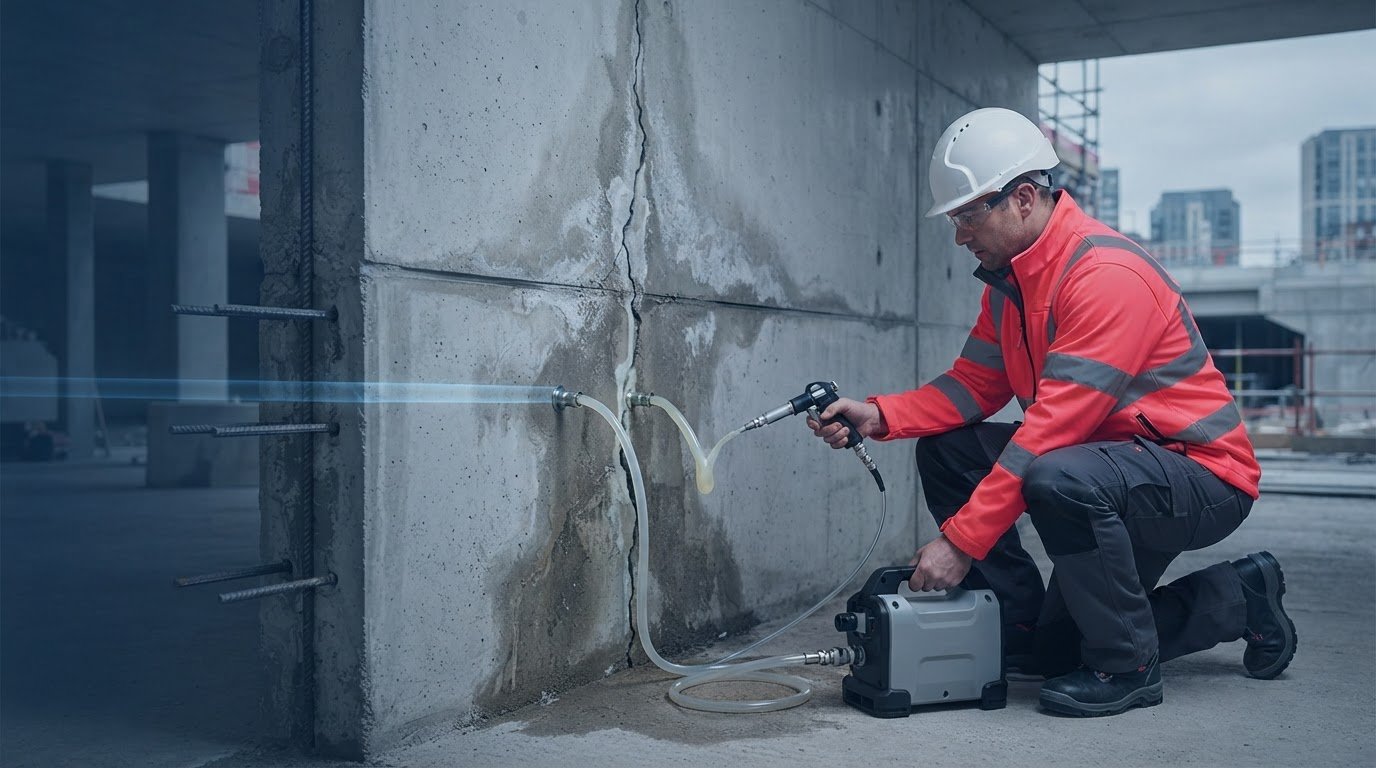
What if the point where water appears isn’t the point where it enters? With concrete leak injection, tracing the route water takes through a structure is as important as selecting an injection material. A visible leak may relate to a crack, construction joint or void, and sealing only the apparent exit point may leave another part of the water pathway untreated.
It’s reasonable to want a repair that stops ingress, but leak sealing and structural crack repair have different objectives. Injection can seal a water pathway. Whether it also contributes to structural repair depends on the defect, the concrete’s condition and the outcome the repair is intended to achieve.
This guide explains how concrete leak injection works, what influences the choice of approach and what information helps engineers assess and specify remedial work. It also explains how specialist leak sealing can fit within a wider concrete repair or structural rehabilitation strategy, so you can make informed decisions about the next steps for an affected asset.
Key Takeaways
- Concrete leak injection is intended to seal a water pathway. It doesn’t automatically restore the concrete’s structural capacity.
- Diagnosis should guide the repair approach. The leak’s location and behaviour, the substrate and the asset’s function all matter.
- Distinguish leak sealing from structural crack injection and broader concrete repair by defining the objective before specifying the work.
- Record leakage patterns, access constraints and asset context to help engineers assess the defect and develop a project-specific scope.
- Specialist concrete leak injection and leak-sealing systems can form part of a wider concrete repair strategy.
Concrete leak injection: what it is and its purpose
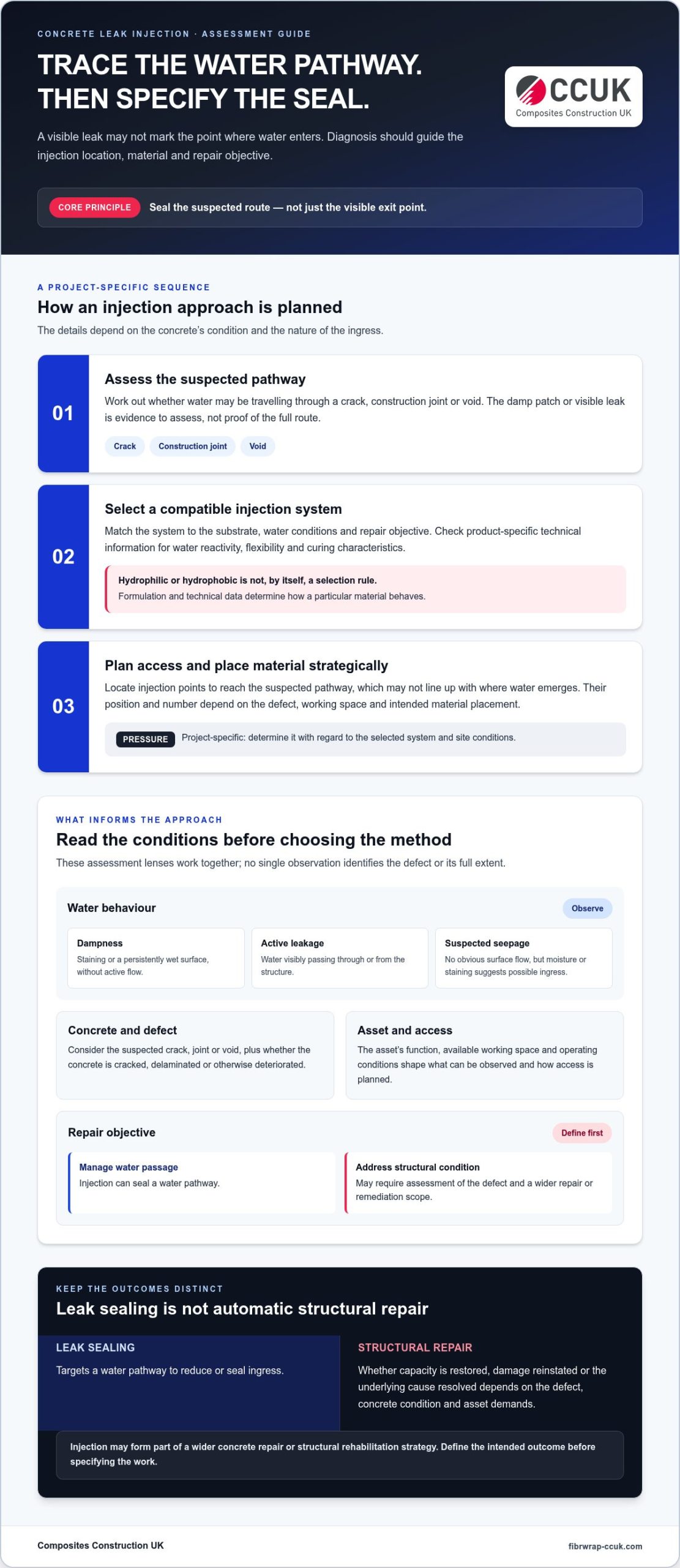
Concrete leak injection is a targeted repair method that introduces material into a crack, joint or void to reduce or seal a pathway for water ingress. The injection location and material are selected in response to the suspected route and the repair objective. Sealing water is not, by itself, proof that the concrete’s structural capacity has been restored.
Visible moisture can indicate different conditions. Dampness may appear as staining or a persistently wet surface without water actively flowing. Active leakage means water is visibly passing through or from the structure. Suspected seepage may have no obvious surface flow, although moisture or water staining suggests that ingress could be occurring. These observations help describe the problem, but none identifies the defect or its full extent on its own.
Where water ingress can occur in concrete structures
Cracks, construction joints and voids can provide routes through concrete, but seeing one does not establish the cause of a leak. A crack may be associated with movement or deterioration; a joint may be allowing water through its interface; and a void may form part of a more complex defect. Assess each in context, including the concrete’s condition and the asset’s function.
In a building basement, for example, water may become visible at a wall-floor junction even if its route began elsewhere. In a transport tunnel, moisture could emerge some distance from where water entered the surrounding structure. In a pipeline asset, leakage may involve a joint or local defect, with access and operating conditions shaping what can be observed. Water can travel through connected cracks, interfaces or voids before reaching an exposed surface, so the wet patch is not necessarily the right injection point.
Concrete can also be designed or modified to address cracking through approaches such as self-healing concrete. This is a broader material concept, distinct from targeted injection into an identified water pathway.
Leak sealing and structural repair are not identical outcomes
Stopping or reducing ingress addresses a water-management objective. It does not establish that a crack is structurally acceptable, that damaged concrete has been reinstated or that the underlying cause has been resolved. Those questions depend on the defect, the extent of deterioration and the demands placed on the asset.
Assessment may need to establish whether the concrete is cracked, delaminated or otherwise deteriorated, and whether the repair must address more than water passage. Depending on the condition and function of the asset, the scope could include leak sealing alongside concrete repair or other structural remediation.
For an overview of how broader interventions fit together, see this guide to concrete repairs and structural remediation. Defining the intended outcome first helps ensure injection is specified as a targeted part of the repair strategy, rather than treated as a substitute for assessing the structure.
How concrete leak injection works: materials, pathways and sealing
Concrete leak injection is planned around the route water is believed to follow, not simply the surface where it appears. The general sequence is to assess the suspected pathway, select a compatible injection system for the substrate and repair objective, then deliver material through strategically located injection points. The details depend on the concrete’s condition and the nature of the ingress. There is no single material or layout suited to every defect.
Before specifying a system, assess whether water is actively flowing, entering intermittently or appearing as dampness. Consider the likely crack, joint or void and the function of the affected asset. This helps establish whether the immediate requirement is to manage water passage, address a crack for another purpose, or include injection in a broader repair. Check material behaviour, including its interaction with water, flexibility and curing characteristics, against the technical documentation for the selected system.
Hydrophilic and hydrophobic leak sealing
Hydrophilic and hydrophobic describe different relationships with water: broadly, attraction to water and resistance to it. These terms alone don’t establish how a particular injection material will behave or whether it suits a given leak. Formulation and product-specific technical data determine characteristics such as water reactivity, expansion, flexibility and curing. CCUK provides hydrophilic and hydrophobic leak-sealing services, with the approach selected in relation to the assessed condition and required repair function.
Neither category is a universal answer. A system’s suitability depends on the substrate, the pathway, the water conditions and the purpose of the intervention. Where performance depends on a particular material response, verify that response from the relevant technical documentation rather than inferring it from the hydrophilic or hydrophobic label alone.
Injection points, pressure and material placement
Injection access is planned to reach the suspected pathway, which may not line up with the visible point where water emerges. The number and position of access points depend on the defect’s shape, available working space and the intended placement of the material. Pressure is also project-specific. It must be determined with regard to the selected system and site conditions, not treated as a universal setting.
In broad terms, the injection sequence involves preparing the required access, introducing material in a controlled manner and observing how it moves through the identified route. The method and any acceptance criteria should be defined for the project. A change in visible leakage during delivery can inform site decisions, but doesn’t, by itself, prove that the whole pathway has been sealed or that structural requirements have been met.
CCUK’s resin injection and leak-sealing work can be considered alongside concrete repairs where the asset’s condition calls for a wider scope. A specialist assessment can help define the technical requirements in relation to the observed ingress and the structure’s function.
Choosing an injection approach: diagnosis, leakage and repair objectives
Start with the repair objective, not a preferred injection material. For concrete leak injection, engineers need to relate what is observed to the suspected pathway, the condition of the surrounding substrate and the asset’s function. Active flow, intermittent dampness and suspected seepage raise different questions. Access constraints and evidence of wider deterioration can also change the scope.
| Intervention | Primary objective | Assessment focus |
|---|---|---|
| Leak sealing | Reduce or seal water passage through an identified pathway. | Leak behaviour, likely route, substrate condition and access for injection. |
| Crack injection | Address a crack in line with the specified repair function. | Crack characteristics, concrete condition and whether the requirement is water control, structural repair or both. |
| Broader concrete repair | Remediate deterioration or damage beyond the immediate water pathway. | Extent of affected concrete, asset function and the intended performance of the overall repair. |
This comparison is a guide for discussion, not a specification or substitute for engineering assessment. The categories can overlap: injection may be one part of a repair scope, but the required outcome must be defined before methods and materials are selected.
What the observed leak can and cannot tell you
A visible exit point identifies where water is reaching the exposed surface, not necessarily where it entered or the full route it has travelled. Flow, staining and location are useful observations, but none confirms the defect’s cause or the structural condition of the concrete. A stain may remain after active flow has stopped, while intermittent moisture may vary with conditions at the asset.
Record what you can observe, then frame the assessment around questions such as:
- Is water flowing now, appearing intermittently, or showing only as dampness or staining?
- Does the location or visible behaviour change over time?
- Are nearby joints, cracks or areas of damaged concrete also present?
These details help distinguish evidence from assumptions. Appearance alone cannot establish whether a crack is structural, whether deterioration extends beyond the wet area, or where injection access should be placed.
When leak sealing may sit within a wider repair
Where inspection identifies damaged concrete or deterioration beyond the water pathway, water exclusion may not address the full repair requirement. The scope should reflect the asset’s purpose and the intended result, including whether the work is limited to leak control or must also consider concrete reinstatement or structural remediation.
For example, a leak at a joint may warrant sealing, while adjacent deterioration could require separate assessment and repair. Injection alone doesn’t establish load capacity or resolve every defect. Defining the relationship between the leak, the substrate and the asset’s function allows leak sealing to be specified as a targeted intervention within a wider concrete repair strategy where necessary.
What to expect during concrete leak injection assessment and delivery
A sound repair process links observations at the structure to a defined scope, a project-specific method and a review against the intended outcome. Concrete leak injection is not a fixed sequence applied identically at every site. Access, operating requirements, substrate condition and the specified system all shape how work is assessed and delivered.
A typical assessment-to-delivery sequence may include:
- Compile available information. Record where water is visible, whether it flows or appears intermittently, and any changes observed over time. Drawings, previous inspection records and relevant maintenance history can help put the leak in context.
- Assess the structure and constraints. Review the affected area, access for inspection and work, and the asset’s function. Operating requirements may influence where and how the assessment can be carried out.
- Define the repair scope. Relate the observed ingress and substrate condition to the required outcome, then specify the repair system and method for the site.
- Deliver and review the work. Preparation, injection and subsequent review follow the project-specific method and technical specification, with the review focused on the agreed objective.
Information that helps establish the repair scope
Useful records include the leak’s precise location, visible flow or staining, when symptoms occur and whether their pattern changes. Note practical constraints such as restricted working space, access to the affected face and any operating requirements for the asset. Drawings and maintenance history, where available, can help relate the affected area to the wider structure, but no single record or observation is sufficient for every assessment.
Photographs can help record visible conditions, particularly if taken from consistent viewpoints over time. They don’t replace inspection, but they may help describe changes between site visits. The assessment method should reflect the structure and the information needed to define a suitable scope.
From injection work to review of the repaired area
Before delivery, the specified method should set out the relevant preparation, injection approach and review process. The work sequence depends on the selected system and site conditions. Don’t assume access arrangements, disruption or duration will be the same from one asset to another. Any review should relate to the stated objective, such as assessing water ingress at the treated area, rather than implying broader structural performance without supporting assessment.
Acceptance criteria are project-specific and should be established in the technical specification. Observations made during or after the work can inform that review, while any remaining or changing signs of water should be considered against the agreed scope. A review of leak sealing does not, by itself, confirm that separate structural repair requirements have been met.
For an assessment and repair scope shaped around the structure’s condition and requirements, contact CCUK about concrete leak injection.
How CCUK approaches concrete leak injection and specialist leak sealing
CCUK provides concrete repair, crack injection systems and specialist leak sealing using hydrophobic and hydrophilic approaches. The company’s resin injection and leak-sealing work is considered in its engineering context: the condition and function of the affected asset, the observed leakage and the outcome required. This helps establish whether leak sealing is the primary scope or whether injection should be considered alongside wider concrete repairs.
CCUK delivers specialist engineering services nationally across the UK for Buildings, Transportation Infrastructure, and Power, Energy & Pipelines. For each asset, the repair scope is tailored to project requirements rather than determined by the visible leak alone. Relevant considerations include the suspected pathway, substrate condition, access and whether the work needs to address water ingress, concrete deterioration or both.
Leak sealing within a wider concrete repair strategy
Leak sealing may be specified as a focused intervention or considered alongside concrete repair where the surrounding material is damaged or deteriorated. The scope should distinguish the water-control objective from any separate requirements for concrete reinstatement or structural repair. Injection is not, by itself, evidence of restored load capacity, so the relationship between leak sealing and the wider repair objective needs to be clearly defined.
Where appropriate, a coordinated repair strategy can support the continued use of an asset and help extend its functional life. That is an engineering objective, not an assured result. The approach depends on the assessed condition, the work specified and the demands placed on the structure.
Discussing a project with a specialist contractor
For an initial technical discussion, useful information includes the asset type and function, the location and behaviour of the leakage, any known access constraints and the repair outcome being sought. Drawings, inspection records or maintenance history can add context where available. These details help frame the engineering requirements; they don’t replace assessment of the structure or determine a repair method on their own.
CCUK’s experience in structural strengthening and concrete repair spans over 25 years. That background informs a project-specific scope, whether the requirement is leak sealing, crack injection, concrete repair or a combination of these services. The intervention is considered in relation to the asset, with the aim of addressing the identified need through a suitable repair strategy.
To discuss a concrete repair project, share the asset context and observed leakage with CCUK. A clear description of the intended outcome provides a practical starting point for considering the project’s engineering requirements.
Set the next repair decision in context
Turn observations into a defined engineering objective before specifying concrete leak injection. Consider what the asset needs the intervention to achieve and whether the visible ingress sits within a wider repair requirement. A clear scope helps keep water control, concrete condition and structural performance distinct, while allowing related work to be considered together where appropriate.
CCUK brings over 25 years of expertise in structural strengthening, concrete repair and carbon-fibre strengthening. Its relevant services include concrete repairs, crack injection systems, and hydrophobic and hydrophilic leak sealing. This enables the repair scope to be considered in relation to the asset, rather than treating the leak as an isolated issue.
Share the asset context, observed leakage and intended outcome with CCUK to start a project-specific discussion. Discuss your concrete repair and leak-sealing requirements with CCUK and take the next step towards a considered repair strategy for your structure.
Frequently Asked Questions
What is concrete leak injection?
Concrete leak injection is a repair technique that introduces a suitable material into a crack, joint or void to control water ingress. The injection plan relates access points to the suspected route through the concrete, which may differ from the visible damp patch. The repair brief should specify whether the intended result is water control, crack repair or part of a broader intervention, since these objectives are not interchangeable.
Can concrete leak injection be used when water is actively entering a structure?
It may be considered for active leakage, but suitability depends on the observed flow, the pathway, the substrate and the selected injection system. For example, concentrated flow at one location presents a different assessment question from moisture appearing intermittently along a longer joint. Record when and where water is entering, then use those observations to inform the project-specific method. Active leakage alone doesn’t determine the appropriate material or establish that injection is suitable.
How do hydrophilic and hydrophobic leak-sealing systems differ?
The terms describe how a material relates to water: hydrophilic materials are water-attracting, while hydrophobic materials are water-repelling. Those labels don’t, on their own, specify how a particular system behaves during installation or after curing. For a project, use the relevant product documentation to assess its stated properties and intended use. Selection also needs to account for the actual leakage condition and the function required from the repair.
Does crack injection always restore the structural strength of concrete?
No. Injection may be specified to control water ingress or meet a particular crack-repair objective, but the fact that a crack has been injected doesn’t establish the structure’s capacity. For example, a dry, filled crack may still require assessment if it is associated with movement, damage or a wider structural concern. The repair specification should identify whether structural performance is an objective and what assessment is needed to verify it.
What information is useful when assessing a concrete leak?
Provide a marked-up plan or clear description of the affected location, together with dated photographs if available. Note whether the water is flowing, intermittent or visible only as staining, and record changes after rainfall, operation or other relevant site conditions. Previous repair records can help identify whether the same area has been treated before. Also describe access restrictions and how the affected structure is used, since these details help frame the assessment.
Can injection seal water entering through a construction joint?
Injection may be considered where assessment indicates that a construction joint is providing a route for water, but the joint’s presence alone doesn’t determine the method. Its length, accessibility, condition and relationship to nearby cracks or interfaces can all affect the repair scope. A useful site record identifies the affected section and whether moisture appears along the joint or at a localised point. The proposed intervention should then be specified for the assessed pathway and objective.
What happens if water ingress returns after injection?
Returning water calls for a fresh assessment, not an assumption that the original injection point is the only issue. Record where it reappears, when it occurs and whether the pattern differs from the original leak. Water may be emerging through another part of a connected pathway, or the repair scope may need review against the observed conditions. Comparing current evidence with the original site records helps inform whether further investigation or a revised intervention is appropriate.