
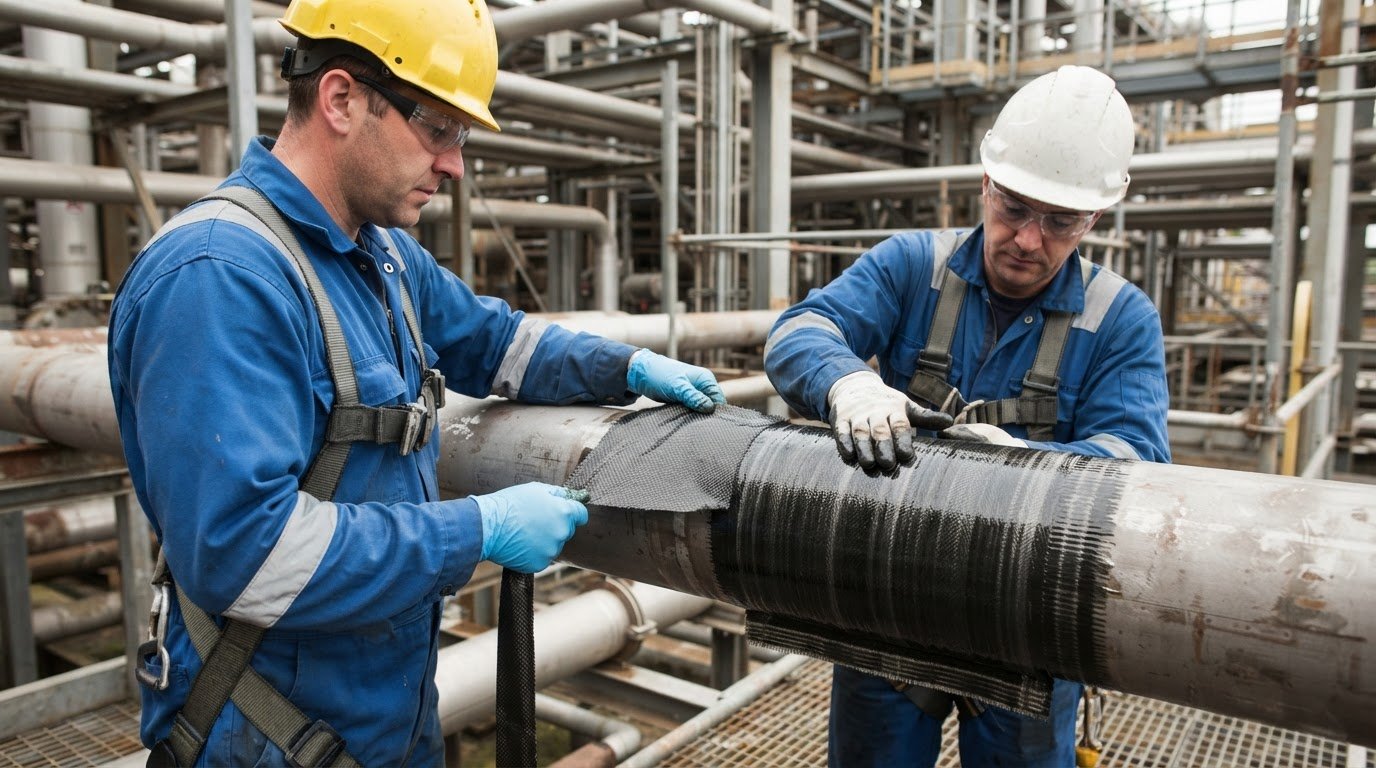
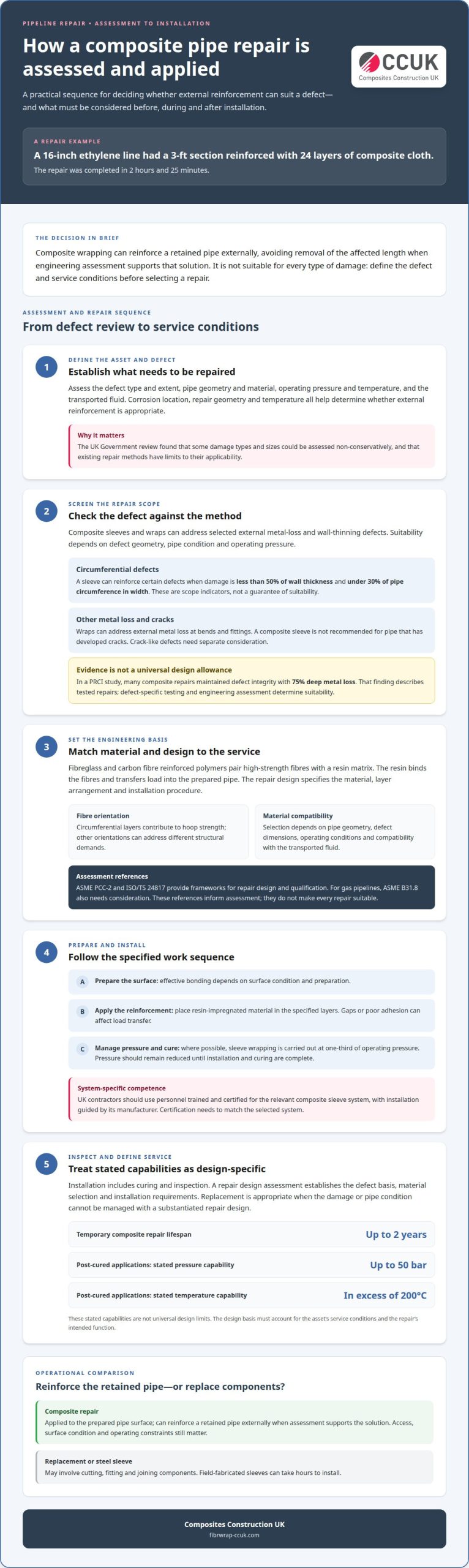
A repair can be significant because it restores a section of pipe without replacing it. One example of composite pipeline repair involved a 16-inch ethylene line: a 3-ft section was reinforced with 24 layers of composite cloth, with the repair completed in 2 hours and 25 minutes.
For asset teams, choosing a composite pipeline repair means weighing the defect, operating conditions and the consequences of taking equipment out of service. Composite materials offer an alternative to conventional repairs, but they are not suitable for every type of damage.
This article explains which pipe problems composite repairs can address, how they compare with traditional options, and how fibreglass and carbon fibre reinforced polymers provide structural support. It also looks at the development of engineered composite repair systems and what their history means when assessing their role in pipeline rehabilitation.
Key Takeaways
- Learn which defect characteristics help determine whether a composite wrap or sleeve is appropriate, and when damage calls for a different repair approach.
- See how assessment under ASME PCC2 and ISO 24817 helps frame decisions about repair design and suitability.
- Understand how fibreglass and carbon fibre reinforced polymers contribute to pipeline rehabilitation, and what material compatibility means in practice.
- Trace the development of engineered repair systems to understand how their established use informs today’s maintenance and rehabilitation decisions.
What are the advantages of using composite repairs over traditional repair methods?
A composite pipeline repair can reinforce a retained pipe externally, avoiding removal of the affected length when engineering assessment supports that solution. Traditional replacement or steel-sleeve methods may involve cutting, fitting and joining components. Field-fabricated sleeves can take hours to install. Composite wrapping is applied to the prepared pipe surface, so access, surface condition and operating constraints all affect the comparison.
Assessment should establish the defect type and extent, pipe geometry, material, operating pressure, temperature and transported fluid. ASME PCC-2 and ISO/TS 24817 provide reference frameworks for evaluating composite repair design and qualification. ASME PCC-2 compliance testing should relate to the repair system and its installation procedure, rather than the fibre type alone. For gas pipelines, ASME B31.8 also needs consideration within the applicable engineering review. These standards and code references inform the assessment; they do not make every repair suitable for every defect.
A temporary composite repair can provide a service lifespan of up to 2 years. After post-curing, composite repairs can operate at pressures up to 50 bar and in excess of 200°C. These stated capabilities describe post-cured applications, not universal design limits. The design basis must account for the asset’s service conditions and the repair’s intended function.
Installation planning also shapes the operational comparison. Where possible, composite sleeve wrapping is carried out at one-third of operating pressure, and pressure should remain reduced until installation and curing are complete. The UK Government review found that some damage types and sizes could be assessed non-conservatively, and that existing repair methods had limits to their applicability. This underlines the need to define and assess the defect before selecting a repair. Corrosion location, repair geometry and temperature help determine whether external reinforcement is appropriate to restore integrity.
What type of pipe repairs do composite fibre products typically address?
Composite sleeves and wraps can address selected external metal-loss and wall-thinning defects. Suitability depends on the defect geometry, pipe condition and operating pressure.
Sleeves and Wraps for Pipeline Defects
A sleeve can reinforce certain circumferential defects when damage is less than 50% of wall thickness and under 30% of pipe circumference in width. Composite wraps can also address external metal loss at bends and fittings. These limits help define the repair’s scope; they don’t establish suitability for every pipe or operating condition.
A composite sleeve is not recommended for damaged pipe that has developed cracks. For a defect assessed as suitable, installation involves surface preparation, applying the specified material in layers, curing and inspection. Pressure management during installation and curing is part of the work sequence.
Repairing Non-Through-Wall Defects
Non-through-wall metal loss can be assessed for reinforcement, including deep defects. In a PRCI study, many composite repairs maintained defect integrity with 75% deep metal loss; this finding describes tested repairs, not a universal design allowance. Defect-specific testing and engineering assessment determine whether the repair method suits the pipe and its service.
Crack-like defects need separate consideration. Severe cracks subject to heavy pressure cycling are treated as temporary repairs, while permanent repairs can suit cracks with low penetration and reasonable cycling conditions. Monitoring should therefore account for crack behaviour and pressure cycles. ASME PCC-2 and ISO/TS 24817 provide repair-assessment references; ASME B31.8 may also inform gas-pipeline design. Applicable UK requirements depend on the asset and project basis.
Suitability and Replacement Decisions
A composite repair may suit a defect if assessment shows that external reinforcement can preserve the pipe’s structural integrity. Replacement is appropriate when the damage or pipe condition cannot be managed with a substantiated repair design. Risks include an unsuitable design, inadequate surface preparation or installation that does not follow the specified procedure.
UK contractors should use personnel trained and certified for the relevant composite sleeve system, with installation guided by its manufacturer. Certification is system-specific, so the contractor’s competence needs to match the selected repair. A repair design assessment can establish the defect basis, material selection and installation requirements before work proceeds.
Fibreglass and carbon fibre reinforced polymers
Fibreglass and carbon fibre reinforced polymers combine high-strength fibres with a resin matrix. In a pipeline wrap, the resin binds the fibres and transfers load into the prepared pipe section. Fibre orientation matters: circumferential layers contribute to hoop strength, while other orientations can address different structural demands. The repair design therefore specifies the material, wrap arrangement and installation procedure for the defect.
Carbon-fibre reinforcement is selected when the design calls for the properties of carbon fibre, while fibreglass offers another reinforcement material. Neither is a universal choice. Selection depends on pipe geometry, defect dimensions, operating conditions and compatibility with the transported fluid. For piping exposed to external corrosion, assessment also considers the remaining pipe wall and whether the surrounding surface can support effective bonding.
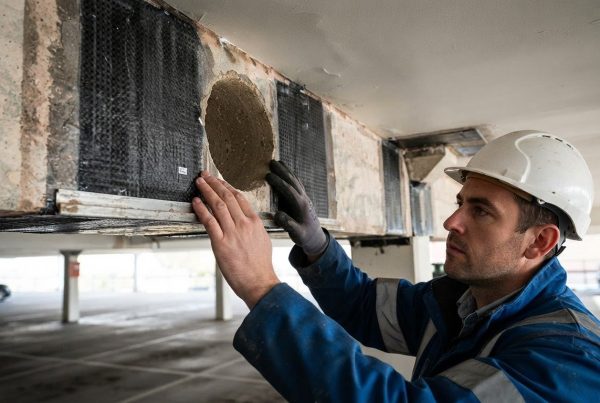
During installation, the affected section is prepared before resin-impregnated reinforcement is applied in specified layers. Each layer contributes to the designed load transfer, so gaps, poor adhesion or inconsistent application can undermine the intended performance. The system’s curing requirements must be followed before the repaired section returns to service. These steps make workmanship and design integral to material selection.
Engineered fibre-reinforced polymer systems began transforming pipeline repair in the 1980s. Their use developed from simple wrapping into designed reinforcement systems, in which fibre type, orientation and coverage are matched to the pipe’s structural requirements. This distinction matters: a wrap is not simply a protective covering, but a composite assembly intended to restore capacity in a defined section.
Permanent use depends on the repair design and operating conditions, not simply on whether the material is labelled “carbon” or “fibreglass”. Assessment considers pressure cycling, fluid compatibility, temperature and defect behaviour. A repair intended to reinforce external corrosion must also account for the pipe’s condition beyond the visible damage. This ensures that material selection and reinforcement design address the same structural problem.
History of engineered composite pipeline repair
Engineered composite repair systems date to the late 20th century. By the 1990s, standardised systems had emerged, moving the method beyond improvised wrapping towards defined repair designs. Materials, installation procedures and performance requirements could be specified together. That change matters: structural integrity depends on an engineered system, not simply the presence of a high-strength fibre.
Standardisation also made it possible to assess repairs against a defined design basis. The defect, pipe geometry, service conditions and reinforcement arrangement could be considered as connected design inputs. This helps explain how composite systems can address complex rehabilitation needs while keeping the repair specific to the damaged section. A repeatable method does not mean every pipeline receives the same repair.
A PRCI research study subjected composite repairs to a 10-year study under full operational conditions. This extended evaluation considered performance beyond initial installation, making long-term integrity central to the evidence. Under operational conditions, pressure cycling and environmental exposure form part of the context for assessing repair behaviour. Such testing helps distinguish an engineered system from a short-term covering, although the study does not make every design suitable for every asset.
Field use offers another measure of development. A few dozen permanent repairs were used on an ethylene line, demonstrating that engineered repair systems could be applied repeatedly along an operating asset. Each location still needs a defect-specific assessment; repeated use alone does not establish suitability elsewhere. The practical lesson is to specify the repair for the pipe’s condition and service, then document its design and installation basis to support integrity over time.
For asset teams, this history supports a disciplined next step: connect defect assessment, material selection and installation requirements within one design process. Explore the pipeline repair design approach to see how that engineering basis can inform rehabilitation decisions.
Composites Construction UK: Concrete Repair
Composites Construction UK helps asset owners assess whether pipeline rehabilitation can address a damaged or weakened section. Its services include Pipeline Rehabilitation, Concrete Repair and Carbon Fibre Reinforced Polymer (CFRP) Strengthening, with Tyfo® Fibrwrap® Systems for structural applications.
For an industrial pipeline, start by defining the defect and operating conditions so the repair can be designed around the asset. Inspection findings, pipe geometry, service conditions and the required outcome establish the engineering basis. Where reinforcement is appropriate, design and installation can be considered together to support rehabilitation rather than immediate replacement.
If you’re assessing a pipeline or concrete asset, contact Composites Construction UK to discuss the project requirements.
Plan the next engineering decision
The next step is to turn the repair concept into an asset-specific engineering decision. A clear project brief brings together inspection findings, defect location, pipe configuration, service conditions and the required outcome. This gives the design process a defined basis and helps establish whether reinforcement, further assessment or another intervention best suits the asset.
Composites Construction UK provides Carbon Fibre Reinforced Polymer (CFRP) Strengthening, Tyfo® Fibrwrap® Systems and Blast Mitigation Systems as part of its wider structural engineering work, alongside pipeline rehabilitation. For teams considering a composite pipeline repair, a useful starting point is a discussion grounded in the pipe’s condition and operational requirements, rather than material selection alone.
Share the project context with Composites Construction UK to discuss the engineering requirements and appropriate next steps. A considered assessment can help your team progress with greater clarity.
Frequently Asked Questions
Can you share a notable project where composite repairs made a significant impact?
In October 2025, a 16-inch section of high-pressure natural gas pipeline with external corrosion defects was identified for composite repair. The example shows how a specific asset and defect can form the basis for a targeted engineering assessment. Its documented significance is the identification of a defined pipeline section for repair, rather than a reported installation result or measured performance outcome.
What is composite pipeline repair and how does it work?
A composite pipeline repair is an engineered method of reinforcing a damaged pipe section with a bonded composite system. The design turns inspection findings into a repair specification, including the reinforcement layout and installation sequence. Project planning also considers the transported fluid and operating conditions, as these affect material compatibility and the repair design. Installation then follows the specified procedure, including its curing requirements.
What types of composite pipe repair systems are available?
Systems include engineered wraps and sleeves, using fibreglass or carbon-fibre reinforcement as specified by the design. The repair configuration is selected for the defect and pipe geometry, not by fibre type alone. For a pipeline bend or fitting, for example, the design accounts for the asset’s shape and the location of metal loss when setting the reinforcement arrangement.
How does composite repair compare with steel sleeves, welding and pipe replacement?
The approaches differ in construction and in the extent of work on the asset. A composite system is designed around the affected section; a steel sleeve or welded repair uses metallic components, while replacement renews the pipe itself. The engineering decision weighs defect condition, pipe integrity, access and operational requirements. These criteria help determine the appropriate intervention for the specific pipeline and its required service.
Which UK standards and regulations apply to composite pipeline repairs?
ASME PCC-2 and ISO/TS 24817 provide frameworks for assessing composite repair design and qualification; ASME B31.8 also needs consideration for gas pipelines. Applicable UK requirements depend on the asset and project basis. UK and EU rules also require health and safety training for end-users handling products with more than 0.1% free diisocyanates at work.