
A visible crack is a reason to assess a concrete structure, not a diagnosis on its own. The symptoms of failing concrete structures can include widening cracks, rust staining, spalling, exposed reinforcement, movement or unevenness. Together, these signs may indicate deterioration that needs professional assessment.
It’s understandable to want to know whether damage is superficial or could affect structural performance. This guide explains what common warning signs may indicate, how inspection establishes the extent and likely cause of damage, and when to involve a concrete repair specialist or structural engineer.
You’ll also learn what details to record as damage develops, why sealing a crack may not address its underlying cause, and how a specialist assessment can inform an appropriate repair strategy.
Key Takeaways
- Assess cracks by their width, depth and progression; cracks exceeding ⅛ inch or continuing to grow are a reason to seek structural-engineer evaluation.
- Treat rust staining, spalling or exposed reinforcement as possible signs of corrosion, not just surface discolouration.
- Use regular inspections to identify changes early, and record the location, date and development of any damage.
- A concrete contractor or structural engineer can assess the damage and help determine whether repair or additional structural support is appropriate.
1. Cracks in masonry, foundations and interior walls
Cracks vary in significance. A hairline mark may reflect shrinkage during curing or minor settlement, while a wide or deep crack can indicate movement or foundation problems. Spiderweb patterns across a concrete surface are often associated with rapid drying or poor curing. The pattern and any change over time help distinguish a local surface defect from a developing issue.
Surface cracks are generally less than a few millimetres wide and deep. They may still let water in, contributing to dampness, erosion or later deterioration. Structural cracks are more concerning when they are wide, deep, progressive or accompanied by displacement. Cracks exceeding ⅛ inch, or showing progressive growth, are a benchmark for structural-engineer evaluation.
Consider a crack’s direction and location as well as its width. A diagonal crack near a window or door, for example, may be associated with localised movement. A crack crossing a foundation wall or appearing alongside uneven floors deserves closer assessment. Settlement, thermal changes, overloading and water erosion beneath concrete can all contribute, so sealing the visible line alone may not resolve the cause.
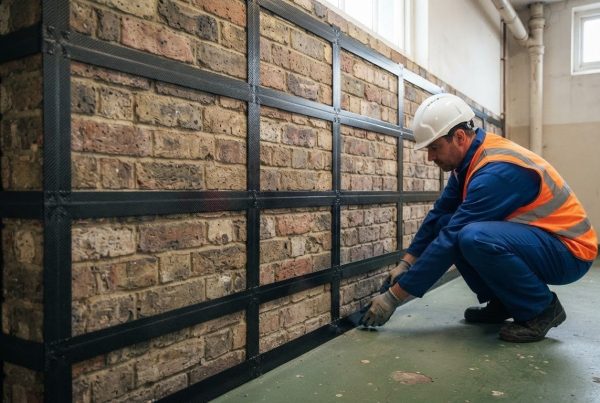
In masonry, check whether cracking follows mortar joints, cuts through bricks or blocks, or coincides with bulging. A cracked chimney separated from the adjoining wall presents a different concern from a fine surface mark: displacement suggests the masonry may have moved. Record its position and any visible change. Avoid treating fresh mortar as a structural repair before the cause is understood.
For a useful comparison, photograph each crack with a ruler beside it and note the date and location. Repeat the record over time. Widening, new cracks, water seepage or associated spalling can change the assessment. A stable hairline crack without other signs may be less concerning. This record helps establish whether the concrete remains sound or needs specialist inspection.
2. Rust stains from corroding reinforcement
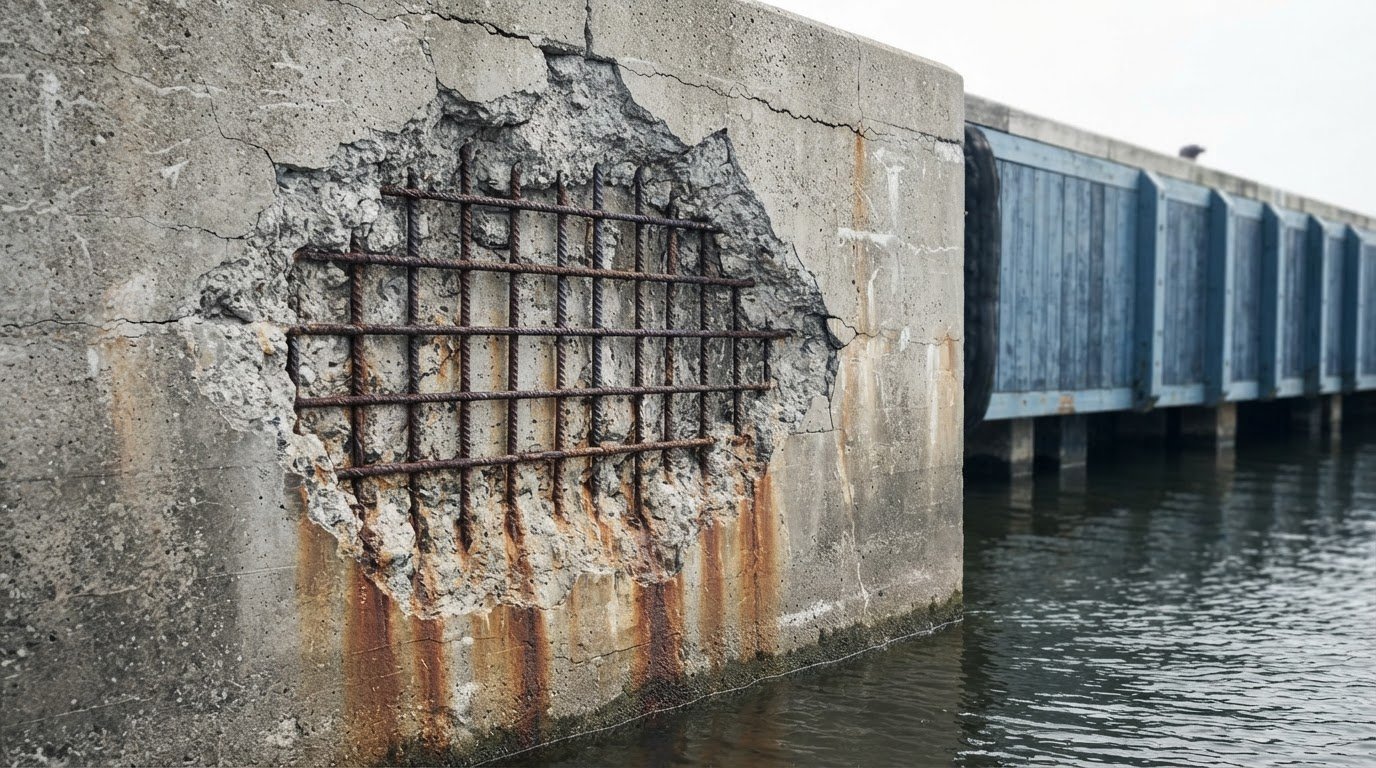
Rust-coloured streaks on a concrete beam, column or soffit can indicate corrosion of embedded steel reinforcement. Water reaching the steel can initiate corrosion, while carbonation lowers concrete’s pH and weakens the protective environment around the bars. Both processes require water, so recurring dampness near a stain matters. Inadequate concrete cover or cracking can also create routes for moisture to reach reinforcement.
As steel corrodes, it expands and presses against the surrounding concrete. This internal stress can cause cracking, delamination and spalling, where surface concrete breaks away. Once reinforcement is exposed, corrosion can accelerate and further damage the surrounding section. Extensive crumbling, deep deterioration or exposed rebar calls for prompt assessment, not a surface coating that conceals the condition.
Not every pale mark is rust. Efflorescence appears as white, powdery deposits when water-soluble salts migrate to the concrete surface; rust staining is typically brown or orange. Record the stain’s location and whether nearby concrete is cracked, hollow-sounding or detached. If the mark is beneath a leaking joint, consider the water source alongside the visible damage.
Corrosion of structural steel, such as an exposed connection or support, also needs assessment, but differs from reinforcement corrosion within concrete. Inspection should establish the affected area, steel condition and moisture pathway before repairs are specified. Cathodic protection is an electrochemical technique used to prevent reinforcement corrosion. Its suitability depends on the structure and deterioration mechanism, and it can form part of a service-life strategy rather than replace assessment and necessary concrete repairs.
When rust staining accompanies spalling or exposed bars, a specialist concrete assessment can establish the extent of damage and help determine the appropriate intervention.
3. Concrete inspection and condition monitoring
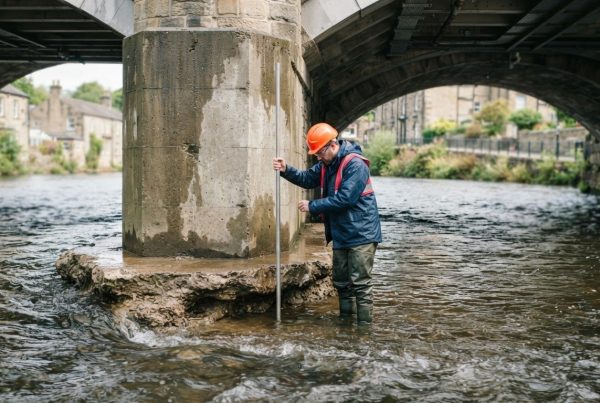
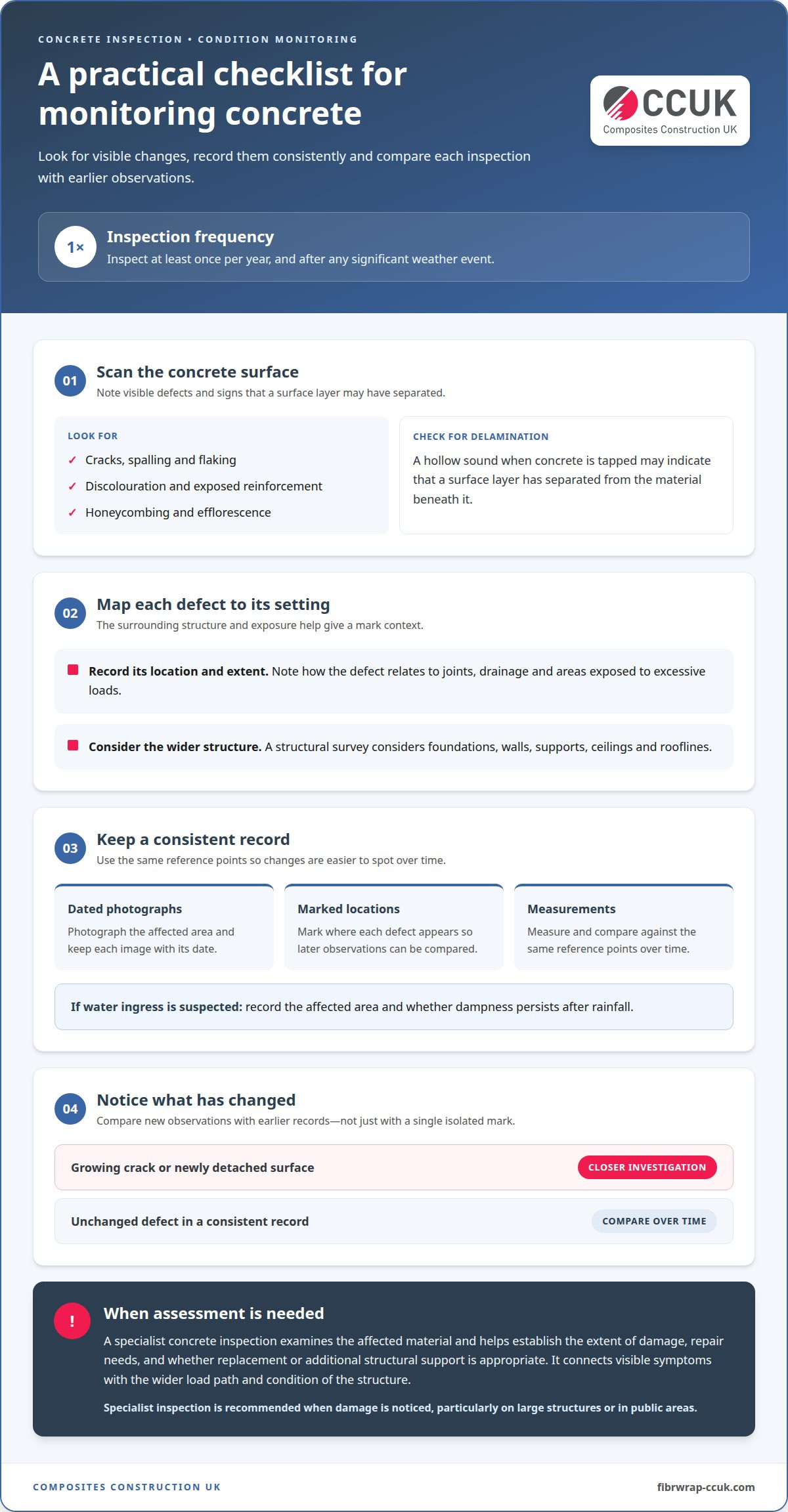
Concrete structures should be inspected at least once per year and after any significant weather event. Planned inspections can identify changes before moisture ingress, corrosion or chemical exposure contributes to further deterioration. For example, compare a bridge support’s current condition with earlier records rather than assessing one isolated mark.
A systematic visual inspection should record cracks, spalling, flaking, discolouration, exposed reinforcement, honeycombing and efflorescence. Note each defect’s location and extent, and its relationship to joints, drainage or areas exposed to excessive loads. A hollow sound when concrete is tapped may indicate delamination, where a surface layer has separated from the underlying material.
A structural survey considers foundations, walls, supports, ceilings and rooflines. A concrete-specific inspection examines the affected material and helps establish the damage extent, repair needs, and whether replacement or additional structural support is appropriate. These assessments connect visible symptoms with the wider load path and condition of the structure.
For condition monitoring, keep a consistent record: dated photographs, marked locations and measurements make changes easier to identify. Where water ingress is suspected, record the affected area and whether dampness persists after rainfall. Compare later observations against the same reference points. A growing crack or newly detached surface warrants closer investigation than an unchanged defect.
What UK building regulations and safety guidance apply to defective concrete structures? The relevant requirements depend on the building, its use and the proposed repair work. An inspection documents the condition and helps determine whether structural design or regulatory considerations need further assessment.
Regular inspections and proactive maintenance can extend pavement lifespan and help prevent extensive repairs. A specialist inspection is recommended when damage is noticed, particularly on large structures or in public areas where unstable concrete could create a hazard. Early condition monitoring gives asset teams a clearer basis for prioritising investigation and repair.
4. Assessment by a concrete contractor or structural engineer
A concrete contractor or structural engineer can assess whether visible damage is superficial or signals a serious failure mechanism. The assessment considers the defect’s location, pattern, progression and relationship to structural elements. A bowed wall with displacement around 1/4 inch is a commonly used threshold for further evaluation. A floor slope exceeding 1 inch over 8 feet is another benchmark for contacting a structural engineer.
Choose the assessment according to the concern. A concrete-specific inspection establishes the extent of damage, repair requirements and whether replacement or additional structural support may be needed. Where movement, load capacity or reinforcement condition is in question, a structural engineer can evaluate how the affected element performs within the wider structure. For example, rust staining beside cracking and concrete loss needs more than a surface-only review.
A useful assessment traces the likely cause as well as the visible defect. Inspection may consider water exposure, corrosion, loading, movement and the condition of adjacent concrete. This distinction matters: repairs addressing only the damaged surface may leave the cause of deterioration unresolved. Findings should guide an intervention suited to the structure, rather than defaulting to replacement or a cosmetic patch.
Before assessment, compile a concise record for the engineer or specialist: dated photographs, measurements, exact locations, observed changes and any recent weather or event history. Include earlier inspection findings or engineer reports where available. These details help distinguish a new crack from a longstanding defect and show whether displacement is progressing. Avoid disturbing exposed reinforcement or loose concrete before the condition has been assessed.
The key point is to seek qualified assessment when concrete damage is growing, displaced, exposing reinforcement or affecting a structural element. For a structural damage assessment, provide the defect’s location and available records so the inspection can focus on the observed condition.
Composites Construction UK: Concrete Repair
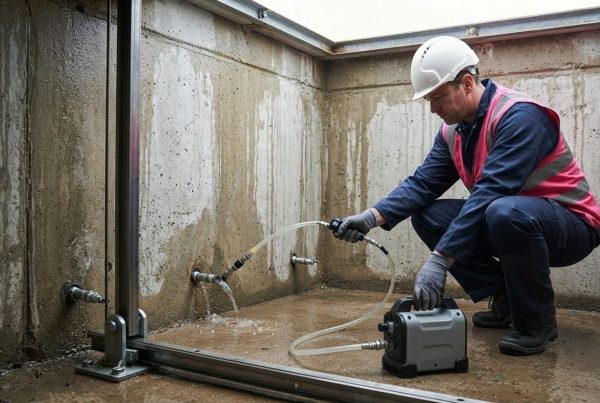
Composites Construction UK provides Concrete Repair for structures affected by cracking, spalling, water ingress or reinforcement corrosion. Following assessment, repair work can address deteriorated concrete and support the continued use of existing assets where repair is appropriate.
Where a structure also requires additional capacity, Carbon Fibre Reinforced Polymer (CFRP) Strengthening and Tyfo® Fibrwrap® Systems can form part of a strengthening solution. The suitable approach depends on the observed damage, its cause and the structure’s requirements. Repair is not a substitute for addressing ongoing movement or moisture exposure.
If inspection findings point to concrete deterioration or a need for strengthening, contact Composites Construction UK to discuss the structure and its assessment.
Turn assessment into a considered repair plan
Recognising the symptoms of failing concrete structures is the start of a decision, not the repair itself. The next step is to connect the observed condition with its cause and the structure’s performance requirements, so intervention addresses the underlying issue rather than concealing visible effects. Where assessment identifies deterioration or a need for added capacity, the repair strategy can be tailored to the asset and its continued use.
Composites Construction UK provides Concrete Repair and Carbon Fibre Reinforced Polymer (CFRP) Strengthening, including Tyfo® Fibrwrap® Systems. Blast Mitigation Systems are also available for projects requiring that protection. These are distinct applications, and the appropriate approach follows from engineering assessment, not the appearance of a defect alone.
For a considered next step, contact Composites Construction UK to discuss your structure and its assessment. A clear understanding of the condition can help inform a durable path forward.
Frequently Asked Questions
What should I do if my property has structural damage?
Restrict access to an area if loose concrete or movement could create an immediate hazard, then arrange a professional assessment. Note whether doors, equipment or services have become difficult to use, as these changes may help explain how the defect affects the asset. Keep earlier maintenance records available and avoid covering damage before its condition has been examined.
What’s the main cause of concrete damage?
There isn’t one cause. Cracking is a common initial form of concrete failure, but the mechanism varies by structure. Moisture can enter through defects and contribute to deterioration, while settlement, thermal movement, overloading or unsuitable materials can also damage concrete. For example, a crack near a leaking joint may involve both movement and continuing water exposure.
What are the warning signs of a failing concrete structure?
Warning signs include changing cracks, rust-coloured marks, crumbling edges, exposed reinforcement and surfaces that sound hollow when tapped. Consider their combined effect: a crack beside a leaking joint and detached concrete, for instance, is more concerning than an isolated colour change. These symptoms of failing concrete structures should be considered alongside movement or changes in how the asset functions.
What types of cracks in concrete indicate structural failure?
Progressive cracks, cracks accompanied by displacement, and cracking that affects a support or load-bearing element warrant structural assessment. A diagonal crack extending from an opening, or one appearing alongside a leaning wall, deserves closer attention than an isolated mark. Crack shape alone cannot confirm failure; location, movement and the element’s role all influence its significance.
How can concrete spalling, flaking or exposed reinforcement affect structural safety?
Spalling and flaking can remove the concrete that protects reinforcement, leaving steel exposed to moisture and corrosion. As corrosion progresses, expanding steel can further crack and dislodge surrounding concrete, potentially reducing the integrity of the affected section. Loose fragments also create a falling-material hazard, particularly above walkways or occupied areas, so the damaged zone should be assessed and managed.
What causes concrete structures to deteriorate or fail?
Deterioration can develop through interacting mechanisms rather than a single defect. Water ingress, reinforcement corrosion, carbonation, freeze-thaw exposure, chemical attack, poor curing, settlement and excessive loading can each contribute. For example, a poorly drained area may remain damp, allowing deterioration to progress around cracked concrete. Identifying the active cause is essential, because a surface repair alone may not stop it.