
FRP strengthening is only as effective as the concrete and bond supporting it. In externally bonded systems, fibre-reinforced polymer is fixed to the concrete surface to improve a member’s structural capacity; application-specific FRP systems are designed around the element, its loading and its condition, rather than treated as a universal retrofit. The method has been used to strengthen and retrofit concrete structures since the mid-1980s.
A strengthening solution should address the structural demand without unnecessary intervention, but suitability depends on more than the composite itself. This article explains how externally bonded FRP works, where it can help concrete members and seismically deficient structures, and what limitations matter, including substrate condition, bonding and exposure. It also outlines the qualifications and project checks that inform system selection, helping you assess where FRP fits and when another repair approach may be more appropriate.
Key Takeaways
- Understand how externally bonded FRP can strengthen concrete flexural members, including through reinforcement applied to the tension face.
- See how FRP confinement may improve the strength and ductility of reinforced concrete columns in seismic retrofitting.
- Weigh the practical benefits of FRP against limitations such as substrate condition, sunlight exposure and the need for a suitable bond.
- Learn which design, condition-assessment and installation qualifications inform the selection of an FRP system for a project.
What is Concrete strengthening by externally bonded FRP?
Externally bonded fibre-reinforced polymer (FRP) strengthens concrete by bonding a fibre composite to its surface. For reinforced-concrete structures, the system is selected to meet a defined need, such as increasing flexural capacity or addressing a construction error.
External reinforcement for flexural members
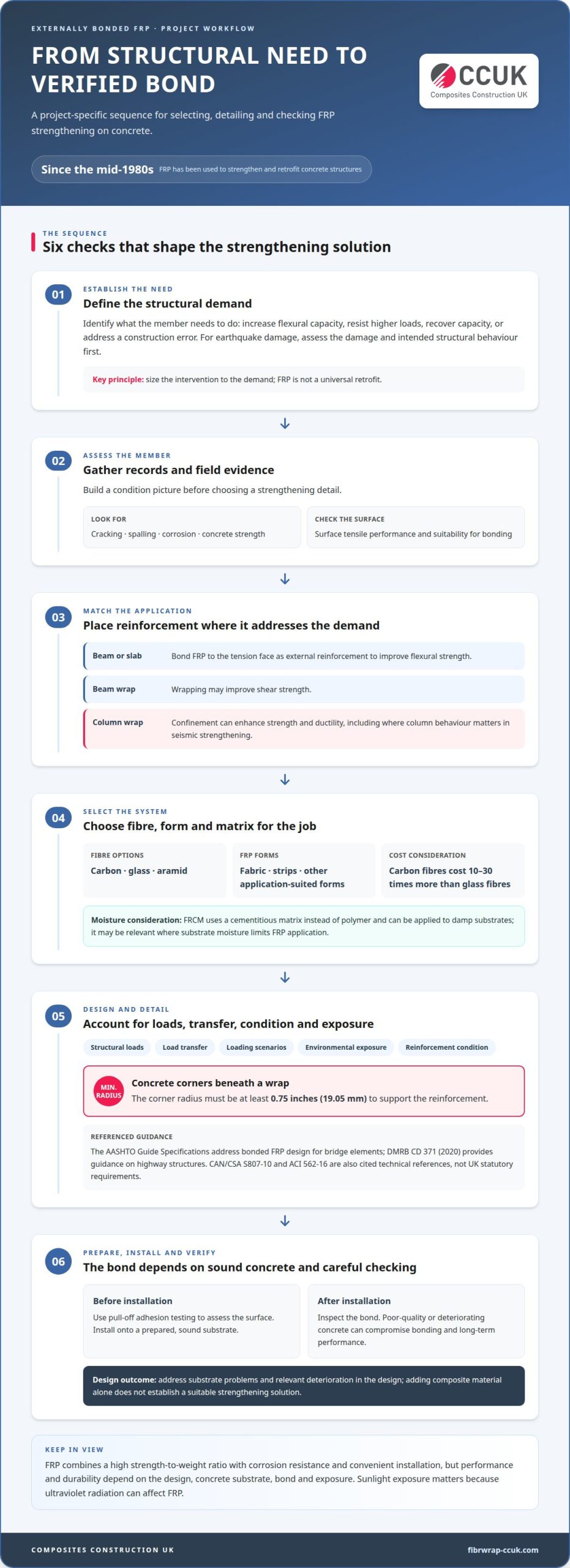
For a concrete beam or slab, FRP bonded to the tension face provides external reinforcement that can improve flexural strength. This can help when a member must resist higher loads or recover capacity, because the reinforcement is positioned to address the specific structural demand. Carbon, glass or aramid fibres may be used in FRP composites, supplied as fabric, strips or other forms suited to the application and substrate.
FRP wrapping of beams and columns
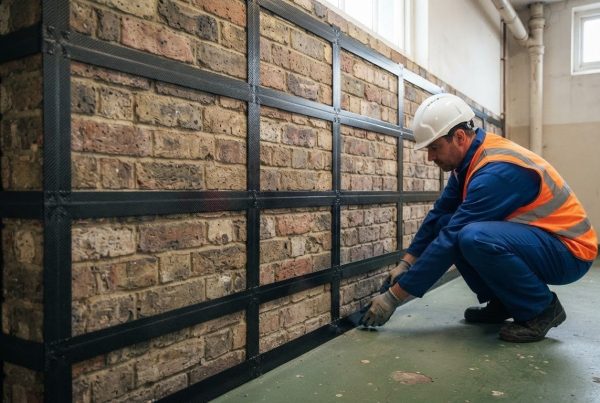
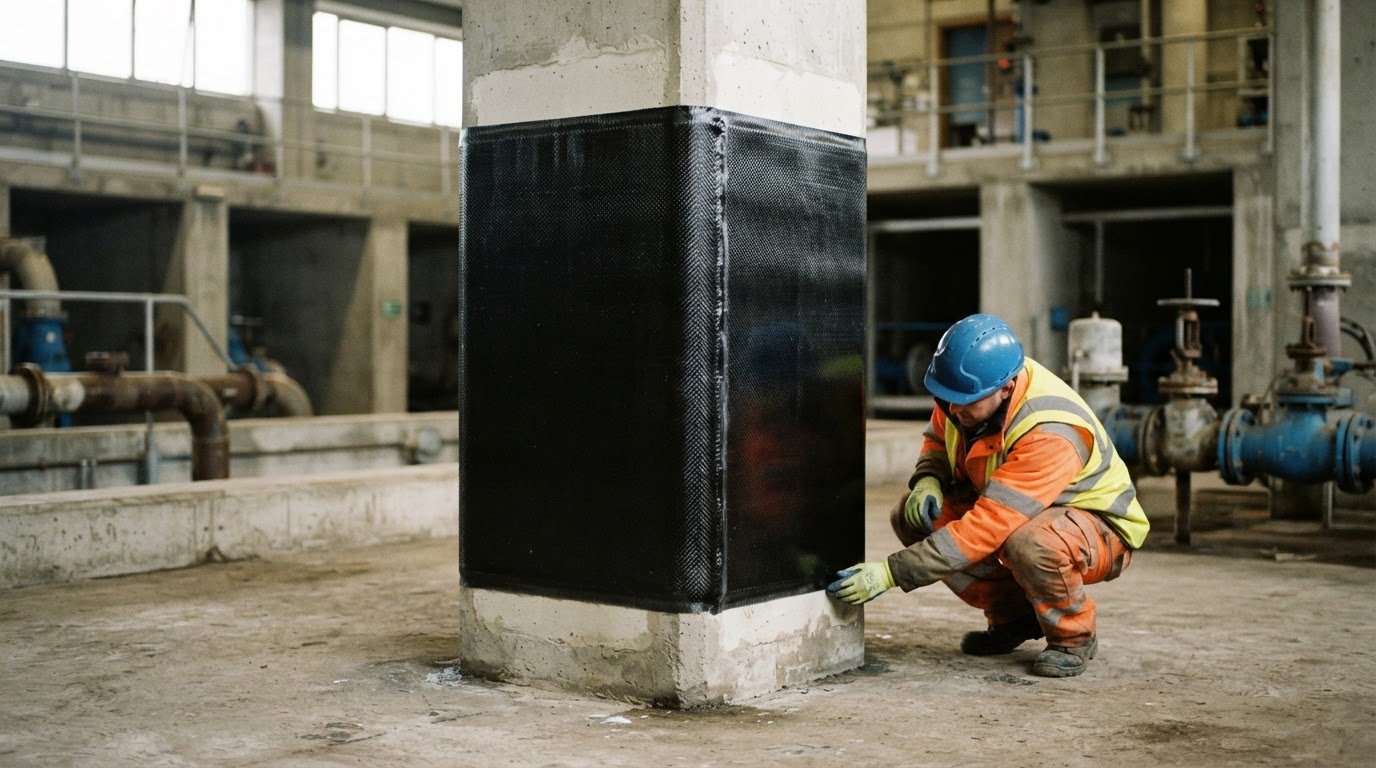
FRP wrapping encloses a concrete beam or column to provide external reinforcement; wrapping beams may improve shear strength. For columns, confinement can enhance strength and ductility, making wrapping relevant to seismic strengthening as well as other capacity requirements. The member’s geometry and concrete condition affect the detail: where the wrap passes around concrete corners, the corner radius must be at least 0.75 inches (19.05 mm) to support the reinforcement.
Design, installation and inspection
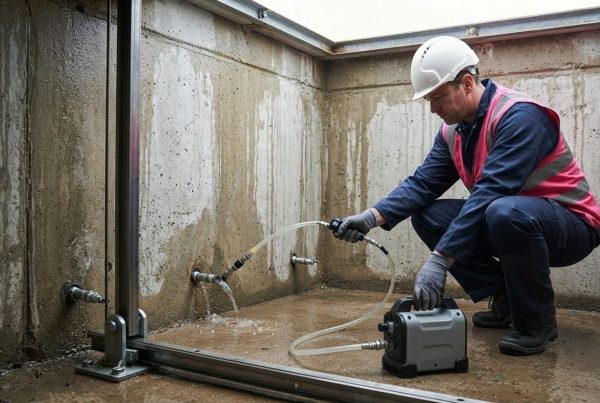
FRP systems are designed against the structure’s loads, load transfer, environmental exposure and reinforcement condition, then installed onto a prepared, sound substrate and inspected for bond. A comprehensive assessment considers records and field evidence, including cracking, spalling, corrosion, concrete strength and surface tensile performance. Construction errors may create a need for strengthening, but poor-quality or deteriorating concrete can compromise bonding and long-term performance, so it must be addressed in the design. Pull-off adhesion testing assesses the surface before installation. For bridge elements, the AASHTO Guide Specifications address bonded FRP design, while DMRB CD 371 (2020) provides guidance on highway structures. Structural design considerations also inform system selection and detailing.
Strengthening earthquake-damaged and seismically deficient structures
Externally bonded FRP can strengthen earthquake-damaged structures and address deficiencies identified in a seismic assessment. Its role depends on the damage, member behaviour and required load path.
Strengthening earthquake-damaged structures
For a damaged reinforced-concrete structure, FRP composites may restore or increase member capacity as part of a designed repair. The strengthening scope should follow an assessment of the damage and the structure’s intended behaviour, rather than applying a standard wrap indiscriminately. This distinction matters because local damage and a wider seismic deficiency may require different interventions.
Bridge projects illustrate this application: the US Federal Highway Administration’s Innovative Bridge Research and Construction/Deployment Program (IBRC/IBRD) includes reports on bridge strengthening and damage repair using FRP. These reports document a specific research and deployment programme, not a substitute for project assessment in the UK. The repair design must relate the proposed reinforcement to the bridge element and its condition.
Column confinement and FRP applications
FRP confinement wraps reinforced-concrete columns to enhance strength and ductility, which can support seismic strengthening when column behaviour is critical. Carbon, glass and aramid fibres form FRP composites; the selected material and externally bonded arrangement depend on the member and design demand. A column wrap is one application within a broader strengthening scope, not a universal treatment for earthquake damage.
Referenced documents include CAN/CSA S807-10, a specification for fibre-reinforced polymers, and ACI 562-16, cited for assessment, repair and rehabilitation of existing concrete structures. These identifiers describe specific technical references; they should not be read as UK statutory requirements. Design also considers possible failure behaviour and how the strengthened member interacts with the wider structure. Discuss seismic strengthening requirements as part of a project-specific assessment.
Benefits and limitations of externally bonded FRP
FRP is a fibre-and-polymer composite, unlike steel plates or bars. Its performance, durability and service life depend on the design, concrete substrate, bond and exposure conditions.
Comparing FRP with other strengthening materials
FRP composites combine a high strength-to-weight ratio with corrosion resistance and convenient installation. Their low weight can also suit vertical and overhead strengthening, where added material weight is a design consideration. Steel is a different material option, so selection depends on structural demand, member condition and strengthening detail, not a universal preference.
Fibre type matters, too. Carbon fibres are 10-30 times more expensive than glass fibres, so the material choice has practical implications for system selection. Fibre-reinforced cementitious matrix (FRCM) systems use a cementitious matrix instead of polymer and can be applied to damp substrates. That difference may make FRCM relevant where substrate moisture limits FRP application.
Performance, durability and service life
FRP performance depends on sound concrete and effective bonding; corrosion or ongoing deterioration can undermine the substrate. The design must also account for load limits, load transfer, loading scenarios, environmental effects and reinforcement corrosion. These factors determine whether the bonded system meets the structural need, rather than simply adding composite material.
Exposure affects durability. Ultraviolet radiation can affect FRP in sun-exposed areas, so exposure conditions should inform system selection and detailing. Temperature and the service environment also matter when assessing which material system suits the element. FRCM has stated advantages in damp conditions and resistance to fire, but it is not interchangeable with FRP in every application.
FRP’s linear-elastic behaviour to failure means failure can occur suddenly, without prior warning. This limitation matters in design: the system must be assessed alongside the member’s load response, bond condition and inspection requirements. FRP strengthening is not a universal retrofit solution; concrete condition and exposure help determine whether it is appropriate.
Manufacturer and applicator qualifications
FRP performance depends on the specified materials and the quality of site application. In the UK, consider the design basis, product evidence, substrate preparation and inspection methods as connected parts of one engineering process.
For manufacturers, technical submittals should identify the proposed fibre, polymer matrix, adhesive and system configuration. Evidence must relate to the actual strengthening application, rather than a broadly similar composite. ACI 440.2R-17 provides guidance on designing and constructing externally bonded FRP systems for concrete structures; it is a technical reference, not a UK qualification or approval by itself. BS EN 1504-4:2004 addresses structural bonding products and systems used in concrete protection and repair.
For applicators, relevant competence is demonstrated through control of the specified installation methods: preparing the surface, mixing and applying adhesive, placing fabric or laminates, and recording site conditions. The engineering specification should define acceptance criteria and inspection stages. BS EN 1504-10:2017 covers site application and quality control for concrete protection and repair works, while BS EN 1504-9:2008 sets out general principles for those systems.
Substrate assessment is essential before work begins. A sound surface supports adhesion; corrosion, cracking, spalling or weak concrete can compromise the bond and require repair before strengthening. Pull-off adhesion testing measures surface tensile performance, while core sampling can assess in-situ compressive strength. These checks help distinguish a material issue from a surface-preparation or application defect.
Test methods also need to suit the material. Tensile testing of wide strips to EN ISO 10319 is generally unsuitable for brittle materials such as carbon fibres, so test evidence should be appropriate to the composite. A robust project record links the specified system to manufacturer data, design assumptions, installation records and inspection results. Discuss FRP system requirements for a planned strengthening project.
Composites Construction UK
Composites Construction UK supports structural strengthening and concrete repair projects where the structure’s condition, loading and exposure inform the intervention. Its Carbon Fibre Reinforced Polymer (CFRP) Strengthening and Tyfo® Fibrwrap® Systems provide options for externally bonded FRP applications, while concrete repair can address substrate issues relevant to strengthening suitability.
Consider involving the team when an assessment identifies a need to increase member capacity, address seismic deficiencies or evaluate repair alongside strengthening. The appropriate approach depends on the engineering requirements and the structure’s condition, not on the composite material alone. This frames FRP as part of a considered rehabilitation strategy, not a universal solution.
Contact Composites Construction UK to discuss your structural strengthening requirements.
Take the next step towards a project-specific solution
The next decision is how to translate the structural objective into a practical project scope. Set out the asset’s current condition, operational constraints and available engineering information. These details help determine whether application-specific FRP systems should form part of the proposed intervention.
Composites Construction UK offers Carbon Fibre Reinforced Polymer (CFRP) Strengthening, Tyfo® Fibrwrap® Systems and Blast Mitigation Systems. The discussion can focus on the structural challenge and the work needed to address it, rather than treating material choice as the starting point. Where a project calls for strengthening, protection or rehabilitation, a defined scope gives the engineering conversation a clear direction.
Contact Composites Construction UK to discuss your project requirements. A considered next step can help move the decision from material selection towards a solution shaped around the structure.
Frequently Asked Questions
What are application-specific FRP systems?
Application-specific FRP systems are composite strengthening arrangements selected for a defined structural element and performance requirement. For example, a bridge beam needing added flexural capacity calls for a different reinforcement layout from a column requiring confinement. The specification links fibre form, polymer matrix, bond detail and substrate condition to the engineering objective, rather than treating FRP as one interchangeable product.
Which types of fibre-reinforced polymer (FRP) systems are used in construction?
Construction uses carbon, glass or aramid fibre composites, supplied as fabrics, strips, sheets or bars. Externally bonded fabrics and pre-cured strips reinforce existing surfaces, while FRP bars can serve as reinforcement within structural concrete. The distinction matters: a bar-reinforced new member and a bonded strengthening layer have different design and installation interfaces, even when both use fibre-reinforced polymer.
Which FRP systems are best for structural strengthening, corrosion protection and new construction?
No single FRP system is best for every purpose. For strengthening existing concrete, externally bonded composites are assessed against the member’s structural demand and substrate condition; their corrosion resistance can be advantageous in relevant exposure conditions. New construction may use FRP bars as internal reinforcement. Corrosion protection requires a defined durability strategy, so material selection should reflect structural function, exposure and detailing.
What standards and regulations apply to FRP systems in the UK?
UK projects should distinguish product and repair standards from design guidance. BS EN 1504-4:2004 concerns structural bonding products; BS EN 1504-9:2008 covers general principles, and BS EN 1504-10:2017 addresses site application and quality control. DMRB CD 371 (2020) provides guidance for highway structures. Project specifications should identify which documents apply to the work and how their provisions are addressed.
What are the fire, UV, moisture and chemical risks of FRP systems?
Fire, ultraviolet exposure, moisture and chemical contact are relevant when selecting a system. FRP can be affected by ultraviolet radiation in sunlight, while FRCM is described as more fire resistant and suitable for damp substrates. In chemical environments, compatibility between the matrix, adhesive and exposure requires engineering assessment; no single FRP formulation should be assumed suitable for every chemical or temperature condition.
Which UK suppliers provide application-specific FRP systems and technical support?
Composites Construction UK provides FRP strengthening and concrete repair services, including Carbon Fibre Reinforced Polymer (CFRP) Strengthening and Tyfo® Fibrwrap® Systems. Project support includes feasibility studies, bespoke design solutions and professional installation. This is relevant when an asset owner needs engineering input that connects assessment and specification with site delivery, rather than material supply alone. The company serves projects across the United Kingdom.