

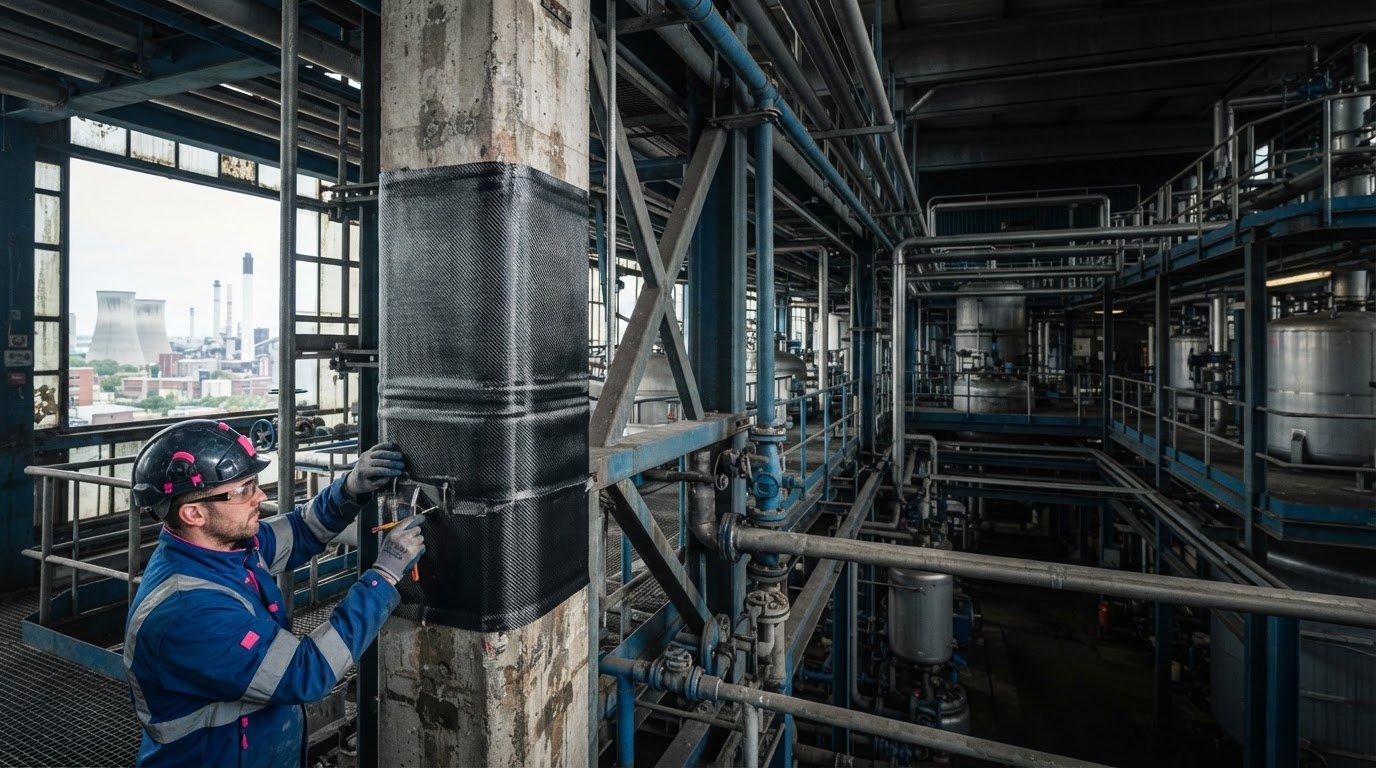
The reinforcement method must suit the structure’s material, condition and exposure. For reinforcing structures in chemical plants, assess the cause and extent of deterioration before choosing repairs or strengthening for concrete, steel, timber or masonry. Fibre-reinforced polymer (FRP) fabrics can also be applied externally to improve resistance to flexure, shear, axial forces or seismic demand.
In an industrial environment, chemical exposure is only one part of the structural picture. Existing damage, load requirements and earthquake risk also affect which intervention is suitable, and whether local repair or broader strengthening is needed.
This article explains how reinforcement approaches differ across common structural materials, where FRP fabric systems fit, and how seismic resilience is assessed. It also outlines the assessment process for matching a structure’s observed condition to a suitable repair strategy.
Key Takeaways
- Identify how chemical exposure and structural deterioration affect concrete, steel, timber and masonry, and why the cause of damage matters when planning repairs.
- Use the existing structure’s condition, materials, weaknesses and loading requirements to guide the reinforcement strategy.
- Understand where externally applied FRP fabrics can improve flexural, shear, axial or seismic resistance.
- Explore how structural assessment, foundation strengthening and post-reinforcement testing contribute to earthquake resilience.
Strengthening concrete, steel, wood and masonry structures
In chemical plants, reinforcement must address both the structural material and the exposure causing deterioration. Sulphate-processing fertiliser facilities, for example, can expose reinforced concrete to aggressive chemical conditions.
Materials for corrosive environments
Suitable reinforcement depends on the substrate, loading and corrosive agents, because repairs must work with the existing structure. Concrete may be strengthened with externally bonded CFRP plates, while methods for steel, timber and masonry must suit their condition and exposure.
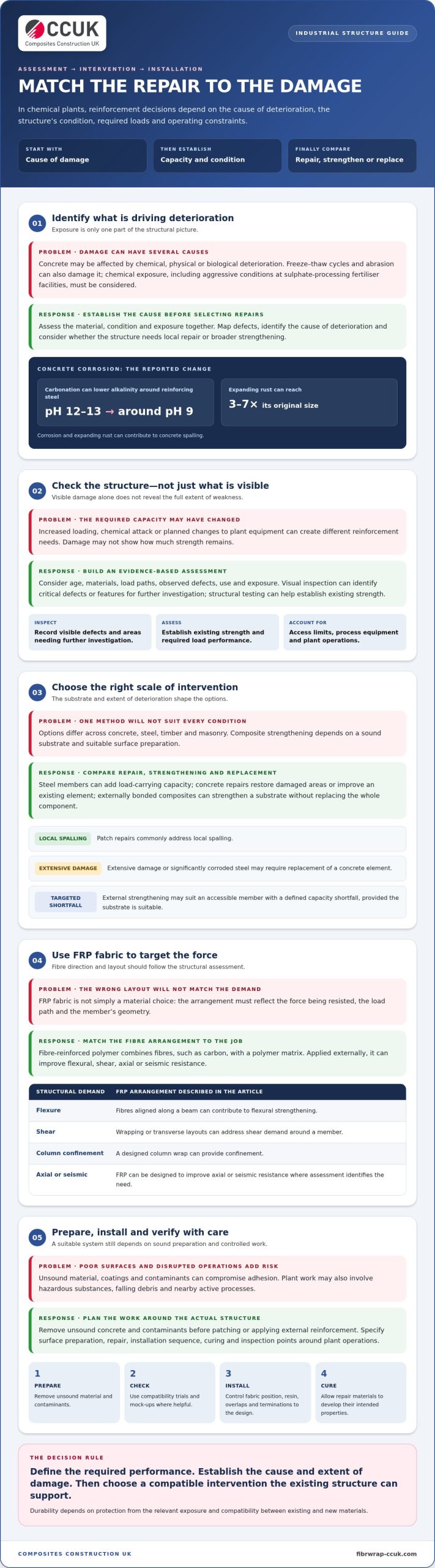
Concrete damage can be chemical, physical or biological. Carbonation can lower the alkaline environment around reinforcing steel from pH 12-13 to around pH 9, allowing corrosion; expanding rust can reach 3-7 times its original size and contribute to spalling. Freeze-thaw cycles and abrasion cause physical damage, whilst biological activity can also affect surfaces. According to Scotland’s Environment Web, acid rain can corrode and weaken structures.
Reinforcement design and installation
Design and installation involve identifying deterioration, assessing existing strength, selecting compatible repair materials and planning work around plant operations. Before patching or applying external reinforcement, remove unsound concrete and contaminants. Compatibility trials and mock-ups can help assess the proposed system before wider application. Curing allows repair materials to develop their intended properties.
For UK projects, EN 206 defines concrete mix design, while EN 10080 gives requirements for concrete cover. These standards inform concrete specifications; they do not, by themselves, determine the appropriate repair for every plant structure.
Patch repairs commonly address local spalling, but extensive damage or significantly corroded steel may require replacement of a concrete element. Inspection should identify defects and trigger further investigation where needed; according to UK Government, visual inspection helps identify critical defects or features requiring further investigation. In operating plants, risks include exposure to hazardous substances, falling debris and work near active processes, so maintenance planning must account for the structure’s condition and operational hazards.
Choosing a reinforcement method
Choose reinforcement to suit the existing structure’s condition and functional requirements. In an operating plant, the method must also suit chemical exposure, access constraints and the intended service life.
Assessing reinforcement needs
Assessment establishes whether a structure can continue carrying its required loads or needs strengthening. Visible damage alone does not reveal the full extent of structural weakness.
Consider the structure’s age, materials, load paths and observed defects alongside its use and exposure. A visual inspection can identify critical features for further investigation, while structural testing can help establish existing strength. Chemical attack, increased loading or planned changes to plant equipment may each create different reinforcement needs.
Comparing reinforcement methods
Steel, reinforced concrete and composite materials meet structural demands in different ways. Steel members can add load-carrying capacity, while concrete repairs restore damaged areas or improve an existing element. Externally bonded composites can strengthen a substrate without replacing the whole component.
Compare options by considering substrate condition, exposure, working space and construction sequence. An accessible concrete beam with a defined capacity shortfall, for example, may suit external strengthening; a badly deteriorated element may need more extensive repair. Composite systems can provide targeted strengthening, but their bond depends on a sound substrate and suitable surface preparation.
For reinforcing structures in chemical plants, start by defining the required performance, then assess whether the existing structure can support the proposed intervention. Map defects and load paths, establish the cause of deterioration, and note operational limits such as restricted access or nearby process equipment. Use these findings to compare repair, strengthening and replacement.
Durability also depends on protection from the relevant exposure and compatibility between existing and new materials. Specify surface preparation, installation sequence, curing requirements and inspection points so construction can be coordinated with plant operations.
Where the decision depends on structural capacity or a tailored strengthening design, structural strengthening design can help translate assessment findings into a suitable intervention.
FRP fabric strengthening
Fibre-reinforced polymer (FRP) fabric combines fibres, such as carbon, with a polymer matrix. Applied externally to a structural member, it can increase flexural, shear, axial or seismic resistance. It is a targeted strengthening option when existing elements need additional capacity without wholesale replacement.
Fibre direction is selected to suit the force being resisted. Fibres aligned along a beam can contribute to flexural strengthening, while wrapping or transverse layouts can address shear demand around a member. A designed column wrap can provide confinement. Each arrangement must reflect the structural assessment, load path and geometry, not just the material chosen.
Installation starts with preparing the concrete surface and confirming that the substrate can transfer forces into the composite. Unsound material, coatings and contaminants can compromise adhesion, so specify preparation and repair for the actual surface. The fabric is then positioned and impregnated with resin as part of the system, with overlaps, terminations and curing controlled to the design.
Map and assess cracks before applying fabric. Active movement, moisture and chemical exposure can affect the repair strategy and material compatibility. FRP does not replace concrete repair when the substrate has lost integrity: damaged areas need suitable treatment before external strengthening can work effectively. The original load-bearing element remains part of the system.
Quality checks should confirm surface condition, fibre alignment, resin impregnation and completion of curing. Designers also account for connections, edges and anchorage, where stress concentrations can affect performance. In a chemical plant, access, operating conditions and future inspection needs influence the layout and installation sequence. These details help deliver the specified strength in service, not just on drawings.
Concrete has approximately 10% of its compression strength in tension. Prefabricated CFRP plates can strengthen concrete substrates by external bonding or near-surface mounting.
Repair planning for chemically attacked reinforced concrete involves identifying deterioration and its causes, assessing existing strength, deciding which repairs are needed, and selecting suitable methods and materials. Impregnation treatments partially or completely fill concrete pores, reducing porosity and adding surface strength. Steel or reinforced-concrete micropiles can strengthen existing foundations and increase ground bearing capacity.
Reinforcement and earthquake resilience
Earthquake resilience depends on how a structure responds to lateral movement, not simply on its material strength. Before selecting reinforcement, a structural engineering assessment considers the building’s age, materials, weaknesses and earthquake risk.
Fire, blast, seismic and corrosion hazards place different demands on structures and materials. Fire affects material performance; blast imposes sudden forces; seismic movement repeatedly stresses connections and members; corrosion can reduce steel reinforcement and weaken its bond with concrete.
Assess the structure in a clear sequence: examine it, identify weaknesses, establish load paths and evaluate relevant hazards. A plant building with vulnerable connections, for example, may need a different intervention from one affected by foundation movement. The design should address the specific weakness and maintain a continuous path for transferring forces.
Foundation capacity can also affect earthquake performance. Jet grouting strengthens an existing foundation by injecting a pressurised mixture of water and cement into it. It may be considered when foundation conditions contribute to structural weakness, alongside assessment of the ground and existing foundation.
At member level, post-tensioned carbon fibre reinforced polymer (CFRP) systems can control cracks and deflections while increasing fatigue and seismic resistance. Their design and application must suit the member, force direction and substrate. This system may form one part of a wider engineering strategy, but does not replace assessment of the complete structure.
After reinforcement, checks and tests help verify the work’s effectiveness and the structure’s safety. Inspection can compare connections, repaired areas and load-transfer details with the intended design. Findings also inform future maintenance, helping asset teams track changes and plan interventions to extend the structure’s useful service life.
For project-specific assessment of strengthening requirements, review the structural design approach alongside the identified hazards and performance needs.
Composites Construction UK: Carbon Fibre Reinforced Polymer (CFRP) Strengthening
Composites Construction UK provides Carbon Fibre Reinforced Polymer (CFRP) Strengthening for structures that need additional capacity or rehabilitation. Where assessment identifies weakened concrete or a need for targeted strengthening, CFRP methods can support an intervention designed around the existing structure. Tyfo® Fibrwrap® Systems are among the systems used for this work.
For chemical plant assets, the appropriate approach depends on the substrate, damage mechanism and required performance. Concrete Repair can address deterioration before strengthening, while Blast Mitigation Systems meet a separate hazard-related need. These services support repairs and structural upgrades when retaining existing infrastructure is appropriate.
To discuss a structural strengthening or repair requirement, contact Composites Construction UK.
Plan the next step for your plant assets
A clear reinforcement strategy starts with a defined performance objective: identify which structural function must be restored, maintained or improved, then relate it to the structure’s condition and operating demands. This gives asset teams a practical basis for prioritising work, coordinating access and planning inspections after installation. A considered approach to reinforcing structures in chemical plants can also support continued use of existing infrastructure when repair and strengthening suit its condition.
Composites Construction UK provides Carbon Fibre Reinforced Polymer (CFRP) Strengthening, Tyfo® Fibrwrap® Systems and Blast Mitigation Systems. These services are relevant when assessment identifies a need for structural strengthening, system-based reinforcement or blast protection. The right intervention depends on the structure and its performance requirements.
To discuss the structural requirements of your facility, contact Composites Construction UK. A well-defined next step can help move the project from assessment towards a durable, engineered solution.
Frequently Asked Questions
What types of reinforcing structures are used in chemical plants?
Common structures include reinforced-concrete foundations and containment walls, steel equipment frames and pipe racks, masonry walls, and timber elements in ancillary buildings. Reinforcement may involve repairing concrete, strengthening masonry or adding capacity with composite materials. Blast mitigation and seismic retrofitting address specific hazards. The suitable solution depends on the element’s function, condition, chemical exposure and role in supporting equipment, access or containment.
What UK regulations and standards apply to structural reinforcement in chemical plants?
For UK projects, EN 206 defines concrete mix design and EN 10080 sets requirements for concrete cover; neither alone determines the right repair. Visual inspection can identify critical defects or features needing further investigation.